Saudi Arabia Soda Ash Market Snapshot
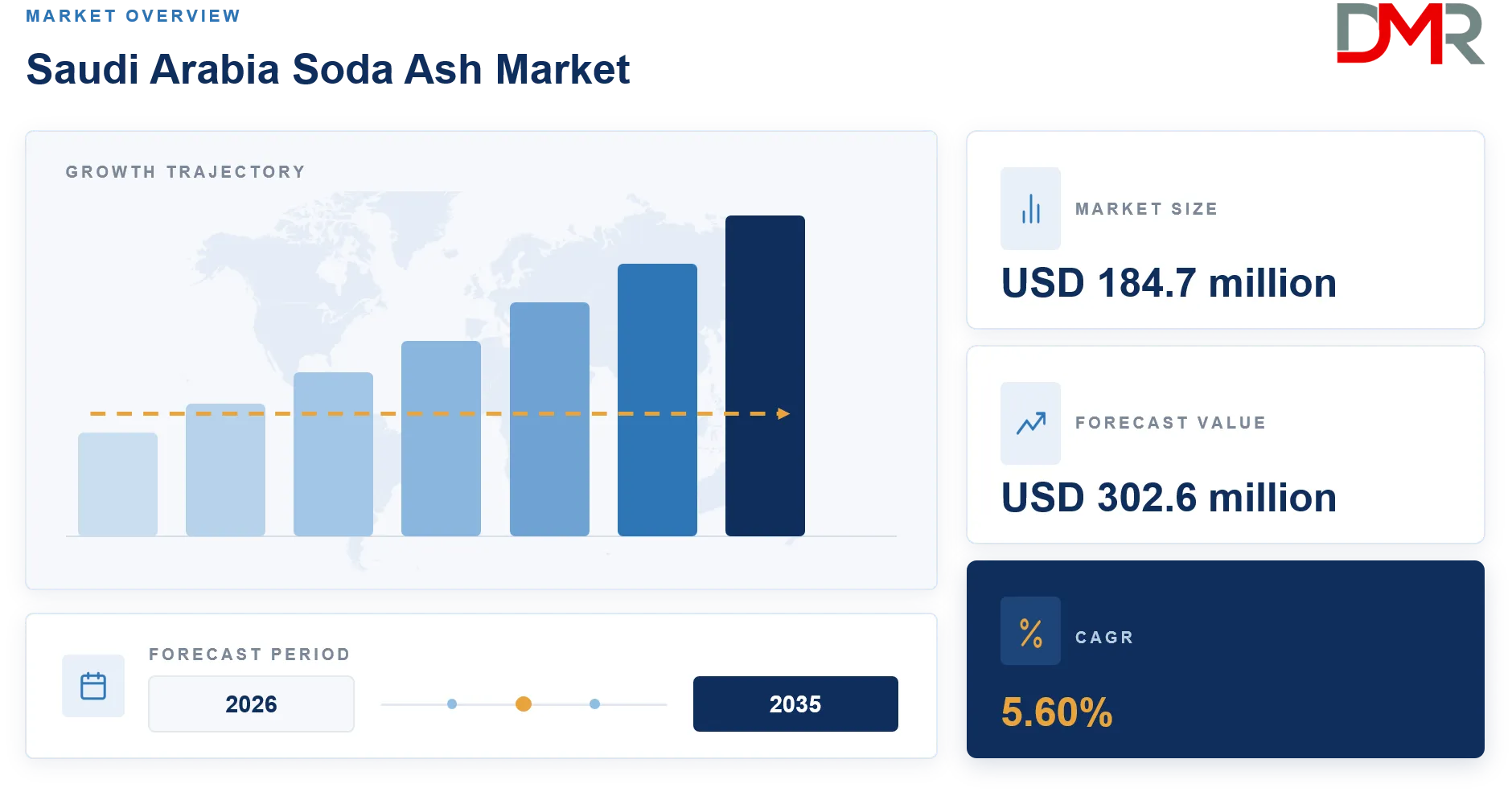
- Market Value: Saudi Arabia soda ash market is valued at USD 184.7 million in 2026 and is expected to reach USD 302.6 million by 2035.
- CAGR: Saudi Arabia soda ash market is expected to grow at a CAGR of 5.6% from 2026 to 2035.
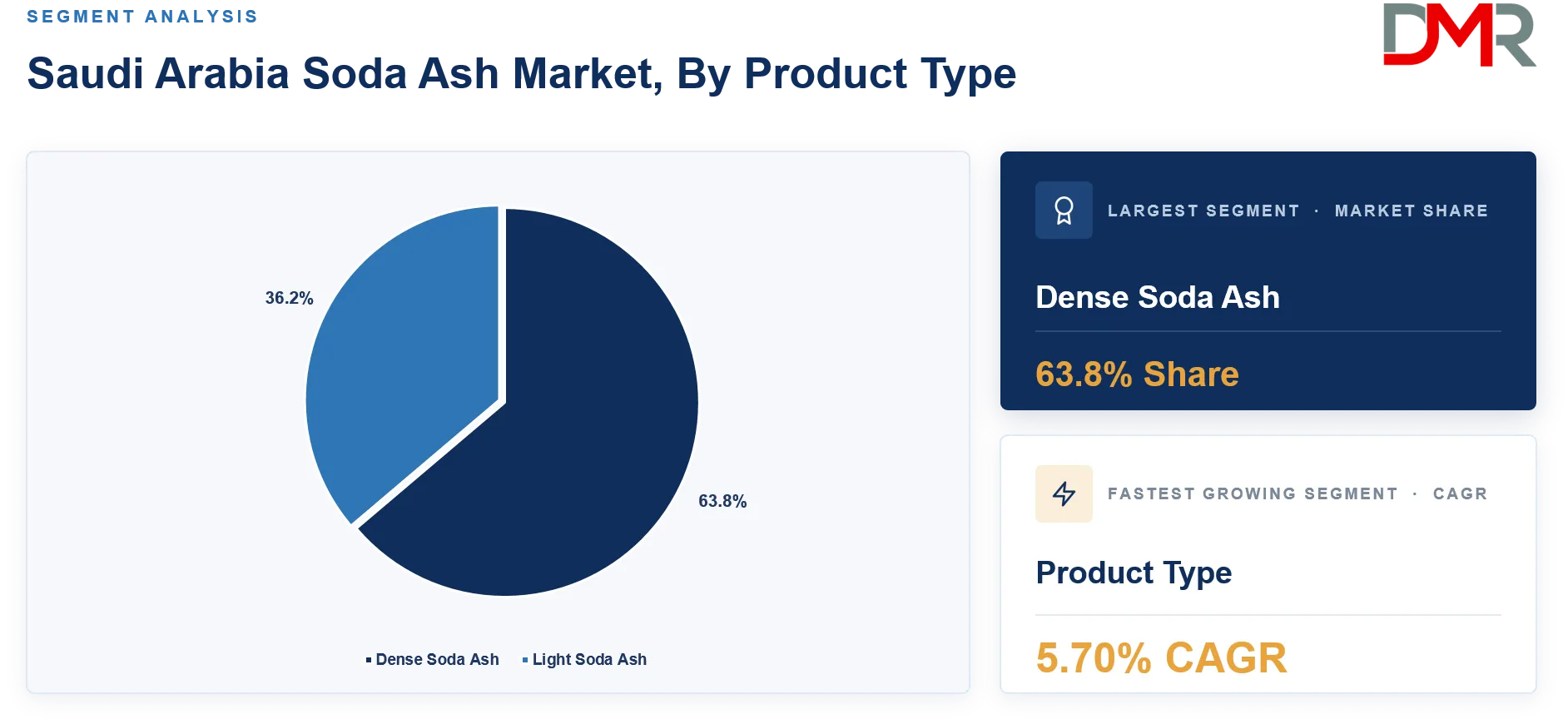
- By Product Type Analysis: Dense soda ash dominated the product type segment with a 63.8% share in 2026.
- By Source Analysis: Synthetic soda ash led the source segment with a 91.6% share in 2026.
- By Application Analysis: Glass manufacturing held the largest application share at 53.7% in 2026.
- Major Players: Khair Inorganic Chemical Industries, United Industrial Chemicals, Solvay S.A., Ciner Group, and Şişecam.
What is the Saudi Arabia Soda Ash Market and its Market Size?
The Saudi Arabia soda ash market size is projected to be valued at USD 184.7 million in 2026 and is expected to reach USD 302.6 million by 2035, expanding at a CAGR of 5.6% during the forecast period. Soda ash, chemically known as sodium carbonate, is an essential inorganic alkali used across glass manufacturing, detergents, sodium silicate, sodium bicarbonate, water treatment, metallurgy, pulp and paper, and several industrial processes.
ℹ
To learn more about this report –
Download Your Free Sample Report Here
Saudi Arabia soda ash demand is closely connected with the Kingdom's construction, architectural glass, industrial manufacturing, chemical processing, municipal infrastructure, and consumer cleaning sectors. Glass manufacturing represents 53.7% of market demand in 2026, making it the most important consumption channel. Dense soda ash holds a 63.8% product share because its physical characteristics make it particularly suitable for flat glass, container glass, and other high-volume glass applications.
The market also has a strong international supply dimension. Saudi industrial consumers source sodium carbonate through domestic chemical distributors and global manufacturers. This creates opportunities for producers, importers, storage operators, logistics companies, and industrial chemical suppliers that can provide reliable volumes, consistent quality, competitive landed costs, and technical support.
Use Cases
- Glass Manufacturing: Soda ash lowers the melting temperature of silica and is a critical feedstock for flat glass, container glass, architectural glazing, specialty glass, and selected solar glass products used across Saudi construction and industrial applications.
- Detergents and Cleaning Products: Light soda ash is used as an alkalinity builder and water softening ingredient in household detergents, industrial cleaners, laundry formulations, and institutional cleaning products produced or consumed within the Kingdom.
- Chemical Production: Saudi chemical processors use soda ash in sodium silicate, sodium bicarbonate, inorganic salts, pH control, neutralization, and other chemical reactions, supporting demand from diversified downstream manufacturing industries.
- Water Treatment: Municipal utilities and industrial operators use sodium carbonate for pH adjustment, alkalinity control, softening, and treatment processes. Its role becomes important in facilities that require stable water chemistry for industrial operations.
- Metallurgy and Industrial Processing: Soda ash serves as a flux, processing aid, or chemical reagent in selected metals, mining, textile, pulp and paper, and emission control applications, creating smaller but diversified industrial demand channels.
How AI/Gen AI is Transforming the Saudi Arabia Soda Ash Market?
Advanced analytics and machine learning are changing how soda ash buyers, distributors, and producers manage demand planning and procurement. Industrial users can combine glass output, construction activity, inventory positions, freight movements, energy costs, supplier lead times, and historical consumption to improve purchase forecasts. For Saudi buyers that depend on large and regular feedstock deliveries, improved forecasting can reduce emergency procurement, excessive inventories, and plant interruptions. Procurement teams can also evaluate supplier performance, delivery reliability, price movements, and contract exposure with greater speed.
Digital systems are also becoming more relevant in manufacturing and quality management. Glass and chemical facilities can use process data to monitor raw material dosing, furnace conditions, energy use, product quality, and maintenance requirements. Better control of soda ash consumption can improve batch consistency and reduce material losses. Suppliers can use automated demand signals and inventory analytics to position stocks nearer major Saudi industrial customers. These capabilities are likely to strengthen supply chain visibility as the soda ash market becomes more closely integrated with domestic manufacturing expansion and industrial localization.
Key Drivers in the Saudi Arabia Soda Ash Market
Expansion of Glass Manufacturing and Architectural Demand
Glass manufacturing is the strongest demand driver in the Saudi Arabia soda ash market, accounting for 53.7% of applications in 2026. Dense soda ash is especially important for flat and container glass because it supports efficient melting and stable batch chemistry. Continued development of commercial buildings, residential projects, hospitality properties, transport infrastructure, and industrial facilities creates demand for architectural glazing, façades, windows, partitions, bottles, and specialty glass, directly supporting sodium carbonate consumption.
Industrial Diversification and Local Manufacturing Development
Saudi Arabia's industrial diversification strategy is expanding the addressable market for industrial chemicals. Soda ash is required by glass plants, detergent manufacturers, chemical processors, water treatment facilities, and selected metals operations. Greater localization of downstream manufacturing can raise demand for reliable chemical feedstocks while encouraging distributors to establish larger inventories and stronger supplier relationships. This supports market growth beyond construction alone and creates a broader base of recurring industrial consumption.
Restraints in the Saudi Arabia Soda Ash Market
High Dependence on External Supply Sources
The Saudi soda ash supply chain remains exposed to international producers, shipping conditions, freight rates, port availability, and supplier-country pricing. This dependence can create landed-cost volatility for glass and chemical manufacturers that consume large volumes. Buyers must therefore manage longer procurement cycles and maintain appropriate inventory buffers. Sudden changes in shipping costs, production outages at overseas plants, or regional logistics disruptions can increase working capital requirements and pressure operating margins for downstream users.
Energy and Environmental Pressure on Soda Ash and Glass Production
Soda ash and glass production are energy-intensive industrial processes. Producers and downstream users face increasing pressure to improve furnace efficiency, reduce emissions, optimize fuel consumption, and control industrial waste. Compliance investments and energy costs can affect production economics and supplier pricing. Buyers increasingly consider the carbon intensity, process efficiency, and environmental performance of upstream suppliers, creating additional requirements for companies competing in industrial and construction-related value chains.
Growth Opportunities in the Saudi Arabia Soda Ash Market
Localization of Soda Ash and Downstream Glass Supply Chains
Saudi Arabia offers a significant opportunity to localize more of the soda ash value chain. Large domestic demand from glass, chemicals, cleaning products, and water treatment can support investment in production, storage, bulk handling, and distribution infrastructure. Local supply could shorten delivery times and reduce exposure to international freight fluctuations. It may also strengthen integration between raw material producers and Saudi glass manufacturers, providing investors with opportunities across production, terminals, warehouses, transport, and industrial services.
Specialty and Solar Glass Manufacturing
Growth in higher-value glass applications creates another opportunity for soda ash suppliers. Architectural performance glass, coated glass, specialty products, and glass used within solar-related value chains require consistent raw material specifications. As Saudi Arabia expands advanced manufacturing and renewable energy-related industries, suppliers capable of delivering stable purity, particle size, moisture levels, and dependable volumes can strengthen their position. This shift can increase demand for premium supply agreements rather than purely price-based commodity purchasing.
Trends in the Saudi Arabia Soda Ash Market
Shift Toward Secure and Diversified Procurement
Large industrial consumers are placing greater importance on supply security. Saudi glass and chemical companies increasingly benefit from diversified supplier portfolios, planned inventories, long-term purchase contracts, and multiple shipping options. The trend is especially important for dense soda ash because continuous glass manufacturing requires stable raw material availability. Suppliers that provide predictable lead times, local warehousing, technical specifications, and responsive logistics services can gain an advantage over traders offering only transactional spot-market supply.
Growing Focus on Low-Carbon Production and Operational Efficiency
Sustainability is becoming a larger factor in the soda ash value chain. Producers are evaluating cleaner energy, process optimization, heat recovery, improved material efficiency, and lower-emission production technologies. Saudi downstream industries are also focused on more efficient furnaces and manufacturing systems. This trend can influence supplier selection as customers assess not only delivered price but also product consistency, production footprint, transport distance, energy intensity, and the ability of suppliers to support environmental objectives.
Research Scope and Analysis
The Saudi Arabia Soda Ash Market is segmented based on product type, source, application, end-user industry, and regional demand. The study evaluates market size, share, growth, demand patterns, competitive positioning, procurement dynamics, industrial applications, supply conditions, emerging investments, and the factors expected to influence soda ash consumption through 2035.
ℹ
To learn more about this report –
Download Your Free Sample Report Here
By Product Type
Dense soda ash dominated the product type segment with a 63.8% share in 2026. Its leadership is supported by Saudi Arabia's substantial glass manufacturing demand, particularly in flat glass, container glass, and architectural applications. Dense soda ash has higher bulk density than light soda ash, making it suitable for large-volume glass batches and efficient handling. As construction and architecture remain the largest end-user industry, expansion in façade systems, glazing, bottles, industrial glass, and specialty products is expected to preserve dense soda ash's leading position through the forecast period.
Light soda ash serves a more diversified group of applications, including detergents, chemicals, sodium silicate, water treatment, pulp and paper, and other processing industries. Its finer physical form suits applications where rapid dissolution and chemical reaction are important. Growth in domestic cleaning products and downstream chemical manufacturing is expected to create additional demand, although the segment remains smaller than dense soda ash because glass accounts for the majority of Saudi sodium carbonate consumption.
By Source
Synthetic soda ash accounted for 91.6% of the Saudi Arabia market by source in 2026. The segment benefits from established global production networks and widespread availability from major chemical-producing countries. Saudi consumers can procure synthetic sodium carbonate in dense and light grades for different industrial requirements. Its dominant position is also linked with existing supplier relationships, standardized industrial specifications, and the established use of synthetic material across glass, detergent, chemical, and water treatment operations.
Natural trona-based soda ash represents a smaller 8.4% share but provides an alternative sourcing route. Natural soda ash is produced from trona ore and has a strong presence in selected international production regions. Saudi buyers may evaluate natural material based on landed cost, quality specifications, supplier diversification, carbon footprint, and freight economics. The segment could gain opportunities where major natural soda ash producers expand their commercial presence across the Middle East.
By Application
Glass manufacturing led the application segment with a 53.7% share in 2026. Soda ash is combined with silica sand, limestone, and other raw materials to produce soda-lime glass. Its role in reducing the melting temperature of silica makes it essential to commercial glass production. Saudi demand spans flat glass for buildings, container glass for consumer products, and specialty glass. Long-term investment in construction, hospitality, commercial buildings, industrial projects, and advanced manufacturing is expected to keep glass at the center of Saudi soda ash demand.
Chemicals, detergents, water treatment, metallurgy, pulp and paper, and other industrial uses collectively provide important demand diversification. Soda ash functions as an alkaline agent, chemical intermediate, pH regulator, water softener, and processing material. Expansion of domestic manufacturing can increase consumption across sodium silicate, sodium bicarbonate, soaps, industrial cleaning, municipal utilities, metals processing, textiles, and environmental applications.
The Saudi Arabia Soda Ash Market Report is Segmented on the Basis of the Following:
By Product Type
- Dense Soda Ash
- Light Soda Ash
By Source
- Synthetic Soda Ash
- Natural [Trona-Based] Soda Ash
By Application
- Glass Manufacturing
- Flat Glass
- Container Glass
- Specialty/Solar Glass
- Detergents and Soaps
- Chemical Production
- Sodium Silicate
- Sodium Bicarbonate
- Other Inorganic Chemicals
- Water Treatment
- Metallurgy
- Pulp and Paper
- Other Applications
- Flue-Gas Desulfurization
- Textiles
- Miscellaneous Industrial Uses
By End-User Industry
- Construction and Architecture
- Household and Industrial Cleaning
- Chemical and Petrochemical
- Municipal and Industrial Water Utilities
- Metals and Mining
- Other Industrial Sectors
Competitive Landscape
The Saudi Arabia soda ash market has a mixed competitive structure that includes domestic chemical manufacturers, industrial distributors, trading companies, and large international soda ash producers. Local companies such as Khair Inorganic Chemical Industries, United Industrial Chemicals, Nassguard Trading, SolidDrops Trading Company, Chemco, Janah Alamal Basic Industrial Chemicals, Tira Gulf Trading, Sama Chemical Products Factory, Adwan Chemical Industries Company, and Methanol Chemicals Co. compete through customer access, local inventory, distribution capability, packaging options, and shorter delivery cycles. International participants including Solvay S.A., Ciner Group, Şişecam, Tata Chemicals Ltd., GHCL Limited, Nirma Limited, Shandong Haihua Group, Tangshan Sanyou Chemical Industries, DCW Limited, and Genesis Alkali strengthen competition through large production bases, product quality, export scale, and long-term supply capacity. Competitive advantage in Saudi Arabia increasingly depends on delivered cost, dependable dense soda ash availability, technical specifications, storage infrastructure, logistics resilience, customer credit, and the ability to secure multi-year relationships with glass and industrial buyers.
Some of the prominent players in the Saudi Arabia Soda Ash Industry are:
- Khair Inorganic Chemical Industries
- United Industrial Chemicals
- Nassguard Trading
- SolidDrops Trading Company
- Chemco
- Janah Alamal Basic Industrial Chemicals
- Tira Gulf Trading
- Sama Chemical Products Factory
- Adwan Chemical Industries Company
- Methanol Chemicals Co.
- Solvay S.A.
- Ciner Group
- Şişecam
- Tata Chemicals Ltd.
- GHCL Limited
- Nirma Limited
- Shandong Haihua Group
- Tangshan Sanyou Chemical Industries
- DCW Limited
- Genesis Alkali
- Others
Export-Import Analysis
Saudi Arabia soda ash trade is shaped by the need to secure consistent supplies for glass manufacturing, chemicals, detergents, water treatment, and other industrial applications. With synthetic soda ash accounting for 91.6% of the market by source in 2026, international supply relationships remain important for buyers seeking dense and light grades with defined purity and particle specifications. Dense soda ash is particularly significant because it holds 63.8% of product demand and supports the Kingdom's large glass industry. Importers evaluate suppliers from major soda ash-producing economies based on landed cost, freight availability, delivery schedules, quality consistency, payment terms, and supply security. Saudi ports and inland distribution networks therefore play an important role in inventory planning. Export opportunities are comparatively linked to the development of domestic production and downstream processing. Future localization could reduce import exposure while creating scope to serve neighboring GCC markets.
Investment and White Space Analysis
Saudi Arabia presents investment white space across soda ash production, bulk storage, distribution, specialty grades, and integration with downstream glass and chemical manufacturing. The market is projected to increase from USD 184.7 million in 2026 to USD 302.6 million by 2035, creating room for suppliers that can address rising industrial demand while improving local supply security. A notable opportunity exists around dense soda ash, which represents 63.8% of product demand, while glass manufacturing accounts for 53.7% of applications. Investors can evaluate local production economics, import substitution, port-linked storage terminals, automated bulk handling, and long-term supply agreements with glass manufacturers. Additional white space exists in high-purity material for specialty and solar glass and in reliable distribution for chemical and water treatment users. Companies that combine competitive sourcing, local inventory, technical support, and resilient logistics can capture demand that is currently dependent on international supply chains.
Recent Developments
Report Details
| Report Characteristics |
| Market Size (2026) |
USD 184.7 Million |
| Forecast Value (2035) |
USD 302.6 Million |
| CAGR (2026-2035) |
5.6% |
| Historical Data |
2021 - 2025 |
| Forecast Data |
2027 - 2035 |
| Base Year |
2025 |
| Estimate Year |
2026 |
| Segments Covered |
By Product Type (Dense Soda Ash and Light Soda Ash), By Source (Synthetic Soda Ash and Natural [Trona-Based] Soda Ash), By Application (Glass Manufacturing {Flat Glass, Container Glass, and Specialty/Solar Glass}, Detergents and Soaps, Chemical Production {Sodium Silicate, Sodium Bicarbonate, and Other Inorganic Chemicals}, Water Treatment, Metallurgy, Pulp and Paper, and Other Applications {Flue-Gas Desulfurization, Textiles, and Miscellaneous Industrial Uses}), and By End-User Industry (Construction and Architecture, Household and Industrial Cleaning, Chemical and Petrochemical, Municipal and Industrial Water Utilities, Metals and Mining, and Other Industrial Sectors) |
| Regional Coverage |
Saudi Arabia |
Frequently Asked Questions
What is the current size of the Saudi Arabia Soda Ash Market?
▾ The Saudi Arabia Soda Ash Market is valued at USD 184.7 million in 2026 and forecast to reach USD 302.6 million by 2035.
What is the growth rate of the Saudi Arabia Soda Ash Market during?
▾ The Saudi Arabia Soda Ash Market is expected to grow at a CAGR of 5.6% during the forecast period from 2026 to 2035.
What factors are driving the growth of the Saudi Arabia Soda Ash Market?
▾ Glass manufacturing, construction activity and industrial expansion are driving Saudi Arabia Soda Ash Market growth.
What are the major challenges restraining the Saudi Arabia Soda Ash Market?
▾ Import dependence, freight volatility and supply disruptions are key challenges restraining Saudi Arabia Soda Ash Market growth.
Which segment holds the largest share of the Saudi Arabia Soda Ash Market?
▾ Dense soda ash leads the Saudi Arabia Soda Ash Market product type segment with a substantial 63.8% share in 2026.
Who are the leading companies in the Saudi Arabia Soda Ash Market?
▾ Key Saudi Arabia Soda Ash Market companies include Khair Inorganic Chemical Industries, United Industrial Chemicals, Nassguard Trading, SolidDrops Trading Company, Chemco, Janah Alamal Basic Industrial Chemicals, Tira Gulf Trading, Sama Chemical Products Factory, Adwan Chemical Industries Company, Methanol Chemicals Co., Solvay S.A., Ciner Group, Sisecam, Tata Chemicals Ltd., GHCL Limited, Nirma Limited, Shandong Haihua Group, Tangshan Sanyou Chemical Industries, DCW Limited, and Genesis Alkali.
How is AI influencing the Saudi Arabia Soda Ash Market?
▾ AI supports Saudi Arabia Soda Ash Market demand forecasting, inventory planning, procurement and manufacturing efficiency.
What are the future opportunities and trends in the Saudi Arabia Soda Ash Market?
▾ Local production, specialty glass, supply localization and efficient logistics offer Saudi Arabia Soda Ash Market opportunities.