Market Overview
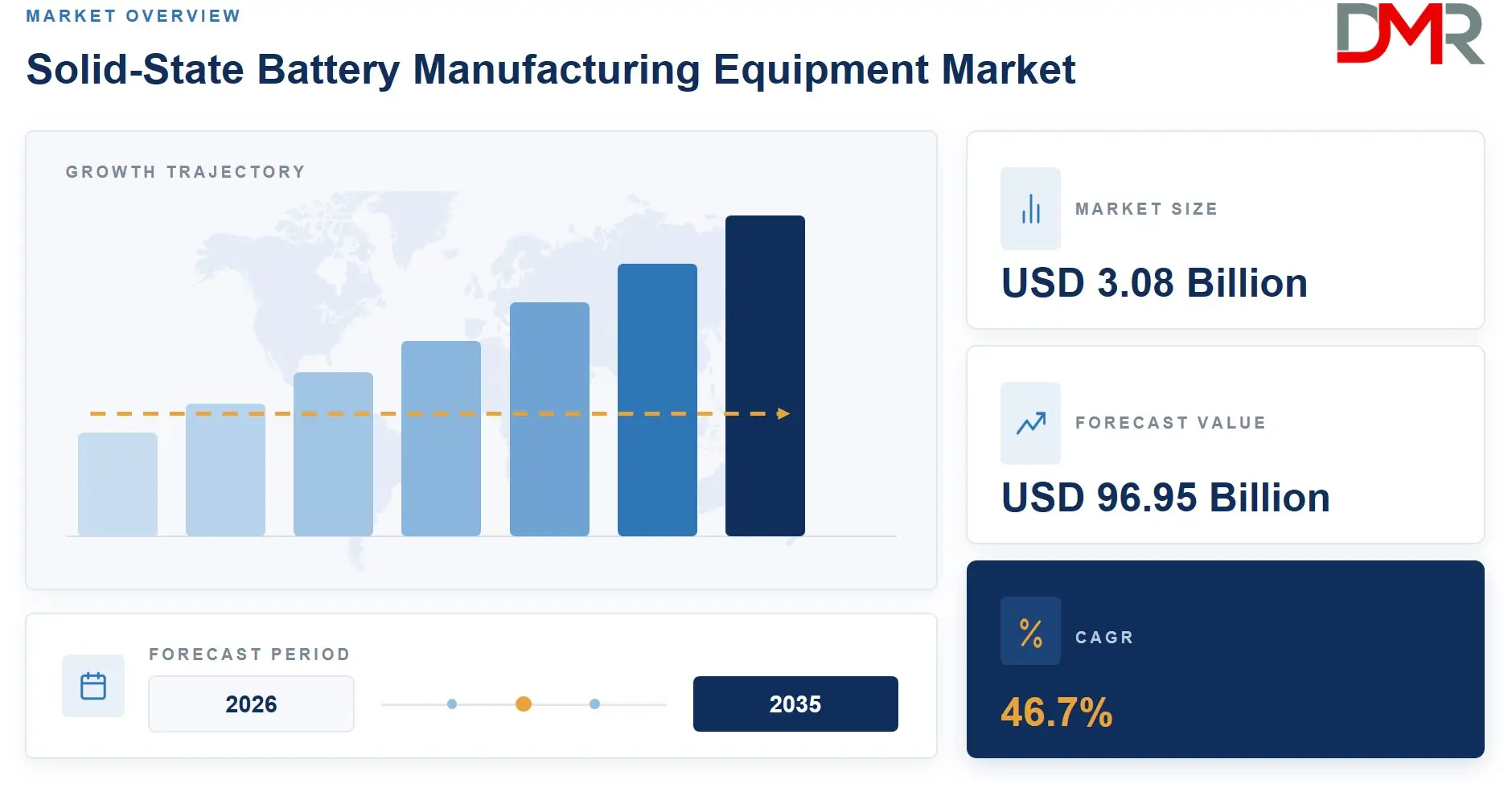
The Global Solid-State Battery Manufacturing Equipment Market size is estimated at USD 3.08 Billion in 2026, and is projected to reach USD 96.95 Billion by 2035, exhibiting a CAGR of 46.7% during the forecast period.
Equipment vendors supplying Solid State Battery production lines are entering the first commercial procurement wave. Toyota, Samsung SDI, and Solid Power have each committed capital to pilot lines, converting years of electrochemical research into tangible machine orders. As reported by VDMA, battery manufacturing is projected to generate €175 billion in revenue and 800,000 jobs by 2030, signaling that original equipment manufacturers and tier-one suppliers view scale as the next competitive battleground.
Forecast assumptions rest on three pillars. EV OEM timelines for solid-state cell integration between 2027 and 2030 create a pull-through demand curve for specialized equipment. Government subsidy programs in the US, EU, Japan, and South Korea compress commercialization timelines. Ionic conductivity breakthroughs in sulfide electrolyte materials reduce the thickness of active layers, making thin-film deposition tools commercially viable at scale rather than only in laboratory settings.
This market covers equipment designed or adapted specifically for solid-state cell production: electrode coating lines, cell assembly and stacking machines, pressing and densification tools, and formation and testing systems. Conventional lithium-ion battery equipment falls outside scope unless it has been re-engineered for solid-electrolyte compatibility. The equipment market connects upstream to specialty chemicals suppliers and downstream to gigafactory operators, defense procurement agencies, and medical device manufacturers where liquid electrolyte risk is disqualifying.
ℹ
To learn more about this report –
Download Your Free Sample Report Here
Key Takeaways
- The market size is USD 3.08 Billion in 2026, and is projected to hit USD 96.95 Billion by 2035 at a CAGR of 46.7%.
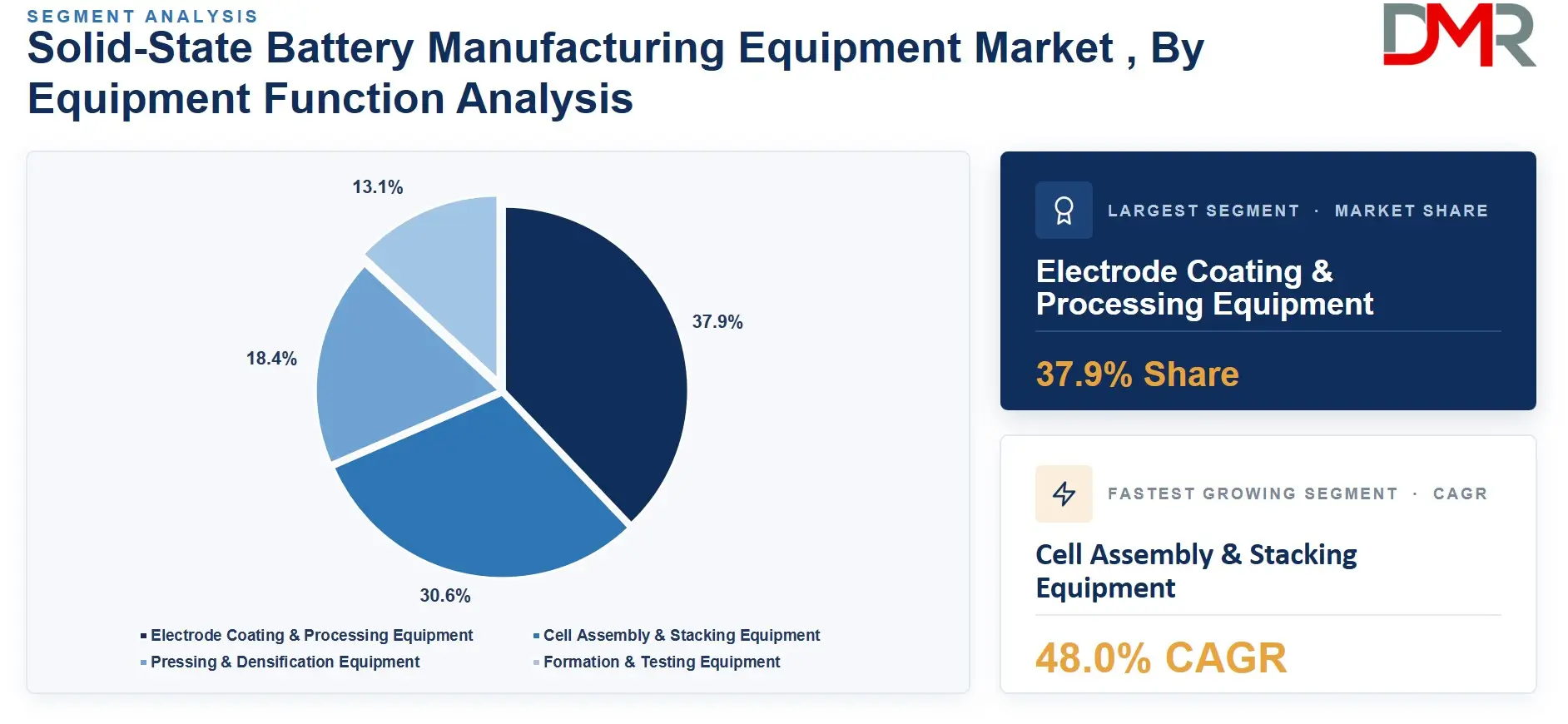
- By Equipment Function: Electrode Coating & Processing Equipment led as the largest category with a 37.90% share in 2026.
- By Solid Electrolyte Platform: Sulfide-Based Battery Equipment led with a 53.30% share in 2026.
- By Production Application: Electric Vehicle Batteries led with a 56.40% share in 2026.
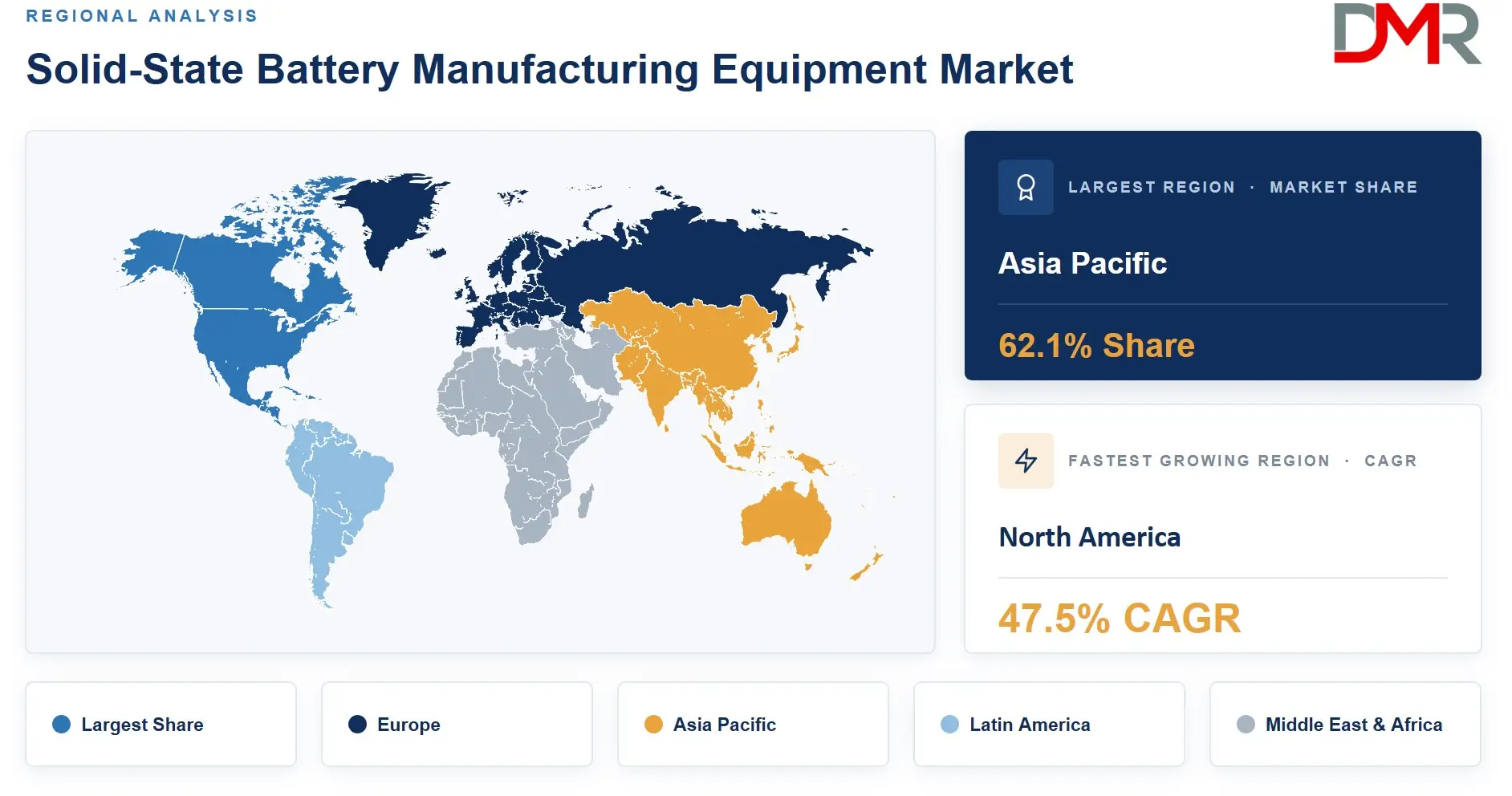
- By Region: Asia Pacific led with a 62.1% share in 2026.
- Top 5 key players: KATOP, Wuxi Lead Intelligent Equipment Co., Ltd., Dürr AG, Manz AG, Hitachi High-Tech Corporation.
Equipment Function Analysis
Electrode Coating & Processing Equipment accounted for 37.90% of Equipment Function demand in 2026, the highest of any category.
Electrode coating lines sit at the most capital-intensive node of the solid-state production chain. Coating uniformity at micron-level tolerances directly controls cell energy density and cycle life, so gigafactory operators pay premium prices for high-precision slot-die and doctor-blade systems. In January 2025, Dürr announced an order for eight electrode-coating lines supporting an Italian battery plant designed for 8 GWh of annual capacity, confirming that demand for coating equipment is converting from pilot-scale to industrial-scale contracts.
Cell Assembly & Stacking Equipment is the fastest-growing sub-category, driven by OEM targets to reduce cell cycle times below competitive thresholds. Pressing & Densification Equipment holds structural importance for sulfide-based lines where controlled sintering determines electrolyte layer integrity. Formation & Testing Equipment, while currently the smallest segment by revenue share, carries disproportionate long-term value as quality assurance requirements tighten and end-users demand cell-level traceability. Vendors with expertise in Semiconductor Manufacturing Equipment are pivoting precision tooling capabilities into this segment, compressing the time-to-market for next-generation stacking platforms. With 9.2 billion mobile-cellular subscriptions recorded globally in 2025, as confirmed by ITU, the consumer electronics pull for compact solid-state cells is sustaining parallel demand for miniaturized assembly and testing tools alongside the dominant EV channel.
ℹ
To learn more about this report –
Download Your Free Sample Report Here
Solid Electrolyte Platform Analysis
With a 53.30% share in 2026, Sulfide-Based Battery Equipment outpaced all other Solid Electrolyte Platform categories.
Sulfide chemistry commands majority equipment investment because it offers the highest ionic conductivity values achievable today among solid electrolyte materials. Scale-up activity for sulfide processing is outpacing oxide chemistry at every stage, from electrolyte materials supply through to line commissioning. Equipment vendors are redirecting R&D budgets specifically toward wet and dry sulfide processing tool design as customer order books concentrate around this chemistry.
Oxide-Based Battery Equipment retains relevance for thin-film applications in medical and specialty cells where processing temperatures are less constrained. Polymer-Based Battery Equipment serves niche stationary and wearable applications but faces displacement risk as sulfide performance data accumulates. Buyers evaluating the Battery Energy Storage Management System Market alongside cell chemistry decisions are increasingly selecting sulfide platforms for stationary grid applications, reinforcing equipment procurement toward that sub-segment.
Production Application Analysis
Electric Vehicle Batteries captured 56.40% of the Production Application segment in 2026, ahead of all rivals.
EV battery production lines account for the majority of solid-state equipment orders because automotive OEMs are the only buyers capable of committing to the multi-hundred-million-dollar line investments needed to justify custom equipment engineering. The June 2026 road test of 375 Wh/kg FEST solid-state cells integrated into a Stellantis Dodge Charger Daytona development vehicle by Factorial validated cell performance under real driving conditions, accelerating OEM procurement confidence and drawing forward equipment orders that had been contingent on performance proof points.
Consumer Electronics Batteries represent the second-largest application segment, with compact cell geometry requirements driving a distinct equipment sub-category separate from automotive-scale tools. Stationary Energy Storage Batteries are gaining specification attention from grid operators seeking fire-safe alternatives to liquid-electrolyte systems, particularly in dense urban deployments. Medical & Specialty Batteries constitute a high-margin, low-volume segment where defense and implantable device programs are generating spec-driven, non-commercial equipment procurement separate from commercial gigafactory timelines.
Key Market Segments
By Equipment Function
- Electrode Coating & Processing Equipment
- Cell Assembly & Stacking Equipment
- Pressing & Densification Equipment
- Formation & Testing Equipment
By Solid Electrolyte Platform
- Sulfide-Based Battery Equipment
- Oxide-Based Battery Equipment
- Polymer-Based Battery Equipment
By Production Application
- Electric Vehicle Batteries
- Consumer Electronics Batteries
- Stationary Energy Storage Batteries
- Medical & Specialty Batteries
Regional Analysis
Asia Pacific led the global Solid-State Battery Manufacturing Equipment Market with a 62.1% share in 2026.
Asia Pacific
China, Japan, and South Korea collectively anchor the Asia Pacific lead through three interlocking advantages: dominant battery cell manufacturing capacity, vertically integrated supply chains, and government-backed cell chemistry R&D programs. As reported by IEA, China accounted for 85% of global lithium-ion battery production in 2025. That concentration creates captive domestic demand for Chinese equipment vendors while simultaneously exposing overseas buyers to supply dependency risk, prompting European and North American operators to qualify Asian equipment suppliers as tier-two options.
North America
North America is accelerating equipment procurement through federal subsidy structures rather than organic private capital alone. Europe produced 110 GWh of electric-vehicle batteries in 2023, as reported by IEA, establishing a baseline of cell manufacturing capacity that is now pulling equipment investment across the Atlantic. US-based solid-state startups are operating pilot lines that serve as first-customer reference sites for equipment vendors seeking automotive qualification approvals.
ℹ
To learn more about this report –
Download Your Free Sample Report Here
Europe
European gigafactory buildout is generating cross-border equipment procurement demand. Poland's battery-manufacturing ecosystem included a lithium-ion factory with planned annual capacity of 90 GWh by 2025, as documented by UNIDO, signaling that Eastern Europe is absorbing a meaningful share of cell manufacturing investment alongside Western European incumbents. Equipment vendors with EU manufacturing or service presence gain preference in public-funded plant projects where local-content requirements apply.
Latin America
Latin America remains a nascent equipment market in 2026. Brazil and Mexico are attracting EV assembly investment from global OEMs, but solid-state battery cell manufacturing has not yet migrated to the region. Equipment procurement in Latin America is currently limited to feasibility-stage inquiries from lithium-resource owners exploring downstream integration opportunities.
Middle East & Africa
Gulf Cooperation Council governments are funding clean energy transition programs that include battery storage, but solid-state manufacturing equipment has not yet entered active procurement cycles in the region. South Africa's critical mineral position in cobalt and manganese creates upstream leverage, but downstream equipment investment requires cell manufacturing commitments that have not materialized at commercial scale as of 2026.
Key Regions and Countries
North America
Europe
- Germany
- France
- The UK
- Spain
- Italy
- Rest of Europe
Asia Pacific
- China
- Japan
- South Korea
- India
- Australia
- Rest of APAC
Latin America
- Brazil
- Mexico
- Rest of Latin America
Middle East & Africa
- GCC
- South Africa
- Rest of MEA
Macroeconomic Impact
Federal capital allocation is the single most powerful macroeconomic accelerator for this market in North America. The US Bipartisan Infrastructure Law allocated nearly $7 billion to strengthen the domestic battery supply chain, as reported by the DOE, creating grant-funded demand for equipment that would not materialize through private capital alone at the current technology readiness level. Interest rate environments in 2025 and 2026 have raised the hurdle rate for private gigafactory investment, making public subsidy programs structurally more important, not less.
Trade policy is reshaping equipment sourcing decisions. As per IMF projections, world trade volume growth is projected to slow from 5.0% in 2025 to 3.5% in 2026, a deceleration that is pushing OEMs toward regional supply chain strategies and favoring equipment vendors with domestic manufacturing or service networks. Currency movements between the Japanese yen, Chinese yuan, and euro directly affect import pricing for precision components used in solid-state equipment, adding cost volatility that buyers are managing through multi-year supply contracts.
Market Dynamics
Driver: EV Production Scale and Electrolyte Breakthroughs Pull Equipment Orders
Almost 22 million electric cars were produced globally in 2025, more than 25% above 2024 levels, as reported by IEA. That production volume concentrates capital commitments from Toyota, Samsung SDI, and Solid Power into first-wave pilot line procurement cycles. Equipment vendors that secured qualification approvals from tier-one automotive customers during 2024 and 2025 are now the default shortlist for commercial-scale orders entering 2026.
Global electric-car sales exceeded 20 million in 2025, representing 25% of all new-car sales, as reported by IEA. The crossover of EVs past one-quarter of global new-car sales marks the point at which solid-state battery timelines shift from strategic roadmap items to funded engineering programs. In April 2025, Idemitsu increased annual solid-electrolyte sample capacity from several tonnes to more than a dozen tonnes, signaling that materials supply is beginning to scale ahead of equipment demand, removing a key bottleneck that had delayed line commissioning decisions.
Research by DOE shows Li5B7S13 carrying a theoretical ionic conductivity of 74 mS/cm, while experimental Li10B10S20 exceeded 1 mS/cm after LiI addition. Conductivity gains of that magnitude compress the required electrolyte layer thickness, making scalable thin-film deposition equipment commercially viable rather than limited to laboratory batch processes. LEAD's dry-electrode process reduces overall solid-state-battery production-line investment by 30%, as reported by LEAD Intelligent, a cost reduction that changes the business case for mid-scale operators who previously could not justify the capital commitment. Battery Manufacturing Robotics integration into coating and stacking lines further reduces cycle time and defect rates, accelerating the ROI timeline for equipment buyers.
Restraint: Non-Standardized Formats and Facility Costs Block Universal Line Design
Equipment vendors cannot engineer a universal production line because oxide, sulfide, and polymer solid electrolyte chemistries each require distinct processing environments, tool geometries, and temperature profiles. A line built for sulfide processing cannot be redeployed for oxide without near-complete re-engineering. Vendors are forced to carry parallel engineering programs across three chemistry families, spreading R&D budgets thin and delaying any single platform from reaching full commercial maturity.
Sulfide electrolyte processing requires dry room infrastructure and inert atmosphere containment that multiplies facility buildout costs far beyond a conventional lithium-ion line conversion. A greenfield sulfide-capable facility can cost two to three times more per GWh than a standard lithium-ion plant. Buyers absorb that premium only when cell performance projections justify the delta, a threshold most operators have not yet crossed at commercial production volumes.
Opportunity: Microbattery, Defense, and Semiconductor Tool Pivot Open New Revenue Streams
US DOE laboratory equipment tests solid-state cells under controlled stack pressures of 1 to 100 MPa, as confirmed by DOE, establishing validated test protocols that equipment vendors can reference when designing commercial formation and testing lines. Solid-state microbattery equipment for implantable medical devices and industrial IoT sensors constitutes a distinct equipment category with no liquid electrolyte risk, ultra-thin geometry requirements, and high-cycle-life specifications that standard lithium-ion tools cannot meet. In July 2025, QuantumScape and PowerCo expanded their collaboration with up to $131 million in milestone payments and rights for 5 GWh of additional annual production, a deal structure that validates toll-manufacturing as a route for equipment buyers to share capital risk with cell developers.
Atmospheric plasma deposition and atomic layer deposition vendors are crossing over from semiconductor tool markets into solid electrolyte thin-film manufacturing. Defense procurement programs for drone and autonomous ground vehicle platforms are generating spec-driven equipment demand that operates outside commercial gigafactory procurement timelines, creating a parallel sales channel for vendors with security-cleared facility capabilities. All-solid-state battery production line consulting and commissioning services represent an adjacent revenue opportunity targeting emerging Asian and European gigafactory operators who lack in-house process expertise.
Porter's Five Forces
Competitive intensity in the solid-state battery manufacturing equipment market is currently moderate but will compress rapidly as cell production scales past pilot. New entrant barriers are high: customers require equipment vendors to pass automotive-grade qualification audits before any purchase order is issued, a process that consumes 18 to 36 months and substantial engineering capital. Supplier bargaining power is elevated because precision components including ultra-flat press platens, inert-atmosphere glovebox modules, and high-vacuum deposition chambers are sourced from a narrow base of specialty manufacturers. LiPON used in commercial thin-film solid-state batteries carries ionic conductivity of approximately 10^−6 S/cm, as documented by NIST, illustrating the precision requirements that cascade through every equipment subsystem and make substitution of components technically risky. Buyer bargaining power grows with order size; a gigafactory operator committing to a full multi-hundred-million-dollar line retains significant pricing leverage over a vendor whose order book is thin. Substitutes pose limited near-term risk because no existing tool category can replicate the process-specific capabilities required for dry-room solid electrolyte deposition. Competitive rivalry among the top vendors is intensifying as Japanese precision machinery firms enter joint ventures with US and European solid-state startups, accelerating process-specific tool commercialization and narrowing the technology gap that incumbent vendors currently exploit.
AI and Gen AI Impact
Artificial intelligence is entering the solid-state equipment market first at the process control layer, where real-time defect detection in electrode coating, electrolyte deposition, and cell stacking is reducing yield loss rates that would otherwise make sub-commercial-scale lines economically unviable. In August 2026, Hitachi High-Tech and Powrex completed a physical-AI demonstration for optimizing all-solid-state-battery cathode coating, targeting commercialization around 2030. The demonstration confirms that equipment vendors are embedding AI-driven process optimization directly into tool firmware rather than treating it as an optional software add-on. Battery Simulation Software platforms that model electrolyte layer stress and ionic transport under operating conditions are shortening the experimental cycle for equipment parameter tuning, reducing physical trial runs and the associated material waste. Vendors without AI-enabled process control face displacement risk as customers apply AI performance benchmarks to equipment procurement scorecards alongside throughput and defect metrics.
Market Trends
Roll-to-Roll and Continuous Processing Formats Replace Batch Production
Roll-to-roll solid electrolyte deposition trials are underway at multiple national laboratories, signaling an imminent transition from batch to continuous production formats. As per DOE research, solid-polymer electrolytes with ionic conductivity above 10^−3 S/cm have been identified as a battery R&D target, a threshold that, once reliably achieved, makes continuous deposition economically viable at gigawatt-hour scale. In December 2025, LEAD launched an integrated solid-state-battery cutting-and-stacking system with single-station efficiency surpassing 0.35 seconds per piece, setting a throughput benchmark that batch-format competitors must now match or accept a commercial disadvantage.
Market Competition Overview
The competitive landscape is fragmented in 2026, with no single vendor holding dominant share across all equipment function categories. Chinese equipment manufacturers including Wuxi Lead, KATOP, and Yinghe Technology compete primarily on price and speed of delivery, with growing process capabilities built on lithium-ion equipment heritage. European vendors including Dürr and ANDRITZ compete on process precision, automotive-grade qualification track records, and capacity to integrate multi-step production lines under a single service agreement. Hitachi High-Tech recorded approximately JPY 821.7 billion in FY2025 revenue, as per company filings, reflecting the breadth of its precision equipment portfolio that spans semiconductor, life science, and battery tool markets. In May 2024, ION Storage Systems commissioned a solid-state-battery pilot line targeting 1 MWh in 2024 and 10 MWh by early 2025, a ramp profile that is generating first reference-site data points that equipment vendors are using to validate process claims in commercial sales conversations.
Pricing Analysis
Pricing for solid-state battery manufacturing equipment reflects the custom engineering intensity of each line. Electrode coating and thin-film deposition systems carry the highest per-unit prices because of the precision tolerances required and the limited number of qualified vendors. Cell assembly and stacking tools are priced more competitively as Chinese manufacturers enter with lithium-ion-adapted platforms, introducing a downward price gradient on commodity-adjacent functions. Formation and testing equipment pricing is rising as traceability and data-density requirements tighten under automotive qualification protocols.
Market leaders price on a total-cost-of-ownership model that bundles equipment, commissioning, process validation, and multi-year service contracts, insulating margin from pure-hardware price competition. Challengers from lower-cost manufacturing bases use entry-level unit pricing to win first orders and then expand scope within the customer site. Regional pricing differences are most pronounced between Asian and European markets, where import duties, installation logistics, and local-content preferences add 15 to 25 percent to the total landed cost of cross-border equipment procurement.
Company Profiles
Wuxi Lead Intelligent Equipment Co., Ltd. is the largest Chinese-listed battery equipment vendor by revenue. Findings from HKEX filings show the company recorded RMB 14.358 billion in 2025 revenue, including RMB 9.451 billion from lithium-ion battery intelligent equipment. Lead's strategic position rests on vertical breadth across the battery production line and a price-to-performance ratio that Chinese and Southeast Asian gigafactory operators prioritize over Western alternatives. LEAD's solid-state-battery stacking equipment achieves approximately 0.35 seconds per cell, as reported by LEAD Intelligent, a throughput figure that places it competitively against higher-priced Japanese and European alternatives on pure cycle-time metrics.
ANDRITZ AG positions as the European precision equipment leader with demonstrated capacity to integrate large-scale battery formation lines. Data published by ANDRITZ shows the company recorded €7.8831 billion in revenue and €8.9098 billion in order intake in 2025, with order intake exceeding revenue by a meaningful margin that signals a strong forward pipeline. ANDRITZ's competitive advantage rests on engineering depth across drying, separation, and formation systems, enabling turnkey line contracts that Chinese competitors cannot yet replicate at comparable process certification levels.
Key Players
- Wuxi Lead Intelligent Equipment Co., Ltd.
- KATOP
- Xiaowei New Energy
- Guangdong Lyric Robot Automation Co., Ltd.
- Hymson Laser Technology Group Co., Ltd.
- Manst
- Yinghe Technology Co., Ltd.
- Mikrouna
- Xiamen Tmax Battery Equipments
- Xiamen Lith Machine Limited
- Xiamen Acey New Energy Technology Co., Ltd.
- Dürr AG
- Manz AG
- Hitachi High-Tech Corporation
- Andritz AG
- Bühler Group
- Nordson Corporation
- Rosendahl Nextrom GmbH
- CKD Corporation
- Targray
Supply Chain and Value Chain Analysis
The solid-state battery equipment supply chain originates at critical mineral extraction. The Democratic Republic of the Congo accounted for 74% of global cobalt mine production in 2025, as reported by UNCTAD, creating a single-point geographic concentration risk that equipment buyers are factoring into long-term line utilization projections. China produced 78% of the world's natural graphite in 2025, per UNCTAD, adding a second tier of geographic concentration in anode material supply that compounds the supply chain vulnerability already present in electrolyte precursors.
Maximum value in the value chain is created at the electrolyte deposition and cell assembly stages, where process knowhow rather than commodity materials determines yield and cell performance. The biggest bottleneck sits at the precision components tier immediately upstream of final equipment assembly: ultra-flat press platens, high-vacuum chambers, and inert-atmosphere handling systems are sourced from a narrow supplier base and carry 16 to 24 week lead times. Equipment vendors that vertically integrate critical sub-assemblies reduce delivery risk and improve margin relative to competitors assembling from spot-market components.
Regulatory Landscape
The US Bipartisan Infrastructure Law and the EU Battery Regulation together constitute the two most consequential regulatory frameworks shaping equipment procurement decisions. The EU Battery Regulation imposes carbon footprint declarations and supply chain due diligence requirements on battery cells placed on the European market, indirectly requiring gigafactory operators to select equipment that enables cell-level traceability data collection from day one of line commissioning. Non-compliant line designs face retrofit costs that vendors are beginning to price into initial equipment proposals.
Japan's Green Innovation Fund and South Korea's K-Battery Development Strategy each allocate government capital toward domestic solid-state cell programs, with local equipment vendor preference embedded in grant conditions. North American operators accessing DOE battery manufacturing grants must demonstrate domestic content compliance, a requirement that disadvantages pure-import equipment procurement and creates a regulatory floor for US-based or US-assembled tool vendors. Export control regimes are beginning to intersect with advanced battery equipment as dual-use technology designations expand.
Investment and White Space Analysis
Global lithium demand is projected to increase 353% between 2024 and 2040, as reported by UNCTAD, a demand trajectory that makes solid-state battery manufacturing equipment one of the highest-growth capital goods categories of the next two decades. In January 2026, Solid Power priced a registered direct offering expected to generate approximately $130 million in gross proceeds, a funding event that confirms equity capital markets are actively financing solid-state cell developers whose scale-up plans create direct equipment procurement pipelines.
White space is largest in three areas: solid-state microbattery equipment for medical and IoT applications, production line consulting and commissioning services for emerging gigafactory operators, and atmospheric deposition tool adaptation from semiconductor manufacturing. Regions with high growth potential and currently low equipment competition include India, Southeast Asia, and the Middle East, where government energy transition mandates are generating cell manufacturing feasibility studies ahead of committed capex. Vendors entering these markets early with service infrastructure and local engineering partnerships are positioned to capture anchor customer relationships before European and US competitors establish regional presence.
Recent Developments
- September 2026: ProLogium began mass production of its Gen 3.5 solid-state battery. Its 185.4 Ah cell achieved 381 Wh/kg and 903 Wh/L, establishing a new commercial energy density benchmark for all-solid-state production lines.
- March 2026: ANDRITZ launched the LIB4000 helix dryer following trials that demonstrated solvent-extraction rates of up to 99.5%, targeting high-throughput electrode drying in solid-state and lithium-ion production environments.
- February 2026: Bühler reported delivery of 113 battery-slurry and dry-compound production systems over 10 years, marking a milestone that confirms its position as a volume supplier to global battery manufacturers.
- January 2026: ANDRITZ commissioned a 1.5 GW battery-cell formation line featuring more than 50,000 channels, 200 chambers, and processing of more than two million data points per second.
- March 2025: Vikram Solar announced a 1 GWh integrated solid-state cell and battery facility scalable to 5 GWh, marking one of the first solid-state manufacturing commitments from an Indian energy company.
- September 2024: Solid Power was selected to negotiate up to $50 million in US Department of Energy funding and planned to expand electrolyte capacity from 30 tonnes to 75 tonnes in 2026 and 140 tonnes in 2028.
- July 2024: PowerCo and QuantumScape signed a licensing agreement covering 40 GWh of annual production capacity, with rights expandable to 80 GWh, forming one of the largest solid-state battery technology licensing deals on record.
- January 2024: Solid Power and SK On signed agreements expected to generate at least $50 million, including a $22 million pilot line and purchases of at least eight tonnes of electrolyte through 2030.
Report Scope
| Report Characteristics |
| Market Value (2026) |
USD 3.08 Billion |
| Forecast Revenue (2035) |
USD 96.95 Billion |
| CAGR (2026 to 2035) |
46.7% |
| Base Year for Estimation |
2025 |
| Historic Period |
2020 to 2024 |
| Forecast Period |
2026 to 2035 |
| Report Coverage |
Revenue Forecast, Market Dynamics, Competitive Landscape, Recent Developments |
| Segments Covered |
By Equipment Function (Electrode Coating & Processing Equipment, Cell Assembly & Stacking Equipment, Pressing & Densification Equipment, Formation & Testing Equipment), By Solid Electrolyte Platform (Sulfide-Based Battery Equipment, Oxide-Based Battery Equipment, Polymer-Based Battery Equipment), By Production Application (Electric Vehicle Batteries, Consumer Electronics Batteries, Stationary Energy Storage Batteries, Medical & Specialty Batteries) |
| Regional Analysis |
North America (US and Canada), Europe (Germany, France, The UK, Spain, Italy, and Rest of Europe), Asia Pacific (China, Japan, South Korea, India, Australia, and Rest of APAC), Latin America (Brazil, Mexico, and Rest of Latin America), Middle East & Africa (GCC, South Africa, and Rest of MEA) |
| Competitive Landscape |
KATOP, Xiaowei New Energy, Wuxi Lead Intelligent Equipment Co., Ltd., Guangdong Lyric Robot Automation Co., Ltd., Hymson Laser Technology Group Co., Ltd., Manst, Yinghe Technology Co., Ltd., Mikrouna, Xiamen Tmax Battery Equipments, Xiamen Lith Machine Limited, Xiamen Acey New Energy Technology Co., Ltd., Dürr AG, Manz AG, Hitachi High-Tech Corporation, Andritz AG, Bühler Group, Nordson Corporation, Rosendahl Nextrom GmbH, CKD Corporation, Targray |
| Customization Scope |
Customization for segments and region or country level will be provided. Additional customization can be done based on requirements. |
| Purchase Options |
Three license options: Single User License, Multi-User License (Up to 5 Users), Corporate Use License (Unlimited Users and Printable PDF) |
Frequently Asked Questions
What is the biggest investment opportunity in the Solid-State Battery Manufacturing Equipment market?
▾ The highest-return investment opportunity sits at the intersection of sulfide-based line commissioning services and microbattery equipment for medical and IoT applications. Both segments carry higher margins than standard lithium-ion equipment adaptation and face less price competition from Chinese vendors. Global lithium demand is projected to increase 353% between 2024 and 2040, sustaining the long-term capital case for equipment vendors positioned across the solid-state value chain.
Who are the top companies in the Solid-State Battery Manufacturing Equipment market?
▾ The five leading companies are KATOP, Wuxi Lead Intelligent Equipment Co., Ltd., Dürr AG, Hitachi High-Tech Corporation, and ANDRITZ AG. Chinese vendors lead on volume and price competitiveness, while European and Japanese vendors lead on process precision and automotive-grade qualification credentials. No single vendor holds dominant share across all equipment function categories in 2026.
Which segment is growing fastest in the Solid-State Battery Manufacturing Equipment market and why?
▾ Cell Assembly & Stacking Equipment is the fastest-growing sub-category within the Equipment Function segment. OEM pressure to reduce cell cycle times below 0.35 seconds per cell is driving procurement of purpose-built stacking platforms that lithium-ion heritage tools cannot match. Electric Vehicle Batteries, holding a 56.40% production application share, provides the primary demand signal pulling this equipment category forward.
Which region is growing fastest in the Solid-State Battery Manufacturing Equipment market and why?
▾ Asia Pacific holds the dominant 62.1% regional share and is also the fastest-growing region, driven by concentrated cell manufacturing capacity in China, Japan, and South Korea alongside government-backed solid-state R&D programs. Chinese equipment vendors operating from a domestic cost base and with home-market customer relationships hold a structural advantage in capturing the first wave of regional pilot-line orders. North America and Europe are accelerating through subsidy programs but remain behind Asia Pacific in equipment order volume through 2026.
What is the biggest challenge holding in the Solid-State Battery Manufacturing Equipment market back?
▾ The absence of standardized solid electrolyte material formats is the primary structural barrier. Equipment vendors cannot engineer a universal production line across oxide, sulfide, and polymer chemistries, forcing parallel engineering programs that dilute R&D investment and delay any single platform from reaching full commercial maturity. Dry room and inert atmosphere infrastructure costs for sulfide lines compound the problem by making facility economics prohibitive for all but the most capitalized operators.