Market Overview
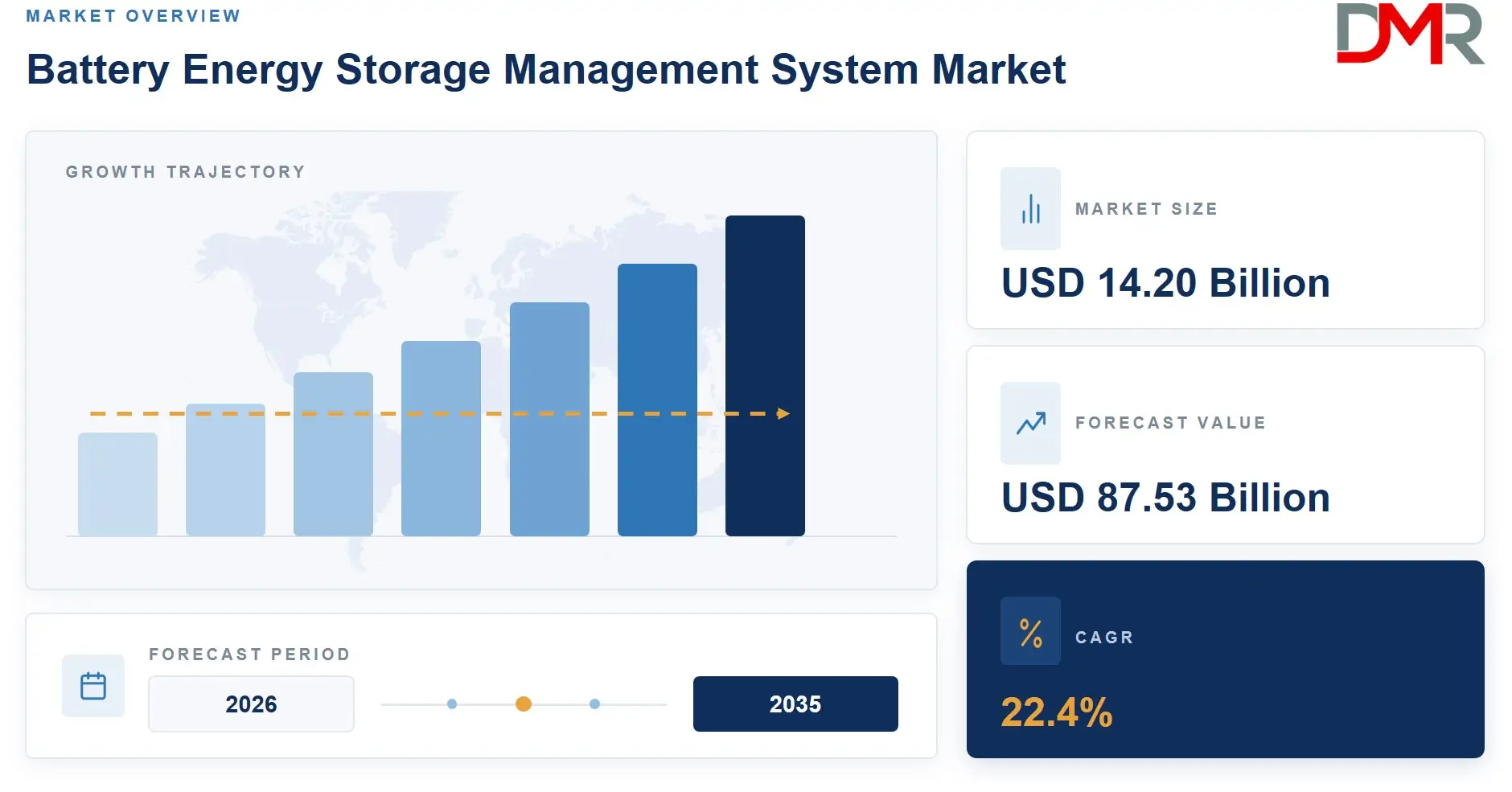
The Global Battery Energy Storage Management System Market size is estimated at USD 14.20 Billion in 2026, and is projected to reach USD 87.53 Billion by 2035, exhibiting a CAGR of 22.4% during the forecast period. As reported by the IEA in 2026, 108 GW of new battery storage capacity was deployed worldwide in 2025, a 40% increase over the prior year. That pace of physical deployment directly expanded the addressable base for Battery Management System hardware, firmware, and software platforms. Every new rack of cells commissioned at utility or commercial scale requires active monitoring, protection, and dispatch coordination from day one of operation. The IEA also confirms the global lithium-ion battery market exceeded USD 150 Billion in 2025, an increase of over 20% from 2024. That upstream growth translates to a proportional rise in BMS procurement, since no large-format battery system ships without an embedded or externally integrated management layer. The forecast assumes continued renewable energy buildout, accelerating EV fleet electrification, and tightening grid-stability mandates as the three compounding forces sustaining the 22.4% CAGR through 2035. The market covers all software, hardware, and firmware systems that govern cell monitoring, state estimation, ther
mal management, cell balancing, and energy dispatch across stationary and mobile battery platforms. Adjacent to the broader Energy Storage Systems market, BMS sits at the intelligence layer of every deployment. Without it, chemistry performance cannot be sustained, safety certification cannot be achieved, and warranty liabilities cannot be bounded. Artificial intelligence is now entering this layer directly, with adaptive algorithms replacing fixed-threshold balancing logic in premium applications.
ℹ
To learn more about this report –
Download Your Free Sample Report Here
Key Takeaways
- The market size is USD 14.20 Billion in 2026, and is projected to hit USD 87.53 Billion by 2035 at a CAGR of 22.4%.
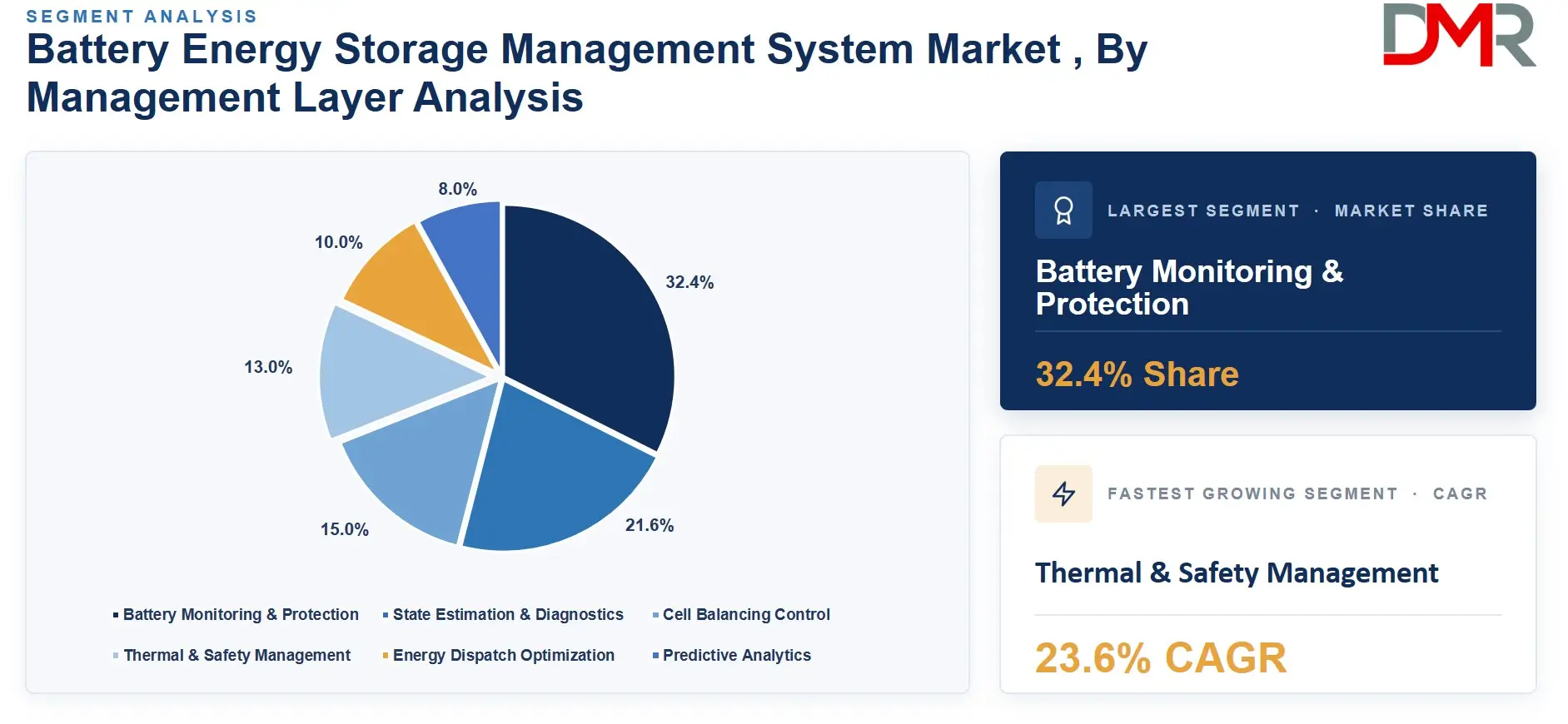
- By Management Layer: Battery Monitoring & Protection led with a 32.4% share in 2026.
- By Control Architecture: Centralized BMS led with a 46.8% share in 2026.
- By Battery Platform: Lithium-Ion/LFP Systems led with a 67.8% share in 2026.
- By Storage Environment: Utility-Scale BESS led with a 45.7% share in 2026.
- By Connectivity Model: Cloud-Connected led with a 54.2% share in 2026.
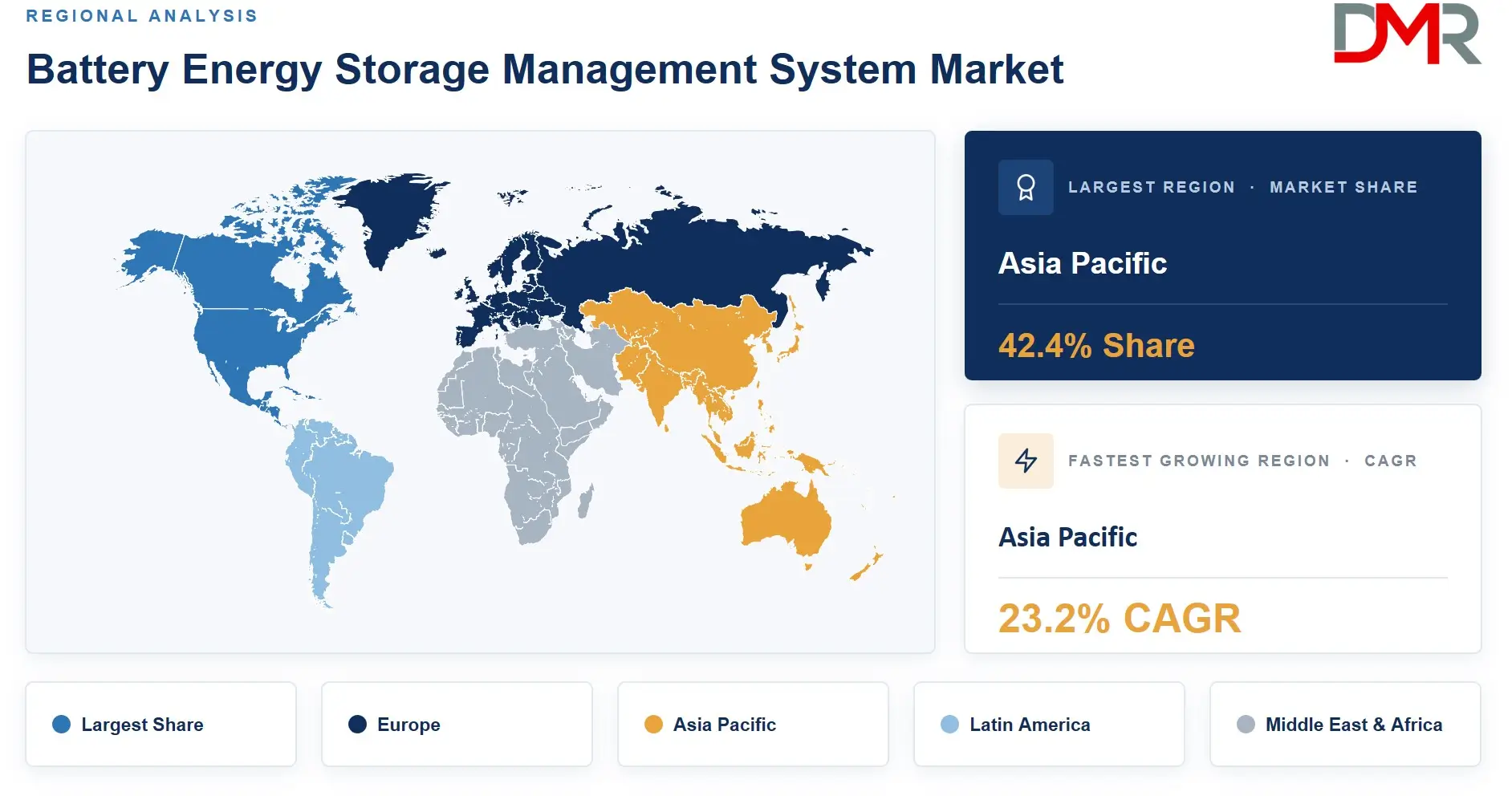
- By Region: Asia Pacific led with a 42.4% share in 2026.
- Top key players include Sensata Technologies, LG Energy Solution, Analog Devices, Inc., STMicroelectronics, Panasonic Holdings Corporation, NXP Semiconductors, Texas Instruments Incorporated, Infineon Technologies AG, Nuvation Energy, and Fluence Energy.
Management Layer Analysis
Battery Monitoring & Protection accounted for 32.4% of Management Layer demand in 2026, the highest of any category. As published by the US DOE in 2025, a Battery Management System connects cell-level measurements to control state of charge, prevent overcharge, track state of health, and maintain state of function across the entire pack. That functional scope explains why monitoring and protection commands the largest revenue share. Buyers cannot compromise on this layer because a failure here voids safety certifications and triggers warranty claims simultaneously. State Estimation and Diagnostics ranks second and is gaining share as second-life repurposing programs scale. Repurposed packs carry degraded and mixed-chemistry cells, which demand recalibration algorithms far beyond what first-life monitoring requires. Cell Balancing Control benefits from a DOE-documented architecture that enables balancing across every 5, 10, 15, 20, or 30 cells, as reported by the US DOE, giving vendors flexibility to serve both small residential stacks and large utility racks. Thermal and Safety Management and Predictive Analytics are the fastest-growing sub-layers, pulled by IEC 62619 and UL 9540 certification requirements that mandate active thermal intervention as a non-negotiable compliance condition.
ℹ
To learn more about this report –
Download Your Free Sample Report Here
Control Architecture Analysis
With a 46.8% share in 2026, Centralized BMS outpaced all other Control Architecture categories. Centralized architecture dominates because it reduces per-unit hardware cost and simplifies firmware deployment across uniform cell chemistries. STMicroelectronics confirms its AEK-POW-BMS63EM evaluation board handles from 1 to 31 lithium-ion battery nodes, with each node managing between 4 and 14 cells, supporting the scalability buyers in commercial and industrial segments demand from a centralized platform. Distributed BMS is taking share in applications where string-level redundancy justifies the added node hardware. Modular BMS sits at the intersection of both architectures, appealing to fleet operators who need plug-and-replace scalability without a full firmware rewrite. The shift toward modularity is a direct response to chemistry fragmentation. As LFP, NMC, NCA, and sodium-ion packs co-exist within the same portfolio, firmware that cannot adapt to each chemistry creates liability exposure for OEMs managing multi-site deployments.
Battery Platform Analysis
Lithium-Ion/LFP Systems captured 67.8% of the Battery Platform segment in 2026, ahead of all rivals. IEA data published in 2026 confirms LFP batteries now account for approximately 90% of battery-storage deployments globally. The LFP platform's dominance reflects its combination of thermal stability, long cycle life, and falling cathode costs. BMS vendors serving this platform have standardized firmware stacks tuned for LFP electrochemistry, creating a switching cost that reinforces market share. In June 2026, CATL launched the TENER Sodium Energy Storage System, the world's first field-validated sodium-ion BESS, with cumulative shipments targeting 1 GWh by year-end 2026, signaling where the next platform competition will emerge. Lead-Acid Systems retain relevance through a 99% recycling rate and a claim to 70% of worldwide rechargeable battery capacity sold annually, as reported by the US DOE. However, the energy density gap is severe. DOE data shows PbA delivers 25 to 100 kWh/m³ against lithium-ion's 150 to 500 kWh/m³, a disadvantage that makes lead-acid increasingly non-competitive for space-constrained deployments. Flow Batteries benefit from the US DOE's definition of long-duration energy storage as systems delivering electricity for 10 or more continuous hours, a threshold where flow chemistry gains genuine competitiveness.
Storage Environment Analysis
Utility-Scale BESS led the Storage Environment segment with a 45.7% share in 2026. IEA data from 2026 records utility-scale battery additions reaching a record 63 GW in 2024, bringing total installed capacity to 124 GW globally. Earlier IEA data shows that 2023 battery storage additions split 65% utility-scale versus 35% behind-the-meter, a ratio that has continued shifting toward grid-front-of-meter deployments as renewable intermittency intensifies grid balancing requirements. Grid Scale Energy Storage procurement is now driven by capacity market contracts rather than opportunistic project financing, which extends BMS procurement cycles and raises baseline specification requirements. Commercial and Industrial Storage is accelerating as corporate energy buyers seek grid-independence during peak pricing hours. Residential Battery Energy Storage Systems remain the fastest-growing environment by unit count, even though revenue share trails utility scale. Microgrids and Backup Systems offer one of the most technically demanding environments for BMS. The Viejas Microgrid pairs a 15 MW photovoltaic system with a 70 MWh battery, backed by a $72.8 million DOE partial loan guarantee, illustrating the capital intensity and complexity that requires sophisticated state-of-charge management at every operating condition.
Connectivity Model Analysis
A 54.2% share made Cloud-Connected the clear leader across Connectivity Model categories in 2026. Cloud-connected BMS platforms capture the majority share because they enable fleet operators to monitor thousands of distributed assets from a single dashboard. ITU data published in 2025 records data centres consuming approximately 1.5% of global electricity, with consumption rising 12% annually between 2017 and 2024. That growth in cloud infrastructure directly supports the real-time telemetry volumes that cloud-connected BMS platforms generate at scale. ITU-T Y.3149 specifies latency of 5 ms or less for real-time tactile and edge interactions, a benchmark that cloud-native BMS platforms must meet or route around using edge pre-processing to maintain system responsiveness. Local and Edge-Controlled architectures retain a base of utility and defense buyers who reject cloud connectivity on cybersecurity grounds. Hybrid Edge-Cloud Management is emerging as the commercial compromise. Operators pre-process time-critical safety decisions at the edge while routing non-latency-sensitive analytics to cloud platforms for aggregation and predictive modelling.
Key Market Segments
By Management Layer
- Battery Monitoring & Protection
- State Estimation & Diagnostics
- Cell Balancing Control
- Thermal & Safety Management
- Energy Dispatch Optimization
- Predictive Analytics
By Control Architecture
- Centralized BMS
- Distributed BMS
- Modular BMS
By Battery Platform
- Lithium-Ion/LFP Systems
- Lead-Acid Systems
- Flow Batteries
- Sodium-Ion & Emerging Chemistries
By Storage Environment
- Utility-Scale BESS
- Commercial & Industrial Storage
- Residential Storage
- Microgrids & Backup Systems
By Connectivity Model
- Cloud-Connected
- Local/Edge-Controlled
- Hybrid Edge-Cloud Management
Regional Analysis
Asia Pacific led the Battery Energy Storage Management System Market with a 42.4% share in 2026.
Asia Pacific
China drove the region's dominance. IEA data from 2026 confirms China added just over 63 GW of battery capacity in 2025, approximately one-third more than it added in 2024. That single country's annual addition exceeded the entire cumulative installed base of most mid-sized economies. Chinese manufacturers benefit from vertically integrated supply chains, government-backed procurement targets, and domestic BMS software ecosystems developed in parallel with cell manufacturing scale-up.
North America
The US EIA confirmed in 2026 that cumulative US utility-scale battery storage capacity exceeded 26 GW in 2024, a 66% increase over the prior year. Federal investment tax credit extensions and state-level clean energy mandates drove that expansion. North American BMS buyers increasingly specify cloud-connected architectures with cybersecurity certifications, creating a higher average selling price environment than Asia Pacific's cost-focused procurement patterns.
ℹ
To learn more about this report –
Download Your Free Sample Report Here
Europe
ENTSO-E's TYNDP 2024, published in 2025, projects an additional 540 GW of storage power capacity as economically efficient across Europe by 2050. That long-range planning signal is already pulling forward investment decisions. The EU Battery Passport regulation creates a separate compliance requirement, compelling BMS vendors to build lifecycle data logging and export functions directly into their firmware stacks. That regulatory feature set raises hardware cost but also raises the barrier for non-compliant competitors.
Key Regions and Countries
North America
Europe
- Germany
- France
- The UK
- Spain
- Italy
- Rest of Europe
Asia Pacific
- China
- Japan
- South Korea
- India
- Australia
- Rest of APAC
Latin America
- Brazil
- Mexico
- Rest of Latin America
Middle East & Africa
- GCC
- South Africa
- Rest of MEA
Macroeconomic Impact
Shipping route disruptions directly threaten BMS component supply chains. As reported by the IMF in 2025, shipping accounts for approximately 80% of worldwide merchandise trade by volume. Red Sea attacks caused a 6.7% year-over-year decline in port calls to sub-Saharan African ports in early 2024, according to IMF data, adding transit time and cost to semiconductor and passive component shipments that BMS hardware depends on. Buyers in Europe and North America responded by qualifying dual-source suppliers, raising short-term procurement costs. Interest rate environments shaped project finance timelines for grid-scale BESS deployments through 2024 and 2025. Higher rates extended payback periods for utility buyers, causing some procurement decisions to shift from full-ownership to BMS-as-a-Service contracts where capital expenditure converts to operating expenditure. Currency movements between the US dollar, Chinese yuan, and Korean won affected spot pricing for BMS integrated circuits sourced from Asian fabs and sold into dollar-denominated contracts.
Market Dynamics
Driver: Grid-Scale Procurement and EV Safety Liability Accelerate BMS Adoption
IEA data published in 2025 confirms battery demand in the energy sector reached the historical milestone of 1 TWh in 2024. Every watt-hour of that deployed capacity requires continuous management. Grid operators signing long-duration capacity contracts now write minimum BMS specification requirements directly into procurement tenders, transforming BMS from an engineering afterthought to a contract-qualifying technical condition. In January 2026, Fluence Energy agreed to supply its Gridstack Pro technology for BrightNight and Cordelio Power's Pioneer Clean Energy Center, pairing 300 MW of solar with a 300 MW / 1,200 MWh BESS, illustrating the scale at which BMS dispatch coordination now operates. EV OEMs face warranty liability exposure that runs directly through BMS quality. Thermal runaway events and capacity fade claims cost manufacturers in both recall expenses and brand equity. Precision cell-level monitoring that prevents these failures has shifted from a differentiating feature to a minimum entry condition for OEMs competing in markets where consumer protection regulations hold manufacturers liable for battery degradation over defined warranty periods.
Restraint: Chemistry Fragmentation and Cybersecurity Risk Constrain Vendor Scale
UNCTAD data published in 2026 projects lithium demand rising by 353% between 2024 and 2040, a trajectory that intensifies pressure on cell chemistry innovation beyond LFP and NMC. As manufacturers introduce sodium-ion, solid-state, and hybrid chemistries to reduce lithium dependency, BMS firmware stacks tuned for one chemistry cannot be redeployed on another without re-validation. That fragmentation prevents vendors from building a single universally deployable BMS firmware, raising development cost and extending time-to-market for each new platform release. UNCTAD also confirms the DR Congo accounted for 74% of global cobalt mine production and Indonesia for 67% of global nickel mine production in 2025. That concentration in two countries creates geopolitical supply risk for NMC and NCA battery chemistries, adding uncertainty to BMS roadmaps built around those platforms. Utility and defense buyers have simultaneously moved to block cloud-connected BMS procurement on cybersecurity grounds, citing vulnerability to network intrusion as an operational and regulatory risk they are not authorized to accept.
Opportunity: VPP Aggregation, Off-Grid Industrial, and Marine Electrification Open New BMS Markets
IRENA reported in 2026 that fully installed battery storage project costs declined 93% between 2010 and 2024, falling from USD 2,571/kWh to USD 192/kWh. That cost compression has made BESS economically viable across a far wider range of applications than utility-scale alone, expanding the total addressable market for BMS vendors into segments that were cost-prohibitive five years ago. Virtual Power Plant aggregation platforms now require BMS application programming interfaces capable of real-time dispatch coordination across hundreds of residential and commercial assets simultaneously. In February 2025, BYD signed the world's largest grid-scale battery storage project at 12.5 GWh for Saudi Arabia's transmission network, a scale that demonstrates the Distributed Energy Resource Management System requirements that modern BMS must satisfy. Mining and off-grid industrial sites operating diesel-hybrid storage systems represent a segment with no OEM-supported BMS solution currently scaled for extreme environment conditions. Marine and aviation electrification programs create a parallel requirement for certified BMS architectures built for high-vibration, weight-constrained, and rapid-discharge duty cycles. BMS-as-a-Service subscription models are emerging as the commercial mechanism for fleet operators who need predictive analytics without the capital commitment of owning proprietary firmware stacks.
Porter's Five Forces
The Battery Energy Storage Management System market carries high competitive intensity across all five structural forces. New entrant barriers are substantial because BMS firmware requires IEC 62619 and UL 9540 safety certification before any stationary storage buyer will consider a purchase. The USABC distributed BMS architecture, as documented by the US DOE, demonstrates that even a standard concept requires a single battery control unit coordinating multiple cell supervisory circuits, an engineering depth that takes years of development to certify. Supplier power is elevated because the semiconductor content of advanced BMS platforms is concentrated among a small group of qualified analog front-end chipset providers, and chemistry-specific firmware is non-transferable across cell platforms. Buyer power is growing as large utility procurers write their own BMS specifications into contracts, effectively setting the technical floor and compressing vendor margin. Substitutes are limited at the system level because no passive or unmanaged configuration can meet safety or warranty requirements at commercial scale. Competitive rivalry is intense among the top-tier players, who are differentiating on EIS integration, AI-driven balancing algorithms, and cloud API connectivity rather than on price alone.
AI and Gen AI Impact
Artificial intelligence is entering the BMS value chain at the balancing and diagnostics layer, replacing fixed-threshold passive balancing logic with adaptive algorithms that respond to real-time electrochemical signals. ITU guidance specifies 10 to 20 ms guaranteed latency for edge cloud-to-centre cloud and edge cloud-to-edge cloud interactions, a constraint that defines where AI inference must run locally versus where it can be offloaded to central servers. In October 2025, NXP Semiconductors introduced the industry's first electrochemical impedance spectroscopy-capable BMS chipset, the BMA7418, BMA6402, and BMA8420, enabling enhanced battery health monitoring at the hardware level for both EV and energy storage applications. That chipset embeds AI-ready measurement capabilities that support continuous state-of-health estimation without external laboratory instruments. Digital twin integration is extending AI's role further. Continuous electrochemical simulation within a digital twin enables remaining useful life projection without waiting for physical degradation signals to appear. Vendors who build AI inference directly into BMS firmware can offer predictive maintenance contracts. Those who do not will face margin pressure as buyers migrate to competitors who replace reactive service calls with data-driven intervention schedules.
Market Trends
Open-Source Firmware, Battery Passports, and Data Centre Convergence Reshape the BMS Stack
Open-source BMS firmware ecosystems are gaining traction among research institutions and emerging market manufacturers who cannot absorb proprietary stack licensing costs. EU Battery Passport regulation is compelling BMS platforms to add lifecycle data logging and circular economy export functions as standard firmware features. In March 2026, Eaton collaborated with NVIDIA to unveil the Beam Rubin DSX platform targeting the data centre buildout market, a convergence that positions power management vendors as direct BMS-adjacent competitors for large-scale infrastructure energy management contracts.
Market Competition Overview
The Battery Energy Storage Management System market is moderately consolidated at the system integration layer but fragmented at the semiconductor and firmware sub-layers. CATL reported 2025 energy storage battery sales of 121 GWh, representing a 30.4% global market share, as published by CATL in 2026. That scale gives CATL captive demand for its own BMS platforms and sets a procurement benchmark that independent BMS vendors must price against. Tesla deployed 13.5 GWh of energy storage products in Q2 2026 alone, confirming that vertically integrated manufacturers are expanding share by controlling both cell and BMS design in-house. Independent BMS vendors compete by offering chemistry-agnostic platforms, faster safety certification timelines, and open API architectures that integrate with third-party VPP and SCADA systems. Market leaders hold share through firmware depth and certification libraries. Challengers target niches such as marine electrification, off-grid mining, and second-life repurposing where OEM-integrated BMS solutions are absent or technically unsuitable.
Pricing Analysis
BMS pricing follows a two-tier structure. Semiconductor-integrated BMS chips sold to cell manufacturers and OEMs are priced per unit at the integrated circuit level, where volume scale and multi-year supply agreements compress margin. System-level BMS platforms sold to BESS integrators are priced per rack or per project, where firmware complexity, certification depth, and connectivity features justify significant premium over commodity chip solutions. In July 2026, Infineon opened the world's largest power semiconductor fabrication facility in Dresden with a €5 billion investment, creating 1,000 jobs. That capacity addition is expected to ease supply constraints on automotive-grade and energy-grade analog semiconductors over the next three to four years, applying downward pressure on chip-level BMS input costs. Vendors in markets with cloud-connected architectures command higher recurring revenue through data subscription and remote diagnostics fees. Those pricing models shift BMS from a one-time capital expense to an ongoing service contract, improving vendor revenue predictability and creating multi-year customer lock-in at the firmware and telemetry layer.
Company Profiles
Sensata Technologies reported full-year 2025 revenue of USD 3,704.5 Million and Q4 2025 revenue of USD 917.9 million, up 1.1% year-over-year, as confirmed by Sensata's 2026 investor release. Sensata's BMS positioning centers on sensor-integrated monitoring solutions sold to automotive OEMs and stationary storage integrators. Its advantage lies in combining precision current and voltage sensing hardware with signal conditioning firmware, reducing the component count that competing BMS architectures require and lowering overall system integration risk for buyers who face strict safety certification timelines. Analog Devices, Inc. reported fiscal 2025 revenue of USD 11.0 Billion, up 17% versus 2024, as published in its 2025 investor release. Analog Devices competes at the analog front-end layer of BMS, where its signal chain expertise in precision measurement underpins cell voltage and temperature monitoring across lithium-ion platforms. In June 2026, Texas Instruments launched the BQ79826Z-Q1, the industry's highest-cell-count battery monitor supporting 26 cells per device with integrated electrochemical impedance spectroscopy, production quantities expected by year-end 2026. That competitive move from Texas Instruments directly challenges Analog Devices' position in multi-cell precision monitoring, raising the technical bar across the entire analog BMS semiconductor segment.
Key Players
- Sensata Technologies
- LG Energy Solution
- Analog Devices, Inc.
- STMicroelectronics
- Panasonic Holdings Corporation
- NXP Semiconductors
- Texas Instruments Incorporated
- Infineon Technologies AG
- Nuvation Energy
- Fluence Energy
- Tesla
- Sungrow
- Schneider Electric
- ABB
- Honeywell
- CATL (Contemporary Amperex Technology Co., Limited)
- Samsung SDI
- BYD Company Ltd.
- Eaton Corporation
- Mitsubishi Electric Corporation
Supply Chain and Value Chain Analysis
IEA data published in 2026 confirms China accounts for approximately 80% of global lithium-ion battery supply chain production capacity. Over 98% of LFP cathode material and the LFP battery supply chain is concentrated in China, according to separate IEA reporting from 2026. Those two figures together define the single greatest structural risk in the BMS supply chain. BMS vendors sourcing LFP-tuned firmware reference designs, battery management integrated circuits qualified for LFP electrochemistry, and thermal sensor arrays calibrated against LFP discharge curves are all exposed to the same geographic concentration. A trade restriction, export control, or logistics disruption at the cathode material level propagates upstream through cell manufacturers and reaches BMS platform vendors within one to two production cycles. Value creation concentrates at the firmware and analytics layer rather than the hardware layer. Raw semiconductor die carries thin margin. Certified firmware stacks with chemistry-specific state-of-health algorithms, multi-protocol communication libraries, and safety certification documentation carry pricing power that hardware commoditization cannot erode. Vendors who own the firmware layer own the long-term customer relationship.
Regulatory Landscape
IEC 62619 and UL 9540 function as de facto global entry requirements for stationary BMS deployments. No utility-scale or commercial BESS project receives grid connection approval or insurance coverage without BMS systems certified to these standards. The EU Battery Passport regulation extends compliance obligations further, requiring BMS platforms to log, store, and export lifecycle performance data in a standardized format for circular economy reporting. Vendors who cannot deliver this data architecture face disqualification from European procurement tenders regardless of technical performance on other metrics. China's mandatory energy storage safety standards, updated in alignment with national grid operator requirements, specify active thermal management and real-time state-of-charge reporting as non-negotiable operating conditions. North American interconnection standards, including FERC Order 841, require storage systems to respond to dispatch signals without BMS-imposed delay, setting a latency ceiling that cloud-only BMS architectures struggle to meet without edge pre-processing. Regulatory complexity across three major markets creates a certification cost that favors established vendors over new entrants.
Investment and White Space Analysis
Investment is flowing most heavily into the utility-scale BMS segment, where project scale justifies higher firmware complexity and longer certification timelines. White space exists in three specific areas. Off-grid mining and industrial sites operating diesel-hybrid storage systems have no OEM-supported BMS scaled for extreme vibration, temperature, and humidity conditions. Marine and aviation electrification programs demand certified BMS architectures that no mainstream provider currently offers at production scale. BMS-as-a-Service platforms targeting fleet operators managing multi-site stationary storage portfolios remain underbuilt relative to the volume of assets now deployed. Regions with high growth but low BMS vendor competition include the Middle East, where large-scale grid storage projects are being commissioned without domestically developed BMS solutions, and Southeast Asia, where behind-the-meter commercial storage is scaling without the regulatory pressure that would compel buyers to pay premium for certified platforms. Early entrants to these geographies can establish reference project credentials that become barriers to subsequent competitors.
Recent Developments
- March 2026: Sungrow signed a 1 GWh energy storage agreement with ENEVO Group in Romania, with the first phase covering 440 MWh for delivery before December 2026.
- April 2026: LG Energy Solution reached cumulative ESS orders of 140 GWh as of December 2025 and targets over 90 GWh in new 2026 orders.
- September 2025: Honeywell introduced the Honeywell Ionic Modular All-in-One BESS, offering scalable capacity from 250 kWh up to 5 MWh for commercial and industrial applications.
- July 2025: Panasonic Energy began mass production at its new De Soto, Kansas lithium-ion battery factory, targeting approximately 32 GWh of annual capacity.
- July 2025: Fluence was selected to supply a 300 MW / 600 MWh Wellington Stage 1 BESS for AMPYR Australia, with the system scheduled for energisation in 2026.
- March 2026: Sungrow signed a 1 GWh BESS framework agreement with Delta Capacity for PowerTitan 2.0 delivery within 2026.
- February 2026: LG Energy Solution Vertech and Qcells partnered to deliver 5 GWh of American-made utility-scale lithium-ion energy storage projects scheduled for 2028 to 2030.
- September 2025: Fluence was selected by DTEK subsidiary DRI to deliver the Trzebinia BESS at 133 MW / 622 MWh, the largest in Poland, under a 17-year capacity market contract beginning in 2027.
- March 2026: CATL reported global production capacity reached 772 GWh in 2025 with 321 GWh under construction; lithium-ion battery sales rose to 661 GWh, up 39% year-over-year.
- November 2025: Schneider Electric launched Schneider Boost Pro, a battery energy storage solution scalable from 200 kWh to 2 MWh by combining up to 10 units.
- 2024: Samsung SDI finalized a joint venture with GM valued at approximately USD 3.5 Billion for an EV and ESS battery plant in Indiana, with initial capacity of 27 GWh rising to 36 GWh.
- 2026: Texas Instruments reported full-year 2025 revenue of USD 17.68 Billion, up 13.0% year-over-year, reflecting broad-based demand across automotive and industrial BMS semiconductor end markets.
Report Scope
| Report Characteristics |
| Market Value (2026) |
USD 14.20 Billion |
| Forecast Revenue (2035) |
USD 87.53 Billion |
| CAGR (2026 to 2035) |
22.4% |
| Base Year for Estimation |
2025 |
| Historic Period |
2020 to 2024 |
| Forecast Period |
2026 to 2035 |
| Report Coverage |
Revenue Forecast, Market Dynamics, Competitive Landscape, Recent Developments |
| Segments Covered |
By Management Layer (Battery Monitoring & Protection, State Estimation & Diagnostics, Cell Balancing Control, Thermal & Safety Management, Energy Dispatch Optimization, Predictive Analytics), By Control Architecture (Centralized BMS, Distributed BMS, Modular BMS), By Battery Platform (Lithium-Ion/LFP Systems, Lead-Acid Systems, Flow Batteries, Sodium-Ion & Emerging Chemistries), By Storage Environment (Utility-Scale BESS, Commercial & Industrial Storage, Residential Storage, Microgrids & Backup Systems), By Connectivity Model (Cloud-Connected, Local/Edge-Controlled, Hybrid Edge-Cloud Management) |
| Regional Analysis |
North America (US and Canada), Europe (Germany, France, The UK, Spain, Italy, and Rest of Europe), Asia Pacific (China, Japan, South Korea, India, Australia, and Rest of APAC), Latin America (Brazil, Mexico, and Rest of Latin America), Middle East & Africa (GCC, South Africa, and Rest of MEA) |
| Competitive Landscape |
Sensata Technologies, LG Energy Solution, Analog Devices Inc., STMicroelectronics, Panasonic Holdings Corporation, NXP Semiconductors, Texas Instruments Incorporated, Infineon Technologies AG, Nuvation Energy, Fluence Energy, Tesla, Sungrow, Schneider Electric, ABB, Honeywell, CATL, Samsung SDI, BYD Company Ltd., Eaton Corporation, Mitsubishi Electric Corporation |
| Customization Scope |
Customization for segments and region or country level will be provided. Additional customization can be done based on requirements. |
| Purchase Options |
Three license options: Single User License, Multi-User License (Up to 5 Users), Corporate Use License (Unlimited Users and Printable PDF) |
Frequently Asked Questions
What is the biggest investment opportunity in the Battery Energy Storage Management System market?
▾ BMS-as-a-Service platforms for multi-site fleet operators represent the largest underserved opportunity. Installed battery storage project costs have fallen 93% since 2010, making BESS economically viable across far more deployment contexts, yet most operators lack the firmware and analytics infrastructure to manage distributed assets at scale. Vendors who build open API architectures capable of real-time VPP dispatch coordination will capture the longest-duration customer relationships in this market.
Who are the top companies in the Battery Energy Storage Management System market?
▾ Leading players include Sensata Technologies, LG Energy Solution, Analog Devices, Inc., STMicroelectronics, Panasonic Holdings Corporation, NXP Semiconductors, Texas Instruments Incorporated, Infineon Technologies AG, Nuvation Energy, Fluence Energy, Tesla, Sungrow, Schneider Electric, ABB, Honeywell, CATL, Samsung SDI, BYD Company Ltd., Eaton Corporation, and Mitsubishi Electric Corporation. CATL holds a 30.4% global energy storage battery market share based on 2025 sales volumes, making it the single largest participant across both cell and integrated BMS supply.
Which segment is growing fastest in the Battery Energy Storage Management System market and why?
▾ Predictive Analytics within the Management Layer and Hybrid Edge-Cloud Management within the Connectivity Model are the two fastest-growing sub-segments. AI-driven adaptive balancing algorithms are replacing fixed-threshold passive balancing logic, pulling demand toward BMS platforms that embed inference capability at the firmware level. Cloud-connected platforms commanding a 54.2% connectivity share underpin this shift by generating the real-time telemetry that predictive models require.
Which region is growing fastest in the Battery Energy Storage Management System market and why?
▾ Asia Pacific leads both in share at 42.4% and in absolute growth rate, driven by China's extraordinary deployment velocity. China added just over 63 GW of battery capacity in 2025, approximately one-third more than it added in 2024, and its vertically integrated supply chain gives domestic BMS vendors a structural cost advantage that imported solutions cannot easily match.
What is the biggest challenge holding in the Battery Energy Storage Management System market back?
▾ Battery chemistry fragmentation is the most structurally damaging restraint. LFP, NMC, NCA, and emerging sodium-ion chemistries each require distinct BMS firmware validation, preventing vendors from building a single universally deployable platform. That fragmentation inflates development cost, extends certification timelines, and concentrates risk in a supply chain where over 98% of LFP cathode material is sourced from a single geography.