Market Overview
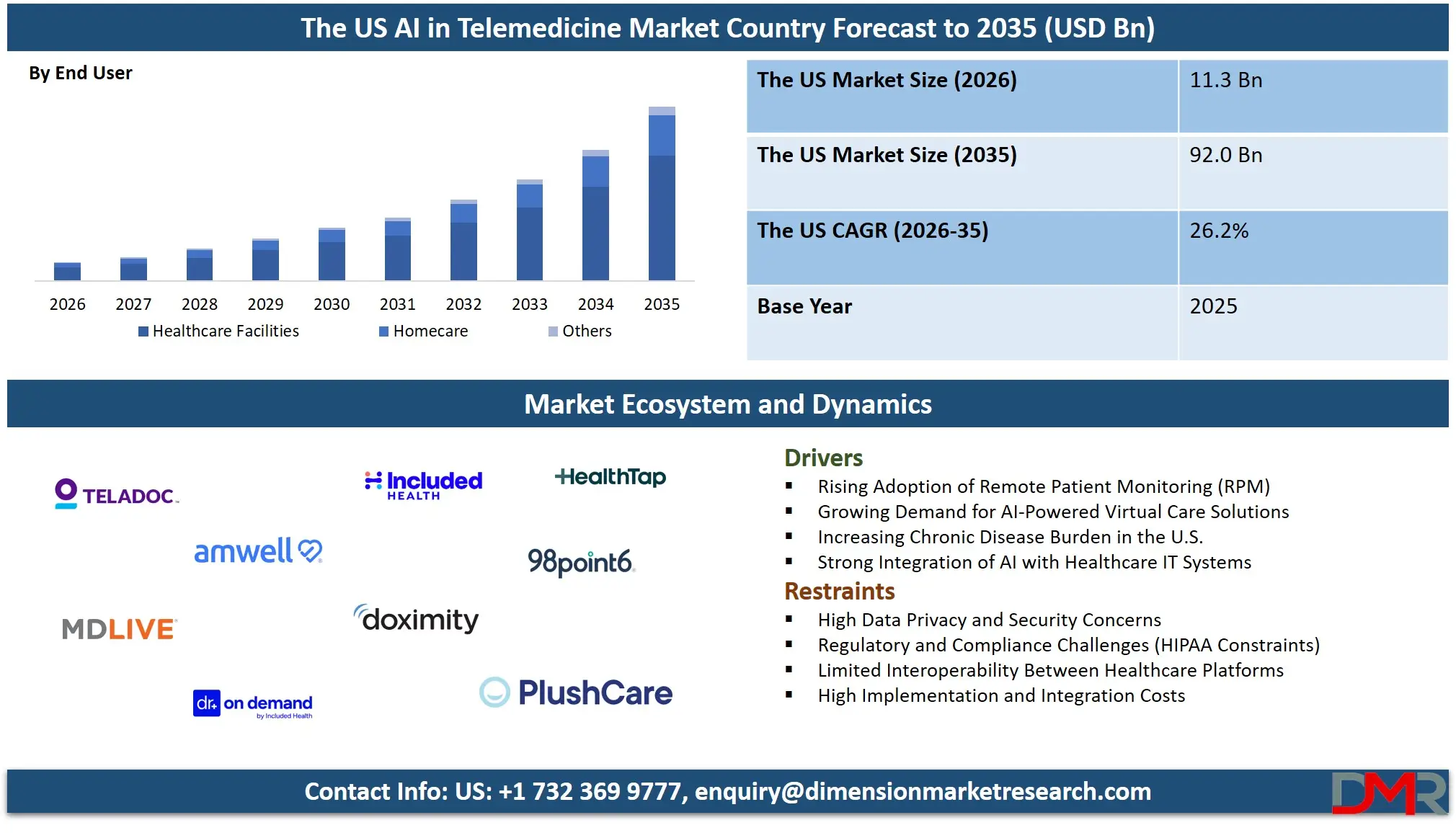
The US AI in Telemedicine Market is projected to reach USD 11.3 billion in 2026 and grow at a compound annual growth rate of 26.2%, reaching USD 92.0 billion.
ℹ
To learn more about this report –
Download Your Free Sample Report Here
The AI in telemedicine in the US market is related to the application of machine learning algorithms, natural language processing, and predictive analytics for the provision of remote medical care, clinical decision-making process, automation of patient monitoring, and diagnosis through digital channels and intelligent medical systems.
The AI in telemedicine market in the US can be described as the implementation of intelligent healthcare solutions on a large scale throughout the country owing to the highly developed digital health infrastructure, huge investment in healthcare, and rising popularity of telemedicine services, thus facilitating AI-based virtual consultations, remote patient monitoring, treatment plans based on the analysis of available data, and better results for patients.
ℹ
To learn more about this report –
Download Your Free Sample Report Here
The US AI in Telemedicine Market: Key Takeaways and Other Influencing Factors
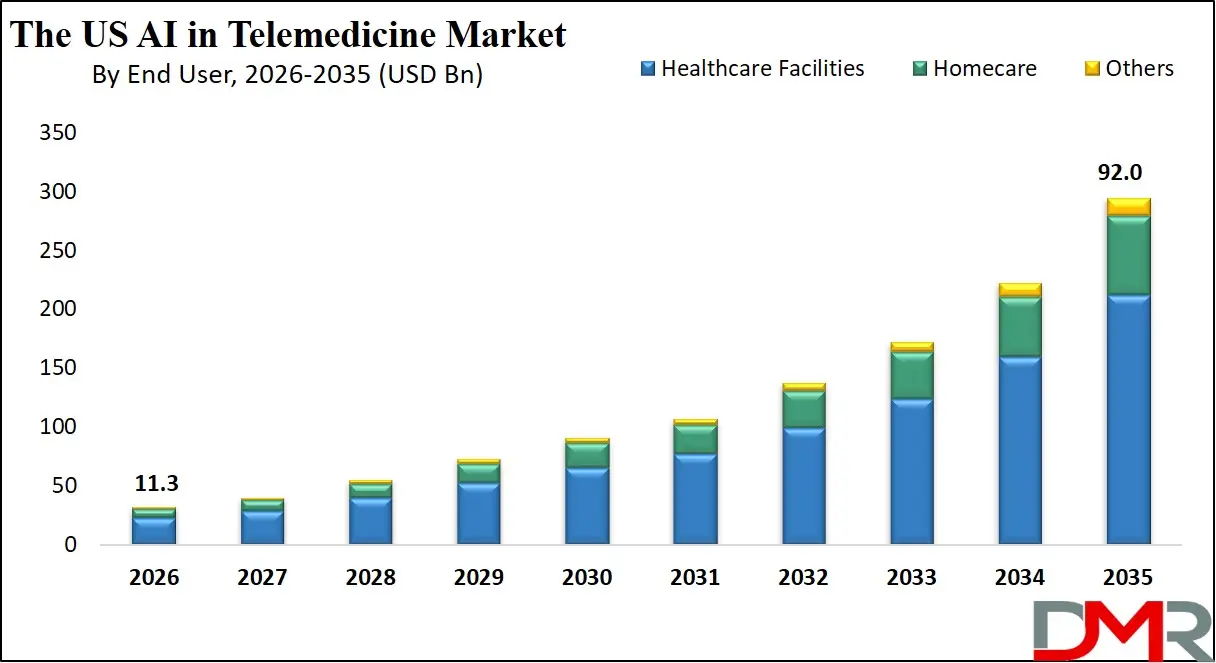
- Strong Market Expansion with High Growth Rate: The market is projected to reach USD 11.3 billion in 2026 and expand significantly to USD 92.0 billion by 2035, reflecting strong momentum driven by digital health transformation and AI integration in care delivery.
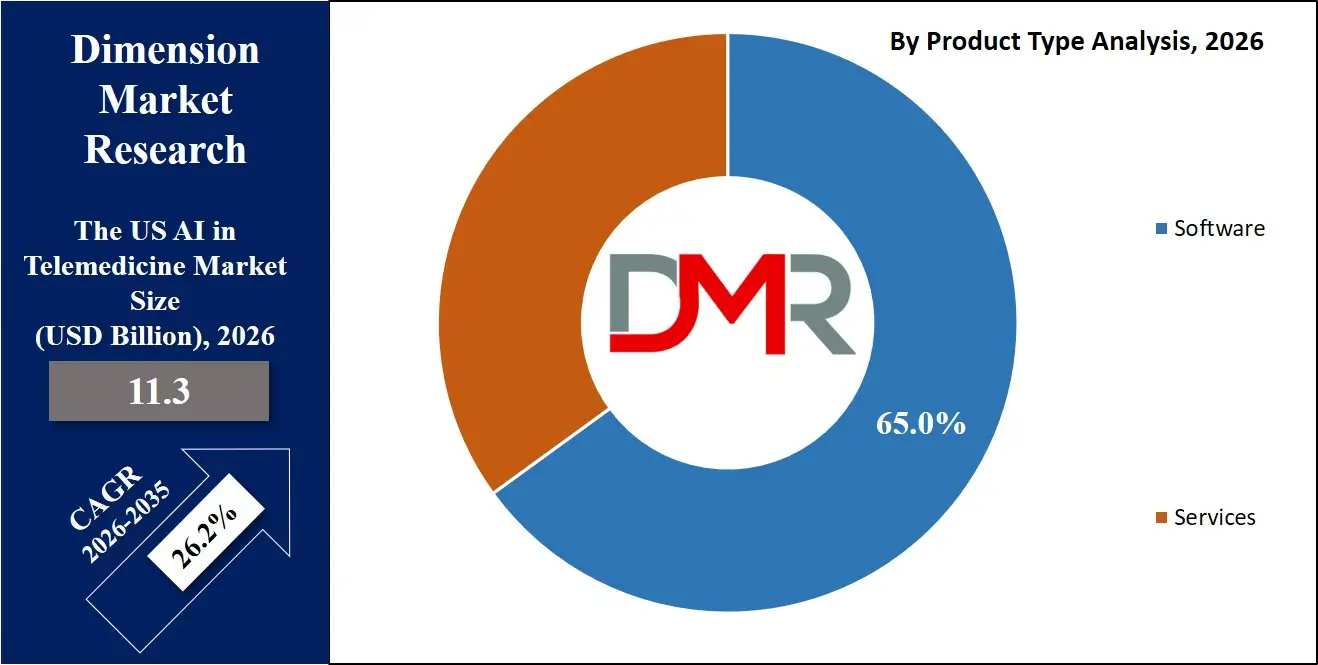
- Software Dominance across Product Segment: Software leads with 65.0% share in 2026 due to rising adoption of AI-driven platforms, predictive analytics, and clinical decision support systems across U.S. healthcare providers.
- Healthcare Facilities Leading End User Adoption: Healthcare facilities dominate with 72.0% market share in 2026, supported by large-scale deployment of AI-enabled telemedicine systems and integrated digital health infrastructure.
- Remote Monitoring Driving Application Growth: Remote monitoring and predictive analysis hold 30.0% share, fueled by increasing chronic disease burden and demand for continuous patient tracking solutions.
- CDC / NCHS – Telemedicine Adoption in the U.S.: Around 32.8% of the U.S. population used telemedicine services in 2021, highlighting strong digital health adoption trends.
- CDC / NCHS – Adult Usage Trends: About 35.3% of adults aged 18–64 used telemedicine, with higher usage among women at 41.7% compared to men.
- MEPS – Telehealth Utilization Stability: Telehealth usage remained around 12.1% of the population during 2021–2023, indicating sustained reliance on virtual care services.
The US AI in Telemedicine Market: Use Cases
- Remote Patient Monitoring for Chronic Disease Management: AI-enabled remote patient monitoring uses wearable devices and real-time data analytics to track chronic conditions, enabling early intervention and reducing hospital visits.
- AI-Driven Virtual Consultations and Decision Support: Telehealth platforms integrate AI for symptom analysis, clinical decision support, and personalized recommendations, improving diagnosis and care delivery.
- Intelligent Medical Imaging and Diagnostics: AI algorithms analyze medical imaging and diagnostic data to support early detection, faster interpretation, and improved clinical accuracy.
- Medication Adherence and Treatment Optimization: AI tools enhance medication adherence through reminders and predictive insights while enabling personalized treatment planning for better patient outcomes.
Impact of Iran Conflict on the US AI in Telemedicine Market
The Iran conflict has led to global supply chain disruptions and rising healthcare costs, impacting the deployment of AI in telemedicine solutions in the U.S. market. At the same time, increasing pressure on healthcare infrastructure is accelerating the adoption of AI-powered telehealth platforms for cost-efficient and remote care delivery. The demand for remote patient monitoring and virtual consultations is rising as providers seek to manage patient loads without overburdening hospitals. Additionally, heightened geopolitical tensions are increasing cybersecurity risks, driving greater investment in data protection and secure digital health systems in the U.S. market.
The US AI in Telemedicine Market: Market Dynamics
Driving Factors in the US AI in Telemedicine Market
Expansion of AI-Powered Remote Patient Monitoring
The growing adoption of remote patient monitoring systems supported by machine learning and real-time health analytics is driving market growth. The increasing prevalence of chronic diseases and demand for continuous patient tracking are accelerating the use of connected devices and predictive healthcare solutions in the U.S. market.
Rising Demand for Virtual Care and Digital Health Platforms
The shift toward telehealth services and virtual consultations is boosting the integration of AI-driven clinical decision support and automation tools. Healthcare providers are leveraging intelligent workflows and data-driven insights to enhance patient engagement and improve care delivery efficiency.
Restraints in the US AI in Telemedicine Market
Data Privacy and Regulatory Compliance Challenges
Strict healthcare regulations and concerns around patient data security limit the adoption of AI enabled telemedicine systems. Compliance with privacy frameworks and secure data management increases complexity and slows implementation across healthcare organizations.
High Implementation and Integration Costs
The deployment of advanced AI technologies and digital health infrastructure requires significant investment. Integration with existing healthcare IT systems and interoperability challenges act as barriers for small and mid-sized providers in the U.S. market.
Opportunities in the US AI in Telemedicine Market
Growth in Personalized and Predictive Healthcare Solutions
AI enables personalized treatment planning through advanced analytics and patient specific data insights. The increasing focus on precision medicine and outcome based care is creating new opportunities for AI driven telemedicine platforms in improving long term health outcomes.
Expansion of Home Healthcare and Aging Population Support
The rising demand for home based care and elderly patient monitoring is opening new avenues for AI powered telehealth solutions. Smart monitoring devices and virtual care models are supporting independent living and reducing hospital dependency in the U.S. market.
Trends in the US AI in Telemedicine Market
AI Integration with Wearable and IoT Medical Devices
The integration of artificial intelligence (AI) with wearable technology and IoT-based medical devices has brought revolutionary changes in remote healthcare services. Real-time analysis of patients' health has improved preventive measures and early diagnoses of health conditions.
Conversational AI and Virtual Health Assistants
Natural language processing and the usage of AI chatbots have increased among telemedicine applications. Virtual health assistants are providing better patient interactions through automated query answering systems.
The US AI in Telemedicine Market: Research Scope and Analysis
By Product Type Analysis
Software is anticipated to dominate the product type segment, capturing 65.0% of the total market share in 2026, driven by the widespread adoption of AI-powered telemedicine platforms, clinical decision support systems, predictive analytics tools, and integrated digital health solutions that enhance virtual care delivery and operational efficiency in the U.S. market.
ℹ
To learn more about this report –
Download Your Free Sample Report Here
The increasing use of machine learning, natural language processing, and cloud-based healthcare IT systems further strengthens software demand across hospitals and telehealth providers. Meanwhile, services hold a significant share as they support implementation, system integration, maintenance, and consulting for AI-enabled telemedicine solutions, helping healthcare organizations optimize performance, ensure interoperability, and maintain regulatory compliance while scaling digital care infrastructure.
By Application Analysis
Remote Monitoring and Predictive Analysis are anticipated to dominate the application segment, capturing 30.0% of the total market share in 2026 due to the increasing adoption of AI-enabled remote patient monitoring systems, real time health tracking, and predictive analytics for early risk detection and chronic disease management in the U.S. market. The rising use of connected devices and data driven healthcare insights is enabling proactive care and reducing hospital admissions. Diagnostics and Medical Imaging also hold a significant share as AI algorithms support automated image analysis, radiology interpretation, and early disease detection, improving clinical accuracy and enabling faster remote diagnosis across telemedicine platforms.
By End User Analysis
Healthcare facilities are anticipated to dominate the end user segment, capturing 72.0% of the total market share in 2026, driven by large scale adoption of AI powered telemedicine platforms, clinical decision support systems, and integrated digital health infrastructure across hospitals, clinics, and diagnostic centers in the U.S. market. These facilities leverage advanced analytics and virtual care solutions to improve patient management, workflow efficiency, and treatment outcomes. Homecare is also gaining traction with the rising demand for remote patient monitoring, elderly care, and post acute care services, where AI enabled telehealth tools and connected devices support continuous monitoring, personalized care, and reduced hospital dependency.
The US AI in Telemedicine Market Report is segmented on the basis of the following:
By Product Type
By Application
- Virtual Nursing Assistant
- Remote Monitoring & Predictive Analysis
- Diagnostics & Medical Imaging
- Medication Adherence & Treatment Plans
- Teleconsultation Enhancement
- Others
By End User
- Homecare
- Healthcare Facilities
- Others
Impact of Artificial Intelligence in the US AI in Telemedicine Market
Artificial intelligence is transforming the U.S. AI in the telemedicine market by improving clinical decision making through predictive analytics and real-time data insights. It enables faster diagnosis with AI driven medical imaging and automated analysis. Remote patient monitoring is enhanced through continuous tracking and early risk detection for chronic diseases.
Virtual consultations benefit from natural language processing and automated symptom assessment. AI also supports personalized treatment planning and better patient engagement. Additionally, it improves operational efficiency by automating workflows and reducing healthcare costs.
The US AI in Telemedicine Market: Competitive Landscape
The U.S. AI in the telemedicine market is highly competitive with the presence of established healthcare technology providers, telehealth platforms, and emerging AI startups driving innovation. Companies are focusing on advanced analytics, virtual care integration, and strategic partnerships to strengthen their market position and expand service offerings. Continuous investments in AI capabilities, interoperability, and data security are shaping the competitive dynamics in the U.S. market.
ℹ
To learn more about this report –
Download Your Free Sample Report Here
Some of the prominent players in the US AI in Telemedicine Market are:
- Teladoc Health
- Amwell
- MDLIVE
- Doctor on Demand
- Included Health
- Doximity
- HealthTap
- 98point6
- PlushCare
- Amazon Clinic
- One Medical
- Oracle Health
- Epic Systems Corporation
- Microsoft
- Google Health
- Apple Health
- IBM
- GE HealthCare
- Siemens Healthineers
- TytoCare
- Other Key Players
Recent Developments in the US AI in Telemedicine Market
- March 2026: eMed raised approximately USD 200 million in funding to advance its AI-powered healthcare platform and expand digital health services.
- February 2026: Spring Health announced the acquisition of Alma to expand its AI-driven care delivery and integrated virtual healthcare services.
- December 2025: Included Health launched an AI-powered personal health assistant to deliver personalized care guidance, automate patient interactions, and enhance virtual consultation efficiency.
Report Details
| Report Characteristics |
| Market Size (2026) |
USD 11.3 Bn |
| Forecast Value (2035) |
USD 92.0 Bn |
| CAGR (2026–2035) |
26.2% |
| Historical Data |
2021 – 2025 |
| Forecast Data |
2027 – 2035 |
| Base Year |
2025 |
| Estimate Year |
2026 |
| Report Coverage |
Market Revenue Estimation, Market Dynamics, Competitive Landscape, Growth Factors and etc. |
| Segments Covered |
By Product Type (Software and Services), By Application (Virtual Nursing Assistant, Remote Monitoring & Predictive Analysis, Diagnostics & Medical Imaging, Medication Adherence & Treatment Plans, Teleconsultation Enhancement, and Others), By End User (Homecare, Healthcare Facilities, and Others) |
| Country Coverage |
The US |
| Prominent Players |
Teladoc Health, Amwell, MDLIVE, Doctor on Demand, Included Health, Doximity, HealthTap, 98point6, PlushCare, Amazon Clinic, One Medical, Oracle Health, Epic Systems Corporation, Microsoft, Google Health, Apple Health, IBM, GE HealthCare, Siemens Healthineers, TytoCare, and Other Key Players |
| Purchase Options |
We have three licenses to opt for: Single User License (Limited to 1 user), Multi-User License (Up to 5 Users) and Corporate Use License (Unlimited User) along with free report customization equivalent to 0 analyst working days, 3 analysts working days and 5 analysts working days respectively. |