US Business Process Automation Market Snapshot
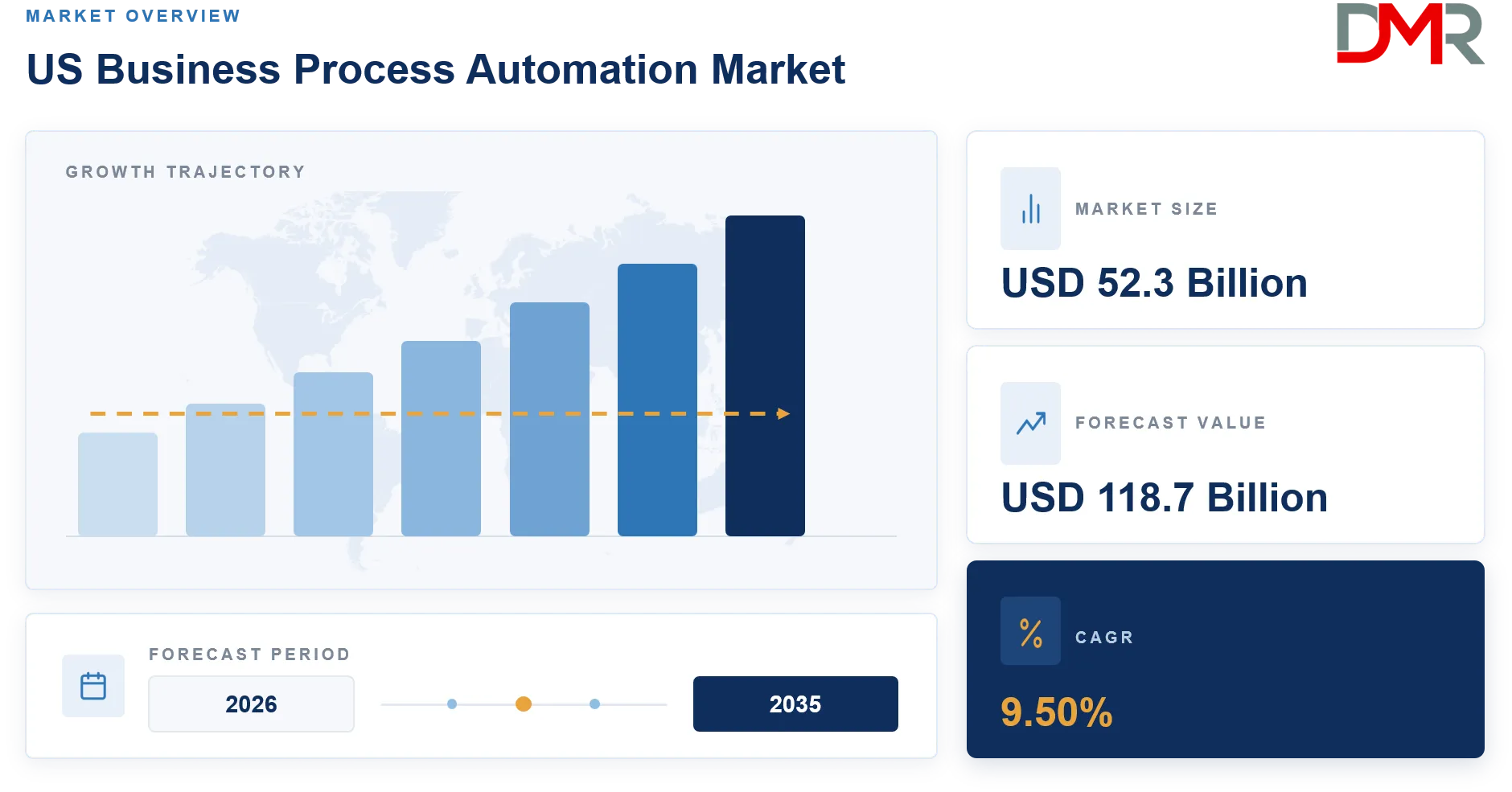
- Market Value: The US Business Process Automation Market is valued at USD 52.3 Billion in 2026 and is projected to reach USD 118.7 Billion by 2035.
- CAGR: The US Business Process Automation Market is expected to grow at a CAGR of 9.5% from 2026 to 2035.
- By System Type Analysis: Sensors and Transmitters led the system type segment with an 18.5% share in 2026.
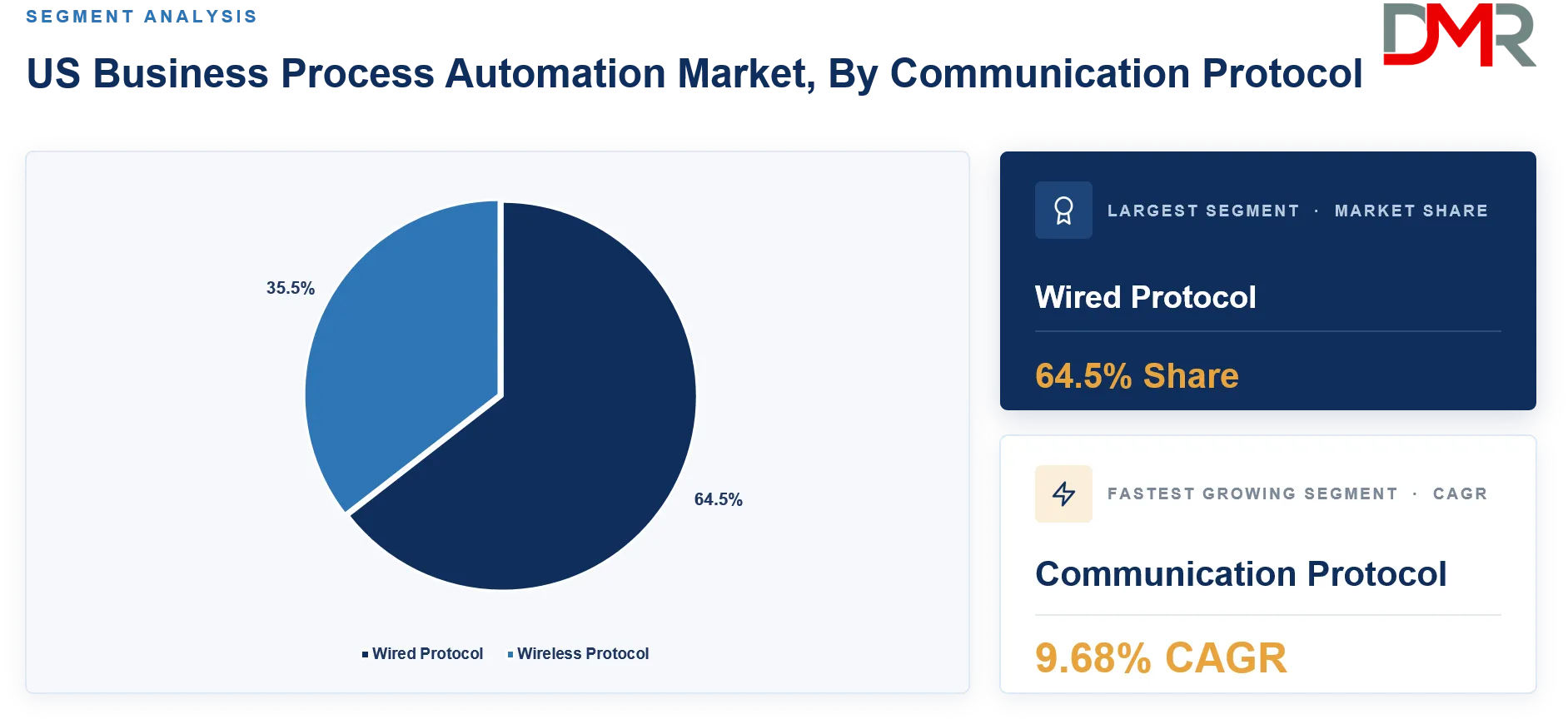
- By Communication Protocol Segment Analysis: Wired Protocol led the communication protocol segment with a 64.5% share in 2026.
- By End-User Industry Segment Analysis: Chemical and Petrochemical led the end-user industry segment with a 16.8% share in 2026.
- Major Players: Microsoft, IBM, Appian, Pegasystems, UiPath and Others.
What is the US Business Process Automation Market and its Market Size?
The US Business Process Automation Market size is projected to be valued at USD 52.3 Billion in 2026 and is expected to reach USD 118.7 Billion by 2035, expanding at a CAGR of 9.5% during the forecast period. Business process automation in the United States increasingly connects software workflows with industrial control, monitoring, data acquisition, process management, and enterprise decision systems. Companies use automation to reduce manual intervention, improve production consistency, accelerate approvals, monitor operational conditions, coordinate assets, and maintain traceability across complex workflows. Adoption is particularly important in asset-intensive industries where sensors, transmitters, manufacturing execution systems, distributed control systems, programmable logic controllers, supervisory platforms, and workflow applications create an integrated operating environment.
ℹ
To learn more about this report –
Download Your Free Sample Report Here
US Business Process Automation Market growth is being shaped by the convergence of enterprise software, industrial automation, connected equipment, cloud platforms, intelligent workflow management, process analytics, and data-driven operations. Management teams increasingly evaluate automation as an operating model rather than a stand-alone technology purchase. This shift expands demand for platforms that can connect business rules with physical processes, plant operations, maintenance activities, quality management, compliance reporting, supply chains, and customer-facing workflows. The US market outlook therefore reflects both technology modernization and the broader need for faster, more measurable, and more resilient business processes.
Use Cases
- Production Process Control: Manufacturers use sensors, transmitters, PLCs, MES platforms, SCADA systems, valves, and control technologies to automate production activities. Connected process data allows operators to monitor output, identify deviations, coordinate equipment, improve quality consistency, and reduce manual intervention across high-volume industrial operations.
- Workflow and Approval Automation: Enterprises automate purchasing, invoicing, customer onboarding, service requests, compliance approvals, employee workflows, and internal reporting. Business rules route tasks to the appropriate teams while digital records improve visibility, accountability, processing speed, and management control across departments.
- Asset Monitoring and Maintenance: Process automation platforms collect operational information from industrial assets and transmit conditions to control or management systems. Companies can identify abnormal operating patterns, coordinate preventive maintenance, improve equipment availability, manage service schedules, and reduce disruption caused by unexpected asset failures.
- Quality and Compliance Management: Chemical, pharmaceutical, food, energy, and other regulated industries automate inspection records, production parameters, audit trails, documentation, and compliance workflows. Standardized digital processes reduce data gaps, strengthen traceability, and help management teams maintain consistent operating procedures across multiple facilities.
- Energy and Resource Optimization: Energy, utilities, chemical, water treatment, and manufacturing companies use automation to coordinate motors, valves, pumps, control systems, and production equipment. Real-time monitoring helps organizations manage energy use, production efficiency, material consumption, plant throughput, and resource allocation with greater precision.
How AI/Gen AI is Transforming the US Business Process Automation Market?
Artificial intelligence is extending US business process automation beyond fixed rules toward systems that can classify information, detect patterns, prioritize actions, summarize operational conditions, and recommend workflow decisions. In traditional automation, a predefined trigger starts a predefined process. AI-enabled automation can add context by interpreting documents, analyzing equipment information, detecting abnormal patterns, and routing exceptions based on changing conditions. For industrial enterprises, this allows business workflows to connect more closely with MES, SCADA, DCS, sensor data, maintenance systems, enterprise applications, and production records. Managers gain faster access to operational signals while employees spend less time reviewing repetitive information or manually transferring data between systems.
Generative AI is also changing how employees create and manage automation. Natural-language interfaces can make workflow configuration more accessible to business users, while intelligent assistants can help summarize process activity, generate documentation, interpret exceptions, and support decision workflows. The largest value is expected where Gen AI is combined with governed enterprise data, process orchestration, human approvals, and existing automation infrastructure. This creates opportunities for Microsoft, IBM, Appian, Pegasystems, UiPath, Automation Anywhere, ServiceNow, Salesforce, SAP, Oracle, and other vendors to integrate intelligent automation into broader enterprise platforms. Governance, cybersecurity, process accuracy, human oversight, and data quality remain central requirements as organizations expand these capabilities.
Key Drivers in the US Business Process Automation Market
Rising Need for Operational Efficiency and Process Standardization
US enterprises are under continuous pressure to improve throughput while controlling labor, operating, maintenance, and administrative costs. Automation enables organizations to standardize repetitive processes, shorten cycle times, reduce manual data handling, and create measurable workflows across plants and business functions. In manufacturing, chemicals, utilities, and energy operations, connected control systems also improve coordination between equipment and management processes. These benefits are increasing demand for automation technologies that combine operational visibility with repeatable execution.
Industrial Digitalization and Connected Infrastructure Investment
Digital transformation across US industrial facilities is increasing demand for sensors, MES, DCS, SCADA, PLCs, HMI platforms, control equipment, and connected business applications. Companies want production data to move more efficiently between machines, operators, engineering teams, and management systems. Modernization programs therefore increasingly involve both operational technology and enterprise workflow automation. This integration improves production visibility, supports faster decisions, and creates a foundation for predictive maintenance, quality control, energy optimization, and automated compliance processes.
Restraints in the US Business Process Automation Market
Integration Complexity Across Legacy Systems
Many US industrial organizations operate facilities containing equipment, software, controllers, communication standards, and enterprise applications installed across different technology generations. Integrating these environments can require customized interfaces, process redesign, testing, cybersecurity controls, and specialized engineering resources. Complex integrations increase implementation costs and can lengthen project cycles. Companies may therefore prioritize high-value processes first rather than automating the entire organization, limiting the pace at which some enterprises scale business process automation across multiple plants or departments.
Cybersecurity, Governance, and Operational Risk
Greater connectivity increases the number of systems, devices, workflows, and data exchanges that organizations must secure. Industrial automation environments are especially sensitive because disruption can affect physical operations as well as information systems. Enterprises must control user privileges, remote access, network connections, automation credentials, system updates, and data movement. These requirements can raise compliance and deployment costs. Buyers increasingly evaluate automation vendors on governance, access controls, reliability, auditability, system resilience, and compatibility with established cybersecurity architectures before approving large deployments.
Growth Opportunities in the US Business Process Automation Market
Modernization of Industrial and Process Manufacturing Facilities
A major opportunity lies in upgrading US plants that still depend on fragmented control infrastructure, manual reporting, isolated equipment, and older software environments. Modern sensors, transmitters, MES, SCADA, DCS, PLC, HMI, and automation platforms can connect operational information with enterprise workflows. Chemical, pharmaceutical, food, energy, utilities, and water companies can use these investments to improve visibility, quality, asset utilization, and compliance. Vendors able to support phased modernization without disrupting existing operations are positioned to capture recurring software, integration, service, and maintenance demand.
Expansion of Cloud and Intelligent Automation Platforms
Cloud-based deployment creates an opportunity to extend automation without requiring every workflow to depend on locally managed infrastructure. Enterprises can connect distributed operations, centralize selected analytics, manage automation across multiple sites, and introduce new applications more quickly. Intelligent automation adds another layer by combining workflow orchestration with machine learning, document processing, process analytics, and generative capabilities. Suppliers that provide secure hybrid architectures can address customers that need cloud scalability while retaining local control over latency-sensitive or highly regulated industrial processes.
Trends in the US Business Process Automation Market
Convergence of Business Workflow and Industrial Automation
The US market is moving toward closer integration between enterprise workflows and operational technology. Production events can initiate maintenance requests, quality checks, inventory actions, approval processes, or compliance records without requiring separate manual steps. This convergence connects sensors, control systems, MES, business applications, and management dashboards into broader digital processes. The trend is particularly relevant for asset-intensive businesses seeking real-time visibility from plant operations through executive reporting, creating demand for interoperable software, industrial connectivity, APIs, workflow engines, and orchestration platforms.
Growing Adoption of Low-Code and Composable Automation
Automation development is becoming more accessible through low-code interfaces, reusable workflows, connectors, templates, and modular application components. Business teams can participate more actively in process design while IT departments retain control over architecture, security, data access, and governance. This approach helps companies automate departmental workflows without building every application from the ground up. Major enterprise software providers are expanding low-code, workflow, integration, robotic automation, process orchestration, and intelligent assistant capabilities, increasing competition around ease of deployment and ecosystem connectivity.
Research Scope and Analysis
The study evaluates market size, growth dynamics, competitive positioning, technology adoption, demand patterns, operational requirements, emerging opportunities, deployment models, and industry-specific automation use cases across the United States. The analysis considers both enterprise workflow automation and connected industrial process environments where digital systems coordinate information, equipment, people, approvals, control functions, and management processes.
ℹ
To learn more about this report –
Download Your Free Sample Report Here
By System Type
Sensors and Transmitters led the system type category with an 18.5% market share in 2026. The segment benefits from its foundational role in capturing temperature, pressure, flow, level, position, equipment condition, and other operational variables required for automated processes. Reliable field information allows control platforms and management systems to respond to actual operating conditions rather than manual observations. Demand is supported by plant modernization, connected assets, predictive maintenance programs, process optimization, and greater use of real-time operational data. Sensors and transmitters also support DCS, SCADA, MES, PLC, safety, and analytics environments, making them essential components within broader automation architectures. As US manufacturers expand connected operations, demand is expected to shift toward more accurate, interoperable, digitally enabled, and remotely manageable devices.
By Communication Protocol
Wired Protocol held a 64.5% share of the communication protocol segment in 2026. Wired connectivity remains important in industrial environments that require predictable communications, stable performance, controlled network architecture, and reliable connections between field devices, controllers, supervisory systems, and production infrastructure. Existing US facilities also contain large installed bases of wired automation equipment, making compatibility and modernization important purchasing considerations. Chemical plants, utilities, oil and gas facilities, food processing operations, and other continuous-process environments often prioritize communications reliability because network interruptions can affect production or safety. Wireless technologies are expanding for monitoring and difficult-to-reach assets, yet wired systems remain central to core control applications and brownfield automation upgrades.
By End-User Industry
Chemical and Petrochemical accounted for 16.8% of the US Business Process Automation Market in 2026, making it the leading end-user segment. Chemical facilities operate complex continuous and batch processes that require accurate measurement, process control, safety management, documentation, asset monitoring, and coordinated production workflows. Automation supports temperature and pressure control, material handling, formulation consistency, plant safety, maintenance planning, environmental monitoring, and quality assurance. The sector also has substantial installed infrastructure, which creates recurring demand for system replacement, instrumentation upgrades, control modernization, software integration, and cybersecurity improvements. Future opportunities are expected around connected operations, process analytics, energy efficiency, predictive maintenance, and integration between plant-level systems and enterprise decision platforms.
The US Business Process Automation Market Report is segmented on the basis of the following:
By System Type
- Sensors and Transmitters
- Manufacturing Execution System (MES)
- Electric Motors
- Distributed Control System (DCS)
- Human Machine Interface (HMI)
- Supervisory Control and Data Acquisition (SCADA)
- Valves and Actuators
- Process Safety Systems
- Programmable Logic Controller (PLC)
- Other System Types
By Communication Protocol
- Wireless Protocol
- Wired Protocol
By End-User Industry
- Pharmaceutical
- Energy and Utilities
- Paper and Pulp
- Oil and Gas
- Water and Wastewater Treatment
- Chemical and Petrochemical
- Food and Beverages
- Other End-User Industries
By Deployment Mode
Competitive Landscape
The US Business Process Automation Market has a diverse competitive structure that includes global enterprise software companies, dedicated automation platform vendors, robotic process automation specialists, business process management providers, low-code development companies, system integrators, and process orchestration suppliers. Microsoft, IBM, SAP, Oracle, Salesforce, and ServiceNow compete through broad enterprise ecosystems and integration with existing business applications.
UiPath, Automation Anywhere, and Blue Prism focus strongly on robotic and intelligent automation, while Appian, Pegasystems, Bizagi, Camunda, ProcessMaker, Nintex, Kissflow, Newgen Software, AgilePoint, and AuraQuantic compete across workflow, low-code, process management, document automation, and orchestration. Competition increasingly centers on platform interoperability, cloud deployment, process intelligence, AI-assisted automation, governance, security, integration capabilities, implementation speed, and the ability to automate end-to-end processes rather than isolated tasks. Vendors are also expanding partner ecosystems and industry-specific solutions to strengthen enterprise adoption.
Some of the prominent players in the US Business Process Automation Industry are:
- Microsoft
- IBM
- Appian
- Pegasystems (Pega)
- UiPath
- Automation Anywhere
- Blue Prism (SS&C)
- ServiceNow
- Salesforce
- SAP
- Oracle
- Nintex
- Bizagi
- Camunda
- Kissflow
- ProcessMaker
- AgilePoint
- Genpact
- Newgen Software
- AuraQuantic
- Others
Technology Analysis
The US Business Process Automation Market is evolving through the integration of industrial control systems, workflow platforms, cloud infrastructure, process intelligence, low-code tools, and intelligent automation. Sensors and transmitters form a critical data layer by capturing pressure, temperature, flow, level, and equipment conditions, while PLC, DCS, SCADA, HMI, and MES technologies convert this information into controlled operational actions. At the enterprise level, workflow orchestration, RPA, process mining, document processing, APIs, and AI-assisted tools connect plant and business processes. Cloud-based platforms are gaining relevance for centralized management and faster deployment, while on-premise and hybrid architectures remain important for latency-sensitive and regulated operations. Vendors including Microsoft, IBM, UiPath, Appian, Pegasystems, ServiceNow, SAP, and Automation Anywhere are strengthening integrated automation capabilities, increasing demand for interoperable, secure, scalable, and data-driven process environments.
Investment and White Space Analysis
Investment opportunities in the US Business Process Automation Market are expanding as enterprises replace fragmented workflows and aging industrial infrastructure with connected automation environments. With the market projected to rise from USD 52.3 Billion in 2026 to USD 118.7 Billion by 2035, white space is emerging around brownfield plant modernization, cloud-based process orchestration, industrial cybersecurity, predictive maintenance, process intelligence, and AI-assisted workflow management. Chemical and petrochemical companies offer a notable opportunity because the industry held a 16.8% market share in 2026 and depends heavily on continuous monitoring, safety, quality, and asset reliability. Additional investment potential exists in pharmaceuticals, water and wastewater treatment, energy and utilities, food processing, and manufacturing operations with complex legacy systems. Suppliers that can connect sensors, MES, SCADA, DCS, enterprise applications, and intelligent workflows without requiring full infrastructure replacement can address a valuable gap between legacy automation and fully connected operations.
Recent Developments
- June 2026: IBM launched Cloud Pak for Business Automation 26.0, embedding generative AI and agentic automation with Model Context Protocol support to orchestrate AI agents across workflows, cases, and tasks for US enterprises.
- April 2025: UiPath introduced its enterprise-grade agentic automation platform in the US, unifying AI agents, robots, and humans on a single intelligent system to scale complex workflow automation.
- January 2025: ServiceNow unveiled AI Agent Orchestrator and AI Agent Studio in the US, enabling centralized coordination and custom creation of thousands of prebuilt AI agents for IT, HR, and customer service workflows.
Report Details
| Report Characteristics |
| Market Size (2026) |
USD 52.3 Billion |
| Forecast Value (2035) |
USD 118.7 Billion |
| CAGR (2026–2035) |
9.5% |
| Historical Data |
2021 – 2025 |
| Forecast Data |
2027 – 2035 |
| Base Year |
2025 |
| Estimate Year |
2026 |
| Segments Covered |
By System Type (Sensors and Transmitters, Manufacturing Execution System (MES), Electric Motors, Distributed Control System (DCS), Human Machine Interface (HMI), Supervisory Control and Data Acquisition (SCADA), Valves and Actuators, Process Safety Systems, Programmable Logic Controller (PLC), and Other System Types), By Communication Protocol (Wireless Protocol, and Wired Protocol), By End-User Industry (Pharmaceutical, Energy and Utilities, Paper and Pulp, Oil and Gas, Water and Wastewater Treatment, Chemical and Petrochemical, Food and Beverages, and Other End-User Industries), By Deployment Mode (Cloud-based, and On-premise) |
| Regional Coverage |
United States |
Frequently Asked Questions
What is the current size of the US Business Process Automation Market?
▾ The US Business Process Automation Market size is valued at USD 52.3 Billion in 2026 and is forecast to reach USD 118.7 Billion by 2035.
What is the growth rate of the US Business Process Automation Market during?
▾ The US Business Process Automation Market is expected to grow at a CAGR of 9.5% during the forecast period from 2026 to 2035.
What factors are driving the growth of the US Business Process Automation Market?
▾ Industrial digitalization, workflow automation, plant modernization, cloud adoption, and demand for efficiency drive US Business Process Automation Market growth.
What are the major challenges restraining the US Business Process Automation Market?
▾ Legacy system integration, cybersecurity risks, high implementation costs, and governance needs restrain US Business Process Automation Market growth.
Which segment holds the largest share of the US Business Process Automation Market?
▾ Sensors and Transmitters lead the US Business Process Automation Market system type segment with an 18.5% revenue share in 2026.
Who are the leading companies in the global US Business Process Automation Market?
▾ Microsoft, IBM, Appian, Pegasystems, UiPath, Automation Anywhere, Blue Prism (SS&C), ServiceNow, Salesforce, SAP, Oracle, Nintex, Bizagi, Camunda, Kissflow, ProcessMaker, AgilePoint, Genpact, Newgen Software, and AuraQuantic are prominent companies in the US Business Process Automation Market.
How is AI influencing the US Business Process Automation Market?
▾ AI is advancing the US Business Process Automation Market through intelligent workflows, process analytics, document processing, and decision support.
What are the future opportunities and trends in the US Business Process Automation Market?
▾ Cloud automation, low-code tools, process intelligence, predictive maintenance, and plant modernization create US Business Process Automation Market opportunities.