US Intelligent Building Automation Technologies Market Snapshot
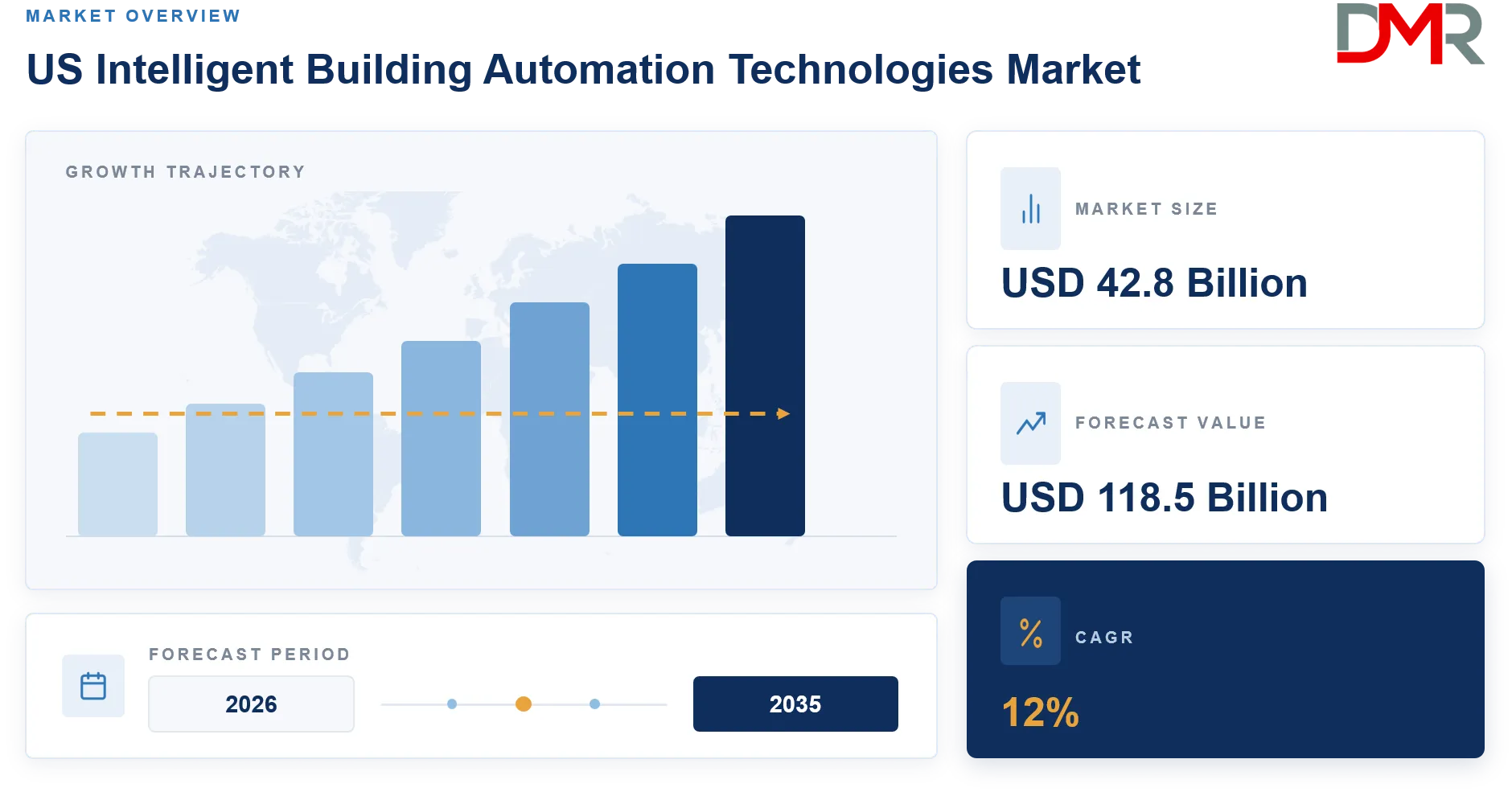
- Market Value: US Intelligent Building Automation Technologies market is valued at USD 42.8 billion in 2026 and is projected to reach USD 118.5 billion by 2035.
- CAGR: US Intelligent Building Automation Technologies market is expected to grow at a CAGR of 12.0% from 2026 to 2035.
- By Offering Analysis: Solutions segment dominated the market with a 71.5% share in 2026.
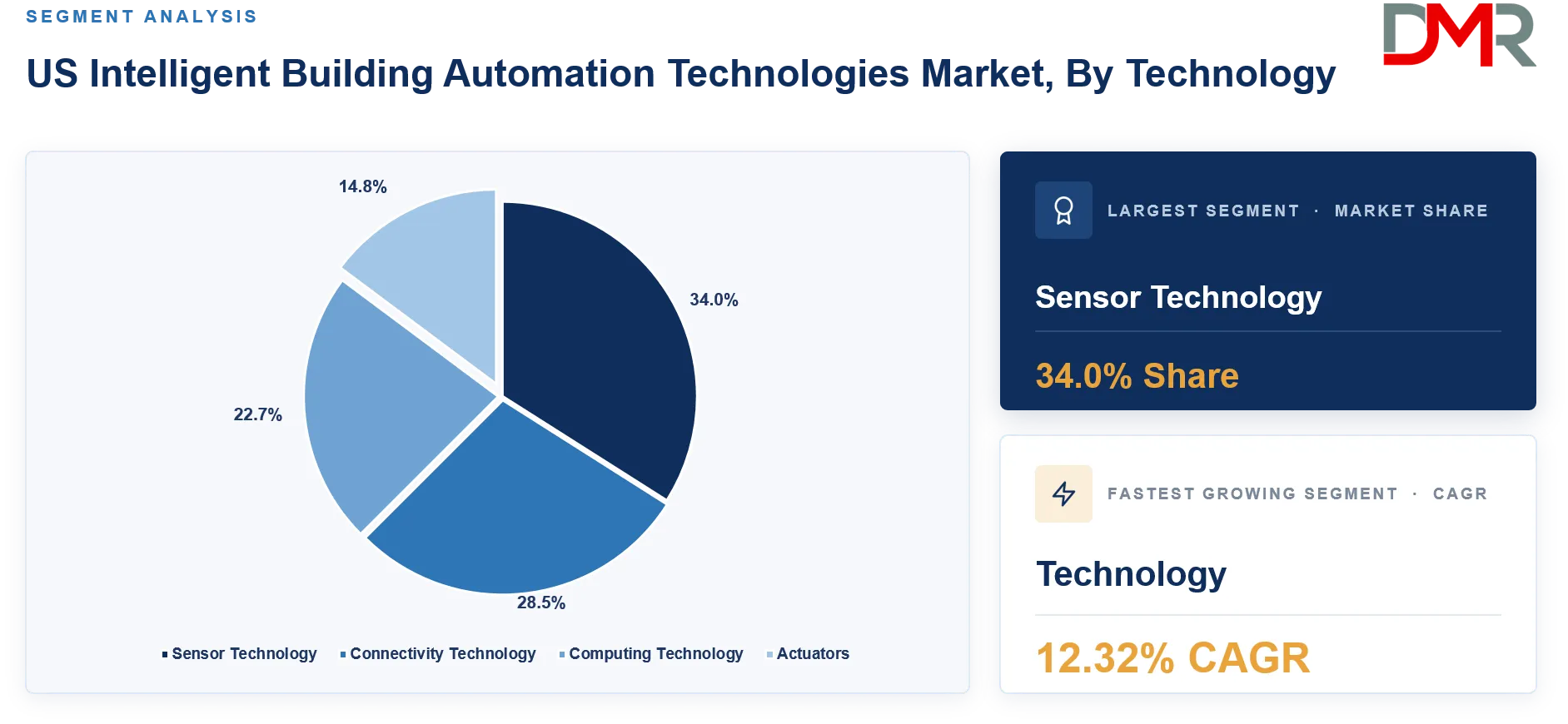
- By Technology Analysis: Sensor Technology segment led the market with a 34.0% share in 2026.
- By End-Use Industry Analysis: Commercial segment held a 48.0% share in 2026.
- Major Players: Honeywell International Inc, Johnson Controls International plc, Siemens AG, and Others.
What is the US Intelligent Building Automation Technologies Market and its Market Size?
The US Intelligent Building Automation Technologies Market size is projected to be valued at USD 42.8 billion in 2026 and reach USD 118.5 billion by 2035, expanding at a CAGR of 12.0% during the forecast period. Intelligent building automation combines sensors, controllers, connectivity infrastructure, software, analytics, actuators, and integrated management platforms to monitor and control building functions. These technologies connect HVAC, lighting, power, access control, fire protection, equipment monitoring, and facility operations through centralized or distributed digital architectures.
ℹ
To learn more about this report –
Download Your Free Sample Report Here
The US intelligent building automation technologies market growth is increasingly linked to measurable operating outcomes rather than standalone automation. Building owners are seeking systems that can reduce HVAC energy consumption, automate scheduling, identify equipment faults, track occupancy, improve indoor environmental quality, and support portfolio-wide facility management. The US Department of Energy has reported that successful high-performance building controls can reduce commercial HVAC energy use by approximately 30%, strengthening the financial case for advanced controls in offices, healthcare facilities, universities, retail assets, hotels, data centers, government properties, and other energy-intensive buildings.
Use Cases
- Energy Optimization: Intelligent automation continuously monitors HVAC, lighting, electrical loads, occupancy, weather conditions, schedules, and energy consumption. Facility teams can adjust operating parameters based on actual building demand, reduce avoidable runtime, manage peak loads, and identify inefficient equipment across single buildings and large property portfolios.
- Predictive Facility Management: Connected sensors and building analytics allow maintenance teams to detect abnormal temperatures, pressure changes, equipment cycling, vibration patterns, airflow problems, and other operating anomalies. Earlier identification of faults supports condition-based maintenance and can reduce emergency repairs, equipment downtime, and unnecessary technician visits.
- Smart HVAC Control: Building automation platforms coordinate temperature, ventilation, variable air volume equipment, chillers, boilers, air handlers, and heat pumps. Occupancy-based scheduling and advanced control sequences help operators match heating and cooling output with real demand while maintaining comfort and indoor air quality requirements.
- Security and Access Management: Intelligent buildings integrate access control, alarms, credentials, occupancy data, surveillance interfaces, and building operating systems. Centralized monitoring provides facility and security teams with improved visibility across entrances, restricted areas, offices, campuses, and mission-critical facilities while supporting faster incident response.
- Portfolio Operations: Cloud-connected building platforms enable organizations with distributed real estate portfolios to compare energy use, equipment health, alarms, comfort conditions, and operating performance across multiple properties. This approach is particularly relevant for retail chains, corporate offices, universities, healthcare networks, public facilities, and multi-site commercial operators.
How AI/Gen AI is Transforming the US Intelligent Building Automation Technologies Market?
AI is shifting intelligent building automation from rule-based operation toward predictive and adaptive control. Traditional building systems generally respond to fixed schedules, thresholds, and operator commands. New platforms can combine sensor readings, historical equipment data, occupancy patterns, weather inputs, utility information, and operating conditions to detect deviations and recommend corrective actions. Applications include automated fault detection, HVAC optimization, predictive maintenance, occupancy forecasting, energy-use analysis, equipment benchmarking, and anomaly identification. These capabilities can help facility teams focus on high-value maintenance events instead of manually reviewing thousands of building-system data points.
Generative AI is also creating a new interaction layer between building data and facility personnel. Instead of navigating multiple dashboards, operators can increasingly query operating information through natural-language interfaces, summarize alarms, investigate recurring faults, generate maintenance recommendations, and compare asset performance. The larger opportunity is the combination of AI with connected sensors, semantic building models, digital twins, and open integration architectures. Adoption will depend on data quality, cybersecurity, interoperability, explainability, and the ability to prevent automated recommendations from compromising safety-critical building functions. Human oversight therefore remains important for HVAC, fire, access, electrical, and other operational technology environments.
Key Drivers in the US Intelligent Building Automation Technologies Market
Growing Pressure to Reduce Building Operating and Energy Costs
Energy and operating expenses are becoming major investment criteria for US building owners. Intelligent controls can optimize HVAC schedules, ventilation, lighting, equipment runtime, and peak demand using real-time building conditions instead of fixed operating assumptions. The US Department of Energy estimates that successful high-performance controls can reduce commercial HVAC energy use by around 30%. This creates a measurable business case for automation upgrades in offices, hospitals, campuses, retail properties, hotels, and other large facilities where HVAC represents a major operating cost.
Modernization of Aging Building Infrastructure
A large portion of the US building stock contains legacy controllers, isolated HVAC systems, proprietary networks, and equipment installed at different points in a property's lifecycle. Owners increasingly need to connect these assets to modern building management platforms without replacing every mechanical system. Retrofit-friendly controllers, gateways, wireless sensors, cloud software, BACnet-based integration, analytics, and phased modernization programs are expanding the addressable market. This creates recurring demand for solutions, engineering, commissioning, software upgrades, cybersecurity assessment, and lifecycle services.
Restraints in the US Intelligent Building Automation Technologies Market
High Integration Costs and Complex Retrofit Requirements
Building automation projects can require substantial upfront spending on controllers, sensors, software, networking, engineering, installation, commissioning, and system integration. Retrofit projects are particularly complex when buildings contain equipment from multiple vendors or older proprietary systems. Business cases can also differ by building size, energy profile, lease structure, and remaining asset life. These factors can slow adoption among smaller commercial properties where capital budgets are limited and the financial return from comprehensive automation may take longer to demonstrate.
Cybersecurity Risk Across Connected Building Systems
Greater connectivity expands the cybersecurity exposure of building automation and control systems. HVAC, lighting, access control, fire systems, meters, cloud platforms, remote service connections, and corporate networks can create interconnected attack surfaces. NIST identifies building automation as operational technology and emphasizes security controls that reflect its reliability and safety requirements. Building owners must therefore invest in network segmentation, access management, device inventories, secure remote connectivity, patching, monitoring, and governance, adding complexity to intelligent building deployments.
Growth Opportunities in the US Intelligent Building Automation Technologies Market
Automation Expansion Across Small and Mid-Sized Buildings
Small and mid-sized commercial properties represent a major expansion opportunity because sophisticated building automation has historically been concentrated in larger facilities. Lower-cost wireless sensing, packaged controllers, cloud-hosted building management, remote monitoring, and simplified installation can improve the economics of automation for smaller offices, restaurants, retail properties, schools, clinics, and multifamily assets. Vendors that reduce engineering effort and offer repeatable configurations can address customers that previously found enterprise-class building automation too expensive or technically complex.
Grid-Interactive and Electrified Building Operations
Building controls are becoming increasingly important as facilities add electric HVAC, battery storage, distributed generation, electric vehicle charging, and flexible loads. Intelligent automation can coordinate when equipment operates and how a facility responds to electricity prices, demand conditions, weather, occupancy, and grid signals. This creates opportunities for building energy management platforms that combine HVAC control with power monitoring and load flexibility. Commercial and government properties are particularly attractive because operators can manage multiple energy-consuming systems through coordinated control strategies.
Trends in the US Intelligent Building Automation Technologies Market
Shift Toward Open and Interoperable Building Platforms
Interoperability is becoming a central purchasing criterion as customers seek to avoid isolated building systems and rigid proprietary architectures. Modern platforms increasingly integrate HVAC, meters, lighting, security, sensors, analytics, and third-party applications using BACnet, IP networking, APIs, gateways, and standardized data models. The US Department of Energy is supporting semantic modeling and interoperable control initiatives intended to reduce the manual configuration required for building controls. This trend favors vendors able to combine installed hardware with open software ecosystems.
Cloud-Based Monitoring and Portfolio-Level Analytics
Building management is moving beyond local control rooms toward cloud-connected environments that allow centralized visibility across multiple sites. Portfolio operators can compare alarms, energy consumption, equipment performance, comfort conditions, and maintenance priorities without maintaining separate analytical systems at every property. Carrier, Schneider Electric, Honeywell, Johnson Controls, Siemens, and other suppliers are developing connected building platforms that combine automation with remote services and analytics. The transition expands recurring software and service revenue alongside traditional controllers and field equipment.
Research Scope and Analysis
The US Intelligent Building Automation Technologies Market is segmented based on Offering, Technology, End Use, and other relevant categories. The study evaluates individual segments and sub-segments based on technology adoption, purchasing priorities, building applications, operating requirements, retrofit activity, digital infrastructure, energy-management needs, and their contribution to overall US intelligent building automation market growth.
ℹ
To learn more about this report –
Download Your Free Sample Report Here
By Offering
The Solutions segment dominated the US Intelligent Building Automation Technologies market with a 71.5% share in 2026. Its leadership is supported by demand for integrated energy management, facility management, asset management, security and access control, fire detection, and other intelligent building applications. Building owners increasingly prefer platforms that consolidate operating information rather than maintaining independent systems for each function. Solutions also capture spending across controllers, management software, analytics, monitoring interfaces, integration capabilities, and connected devices. As commercial organizations modernize existing facilities, scalable building platforms provide a practical way to combine legacy equipment with newer digital services. Future growth will increasingly depend on open architectures, cybersecurity, cloud connectivity, remote monitoring, and the ability to produce measurable energy and operating benefits.
By Technology
Sensor Technology held the leading position with a 34.0% share in 2026, reflecting the central role of real-time data in intelligent building operation. Temperature, humidity, occupancy, carbon dioxide, light, pressure, air-quality, equipment-status, motion, electrical, and environmental sensors provide the inputs required for automated decision-making. More granular sensing allows building systems to respond to actual conditions rather than static schedules. Wireless technologies also reduce installation complexity in retrofit environments where new cabling can be disruptive or expensive. Sensor data increasingly supports HVAC optimization, demand-controlled ventilation, space utilization, energy analytics, fault detection, security monitoring, and predictive maintenance. Continued improvements in connected devices, edge processing, battery performance, communications, and analytics are expected to sustain sensor demand across commercial and institutional buildings.
By End-Use Industry
The Commercial segment accounted for a 48.0% share of the US market in 2026. Offices, retail properties, hotels, healthcare facilities, educational campuses, data centers, warehouses, and other commercial properties contain significant HVAC, lighting, power, security, and facility-management loads that can benefit from coordinated automation. Commercial owners also manage measurable operating expenses, making energy savings and maintenance productivity important investment factors. Large portfolios can gain additional value from centralized monitoring and standardized building operating strategies across multiple sites. Smart sensors, analytics, cloud-based management, occupancy controls, automated fault detection, and connected HVAC systems are therefore becoming important elements of commercial real estate modernization programs.
The US Intelligent Building Automation Technologies Market Report is segmented on the basis of the following:
By Offering
- Services
- Solutions
- Energy Management
- Asset Management
- Facility Management
- Security & Access Control
- Fire Detection & Prevention
- Other Solutions
By Technology
- Computing Technology
- Connectivity Technology
- Sensor Technology
- Actuators
By End Use
- Commercial
- Residential
- Public & Government Buildings
- Industrial
- Transportation Infrastructure
Competitive Landscape
The US Intelligent Building Automation Technologies market features multinational building technology groups, HVAC manufacturers, electrical automation specialists, controls companies, lighting providers, and software-focused smart-building firms. Honeywell International Inc, Johnson Controls International plc, Siemens AG, Schneider Electric SE, Carrier Global Corporation, and Trane Technologies plc compete through broad portfolios covering controllers, building management platforms, HVAC optimization, sensors, analytics, security, energy management, and digital services.
ABB, Emerson Electric, Rockwell Automation, Mitsubishi Electric, Eaton, Bosch, Delta Controls, KMC Controls, and Distech Controls strengthen competition across automation hardware and integration. Newer specialists such as 75F and Verdigris Technologies focus on cloud analytics, energy intelligence, connected controls, and data-driven operations. Competitive differentiation is moving toward interoperability, cybersecurity, cloud deployment, recurring software services, predictive maintenance, scalable retrofits, and measurable customer outcomes rather than basic equipment control alone.
Some of the prominent players in the US Intelligent Building Automation Technologies Industry are:
- Honeywell International Inc
- Johnson Controls International plc
- Siemens AG
- Schneider Electric SE
- Carrier Global Corporation
- Trane Technologies plc
- ABB Ltd
- Emerson Electric Co
- Rockwell Automation Inc
- Delta Controls Inc
- Lutron Electronics Co
- Robert Bosch GmbH
- Mitsubishi Electric Corporation
- Eaton Corporation plc
- Azbil Corporation
- Current Lighting Solutions LLC
- Verdigris Technologies Inc
- 75F
- KMC Controls Inc
- Distech Controls
- Others
Technology Analysis
The US Intelligent Building Automation Technologies market is advancing through the convergence of sensor technology, computing platforms, connectivity technologies, actuators, cloud-based building management, and data analytics. Sensor technology held a 34.0% market share in 2026 as building operators increased the use of occupancy, temperature, humidity, air-quality, pressure, motion, and equipment-condition sensors. BACnet, IP-based networks, wireless connectivity, APIs, and edge computing are helping connect previously isolated HVAC, lighting, security, energy, and facility systems.
Cloud platforms further enable centralized monitoring across multi-building portfolios, while advanced analytics support fault detection, predictive maintenance, energy optimization, and equipment benchmarking. The next phase of technology growth will focus on interoperable architectures, secure remote access, digital twins, automated control sequences, and systems capable of converting real-time building data into measurable energy, maintenance, comfort, and operational improvements.
Regulatory Landscape
The US Intelligent Building Automation Technologies market is influenced by federal efficiency programs, state and local building energy codes, cybersecurity guidance, and technical standards governing building controls and connected equipment. ASHRAE Standard 90.1 establishes important energy-efficiency requirements for commercial buildings, while state codes can create additional demand for advanced HVAC, lighting, scheduling, and control functions. California Title 24 is particularly influential in driving sophisticated building controls and energy-management practices.
ASHRAE Guideline 36 also supports standardized high-performance HVAC control sequences that can improve efficiency and operational consistency. As building automation becomes more connected, NIST guidance for operational technology cybersecurity is increasingly relevant to BMS and BACS deployments. Vendors must therefore address energy performance alongside secure access, network segmentation, system interoperability, commissioning, data governance, and lifecycle management as regulatory and technical expectations evolve.
Recent Developments
- August 2026: Johnson Controls International plc unveiled AI-native expansions to its OpenBlue platform, introducing Energy & Comfort Intelligence and an agentic AI assistant that reduce onboarding time by up to 95% and enable autonomous building operations across US commercial facilities.
- July 2026: Carrier Global Corporation acquired Minneapolis-based 75F, a cloud-native, wireless, AI-enabled building automation firm, to integrate its generative AI and auto-commissioning capabilities into Carrier's QuantumLeap suite for US data centers and commercial buildings.
- March 2026: ABB Ltd launched ABB Ability™ BuildingPro Suites, a modular software platform unifying building automation, HVAC, energy, and IoT systems into a single cybersecure environment for US building owners and system integrators.
Report Details
| Report Characteristics |
| Market Size (2026) |
USD 42.8 Bn |
| Forecast Value (2035) |
USD 118.5 Bn |
| CAGR (2026–2035) |
12.0% |
| Historical Data |
2021 – 2025 |
| Forecast Data |
2027 – 2035 |
| Base Year |
2025 |
| Estimate Year |
2026 |
| Segments Covered |
By Offering (Services, Solutions {Energy Management, Asset Management, Facility Management, Security & Access Control, Fire Detection & Prevention, and Other Solutions}), By Technology (Computing Technology, Connectivity Technology, Sensor Technology, and Actuators), By End Use (Commercial, Residential, Public & Government Buildings, Industrial, and Transportation Infrastructure) |
| Regional Coverage |
United States |
Frequently Asked Questions
What is the current size of the US Intelligent Building Automation Technologies Market?
▾ The US Intelligent Building Automation Technologies Market size is USD 42.8 billion in 2026 and USD 118.5 billion by 2035.
What is the growth rate of the US Intelligent Building Automation Technologies Market during?
▾ The US Intelligent Building Automation Technologies Market is expected to grow at a 12.0% CAGR during 2026-2035.
What factors are driving the growth of the US Intelligent Building Automation Technologies Market?
▾ Energy efficiency, smart building upgrades, connected HVAC, sensors, and automation drive the US market growth.
What are the major challenges restraining the US Intelligent Building Automation Technologies Market?
▾ High retrofit costs, system integration complexity, cybersecurity risks, and legacy systems restrain market growth.
Which segment holds the largest share of the US Intelligent Building Automation Technologies Market?
▾ Solutions hold the largest US Intelligent Building Automation Technologies Market share, accounting for 71.5% in 2026.
Who are the leading companies in the US Intelligent Building Automation Technologies Market?
▾ Honeywell International Inc, Johnson Controls International plc, Siemens AG, Schneider Electric SE, Carrier Global Corporation, Trane Technologies plc, ABB Ltd, Emerson Electric Co, Rockwell Automation Inc, Delta Controls Inc, Lutron Electronics Co, Robert Bosch GmbH, Mitsubishi Electric Corporation, Eaton Corporation plc, Azbil Corporation, Current Lighting Solutions LLC, Verdigris Technologies Inc, 75F, KMC Controls Inc, and Distech Controls are leading companies in the market.
How is AI influencing the US Intelligent Building Automation Technologies Market?
▾ AI supports predictive maintenance, energy optimization, fault detection, and smart controls across US building systems.
What are the future opportunities and trends in the US Intelligent Building Automation Technologies Market?
▾ Cloud controls, smart sensors, building analytics, electrification, and interoperable platforms offer future opportunities.