Market Snapshot
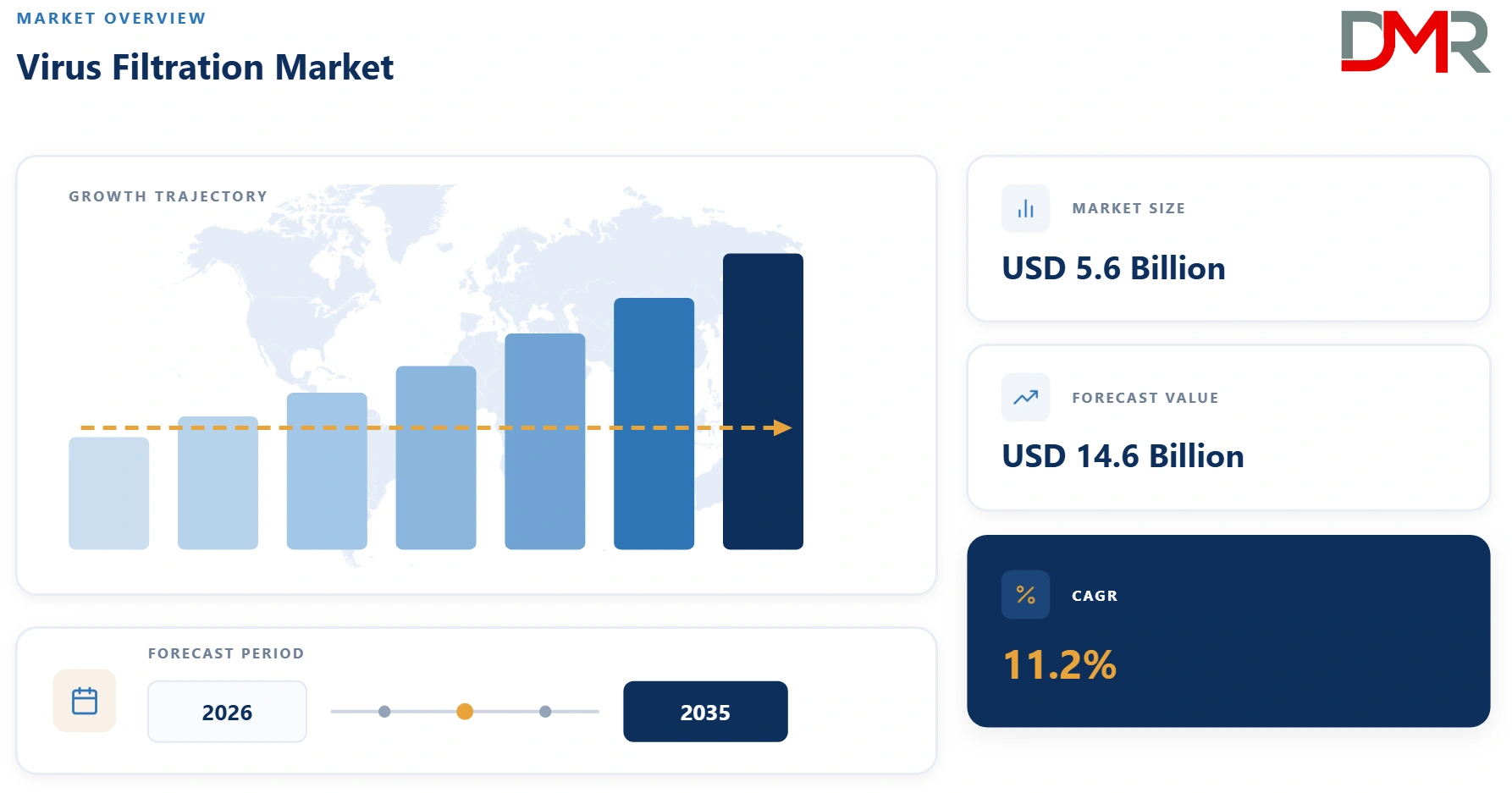
- Market Size (2026): USD 5.6 Bn
- Forecast Value (2035): USD 14.6 Bn
- CAGR (2026-2035): 11.2%
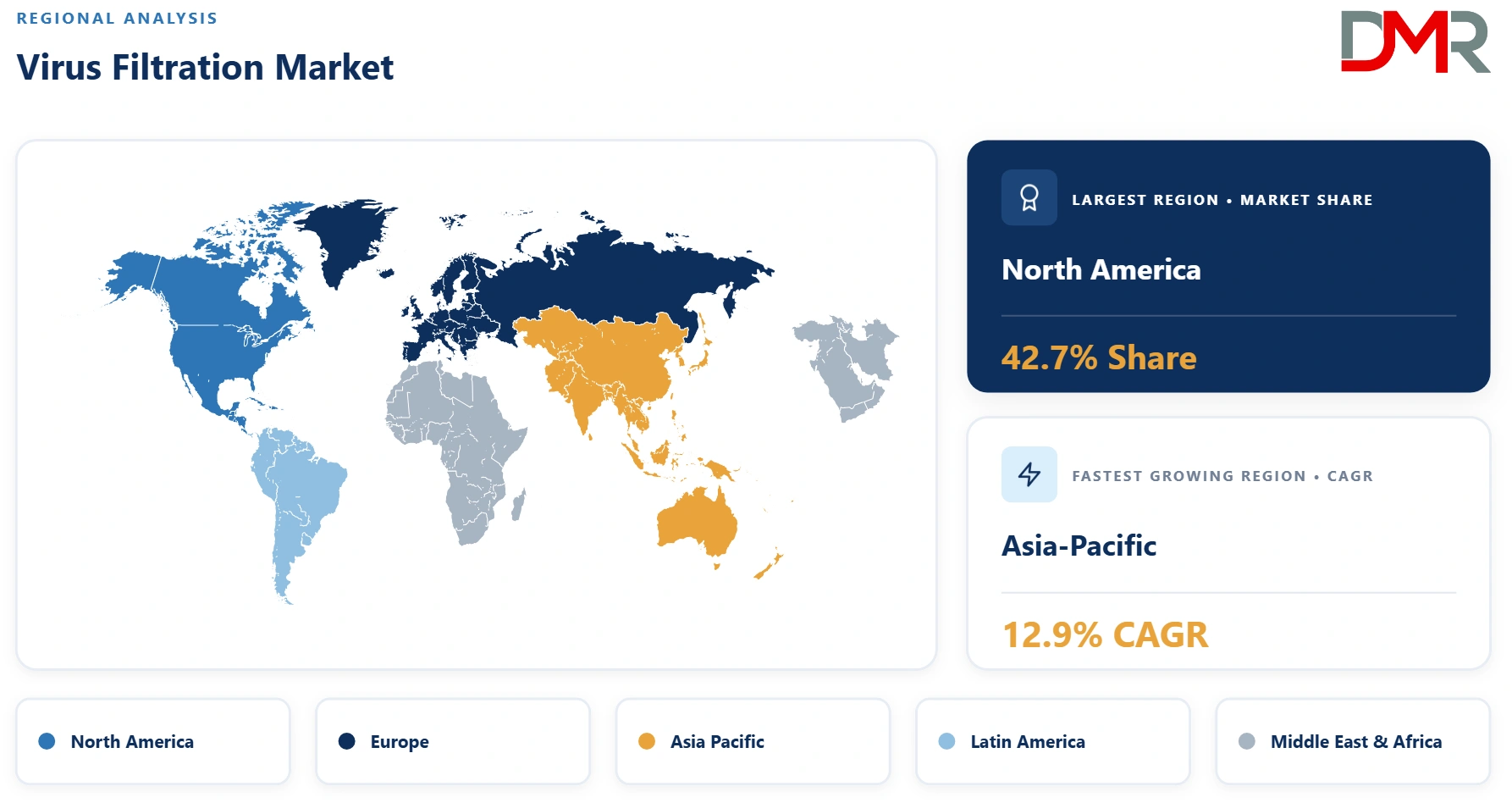
- Largest Region (2026): North America, approximately 42.7%
- Fastest-Growing Region: Asia-Pacific
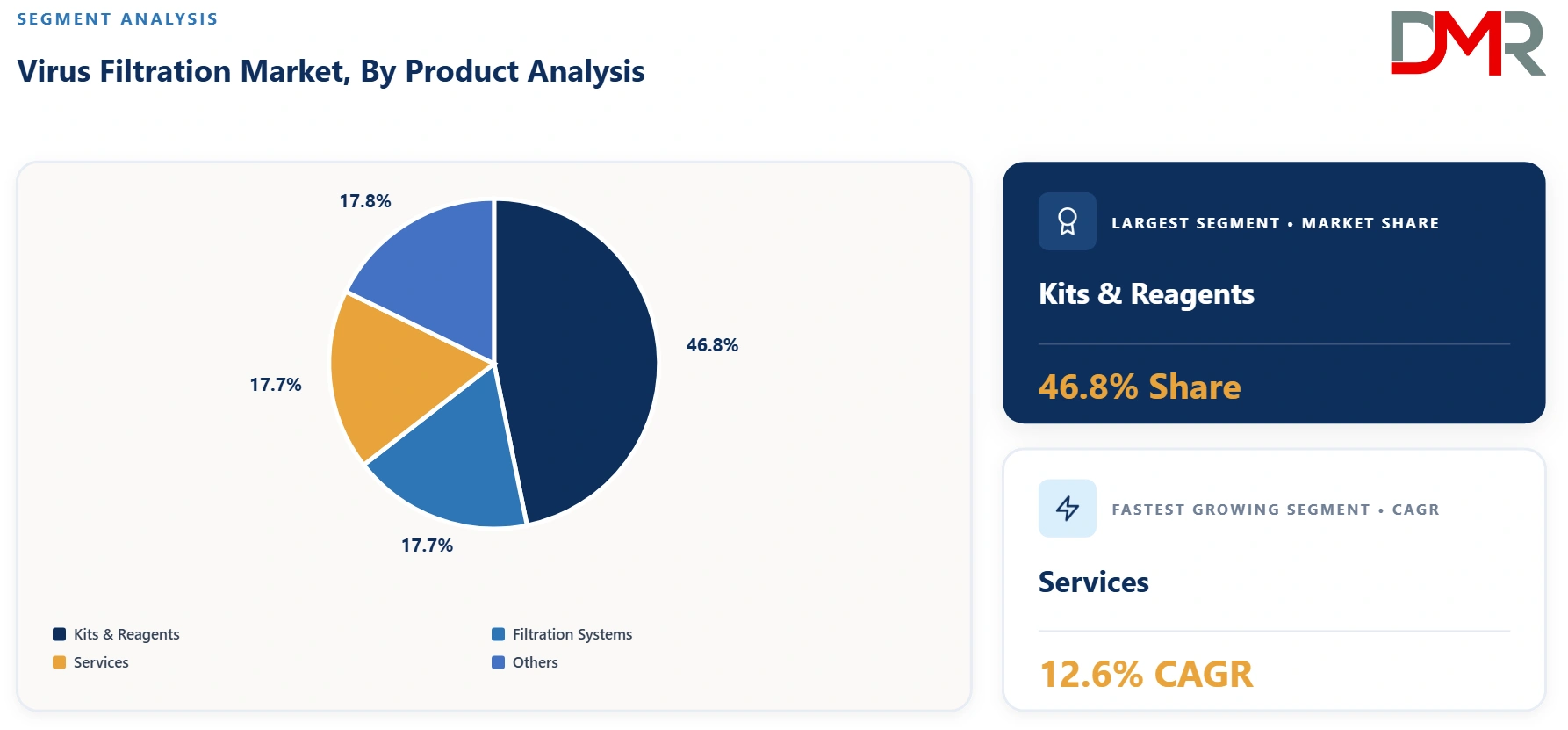
- Leading Product (2026): Kits & Reagents, around 46.8%
- Leading Technology (2026): Filtration, close to 51.6%
- Key Players: Merck KGaA, Danaher Corporation, Sartorius AG, and Others
What is Virus Filtration Market and its Market Size?
Global Virus Filtration Market size is estimated to reach USD 5.6 Bn in 2026 and is further anticipated to reach USD 14.6 Bn by 2035, at a CAGR of 11.2%.
ℹ
To learn more about this report –
Download Your Free Sample Report Here
Virus filtration covers products, systems, validation services, and associated processing technologies used to remove or reduce viral contaminants from biological products, process streams, water, air, and selected medical manufacturing environments. Within biopharmaceutical production, the market is centered on virus-retentive membrane filtration, depth filtration support, chromatography-based clearance, and process validation activities integrated into downstream purification.
Demand is closely linked to expanding production of monoclonal antibodies, recombinant proteins, vaccines, plasma-derived products, cell and gene therapies, and other biologics that require documented viral safety. Manufacturers select virus filtration technologies according to molecule size, process fluid characteristics, target log reduction values, throughput, scalability, filter capacity, and compatibility with single-use processing architectures.
Procurement decisions increasingly emphasize validated performance, low protein binding, high product recovery, process consistency, integrity testing, and supplier documentation. Large biopharmaceutical producers typically qualify multiple filtration steps as part of an overall viral clearance strategy, while emerging biotechnology companies often rely on platform processes, contract development and manufacturing organizations, and standardized disposable assemblies to shorten development timelines.
Structural market expansion is supported by growth in biologics pipelines, rising biosimilar output, investment in biomanufacturing capacity, stricter viral safety expectations, and wider adoption of single-use systems. Suppliers are responding with higher-capacity membranes, preconfigured assemblies, automated integrity testing, and technical services that support scale-up from development to commercial manufacturing.
Use Cases
- Monoclonal Antibody Manufacturing: Biopharmaceutical plants deploy virus-retentive filters during downstream purification to reduce viral contamination risk while preserving antibody recovery. Validated filtration steps support regulatory submissions, batch consistency, and commercial scale production by delivering defined viral clearance performance under controlled pressure, flow, and process conditions.
- Vaccine and Recombinant Protein Production: Vaccine and protein manufacturers integrate filtration with chromatography and other clearance operations to control adventitious agents. The approach supports purification of complex biological streams, improves process safety, and provides documented viral reduction evidence across development, clinical manufacturing, and commercial production.
- Plasma-Derived Therapeutics: Plasma processors use nanofiltration and complementary virus reduction steps for immunoglobulins, coagulation factors, and related products. Small-pore membranes can retain viruses while allowing therapeutic proteins to pass, helping manufacturers strengthen viral safety assurance without materially changing product quality attributes.
- CDMO Bioprocessing Platforms: Contract manufacturers use standardized virus filtration platforms to serve multiple client molecules and production scales. Prequalified filters, single-use assemblies, and validation packages reduce changeover complexity, support technology transfer, and allow faster execution of downstream processing programs for emerging biotechnology sponsors.
Key Takeaways
- Market Size & Share: The market is estimated at USD 5.6 Bn in 2026, with North America accounting for approximately 42.7% of revenue.
- Product Analysis: Services are projected to be the fastest-growing product category at a forecast CAGR of 12.6% from 2026 to 2035.
- Technology Analysis: Filtration is estimated to lead technology demand with approximately 51.6% of 2026 revenue.
- Regional Analysis: North America leads at around 42.7%, while Asia-Pacific is projected to expand at approximately 12.9% CAGR.
- Commercial Catalyst: Biological applications account for an estimated 58.4% of demand as biologics manufacturing capacity expands.
- Competitive Dynamics: The market combines diversified life-science suppliers with specialized filtration and viral safety service providers, creating competition around validation depth, throughput, and process integration.
How AI/Gen AI is Transforming the Virus Filtration Market?
AI is increasingly supporting virus filtration process development by analyzing pressure, flux, conductivity, turbidity, protein concentration, and filter loading data across development runs. Predictive models can help process engineers identify operating windows associated with membrane fouling, capacity loss, or reduced product recovery. In larger manufacturing networks, data-driven monitoring can also support deviation investigation, filter lifecycle assessment, and comparison of performance across sites and molecule platforms.
Gen AI is emerging primarily as a knowledge and workflow layer rather than as a direct filtration mechanism. It can organize validation protocols, summarize historical process deviations, assist technical teams in retrieving filter compatibility information, and accelerate preparation of controlled documentation. Adoption remains governed by data integrity, validation, cybersecurity, and human review requirements, particularly where AI-supported outputs influence GMP decisions or regulatory records.
- Predictive Filter Capacity Modeling: Machine learning can estimate loading limits and fouling risk from historical process and membrane performance data.
- Deviation Investigation Support: AI tools can correlate batch records, sensor trends, and prior events to help technical teams identify likely process causes.
- Validation Knowledge Retrieval: Gen AI can organize protocols, reports, and supplier documentation for faster technical review while retaining controlled human approval.
- Process Monitoring: Multivariate analytics can flag abnormal pressure, flux, or throughput behavior before filtration performance moves outside established operating ranges.
Key Drivers in the Global Virus Filtration Market
Expansion of Biologics and Advanced Therapy Manufacturing
Growth in monoclonal antibodies, recombinant proteins, vaccines, plasma products, and advanced therapies is increasing the number of manufacturing processes that require documented viral safety. Each new biologic program creates demand for virus-retentive membranes, prefilters, validation studies, integrity testing, and technical support. The shift toward higher titers and more concentrated process streams also raises filtration performance requirements, encouraging adoption of membranes with greater capacity and improved resistance to fouling. As manufacturers expand commercial facilities and add modular or single-use production lines, virus filtration becomes a repeat procurement category tied directly to batch throughput, regulatory compliance, and downstream process economics.
Stricter Viral Safety and Quality Expectations
Regulators and manufacturers require biologic processes to demonstrate appropriate control of adventitious and endogenous viral risks through complementary clearance steps. This strengthens demand for validated filtration technologies with documented retention performance, extractables data, integrity testing methods, and scale-up support. Suppliers that provide application-specific validation services gain an advantage because customers must establish process-specific evidence rather than rely only on generic membrane claims. Increasing scrutiny of raw materials, cell substrates, process intermediates, and contamination control strategies also broadens the commercial value of virus filtration beyond a standalone consumable, positioning it as part of an integrated quality and risk-management framework.
Restraints in the Global Virus Filtration Market
High Validation Cost and Process-Specific Qualification Requirements
Virus filtration is a high-consequence unit operation, so manufacturers must qualify filters under representative process conditions and document viral retention, product recovery, integrity, and robustness. These studies can be costly, time intensive, and dependent on specialized laboratories, particularly when live or model virus testing is required. Smaller biotechnology companies may face budget pressure during early clinical development, while established manufacturers can incur substantial revalidation costs when changing membranes, suppliers, process parameters, or manufacturing sites. The resulting switching burden can slow adoption of newer technologies even when they offer better throughput or lower operating costs.
Membrane Fouling and Throughput Limitations
Complex biological feeds can contain aggregates, host-cell proteins, lipids, nucleic acids, and other impurities that reduce virus filter capacity. Fouling increases processing time, filter area requirements, and consumable cost, especially for high-concentration biologics or difficult plasma-derived streams. Manufacturers often need optimized prefiltration, dilution, or intermediate purification to protect the virus filter, adding process steps and development work. Performance can also vary by molecule and formulation, limiting the ability to apply a single platform universally. These technical constraints sustain demand for innovation but can restrict productivity gains and complicate scale-up.
Growth Opportunities in the Global Virus Filtration Market
High-Capacity Single-Use Virus Filtration Platforms
Single-use biomanufacturing is creating demand for virus filtration assemblies that arrive preconfigured, gamma-compatible, scalable, and easier to integrate into closed processing trains. Suppliers can capture additional value by combining high-capacity membranes with tubing, connectors, sensors, integrity testing, and automated control modules. Platform designs that cover development through commercial scale reduce technology transfer effort and simplify facility changeover. Opportunity is particularly strong among multiproduct plants and CDMOs, where rapid campaign switching and reduced cleaning validation are commercially important. Vendors that demonstrate consistent retention performance while increasing throughput can help customers reduce filter area and total processing time.
Biomanufacturing Capacity Expansion in Asia-Pacific
Investment in biologics, vaccines, biosimilars, and contract manufacturing across China, India, South Korea, Singapore, and other Asia-Pacific markets is expanding the installed base of downstream processing equipment. New facilities require virus filtration consumables, systems, validation support, and local technical service. Regional manufacturers are also strengthening compliance with international quality expectations to support exports, increasing demand for documented viral clearance strategies. Global suppliers can expand through local application laboratories, distribution partnerships, and technical training, while regional membrane companies have opportunities to compete on cost, lead time, and localized support.
Trends in the Global Virus Filtration Market
Integration of Prefiltration with Virus-Retentive Membranes
Manufacturers are increasingly treating virus filtration as an integrated clarification and protection sequence rather than an isolated membrane step. Optimized prefilters remove aggregates and process impurities before the virus-retentive membrane, improving capacity and reducing premature fouling. Suppliers are developing matched filter trains and application guidance for specific molecule classes, enabling customers to establish more predictable throughput. This trend supports bundled consumable sales and encourages process development around total filtration economics, including filter area, processing time, product recovery, hold-up volume, and operator handling.
Shift Toward Platform Validation and Standardized Processing
Biopharmaceutical companies and CDMOs are building platform downstream processes that reuse qualified virus filtration approaches across related molecules. Standardization can reduce development time, simplify operator training, and improve comparability across manufacturing sites. Suppliers are responding with scalable membrane formats, standardized holders, single-use flow paths, and validation packages designed to support platform adoption. Although process-specific confirmation remains necessary, greater standardization helps organizations manage growing pipelines and multiple client programs without redesigning viral clearance strategies from the beginning for every project.
Research Scope and Analysis
The market is analyzed by product, technology, application, and end user, with demand shaped by biologics output, viral safety requirements, filtration performance, validation intensity, and regional biomanufacturing investment.
ℹ
To learn more about this report –
Download Your Free Sample Report Here
By Product
Kits & Reagents is estimated to lead the product segment with around 46.8% of 2026 revenue, supported by its established role in viral safety workflows, recurring procurement requirements, and compatibility with regulated bioprocessing environments. Customers prioritize validated performance, reliable supply, and technical support when selecting solutions within this category. Growth, however, is concentrated in Services, which is projected to expand at a CAGR of 12.6% between 2026 and 2035. Expansion is supported by increasing process complexity, greater outsourcing, rising demand for scalable downstream platforms, and the need to improve throughput while maintaining documented viral clearance performance.
By Technology
Filtration is estimated to lead the technology segment with around 51.6% of 2026 revenue, supported by its established role in viral safety workflows, recurring procurement requirements, and compatibility with regulated bioprocessing environments. Customers prioritize validated performance, reliable supply, and technical support when selecting solutions within this category. Growth, however, is concentrated in Nanofiltration, which is projected to expand at a CAGR of 13.1% between 2026 and 2035. Expansion is supported by increasing process complexity, greater outsourcing, rising demand for scalable downstream platforms, and the need to improve throughput while maintaining documented viral clearance performance.
By Application
Biologicals is estimated to lead the application segment with around 58.4% of 2026 revenue, supported by its established role in viral safety workflows, recurring procurement requirements, and compatibility with regulated bioprocessing environments. Customers prioritize validated performance, reliable supply, and technical support when selecting solutions within this category. Growth, however, is concentrated in Biologicals, which is projected to expand at a CAGR of 11.8% between 2026 and 2035. Expansion is supported by increasing process complexity, greater outsourcing, rising demand for scalable downstream platforms, and the need to improve throughput while maintaining documented viral clearance performance.
By End User
Pharmaceutical & Biotechnology Companies is estimated to lead the end user segment with around 67.2% of 2026 revenue, supported by its established role in viral safety workflows, recurring procurement requirements, and compatibility with regulated bioprocessing environments. Customers prioritize validated performance, reliable supply, and technical support when selecting solutions within this category. Growth, however, is concentrated in Contract Research Organizations, which is projected to expand at a CAGR of 12.4% between 2026 and 2035. Expansion is supported by increasing process complexity, greater outsourcing, rising demand for scalable downstream platforms, and the need to improve throughput while maintaining documented viral clearance performance.
The Global Virus Filtration Market Report is Segmented Based on the Following
By Product
- Kits & Reagents
- Filtration Systems
- Services
- Others
By Technology
- Filtration
- Chromatography
- Nanofiltration
- Others
By Application
- Biologicals
- Medical Devices
- Water Purification
- Air Purification
- Others
By End User
- Pharmaceutical & Biotechnology Companies
- Contract Research Organizations
- Academic & Research Institutes
- Medical Device Companies
- Others
Regional Analysis
Global demand is concentrated in established biopharmaceutical manufacturing hubs, while new biologics and biosimilar capacity is shifting incremental growth toward Asia-Pacific.
Region with the Largest Revenue Share
North America is estimated to account for approximately 42.7% of global virus filtration revenue in 2026. The region benefits from a large installed base of biologics manufacturing facilities, strong monoclonal antibody and advanced therapy pipelines, extensive CDMO capacity, and high spending on process validation and quality systems. The United States is the principal contributor, supported by commercial-scale biopharmaceutical production and continuous investment in domestic manufacturing capacity. Demand also reflects frequent replacement of filtration consumables and the use of specialized viral clearance services during process development, comparability exercises, and regulatory submissions.
ℹ
To learn more about this report –
Download Your Free Sample Report Here
Region with the Highest CAGR
Asia-Pacific is projected to record the highest regional CAGR of approximately 12.9% from 2026 to 2035. Growth is supported by expanding biosimilar, vaccine, recombinant protein, and contract manufacturing capacity in China, India, South Korea, and Singapore. Governments and private investors are funding new bioprocessing infrastructure, while regional manufacturers are strengthening quality systems to serve export markets. This creates demand for virus-retentive membranes, single-use filtration assemblies, validation studies, and local technical support. Supplier localization and shorter lead times are likely to become increasingly important competitive factors.
By Region
- North America: The US, Canada
- Europe: Germany, France, The UK, Italy, Spain, Rest of Europe
- Asia-Pacific: China, Japan, India, Australia, South Korea, Rest of APAC
- Latin America: Mexico, Brazil, Colombia, Argentina, Rest of LATAM
- Middle East & Africa: Saudi Arabia, The UAE, South Africa, Rest of MEA
Regulatory Landscape
Virus filtration is embedded within broader viral safety expectations for biological products, where manufacturers establish complementary process steps and provide evidence that manufacturing controls can reduce relevant viral risks. Regulatory submissions commonly depend on process characterization, filter integrity testing, representative viral clearance studies, change control, and documented linkage between development and commercial conditions. Suppliers therefore compete not only on membrane performance but also on validation documentation, extractables and leachables information, scalability, technical support, and consistency of manufacturing. Changes in filter materials, suppliers, operating parameters, or production sites can trigger additional comparability and qualification work, increasing the value of stable product platforms and long-term supply assurance.
Technology Analysis
Virus filtration technology is progressing toward higher membrane capacity, lower hold-up volume, improved protein recovery, and stronger integration with single-use processing. Nanofiltration remains important where small-pore retention is required, while prefiltration and optimized feed conditioning are used to protect final virus-retentive membranes from fouling. System development increasingly combines disposable flow paths, pressure monitoring, automated control, and integrity testing to improve repeatability. Suppliers are also refining membrane chemistry and module geometry to handle concentrated biologics and reduce required filter area. Technology differentiation is therefore shifting from nominal pore size alone toward total process performance, including throughput, scalability, robustness, documentation, and compatibility with closed manufacturing architectures.
Competitive Landscape
The virus filtration market includes diversified life-science suppliers, membrane specialists, bioprocess equipment companies, and viral safety service providers. Competition centers on virus retention performance, filter capacity, product recovery, scalability, validation support, single-use compatibility, supply reliability, and application expertise. Large suppliers benefit from broad downstream processing portfolios that allow them to bundle prefiltration, chromatography, virus filtration, fluid management, and process analytics. Specialists compete through membrane innovation, customized assemblies, and technical responsiveness. Strategic activity increasingly focuses on capacity expansion, portfolio integration, regional manufacturing, and partnerships with biopharmaceutical producers and CDMOs. Customer qualification requirements create meaningful switching costs, favoring suppliers with established process histories and dependable long-term product availability.
Some of the Prominent Players in the Global Virus Filtration Market Are:
- Merck KGaA
- Danaher Corporation
- Sartorius AG
- Thermo Fisher Scientific Inc.
- Pall Corporation
- GE HealthCare Technologies Inc.
- Asahi Kasei Corporation
- Charles River Laboratories International, Inc.
- Lonza Group AG
- WuXi Biologics
- Clean Cells
- Texcell
- Virongy Biosciences
- BioReliance Corporation
- Meissner Filtration Products, Inc.
- Repligen Corporation
- Cobetter Filtration Equipment Co., Ltd.
- Saint-Gobain Life Sciences
- Parker Hannifin Corporation
- 3M Company
- Donaldson Company, Inc.
- Porvair Filtration Group
- Amazon Filters Ltd.
- Eaton Corporation plc
- Alfa Laval AB
- Koch Separation Solutions
- Graver Technologies, LLC
- Hangzhou Anow Microfiltration Co., Ltd.
- GVS S.p.A.
- Advantec MFS, Inc.
- Sterlitech Corporation
- Cole-Parmer Instrument Company, LLC
- Agilitech
- ABEC, Inc.
- Tofflon Science and Technology Co., Ltd.
- Shanghai Duoning Biotechnology Co., Ltd.
- Cytiva
- Avantor, Inc.
- Corning Incorporated
- Other Key Players
Recent Developments
- In 2026, leading bioprocess suppliers continued expanding single-use downstream portfolios, including filtration assemblies designed to support scalable biologics manufacturing and closed processing.
- In 2025, major filtration vendors increased emphasis on high-capacity membrane formats and application support intended to reduce filter area and improve throughput for concentrated biologic process streams.
- In 2025, biopharmaceutical manufacturers and CDMOs continued adding biologics production capacity across North America, Europe, and Asia-Pacific, expanding the installed demand base for virus filtration consumables and validation services.
- In 2024, suppliers strengthened integrated downstream processing offerings by combining prefiltration, virus-retentive filtration, fluid management, and single-use components into more standardized process platforms.
Report Details
| Report Characteristics |
| Market Size (2026) |
USD 5.6 Bn |
| Forecast Value (2035) |
USD 14.6 Bn |
| CAGR (2026–2035) |
11.2% |
| The US Market Size (2026) |
USD 2.0 Bn |
| Historical Data |
2021 – 2025 |
| Forecast Data |
2026 – 2035 |
| Base Year |
2025 |
| Segments Covered |
By Product, By Technology, By Application, By End User |
| Regional Coverage |
North America, Europe, Asia-Pacific, Latin America, Middle East & Africa |
Frequently Asked Questions
How big is the Global Virus Filtration Market?
▾ Global Virus Filtration Market size is estimated to reach USD 5.6 Bn in 2026 and is projected to reach USD 14.6 Bn by 2035, growing at a CAGR of 11.2%.
What is the growth rate of the Global Virus Filtration Market?
▾ The market is expanding at an estimated CAGR of 11.2% from 2026 to 2035, supported by biologics production, viral safety requirements, and wider use of single-use downstream processing.
Which region holds the largest share in the Global Virus Filtration Market?
▾ North America leads the market, holding approximately 42.7% of global revenue in 2026, supported by extensive biopharmaceutical manufacturing and viral clearance validation activity.
Who are the key players in the Global Virus Filtration Market?
▾ Prominent operating companies include Merck KGaA, Danaher Corporation, Sartorius AG, and Thermo Fisher Scientific Inc., alongside specialized filtration and viral safety service providers.
Which segment is leading the Global Virus Filtration Market?
▾ The Kits & Reagents product segment commands the highest share, accounting for roughly 46.8% in 2026, driven by recurring consumable demand across regulated bioprocessing workflows.
Which segment is expanding fastest in the Global Virus Filtration Market?
▾ The Services product segment is projected to record the highest growth, registering a CAGR of 12.6% through 2035 as process validation and outsourced viral clearance testing expand.
What are the major growth drivers in the Global Virus Filtration Market?
▾ Market expansion is primarily propelled by rising biologics and advanced therapy manufacturing, stricter viral safety expectations, expanding CDMO capacity, and adoption of high-capacity single-use downstream filtration platforms.