Market Snapshot
- Market Size (2026): USD 2.8 Bn
- Forecast Value (2035): USD 14.1 Bn
- CAGR (2026-2035): 19.7%
- Largest Region (2026): North America, approximately 43%
- Fastest-Growing Region: Asia-Pacific
- Leading Offering (2026): Software, around 62%
- Leading Deployment (2026): Cloud, close to 48%
- Key Players: Oracle Health, Microsoft, Epic Systems and others
What is AI Powered Clinical Decision Support Market and its Market Size?
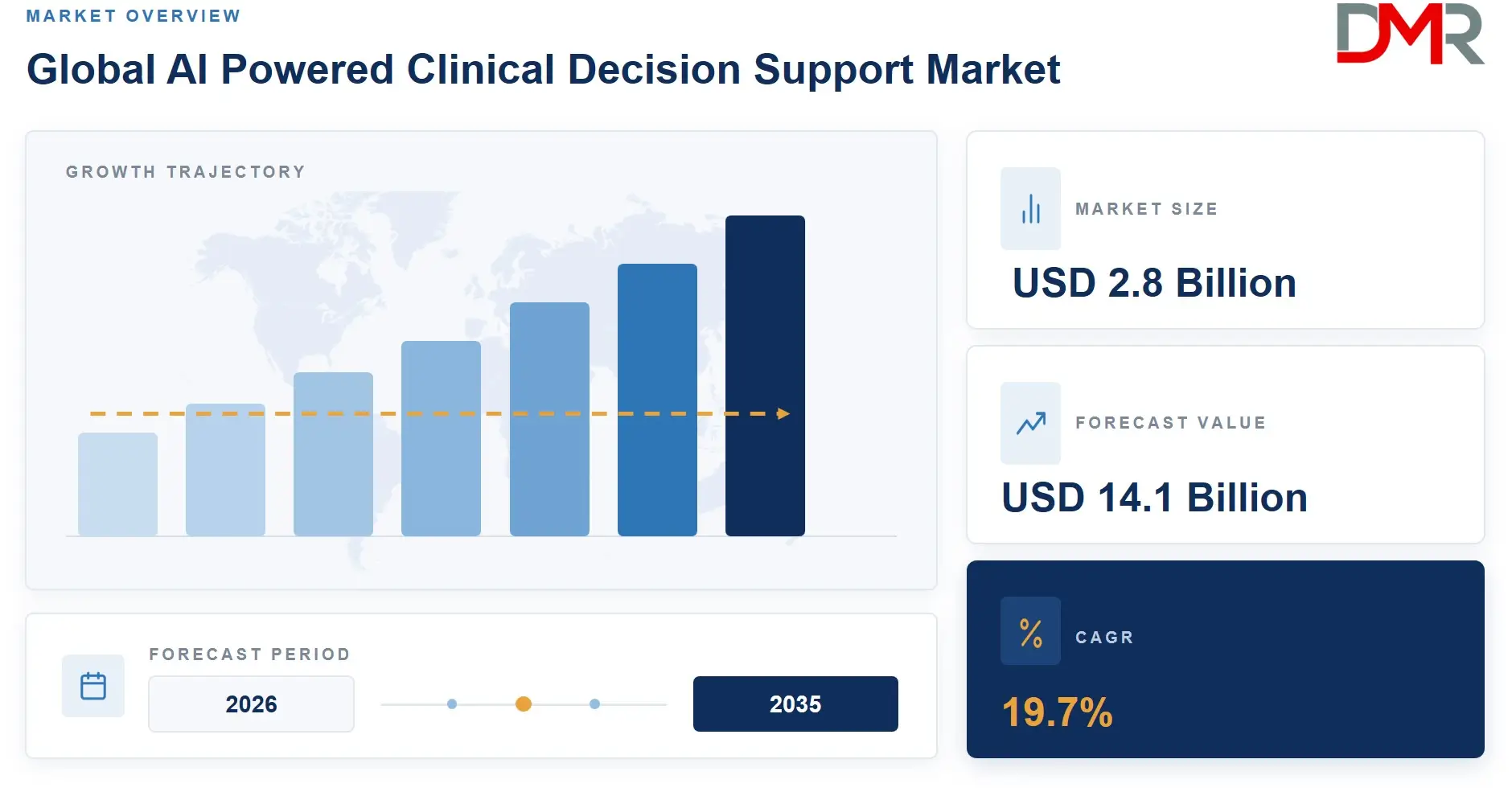
Global AI Powered Clinical Decision Support Market size is estimated to reach USD 2.8 Bn in 2026 and is further anticipated to reach USD 14.1 Bn by 2035, at a CAGR of 19.7%.
ℹ
To learn more about this report –
Download Your Free Sample Report Here
AI powered clinical decision support covers software and associated services that analyze patient-specific information and deliver evidence-linked recommendations, alerts, predictions or prioritized findings to clinicians at the point of care. The scope includes machine learning, natural language processing, computer vision and knowledge-based systems embedded in electronic health records, imaging workflows, laboratory systems and specialty platforms. It excludes general-purpose hospital administration software, autonomous diagnosis without clinician review and AI documentation products that do not influence a clinical decision.
Hospitals, physician groups, diagnostic centers and ambulatory networks buy these tools to reduce information overload, detect deteriorating patients earlier, improve guideline adherence and coordinate treatment across fragmented data sources. Procurement increasingly depends on interoperability with HL7 FHIR interfaces, traceable evidence, measurable workflow impact and controls that allow clinicians to review or override a recommendation. Vendors therefore compete on integration depth and clinical validation as much as on model accuracy.
Structural change is coming from multimodal models that combine notes, laboratory results, medication histories, waveforms and images within one decision context. Retrieval-augmented generation is also making guideline content easier to query while retaining source links. Adoption remains bounded by liability, alert fatigue, uneven data quality and the need to monitor model performance after deployment, making governance and human oversight central to commercial scale.
Use Cases
- Emergency Department Triage: Hospital emergency teams deploy predictive decision support across vital signs, laboratory results and presenting symptoms to identify patients at risk of rapid deterioration. Earlier prioritization changes bed assignment and escalation timing while allowing physicians to examine the factors behind each risk signal.
- Precision Oncology Review: Cancer centers use clinical decision platforms to organize pathology, genomic variants, prior therapies and guideline evidence around an individual case. Multidisciplinary tumor boards receive a structured treatment view, reducing manual evidence searches and helping specialists evaluate trial eligibility and therapy sequencing.
- Medication Safety: Pharmacy and inpatient care teams apply AI to medication lists, renal function, allergies and concurrent orders to surface clinically relevant contraindications. Context-aware prioritization reduces low-value warnings, directs pharmacists toward high-risk cases and supports safer dosing without removing prescriber authority.
- Primary Care Risk Management: Multisite physician groups screen longitudinal records for overdue testing, unmanaged chronic disease and preventable admission risk. Care coordinators receive ranked worklists instead of static registries, enabling limited staff to focus outreach on patients whose clinical history indicates the greatest near-term need.
Key Takeaways
- Market Size & Share: Global revenue is forecast to expand by more than fivefold between 2026 and 2035 as clinical AI moves from pilots into enterprise workflow contracts.
- Application Analysis: Diagnostic support is expected to account for roughly 32% of application revenue in 2026, supported by mature imaging and pattern-recognition use cases.
- Regional Analysis: Europe is projected to represent nearly 27% of global revenue in 2026 as health systems formalize evidence, privacy and medical-device controls.
- Growth Concentration: Risk prediction is forecast to grow at a CAGR of 25.0% through 2035 as real-time patient surveillance expands.
- Clinical Adoption: Hospitals are set to generate approximately 52% of end-user revenue in 2026 because they control the richest longitudinal and acute-care data environments.
- Technology Shift: Cloud deployment is forecast to advance at a CAGR of 23.8%, supported by managed model updates and scalable inference.
How AI/Gen AI is Transforming the AI Powered Clinical Decision Support Market?
AI is shifting clinical decision support from fixed rule engines toward probabilistic systems that interpret several data types and adjust recommendations to patient context. Transformer models can extract conditions, medications and care gaps from unstructured notes, while computer vision identifies image findings and deep learning evaluates time-series signals. These techniques help prioritize information, but safe deployment depends on calibrated confidence, source attribution and controls that keep the clinician responsible for the final decision.
Generative AI adds a conversational layer over clinical evidence and patient records. Retrieval-augmented generation can ground responses in approved guidelines, local protocols and cited chart data, limiting unsupported output. The commercial value lies less in free-form text and more in compressing evidence review, assembling patient timelines and making recommendations explainable inside existing workflows.
- Multimodal Reasoning: Models combine images, laboratory values, notes and physiological signals to create a fuller clinical context.
- Guideline Retrieval: Language models locate relevant passages from governed evidence libraries and present linked rationale at the point of care.
- Patient Trajectory Modeling: Temporal machine learning estimates deterioration, readmission and complication risk from longitudinal records.
- Model Monitoring: Automated surveillance detects data drift, performance changes and subgroup disparities after deployment.
Key Drivers in the Global AI Powered Clinical Decision Support Market
Demand is being pulled by clinical complexity and by the operational need to turn expanding patient data into timely, reviewable actions.
- Rising Clinical Data Burden and Decision Complexity: Software is projected to hold close to 62% of offering revenue in 2026 because the main bottleneck is no longer data capture but interpretation across fragmented records. Clinicians must reconcile imaging, pathology, medications, genomic results and evolving guidelines within constrained visit times. AI-based prioritization can surface material changes and evidence links before a decision is made. This mechanism supports spending on specialty modules and enterprise platforms that integrate with the EHR, particularly when deployments demonstrate reduced review time or earlier intervention. Buyers increasingly require the recommendation to remain traceable to patient facts and approved knowledge sources.
- Enterprise Pressure to Improve Quality with Limited Clinical Capacity: Hospitals are expected to contribute around 52% of end-user revenue in 2026 as staffing constraints meet rising acuity and documentation demands. Decision support can direct nurses, pharmacists and physicians toward high-risk cases without requiring proportional headcount growth. Health systems also use standardized recommendations to reduce unwarranted variation across sites and shifts. The purchasing case strengthens when a platform affects measurable outcomes such as length of stay, diagnostic turnaround or medication safety. Integration and change management remain necessary, but enterprise buyers increasingly view governed AI as an operating-capacity tool rather than an experimental analytics layer.
Restraints in the Global AI Powered Clinical Decision Support Market
Clinical risk, poor workflow fit and inconsistent data can slow deployments even when a model performs well during retrospective validation.
- Regulatory, Liability and Validation Friction: North America is expected to account for approximately 43% of global revenue in 2026, yet its scale also exposes vendors to demanding medical-device, privacy and institutional review requirements. A tool that influences diagnosis or treatment may require evidence supporting its intended use, version controls and post-deployment monitoring. Generative functions introduce further concerns around unsupported statements and changing model behavior. Health systems may delay expansion while responsibility for an incorrect recommendation remains unclear. Vendors must fund prospective validation, cybersecurity reviews and documentation across multiple care settings, increasing selling costs and favoring companies with clinical, regulatory and quality-management resources.
- Alert Fatigue, Bias and Weak Interoperability: On-premises deployment is projected to retain nearly 37% of deployment revenue in 2026, reflecting institutional caution around sensitive data and dependence on older infrastructure. Poorly tuned systems can reproduce missing-data bias, over-alert clinicians and interrupt established routines. Integration across HL7 feeds, FHIR APIs, imaging archives and medication systems often requires substantial local work, while different hospitals encode the same clinical concept differently. If recommendations arrive outside the clinician's primary screen or lack a clear rationale, usage declines. These implementation failures weaken realized value and can turn a technically accurate model into shelfware.
Growth Opportunities in the Global AI Powered Clinical Decision Support Market
White space is strongest where existing clinical evidence is abundant but specialist capacity and real-time interpretation remain scarce.
- Predictive Surveillance Across Acute and Ambulatory Care: Risk prediction is forecast to expand at a CAGR of 25.0% between 2026 and 2035, faster than the overall industry. Continuous models can identify deterioration, sepsis risk, avoidable readmission or therapy complications before a static threshold is crossed. Commercial opportunity lies in connecting these predictions to staffing, escalation and care-management workflows rather than selling another dashboard. Vendors that provide calibrated thresholds, subgroup performance reporting and local validation can address both clinical trust and procurement scrutiny. Extension from inpatient monitoring into home and ambulatory data creates recurring revenue opportunities around chronic disease and post-discharge management.
- Localized Clinical Intelligence for Asia-Pacific Health Systems: Asia-Pacific is expected to grow at a CAGR of 23.4% through 2035 as hospitals digitize, specialist demand rises and governments invest in health data infrastructure. Models trained only on Western records may underperform across local languages, disease patterns and documentation practices. This creates space for regional vendors and partnerships that localize terminology, evidence sources and workflow design. Cloud delivery can reduce infrastructure barriers for mid-sized networks, while federated learning and in-country hosting can address data residency. Commercial success will depend on proving performance across diverse populations rather than translating a user interface alone.
Trends in the Global AI Powered Clinical Decision Support Market
Product architecture is moving toward governed assistants, embedded workflow delivery and continuous evidence management rather than isolated prediction models.
- Shift Toward Cloud-Native and API-Embedded Delivery: Cloud platforms are forecast to grow at a CAGR of 23.8% through 2035 as buyers seek managed upgrades, scalable inference and easier connection to multiple sites. FHIR-based APIs allow recommendations to appear inside the EHR rather than in a separate portal, which can improve adoption and reduce context switching. Vendors are also separating model services, orchestration and user interfaces so health systems can govern each layer. Hybrid patterns remain important for imaging and highly sensitive data, but procurement is moving toward subscription contracts with defined uptime, monitoring and service-level commitments.
- From Black-Box Scores to Evidence-Linked Recommendations: Oncology is projected to advance at a CAGR of 23.5% from 2026 to 2035 because complex biomarker and therapy choices reward transparent evidence synthesis. Buyers increasingly ask systems to show the chart facts, guideline passages and confidence behind a recommendation. Retrieval-augmented generation, knowledge graphs and provenance tracking are becoming product features, not research extras. This shift changes competition from pure benchmark accuracy toward clinical explainability, content governance and update speed. Vendors able to document why a recommendation changed can support safer adoption and stronger institutional review.
Research Scope and Analysis
Segment performance is assessed across offering, deployment, application, clinical specialty and end user. Each axis shows where 2026 revenue is concentrated and which sub-segment is moving fastest through 2035, together with the commercial mechanism supporting each position.
ℹ
To learn more about this report –
Download Your Free Sample Report Here
By Offering
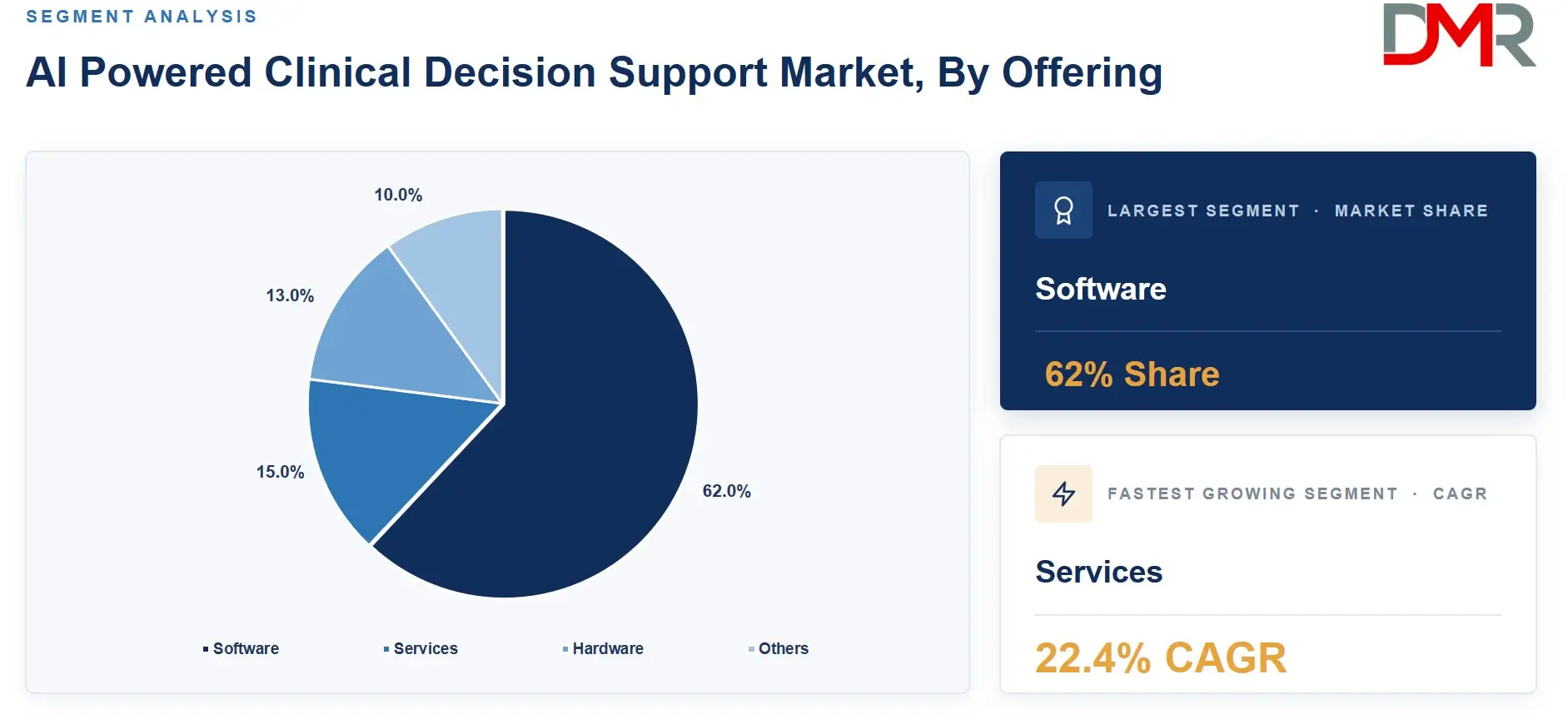
Software is projected to hold the largest offering share in 2026, representing approximately 62% of revenue because algorithms, workflow applications, knowledge content and integration layers carry the core recurring value. Enterprise licensing also expands as hospitals move from single-use models to governed portfolios deployed across service lines. Growth, however, is concentrated in services, advancing at a CAGR of 22.4% between 2026 and 2035. Health systems need clinical workflow redesign, data mapping, local validation, cybersecurity assessment and model monitoring before they can scale. Service demand becomes more durable as regulated functions require documented change control and performance review. Implementation partners that combine clinical informatics with cloud engineering are therefore positioned to capture work that cannot be standardized into a software license.
By Deployment
Cloud is expected to lead deployment in 2026 with a share of roughly 48%, supported by elastic computing, managed model releases and subscription access across distributed clinical networks. Centralized platforms also make it easier to maintain evidence libraries and monitor performance across facilities. The same sub-segment carries the steepest trajectory, expanding at a CAGR of 23.8% through 2035 as FHIR interfaces mature and health systems migrate analytics workloads to governed cloud environments. Growth will not eliminate local infrastructure because imaging, latency-sensitive workflows and data residency requirements continue to favor hybrid designs. Providers that offer private connectivity, regional hosting and clear control over model updates can address these concerns while retaining the operating advantages of cloud delivery.
By Application
Diagnostic support is set to represent the largest application share in 2026, accounting for around 32% of revenue as radiology, pathology and symptom-assessment tools benefit from well-defined inputs and measurable review tasks. Existing imaging workflows provide an installed integration base and a direct path to clinician validation. The faster trajectory sits with risk prediction, growing at a CAGR of 25.0% through 2035. Longitudinal EHR data and continuous physiological monitoring allow systems to estimate deterioration, complications and readmission before traditional rules trigger. Commercial uptake depends on linking predictions to an accountable intervention, because a risk score alone does not change care. Products that include escalation protocols, workload prioritization and outcome measurement are better placed to convert model performance into renewable contracts.
By Clinical Specialty
Radiology is projected to capture close to 27% of specialty revenue in 2026, reflecting established computer-vision use cases, standardized DICOM workflows and the high cost of delayed image interpretation. AI triage and detection modules already fit within picture archiving and reporting processes, supporting repeatable purchasing. Growth, however, is concentrated in oncology at a CAGR of 23.5% between 2026 and 2035. Therapy selection increasingly requires synthesis of pathology, genomics, prior treatments, guidelines and trial evidence. Multimodal platforms can organize this complexity around a patient while preserving specialist review. Vendors need curated molecular knowledge, evidence provenance and integration with tumor-board workflows, making domain depth more important than a generic conversational interface.
By End User
Hospitals are expected to command the largest end-user share in 2026 at approximately 52% because they combine high-acuity decisions, multidisciplinary teams and extensive clinical data. Their procurement budgets support enterprise integration, local validation and governance programs that smaller sites may struggle to fund. The highest expansion is expected in ambulatory care centers, with a CAGR of 22.1% through 2035. Procedure migration outside hospitals, rising specialty volumes and cloud-based delivery make targeted decision support commercially practical for outpatient settings. These centers favor applications with rapid implementation and clear throughput or safety benefits. Vendors that package specialty content, interoperability and monitoring into a predictable subscription can serve this growing buyer group without recreating a hospital-scale project.
The Global AI Powered Clinical Decision Support Market Report is Segmented Based on the Following
By Offering
- Software
- Services
- Hardware
- Others
By Deployment
- Cloud
- On-Premises
- Hybrid
- Others
By Application
- Diagnostic Support
- Treatment Recommendation
- Medication Management
- Clinical Workflow & Triage
- Risk Prediction
- Others
By Clinical Specialty
- Radiology
- Oncology
- Cardiology
- Acute & Critical Care
- Primary Care
- Neurology
- Others
By End User
- Hospitals
- Clinics
- Diagnostic Centers
- Ambulatory Care Centers
- Research & Academic Institutes
- Others
Regional Analysis
Region with the Largest Revenue Share
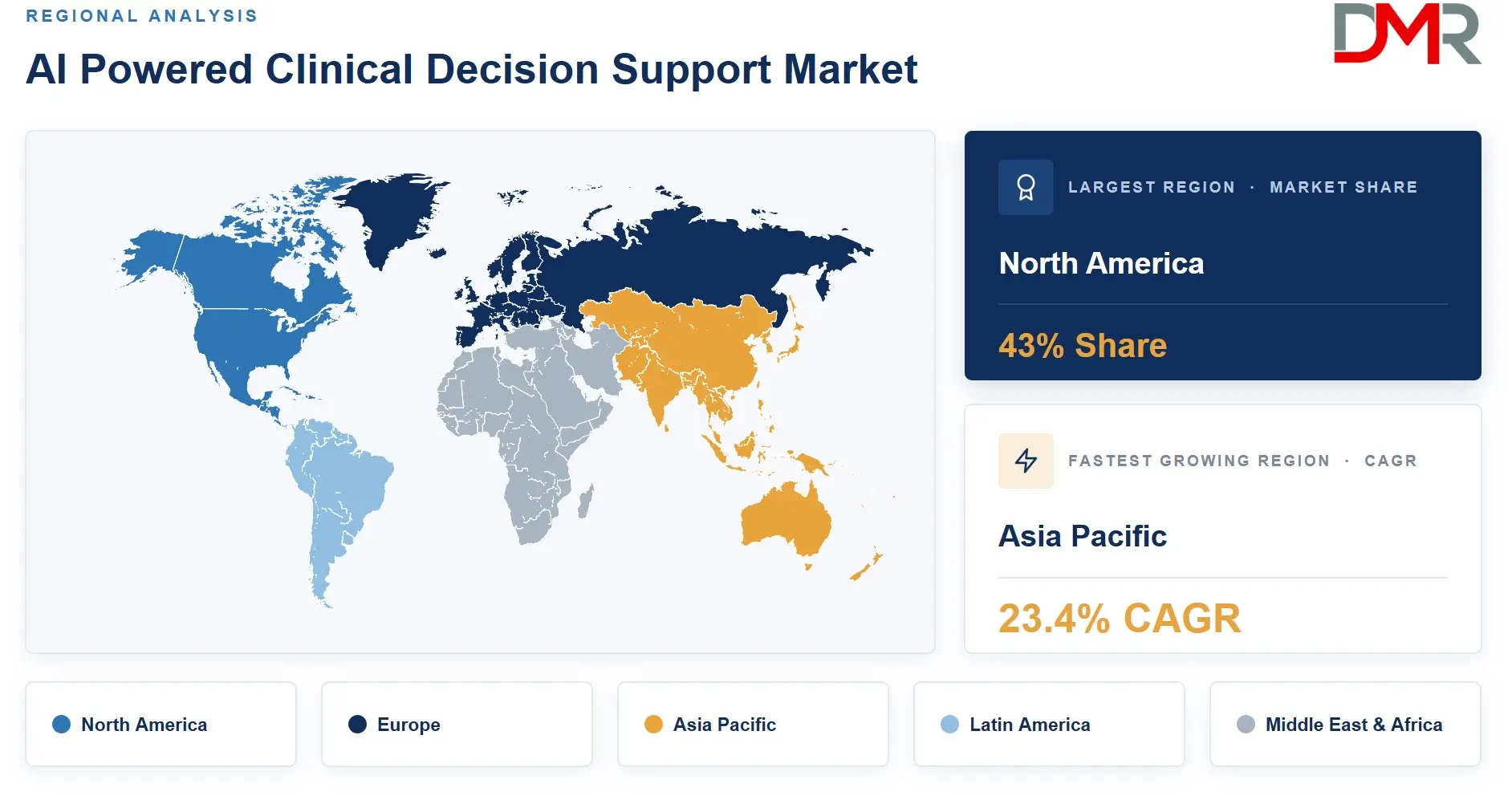
North America is expected to remain the largest region, accounting for approximately 43% of global revenue in 2026. The US combines extensive EHR penetration, large health-system technology budgets, active clinical AI companies and reimbursement structures that reward measurable quality and efficiency. Academic medical centers also provide validation partners and early reference sites for specialty tools. Commercial scale nevertheless requires integration with dominant clinical platforms, security reviews and evidence acceptable to medical leadership. Canada adds demand through provincial digital-health programs, although procurement cycles can be longer. The region's advantage rests on buyer capacity and commercialization infrastructure rather than uniform adoption across all providers.
ℹ
To learn more about this report –
Download Your Free Sample Report Here
Region with the Highest CAGR
Asia-Pacific is forecast to post the highest regional CAGR of 23.4% between 2026 and 2035. Hospital digitization, uneven specialist availability and large patient volumes create a strong operating case for triage, imaging support and chronic-disease risk tools. China, Japan, India, South Korea and Australia offer distinct regulatory and care-delivery environments, encouraging local model development and partnership-based market entry. Regional cloud zones and domestic AI infrastructure are lowering deployment barriers, while language and population differences reward locally validated products. Growth remains sensitive to data residency, reimbursement and interoperability, so vendors with country-specific governance and distribution strategies should outperform generic global rollouts.
By Region
North America
Europe
- Germany
- France
- The UK
- Italy
- Spain
- Rest of Europe
Asia-Pacific
- China
- Japan
- India
- Australia
- South Korea
- Rest of APAC
Latin America
- Mexico
- Brazil
- Colombia
- Argentina
- Rest of LATAM
Middle East & Africa
- Saudi Arabia
- The UAE
- South Africa
- Rest of MEA
Regulatory Landscape
Clinical decision software sits across medical-device, health-data and professional-practice rules, with classification determined by intended use and the degree of clinician dependence. Regulators are shifting from one-time review toward lifecycle evidence, cybersecurity, predetermined change controls and performance monitoring after deployment. Commercial openings favor vendors that separate assistive functions from higher-risk claims, document human oversight and build quality management into model operations. The principal brake is regulatory fragmentation: the FDA, EU Medical Device Regulation and national privacy regimes can require different evidence, hosting and update strategies. These conditions raise compliance cost but strengthen competitive position for platforms that make traceability, validation and controlled releases part of the product.
Technology Analysis
Current systems combine knowledge rules, gradient-boosted prediction, deep learning, computer vision and natural language processing, usually through an orchestration layer connected to the EHR. Development is shifting toward multimodal foundation models, retrieval-augmented generation, FHIR-native apps and continuous monitoring for drift and bias. White space sits in tools that connect a recommendation to cited evidence, calibrated uncertainty and a specific workflow action, especially across specialty care. Risk remains concentrated in hallucination, incomplete records, subgroup performance and uncontrolled model updates. Architecture that keeps patient data governed, separates retrieval from generation and records every recommendation can improve trust, shorten institutional review and support premium enterprise positioning.
Competitive Landscape
Competition spans EHR incumbents, diversified health-technology groups, evidence publishers, cloud providers and focused clinical AI companies. Large vendors benefit from installed workflow access and enterprise contracting, while specialists compete through validated performance in radiology, oncology, medication safety and acute-care prediction. Partnerships are common because model developers need distribution, data connectivity and clinical validation that are difficult to build alone. Purchasing decisions increasingly weigh interoperability, evidence provenance, cybersecurity, model monitoring and total implementation burden alongside accuracy. Consolidation is likely around platforms that can govern multiple models, but specialty leaders retain room where proprietary data, clinical knowledge or regulatory evidence creates defensible differentiation.
Some of the Prominent Players in the Global AI Powered Clinical Decision Support Market Are
- Oracle Health
- Microsoft
- Epic Systems Corporation
- Wolters Kluwer
- Elsevier
- GE HealthCare
- Siemens Healthineers
- Google Cloud
- Amazon Web Services
- Merative
- Aidoc
- Viz.ai
- Tempus AI
- PathAI
- Pieces Technologies
- Regard
- Navina
- Bayesian Health
- Infermedica
- Isabel Healthcare
- VisualDx
- OpenEvidence
- EvidenceCare
- Etiometry
- Health Catalyst
- Altera Digital Health
- Meditech
- Agfa HealthCare
- Qure.ai
- Tricog Health
- Lunit
- VUNO
- Deep Bio
- Ubie
- Airdoc
- Ping An Healthcare and Technology
- Alibaba Cloud
- Tencent Healthcare
- Altibbi
- Synapsica
- Other Key Players
Recent Developments
- In April 2026, Tempus presented an agentic oncology research workflow built around multimodal data, illustrating how clinical evidence tools are moving from passive search toward supervised execution of complex analytical tasks.
- In March 2025, Microsoft introduced Dragon Copilot for healthcare, combining clinical-language capabilities with workflow assistance and extending its enterprise route into clinician-facing AI experiences.
- In February 2025, Aidoc expanded its clinical AI platform strategy around coordinated care workflows, reinforcing the shift from isolated imaging algorithms toward enterprise-wide identification and follow-up of suspected conditions.
- In January 2025, Tempus broadened its AI-enabled clinical assistant capabilities for oncology, supporting faster access to patient-specific treatment and evidence insights inside specialist workflows.
- In October 2024, Oracle announced new clinical AI capabilities for its health platform, strengthening the link between longitudinal patient records, conversational access and decision support within established hospital systems.
Report Details
| Report Characteristics |
| Market Size (2026) |
USD 2.8 Bn |
| Forecast Value (2035) |
USD 14.1 Bn |
| CAGR (2026-2035) |
19.7% |
| The US Market Size (2026) |
USD 1.0 Bn |
| Historical Data |
2021 - 2025 |
| Forecast Data |
2026 - 2035 |
| Base Year |
2025 |
| Segments Covered |
By Offering, By Deployment, By Application, By Clinical Specialty and By End User |
| Regional Coverage |
North America - The US and Canada; Europe - Germany, France, The UK, Italy, Spain, Rest of Europe; Asia-Pacific - China, Japan, India, Australia, South Korea, Rest of APAC; Latin America - Mexico, Brazil, Colombia, Argentina, Rest of LATAM; Middle East & Africa - Saudi Arabia, The UAE, South Africa, Rest of MEA |
Frequently Asked Questions
How big is the Global AI Powered Clinical Decision Support Market?
▾ Industry revenue is estimated at USD 2.8 Bn in 2026. This boundary covers patient-specific software, supporting services and dedicated hardware used to inform diagnosis, treatment, medication and clinical-risk decisions. It excludes general hospital administration systems and documentation-only assistants that do not materially influence care choices.
What is the growth rate of the Global AI Powered Clinical Decision Support Market?
▾ The sector is forecast to grow at a CAGR of 19.7% from 2026 to 2035. Expansion is supported by multimodal clinical data, enterprise demand for capacity improvement, cloud deployment and stronger integration with EHR workflows. Regulatory validation, alert fatigue and weak data quality will continue to moderate adoption.
Which region holds the largest share in the Global AI Powered Clinical Decision Support Market?
▾ North America is projected to hold the largest regional position, with approximately 43% of global revenue in 2026. Its lead reflects mature electronic records, major health-system technology budgets, active clinical AI vendors and extensive validation networks, although security review and workflow integration can lengthen enterprise sales cycles.
Who are the key players in the Global AI Powered Clinical Decision Support Market?
▾ Prominent participants include Oracle Health, Microsoft, Epic Systems Corporation, Wolters Kluwer, Aidoc, Viz.ai and Tempus AI. Competition also comes from imaging specialists, clinical evidence publishers, cloud platforms and regional AI developers. Their positions differ by installed workflow access, clinical validation, interoperability and specialty depth.
Which application leads the industry?
▾ Diagnostic support is expected to lead application revenue with around 32% share in 2026. Imaging, pathology and symptom-assessment workflows provide defined inputs and measurable review tasks that support validation. Risk prediction is growing faster as hospitals connect longitudinal records and monitoring data to proactive intervention pathways.
Why is explainability important for clinical decision support?
▾ Clinicians and institutional reviewers need to understand which patient facts and evidence sources support a recommendation. Provenance, calibrated confidence and linked guidelines help users detect errors, exercise professional judgment and document decisions. Explainability also supports regulatory evidence, incident review and controlled updates after deployment.
What will shape the Global AI Powered Clinical Decision Support Market through 2035?
▾ The AI Powered Clinical Decision Support Market will be shaped by FHIR-based interoperability, multimodal models, retrieval-grounded assistants, lifecycle regulation and continuous model monitoring. Vendors that connect trustworthy recommendations to accountable clinical actions should gain adoption, while products that add alerts without workflow integration will face stronger resistance.