Global DDI Market Snapshot
- Global DDI Market Size in 2026: USD 3.1 Billion
- Global DDI Market Size in 2035: USD 6.1 Billion
- Global CAGR from 2026 to 2035: 7.8%
- Solutions is the leading component segment in 2026: 68.4%
- On-premises is the leading deployment mode in 2026: 55.7%
- Large Enterprises is the leading organization segment in 2026: 66.3%
- Network Automation is the leading application segment in 2026: 25.8%
- Telecom and IT is the leading vertical segment in 2026: 27.4%
- North America is the leading region in 2026: 40.6%
What is the Global DDI Market and Its Market Size?
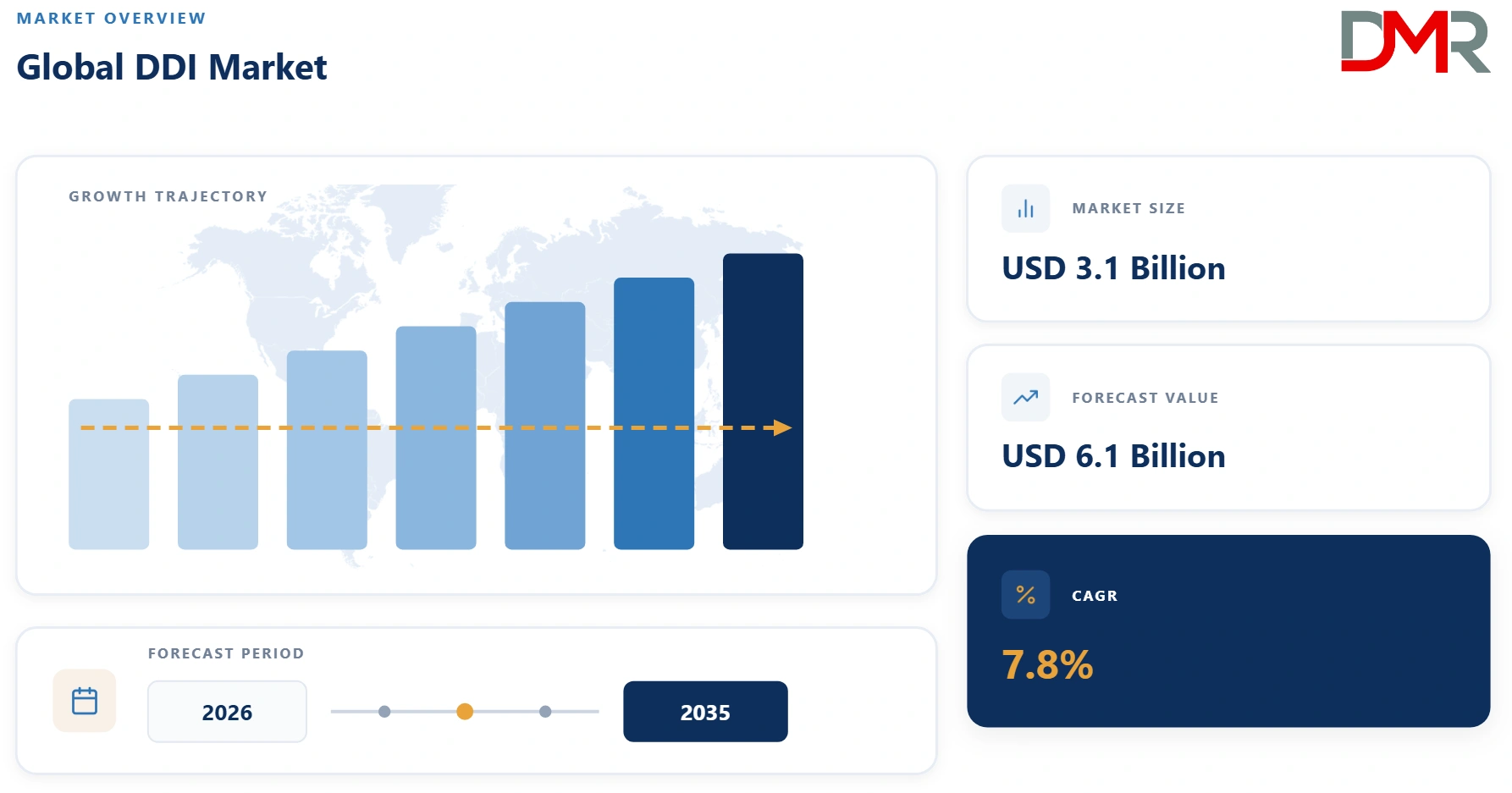
The Global DDI Market is projected to reach USD 3.1 billion in 2026 and grow at a compound annual growth rate of 7.8% from there until 2035 to reach a value of USD 6.1 billion.
ℹ
To learn more about this report –
Download Your Free Sample Report Here
DDI refers to an integrated network management framework combining Domain Name System, Dynamic Host Configuration Protocol, and IP Address Management. It enables enterprises to discover, allocate, control, and secure IP resources across physical, virtual, cloud, and hybrid networks. Adoption is increasing as organizations manage more connected devices, distributed applications, IPv6 addresses, and multi-cloud workloads requiring centralized visibility, automation, availability, and policy enforcement.
Use Cases
- Automated IP Address Allocation: DDI platforms automatically discover devices, allocate available IP addresses, update DNS records, and maintain accurate address inventories. This eliminates manual spreadsheets, minimizes duplicate assignments, and prevents IP conflicts. Enterprises use automated workflows to accelerate device provisioning across corporate networks, branch locations, data centers, private clouds, and public cloud environments while maintaining consistent network policies and reliable connectivity.
- Hybrid and Multi-Cloud Management: Organizations use DDI solutions to centrally manage DNS zones, DHCP services, network spaces, and cloud-native IP resources distributed across AWS, Microsoft Azure, Google Cloud, and private infrastructure. Unified visibility helps network teams reduce configuration inconsistencies, avoid overlapping address spaces, automate workload provisioning, and support application mobility without losing operational control across complex hybrid and multi-cloud environments.
- DNS Security and Policy Enforcement: DDI platforms provide visibility into DNS activity and enable organizations to block malicious domains, detect abnormal queries, enforce access policies, and support threat investigations. Integrating DNS intelligence with security operations improves protection against phishing, malware, command-and-control communication, domain generation algorithms, data exfiltration, and DNS tunneling while strengthening Zero Trust security and regulatory compliance.
- IPv6 and IoT Device Management: DDI technology supports structured IPv6 planning, address allocation, dual-stack environments, subnet management, and device discovery. Organizations use it to manage expanding IoT, operational technology, mobile, and edge-device estates. Automated inventory and policy enforcement provide accurate information about connected assets, reduce unauthorized-device risks, simplify IPv4-to-IPv6 migration, and maintain connectivity across highly distributed networks.
Key Takeaways
- Market Size: The Global DDI Market is anticipated to be valued at USD 3.1 billion in 2026 and is forecast to reach USD 6.1 billion by 2035, expanding at a CAGR of 7.8%.
- Growth Outlook: Market expansion is supported by hybrid and multi-cloud adoption, IPv6 migration, network automation, cloud-native application deployment, IoT proliferation, Zero Trust implementation, data center transformation, rising DNS security risks, and enterprise requirements for unified visibility across increasingly distributed digital infrastructure.
- Primary Growth Drivers: The growing number of connected devices, increasing network complexity, expansion of remote working environments, pressure to automate repetitive network operations, adoption of containers and microservices, and demand for secure DNS infrastructure are accelerating enterprise investment in integrated DNS, DHCP, and IPAM platforms.
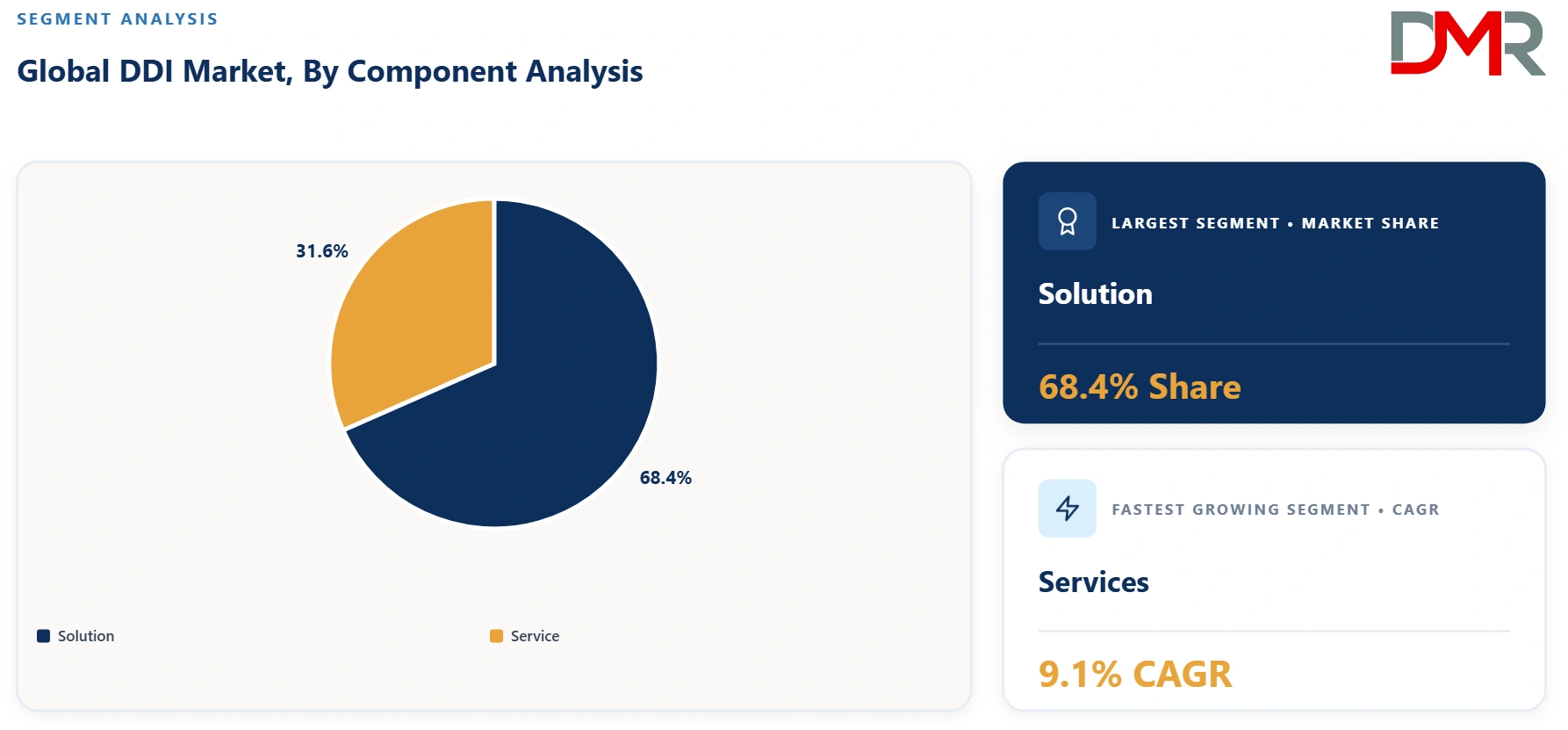
- By Component Analysis: Solutions is projected to dominate the component segment with a 68.4% share in 2026, driven by demand for integrated IPAM, authoritative DNS, recursive DNS, DHCP automation, network discovery, address reconciliation, reporting, and policy enforcement. Services will grow faster as enterprises seek migration, integration, optimization, and managed DDI support.
- By Deployment Mode Analysis: On-premises deployment is expected to lead with a 55.7% share in 2026, supported by security, control, customization, data sovereignty, and availability requirements. Cloud-based deployment is anticipated to record the fastest CAGR of 10.2%, driven by distributed workloads, subscription models, centralized management, and multi-cloud adoption.
- By Organization Analysis: Large Enterprises is anticipated to dominate with a 66.3% share in 2026, owing to complex network estates, multiple locations, large device populations, stringent uptime requirements, and substantial security budgets. SMEs are expected to grow faster at 9.5% as cloud-delivered DDI reduces infrastructure and administration barriers.
- By Application Analysis: Network Automation is projected to lead with a 25.8% share in 2026, supported by demand for automated provisioning, configuration accuracy, faster service delivery, and reduced administrative workloads. IoT and Device Management is forecast to grow fastest at 10.6% due to expanding connected-device estates and edge infrastructure.
- By Vertical Analysis: Telecom and IT is expected to lead with a 27.4% share in 2026, reflecting its extensive IP infrastructure, high DNS query volumes, service availability requirements, and continuous network expansion. Healthcare and Life Sciences is expected to post the fastest CAGR of 9.8%, supported by connected medical devices and digitized clinical environments.
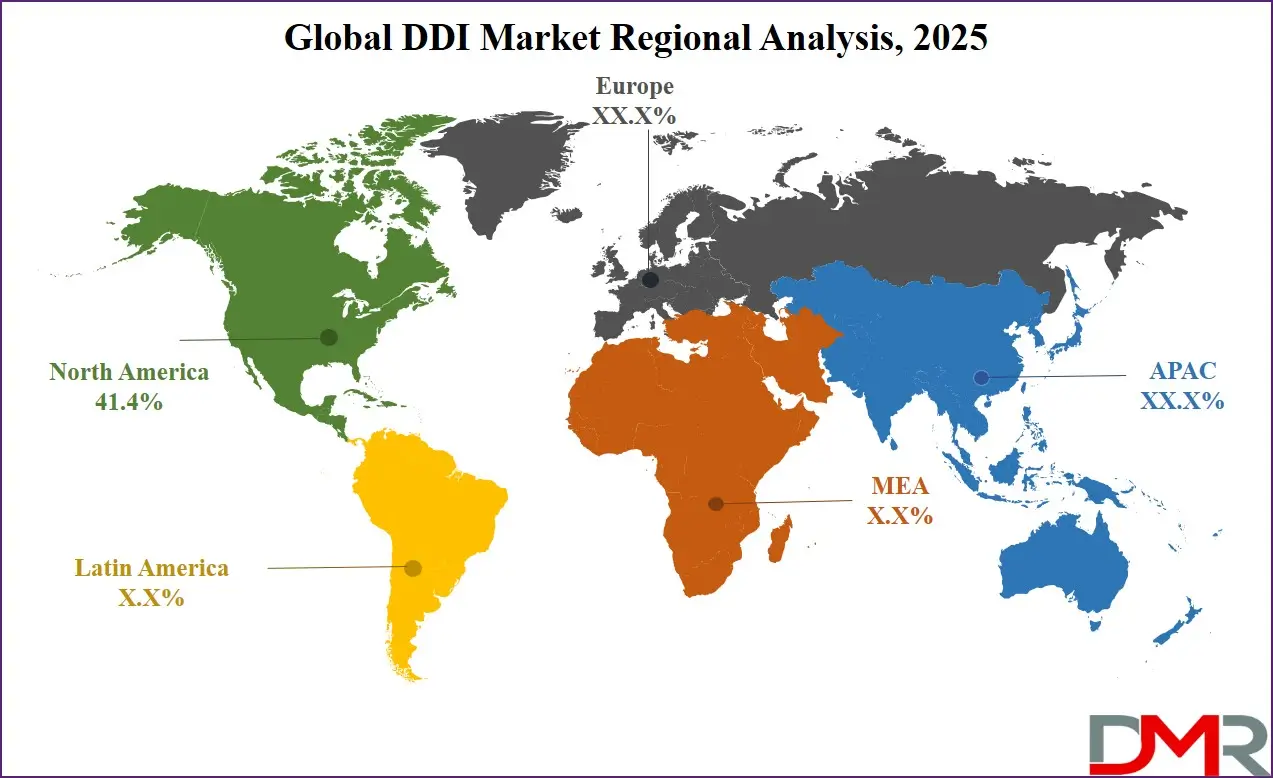
- Regional Leadership: North America is projected to hold 40.6% of the Global DDI Market in 2026, supported by mature enterprise networks, substantial cloud adoption, cybersecurity investment, and the presence of major vendors. Asia Pacific is expected to register the fastest regional CAGR of 9.6% through 2035.
How AI and GenAI Are Transforming the Global DDI Market?
AI and GenAI are transforming DDI by analyzing DNS traffic, identifying abnormal device behavior, forecasting address capacity, and recommending configuration changes. AI-assisted platforms can detect shadow assets, classify devices, prioritize DNS threats, and reduce false alerts. GenAI interfaces allow network teams to query infrastructure using natural language, generate automation workflows, and summarize operational incidents. Predictive intelligence also supports proactive capacity planning and outage prevention. However, human approval remains critical because inaccurate automated changes to DNS, DHCP, or IPAM systems can disrupt connectivity across entire enterprise networks.
Key Drivers in the Global DDI Market
Expansion of Hybrid Cloud and Connected Infrastructure
Enterprises are distributing applications across private data centers, public clouds, branch networks, edge locations, and software-defined environments. Every new workload, endpoint, container, and connected device requires accurate addressing and dependable DNS resolution. Manual tools cannot maintain synchronized records across these environments, increasing demand for unified DDI platforms. These solutions provide a consolidated source of network data and automate resource provisioning across AWS, Azure, Google Cloud, VMware, Kubernetes, and traditional infrastructure. The expansion of IoT and operational technology further increases the need for scalable device discovery, address utilization monitoring, and automated lifecycle management.
IPv6 Adoption and Rising DNS Security Requirements
Global IPv6 adoption reached 50% of Google-observed traffic during 2026, highlighting the need to manage IPv4, IPv6, and dual-stack environments simultaneously. IPv6 introduces significantly larger address spaces and new operational requirements that are difficult to manage with spreadsheets or disconnected tools. DDI platforms support address planning, subnet allocation, DNS synchronization, and migration governance. At the same time, DNS is increasingly used in phishing, malware delivery, command-and-control activity, and data exfiltration. Organizations are consequently integrating DNS visibility, protective DNS, threat intelligence, and policy enforcement into core DDI operations.
Restraints in the Global DDI Market
High Implementation Costs and Integration Complexity
Enterprise-grade DDI transformation may require software licenses, specialized appliances, cloud subscriptions, implementation services, staff training, data cleansing, and redesign of existing network processes. Organizations operating legacy Microsoft DNS and DHCP servers, spreadsheets, scripts, or multiple regional IPAM systems may encounter complicated migrations. Integration with firewalls, identity systems, IT service management, cloud platforms, orchestration tools, and security operations can further increase project duration. Smaller organizations may postpone adoption when existing tools appear adequate, while larger enterprises may hesitate because errors during DNS or DHCP migration can create serious connectivity and application availability risks.
Skills Shortage and Resistance to Infrastructure Change
DDI platforms support foundational services, making network teams cautious about changing established configurations. Effective implementation requires expertise in DNS architecture, DHCP design, IPv4 and IPv6 planning, automation, cloud networking, security, and high availability. Many enterprises face shortages of professionals possessing this combined skill set. Organizational silos between NetOps, CloudOps, DevOps, and SecOps may also delay platform selection and policy standardization. Vendor-specific architectures and inconsistent APIs create additional complexity. Concerns about migration downtime, learning requirements, platform dependence, and responsibility for centralized network services can restrain adoption, particularly in organizations with decentralized infrastructure management.
Growth Opportunities in the Global DDI Market
Cloud-Native DDI and DDI as a Service
Cloud-delivered DDI creates substantial opportunities among enterprises seeking centralized management without deploying extensive physical infrastructure. Subscription-based platforms can support geographically distributed offices, remote users, cloud workloads, and edge environments through unified management and flexible service delivery. Vendors can expand through SaaS-based IPAM, cloud-managed DNS and DHCP, asset discovery, usage-based pricing, and managed services. Integration with native AWS, Azure, and Google Cloud networking will be particularly important. Opportunities also exist in providing migration tools that reconcile fragmented network data and establish consistent policies across on-premises and multiple cloud environments.
Network Automation and Unified NetOps Security
DDI contains authoritative information about IP addresses, subnets, domains, devices, and network relationships, making it valuable for broader automation and security use cases. Vendors can connect DDI platforms with infrastructure-as-code tools, observability platforms, SIEM, SOAR, SASE, NAC, firewalls, and IT service management systems. This allows organizations to automate provisioning, enrich security alerts, quarantine suspicious devices, and remediate configuration problems. Emerging white spaces include autonomous network operations, intent-based networking, AI-assisted capacity planning, and automated policy enforcement. Providers combining network data, observability, and security intelligence can differentiate themselves from standalone IPAM and DNS management tools.
Trends in the Global DDI Market
Convergence of DDI, Security, and Network Observability
The market is shifting from basic address administration toward platforms that combine core network services with DNS security, asset intelligence, performance monitoring, and operational analytics. DNS data provides valuable context regarding device identity, application access, malicious communication, and network behavior. Vendors are incorporating threat detection, domain reputation, DNS filtering, anomaly identification, and incident investigation into their portfolios. Acquisitions and product integrations are also connecting DDI with network observability. This convergence enables NetOps and SecOps teams to use shared data, identify configuration issues faster, improve threat response, and maintain more resilient application connectivity.
API-First DDI and Infrastructure as Code
Enterprises increasingly expect DNS, DHCP, and IP address resources to be provisioned through APIs instead of manual tickets. Modern DDI platforms are integrating with Terraform, Ansible, Kubernetes, ServiceNow, CI/CD pipelines, and cloud orchestration services. This enables developers and DevOps teams to request network resources during application deployment while centralized policies maintain governance. DDI as code reduces provisioning time, improves repeatability, and minimizes human errors. The trend is also encouraging vendors to provide extensible APIs, event-driven workflows, reusable templates, and automated reconciliation between authoritative IPAM records and actual infrastructure configurations.
Research Scope and Analysis
The report analyzes Global DDI Market components including solutions and services, deployment modes covering on premises and cloud platforms, organizations spanning SMEs and large enterprises, applications including automation security IPv6 cloud data centers and IoT, verticals across major industries, and regions covering North America, Europe, Asia Pacific, Latin America, Middle East and Africa.
ℹ
To learn more about this report –
Download Your Free Sample Report Here
By Component Analysis
Solutions is projected to lead the component segment with a 68.4% share in 2026, supported by growing demand for integrated DNS, DHCP, IPAM, network discovery, automation, and security capabilities. Services is anticipated to record the highest CAGR of 9.1% through 2035 as organizations require professional consulting, deployment, integration, migration, training, optimization, and managed support for increasingly complex hybrid networks.
By Deployment Mode Analysis
On-premises deployment is expected to dominate with a 55.7% share in 2026, owing to its greater control, customization, resilience, and data sovereignty advantages. Cloud Based Deployment is forecast to expand at the highest CAGR of 10.2% through 2035, supported by SaaS adoption, distributed applications, multi-cloud management, remote infrastructure, scalable subscriptions, and reduced dependence on physical appliances.
By Organization Analysis
Large Enterprises is anticipated to account for 66.3% of market revenue in 2026, reflecting complex networks, significant address volumes, multiple business locations, and strict uptime requirements. Small and Medium-Sized Enterprises are projected to record the highest CAGR of 9.5% through 2035 as affordable cloud-based platforms, managed services, simplified deployment, and increasing cybersecurity requirements improve accessibility.
By Application Analysis
Network Automation is projected to lead the application segment with a 25.8% share in 2026, driven by automated provisioning, real-time reconciliation, and reduced configuration errors. IoT and Device Management is anticipated to grow at the highest CAGR of 10.6% through 2035 as enterprises require reliable discovery, classification, addressing, tracking, and policy enforcement across expanding connected-device ecosystems.
By Vertical Analysis
Telecom and IT is expected to dominate the vertical segment with a 27.4% share in 2026, supported by extensive network infrastructure, large subscriber bases, substantial DNS traffic, and continuous capacity expansion. Healthcare and Life Sciences is forecast to register the highest CAGR of 9.8% through 2035 due to connected medical devices, telehealth, digital records, cloud migration, and stringent security requirements.
The Global DDI Market Report is Segmented Based on the following:
By Component
- Solutions
- DNS Solutions
- DHCP Solutions
- IP Address Management Solutions
- Services
- Professional Services
- Managed Services
- Integration and Deployment
- Consulting and Training
By Deployment Mode
- On-Premises Deployment
- Cloud-Based Deployment
- Public Cloud
- Private Cloud
- Hybrid Cloud
By Organization
- Small and Medium-Sized Enterprises
- Large Enterprises
By Application
- Network Automation
- Virtualization and Cloud Management
- Data Center Transformation
- Network Security and Policy Enforcement
- IPv6 Migration and Management
- IoT and Device Management
- Others
By Vertical
- Telecom and IT
- Banking, Financial Services, and Insurance
- Government and Defense
- Healthcare and Life Sciences
- Education
- Retail and E-Commerce
- Manufacturing
- Energy and Utilities
- Others
Regional Analysis
North America is the Leading Region in the Global DDI Market
North America is projected to dominate the Global DDI Market with a 40.6% share in 2026, equivalent to USD 1.3 billion. Leadership is supported by mature cloud infrastructure, early network automation adoption, extensive enterprise digitization, strong cybersecurity spending, and the presence of Infoblox, BlueCat Networks, Microsoft, Cisco, and other technology providers. Increasing Zero Trust adoption, multi-cloud networking, data center modernization, IPv6 transition, and demand for secure DNS services will sustain regional expansion through 2035.
ℹ
To learn more about this report –
Download Your Free Sample Report Here
Asia Pacific is the Fastest-Growing Region in the Global DDI Market
Asia Pacific is anticipated to be the fastest-growing regional market, expanding at a CAGR of 9.6% from 2026 to 2035. Growth is supported by 5G deployment, cloud data center expansion, rapid IPv6 adoption, smart-city development, IoT proliferation, and digitalization across China, India, Japan, South Korea, and Southeast Asia. Government network-modernization programs and expanding telecom infrastructure are increasing demand for scalable IPAM, automated DHCP, secure DNS, and centralized management across large and distributed networks.
The Europe DDI Market
The Europe DDI Market is estimated to be valued at USD 0.9 billion in 2026 and is further anticipated to reach USD 1.6 billion by 2035, at a CAGR of 7.3%.
European adoption is supported by cloud migration, network modernization, data sovereignty requirements, and growing attention to DNS resilience. Organizations in Germany, the United Kingdom, France, Italy, Spain, and Nordic countries are consolidating fragmented address-management systems and adopting centralized DDI platforms. NIS2 compliance, Zero Trust programs, industrial digitalization, and hybrid working models are strengthening demand, while regulated enterprises continue to favor hybrid and private-cloud architectures.
Latin America DDI Market
Cloud adoption, telecom-network expansion, digital banking, e-commerce growth, and government modernization are supporting demand in Brazil and Mexico. Budget constraints and limited specialist skills restrict adoption, creating opportunities for managed DDI services, cloud subscriptions, and simplified automation platforms designed for mid-sized enterprises.
Middle East and Africa DDI Market
Smart-city investments, data center construction, 5G deployment, government digitization, and cybersecurity initiatives are driving adoption in Saudi Arabia, the UAE, and South Africa. Cloud-managed and managed-service models offer strong potential where organizations face shortages of specialized DNS and IPAM professionals.
Major Countries Analysis
United States DDI Market
The United States DDI Market is valued at USD 1.05 billion in 2026 and is expected to reach USD 1.91 billion by 2035, registering a CAGR of 6.9% from 2026 to 2035.
The country benefits from high cloud penetration, large data center capacity, extensive enterprise networks, and strong investment in cybersecurity and automation. Federal Zero Trust programs, IPv6 modernization, hybrid working, and AI infrastructure expansion are creating demand for secure, resilient DDI. Major vendors and cloud providers operating in the country also accelerate product innovation, integration, and enterprise adoption.
Japan DDI Market
The Japan DDI Market growth is supported by 5G, industrial IoT, data center investment, cloud migration, and modernization of financial, telecom, manufacturing, and government networks. Japan’s focus on operational reliability and disaster resilience supports high-availability DDI, while limited IT talent encourages network automation and managed-service adoption.
Saudi Arabia DDI Market
Vision 2030 initiatives, smart cities, cloud regions, expanding data centers, 5G infrastructure, and digital government services are increasing IP-resource complexity. Demand is particularly strong across government, energy, telecom, financial services, and large development projects requiring secure DNS and centralized address management.
Technology Analysis
DDI technology is evolving from appliance-centered administration toward cloud-managed, API-first platforms capable of controlling heterogeneous network services. Modern solutions combine authoritative and recursive DNS, DHCP automation, IPv4 and IPv6 management, discovery, analytics, security, and policy orchestration. Integration with Kubernetes, Terraform, Ansible, ServiceNow, public-cloud DNS, SD-WAN, SASE, SIEM, and SOAR platforms is becoming essential. AI-assisted anomaly detection, asset classification, natural-language operations, and predictive capacity planning represent emerging capabilities. Technology risk centers on excessive automation, API security, configuration errors, and interoperability gaps. Vendors offering open integrations, high availability, multi-cloud visibility, and controlled AI automation can gain competitive advantage.
Investment and White Space Analysis
Investment is concentrating on cloud-native DDI, managed network services, DNS security, asset intelligence, and unified NetOps platforms. Established vendors are expanding portfolios through acquisitions and integrations, while emerging providers target affordable SaaS offerings and infrastructure-as-code workflows. Significant white-space opportunities exist among SMEs, distributed enterprises, edge locations, healthcare networks, industrial IoT environments, and emerging markets lacking integrated IPAM. Additional opportunities include automated IPv6 migration, multi-cloud address reconciliation, Kubernetes networking, DNS-based threat detection, and AI-assisted operations. Investors must consider long enterprise sales cycles, migration sensitivity, established vendor relationships, and open-source alternatives, but recurring subscriptions and high customer retention strengthen the market’s commercial attractiveness.
By Region
North America
Europe
- Germany
- France
- The U.K.
- Italy
- Spain
- Rest of Europe
Asia-Pacific
- China
- Japan
- India
- Australia
- South Korea
- Rest of APAC
Latin America
- Mexico
- Brazil
- Rest of LATAM
Middle East and Africa
- Saudi Arabia
- The UAE
- South Africa
- Rest of MEA
Competitive Landscape
The Global DDI Market is moderately consolidated, with Infoblox, BlueCat Networks, EfficientIP, Cisco, Microsoft, and Cygna Labs competing through integrated platforms, cloud management, automation, security, and professional services. Leading vendors differentiate through scalability, DNS threat intelligence, multi-cloud visibility, APIs, and ecosystem integrations. Acquisitions are expanding DDI into network observability and intelligent NetOps. Cloud providers, open-source platforms, regional specialists, and managed-service companies increase competition. Product reliability, migration support, deployment flexibility, pricing, interoperability, and customer service remain important purchasing criteria.
Some of the Prominent Players in the Global DDI Market Are
- Infoblox Inc.
- BlueCat Networks
- EfficientIP
- Cygna Labs Corp.
- Cisco Systems Inc.
- Microsoft Corporation
- Nokia Corporation
- F5 Inc.
- Hewlett Packard Enterprise
- SolarWinds Worldwide LLC
- ManageEngine
- Men and Mice
- TCPWave Inc.
- FusionLayer Inc.
- NSONE Inc.
- Akamai Technologies Inc.
- Cloudflare Inc.
- Amazon Web Services Inc.
- Google LLC
- Oracle Corporation
- International Business Machines Corporation
- BT Group plc
- Verizon Communications Inc.
- NTT Communications Corporation
- Huawei Technologies Co. Ltd.
- ZTE Corporation
- Juniper Networks Inc.
- Alcatel-Lucent Enterprise
- ApplianSys
- PC Network Inc.
- NCC Group
- Diamond IP
- Micetro
- NetBox Labs Inc.
- Device42 Inc.
- GestióIP
- LightMesh Inc.
- 6connect Inc.
- Incognito Software Systems Inc.
- Internet Systems Consortium Inc.
- Other Key Players
Recent Developments
- In November 2025, Infoblox announced that its Universal DDI portfolio had surpassed 200 customers and introduced additional capabilities, including centralized management of Microsoft-hosted DNS and DHCP services. The development strengthened Infoblox’s positioning in hybrid and multi-cloud DDI modernization.
- In July 2025, Cygna Labs released version 3.1 of its Cloud Automation Appliance, expanding DDI-as-code integration capabilities. The update was designed to help enterprises automate DNS, DHCP, and IPAM workflows across cloud and hybrid infrastructure.
- In January 2025, Cygna Labs introduced IPControl version 16.0 with expanded cloud, security, and usability capabilities. The release strengthened visibility and control across enterprise DNS, DHCP, IP address resources, and cloud-based environments.
- In October 2024, BlueCat Networks completed its acquisition of LiveAction, combining DDI capabilities with network observability and intelligence. The transaction expanded BlueCat’s ability to support cloud adoption, SD-WAN, SASE, performance management, and intelligent network operations.
Report Details
| Report Characteristics |
| Market Size (2026) |
USD 3.1 Bn |
| Forecast Value (2035) |
USD 6.1 Bn |
| CAGR (2026–2035) |
7.8% |
| The US Market Size (2026) |
USD 1.05 Bn |
| Historical Data |
2021 – 2025 |
| Forecast Data |
2026 – 2035 |
| Base Year |
2025 |
| Segments Covered |
By Component, By Deployment Mode, By Organization, By Application |
| Regional Coverage |
North America – The US and Canada; Europe – Germany, France, The UK, Italy, Spain, Rest of Europe; Asia-Pacific – China, Japan, India, Australia, South Korea, Rest of APAC; Latin America – Mexico, Brazil, Colombia, Argentina, Rest of LATAM; Middle East & Africa – Saudi Arabia, The UAE, South Africa, Rest of MEA |
Frequently Asked Questions
How big is the Global DDI Market?
▾ The Global DDI Market is valued at USD 3.1 billion in 2026 and is projected to reach USD 6.1 billion by 2035.
What is the CAGR of the Global DDI Market from 2026 to 2035?
▾ The Global DDI Market is expected to expand at a compound annual growth rate of 7.8% from 2026 to 2035.
What factors are driving the growth of the Global DDI Market?
▾ Growth is driven by multi-cloud adoption, IPv6 migration, network automation, IoT expansion, cybersecurity risks, data center transformation, and demand for centralized management.
What are the major trends in the Global DDI Market?
▾ Major trends include cloud-native DDI, infrastructure as code, AI-assisted network operations, integrated DNS security, unified asset visibility, and multi-cloud network management.
Which region held the largest share of the Global DDI Market in 2026?
▾ North America held the largest market share in 2026, accounting for 40.6% of Global DDI Market revenue.
Which region is expected to grow the fastest in the Global DDI Market?
▾ Asia Pacific is expected to grow fastest at a CAGR of 9.6%, supported by 5G, IPv6, cloud, IoT, and data center expansion.
Who are the key players in the Global DDI Market?
▾ Key players include Infoblox, BlueCat Networks, EfficientIP, Cygna Labs, Cisco Systems, Microsoft, Nokia, F5, SolarWinds, ManageEngine, and Men and Mice.
How is the Global DDI Market segmented?
▾ The market is segmented by component, deployment mode, organization, application, vertical, and region, with further analysis of major subsegments and countries.