Market Overview
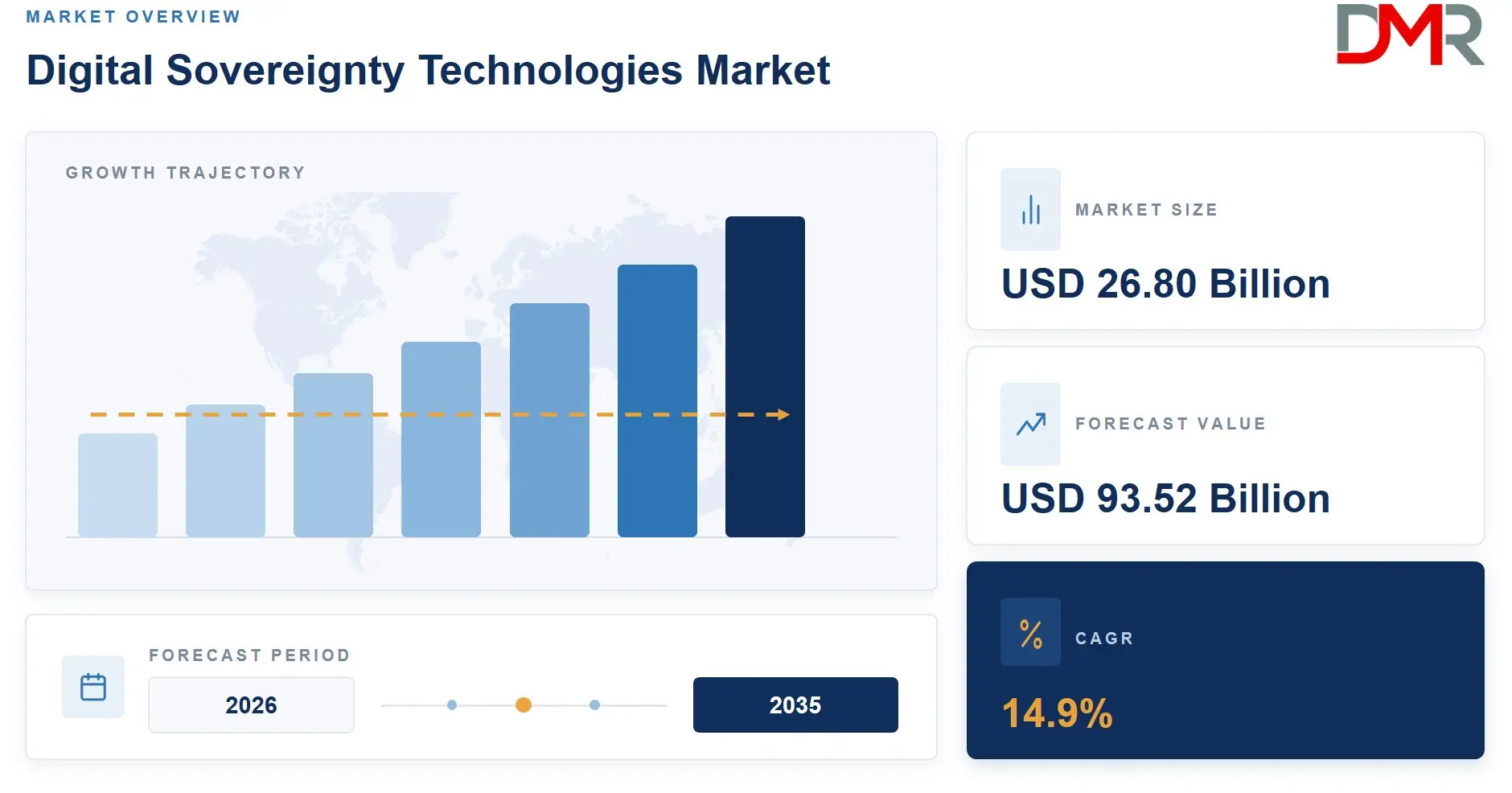
The Global Digital Sovereignty Technologies Market size is estimated at USD 26.80 Billion in 2026, and is projected to reach USD 93.52 Billion by 2035, exhibiting a CAGR of 14.9% during the forecast period.
Buyers across Europe, Asia Pacific, and North America are no longer treating sovereignty as a compliance checkbox. BARC's 2026 survey found that the share of organizations rating data sovereignty ""very important"" rose from 42% in 2025 to 51% in 2026, with 89% rating it very or rather important overall. Only 2% considered it unimportant, a figure that signals this category has crossed from optional to structural. The forecast reflects enterprise technology budgets reallocating toward sovereign architecture as a baseline operating requirement.
Accenture's 2025 European study found that 36% of organizations' AI initiatives and data required a sovereign approach due to regulatory sensitivity. That figure is a floor, not a ceiling. As AI systems process increasingly sensitive government and financial data, sovereign technology layers will extend from storage into compute and model inference.
Digital Sovereignty covers technologies that allow governments and enterprises to control their own data, infrastructure, and AI systems independent of foreign jurisdictional exposure. The market spans sovereign cloud platforms, encryption and key management tools, data residency enforcement systems, and identity sovereignty frameworks. Sectors excluded include standard commercial cloud services without jurisdictional controls and general-purpose cybersecurity tools not architected for sovereignty compliance.
In January 2026, Amazon Web Services launched the AWS European Sovereign Cloud, its first physically and logically isolated cloud region in Brandenburg, Germany, operated entirely by EU-resident staff. That launch marks a structural shift: hyperscalers are no longer selling sovereignty as an add-on. They are building separate physical infrastructure to serve regulated buyers, which compresses the competitive window for niche sovereign-only vendors.
ℹ
To learn more about this report –
Download Your Free Sample Report Here
Key Takeaways
- The market size is USD 26.80 Billion in 2026, and is projected to hit USD 93.52 Billion by 2035 at a CAGR of 14.9%.
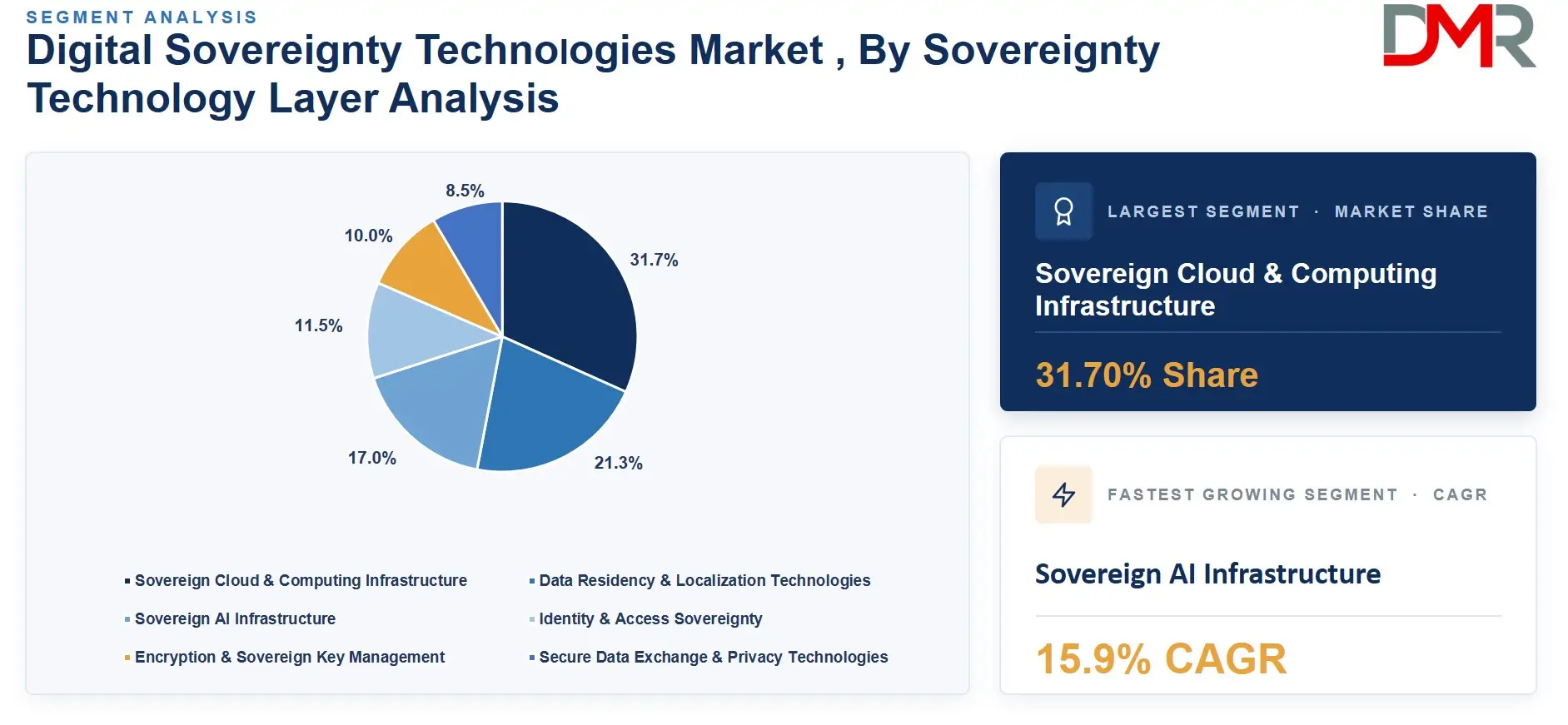
- By Sovereignty Technology Layer: Sovereign Cloud & Computing Infrastructure led with a 31.70% share in 2026.
- By Sovereignty Control Domain: Data Sovereignty led with a 41.10% share in 2026.
- By Deployment Architecture: Sovereign Public Cloud led with a 45.80% share in 2026.
- By Enterprise Use Case: Regulatory Compliance & Data Residency led with a 33.00% share in 2026.
- By Customer Type: Large Enterprises led with a 49.2% share in 2026.
- By Industry Vertical: Government & Defense led with a 30.4% share in 2026.
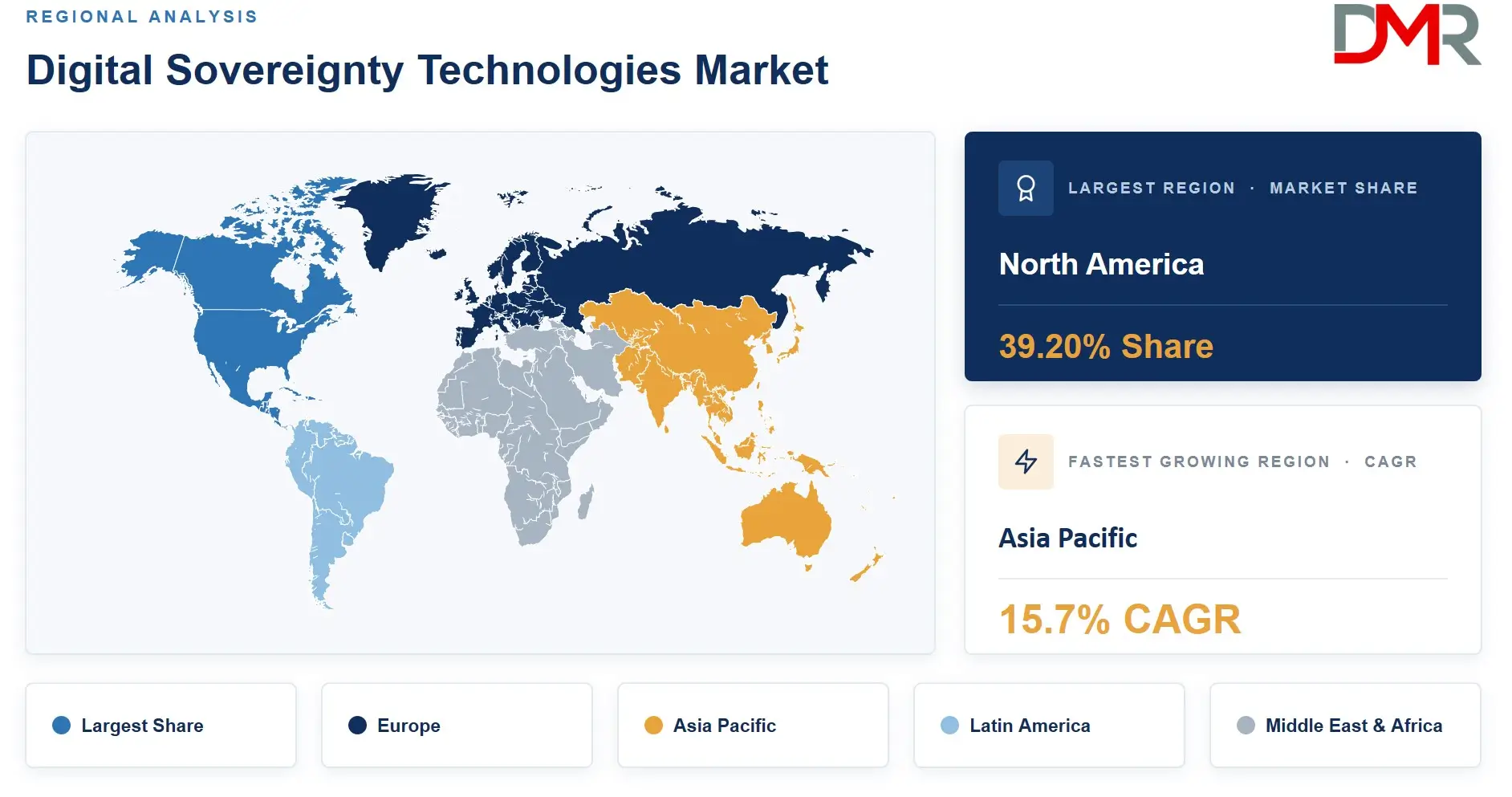
- By Region: North America led with a 39.20% share in 2026.
- Top key players include T-Systems International GmbH, Amazon Web Services Inc., Microsoft Corporation, Google Cloud, and IBM Corporation.
Sovereignty Technology Layer Analysis
Sovereign Cloud & Computing Infrastructure led the Sovereignty Technology Layer segment with a 31.70% share in 2026.
Enterprises running regulated workloads shifted compute to sovereign cloud environments faster than any other technology category. Government buyers across the EU, Australia, and India drove this concentration, prioritizing jurisdictional isolation for data at rest and in transit. The Sovereign Cloud layer absorbs the largest budget share because it sits at the base of every other sovereignty control. Organizations cannot enforce data residency or key management without a compliant compute foundation beneath them.
Sovereignty controls reached only 22% of AI-model layers across surveyed organizations in 2025, according to Accenture. That gap is widening faster than vendors anticipated. Sovereign AI Infrastructure is growing fastest within the layer segment precisely because model-layer exposure is now a board-level risk. Data Residency & Localization Technologies and Encryption & Sovereign Key Management follow in adoption, with Identity & Access Sovereignty growing as zero-trust mandates spread across public sector contracts.
ℹ
To learn more about this report –
Download Your Free Sample Report Here
Sovereignty Control Domain Analysis
Data Sovereignty accounted for 41.10% of Sovereignty Control Domain demand in 2026, the highest of any category.
GDPR enforcement action, the EU Data Act, and India's Digital Personal Data Protection Act each carry hard localization requirements. Enterprises building for multi-jurisdictional compliance treat data sovereignty as the control domain they must solve before any other. The dominant share reflects the legal pressure, not a technology preference. Buyers purchase what regulators compel them to buy.
On-premises system use rose from 19% to 24% between 2025 and 2026, and cloud-workload repatriation doubled from 8% to 16% over the same period, as reported by BARC. AI & Model Sovereignty is the fastest-growing control domain. Operational Sovereignty and Technology Sovereignty are expanding as governments formalize critical infrastructure designation for cloud and telecom systems. Supply-Chain Sovereignty remains the least mature domain but is growing as national procurement mandates extend supplier audit requirements.
Deployment Architecture Analysis
With a 45.80% share in 2026, Sovereign Public Cloud outpaced all other Deployment Architecture categories.
Sovereign public cloud captured the dominant share because large enterprises and mid-tier governments could access jurisdictional compliance without the capital cost of building dedicated private infrastructure. Hyperscalers offering sovereign tiers on existing physical footprints made this the path of lowest friction. IBM's 2026 study found that 73% of organizations operated intentionally multi-vendor AI environments, with 28% using at least four AI providers to reduce lock-in. Sovereign public cloud is the architecture that makes multi-vendor diversification operationally viable at scale.
Hybrid & Federated Sovereign Infrastructure is the fastest-growing architecture category. Sovereign Cloud Services delivered through federated models let organizations keep sensitive workloads on-premises while routing less-sensitive compute to sovereign public tiers. Dedicated Private Infrastructure and On-Premises Sovereign Environments serve the highest-assurance government and defense buyers who cannot accept any shared physical substrate, regardless of jurisdictional isolation controls.
Enterprise Use Case Analysis
Regulatory Compliance & Data Residency captured 33.00% of Enterprise Use Case demand in 2026, ahead of all rivals.
Multinational enterprises operating across ten or more national regulatory regimes built compliance and data residency architecture first. Every other use case depends on the residency foundation. Critical Workload Protection and Cross-Border Data Governance follow in adoption volume. Cloud & Vendor Risk Management is expanding as procurement teams formalize exit-strategy requirements for AI and cloud vendors. AI Governance & Sovereign AI Operations is the fastest-growing use case, driven by public sector buyers mandating auditability for AI-assisted decision systems.
Customer Type Analysis
Large Enterprises led the Customer Type segment as the largest category in 2026.
Large enterprises commanded 49.2% of customer-type demand because their regulatory exposure, cross-border operations, and procurement scale made sovereign architecture financially viable. Government & Public Institutions hold the second position, anchored by national security and public procurement mandates. Critical Infrastructure Operators are growing fastest among institutional buyers as energy, water, and transport networks receive formal critical infrastructure designation. Small & Medium Enterprises remain the smallest segment, constrained by budget and internal expertise gaps.
Industry Vertical Analysis
A 30.4% share made Government & Defense the clear leader across Industry Vertical categories in 2026.
Government and defense buyers set the procurement standards that cascade into every other regulated vertical. BFSI follows, driven by cross-border data-transfer restrictions under financial services regulation in the EU and Singapore. IT & Telecommunications is the fastest-growing vertical because telecoms operators face sovereign 5G infrastructure mandates across the Indo-Pacific and African markets. Healthcare & Life Sciences adoption is accelerating as genomic data residency rules tighten. Energy & Utilities and Manufacturing & Industrial verticals are at earlier adoption stages but face rising regulatory pressure.
Key Market Segments
By Sovereignty Technology Layer
- Sovereign Cloud & Computing Infrastructure
- Data Residency & Localization Technologies
- Sovereign AI Infrastructure
- Identity & Access Sovereignty
- Encryption & Sovereign Key Management
- Secure Data Exchange & Privacy Technologies
By Sovereignty Control Domain
- Data Sovereignty
- Operational Sovereignty
- Technology Sovereignty
- AI & Model Sovereignty
- Supply-Chain Sovereignty
By Deployment Architecture
- Sovereign Public Cloud
- Hybrid & Federated Sovereign Infrastructure
- Dedicated Private Infrastructure
- On-Premises Sovereign Environment
By Enterprise Use Case
- Regulatory Compliance & Data Residency
- Critical Workload Protection
- Cross-Border Data Governance
- Cloud & Vendor Risk Management
- AI Governance & Sovereign AI Operations
- Business Continuity & Digital Resilience
By Customer Type
- Large Enterprises
- Government & Public Institutions
- Critical Infrastructure Operators
- Small & Medium Enterprises
By Industry Vertical
- Government & Defense
- BFSI
- IT & Telecommunications
- Healthcare & Life Sciences
- Energy & Utilities
- Manufacturing & Industrial
- Other Regulated Industries
Regional Analysis
North America led the Digital Sovereignty Technologies Market with a 39.20% share in 2026, reflecting its concentration of hyperscaler infrastructure, federal compliance mandates, and defense procurement budgets.
North America
North American organizations outpaced European peers in sovereignty budget commitment. BARC's 2026 survey found that 16% of North American organizations maintained dedicated sovereignty budgets, versus 9% in Europe, and 57% used existing IT or cloud budgets for sovereignty spending, versus 47% in Europe. Federal cloud security mandates, FedRAMP authorization requirements, and executive orders on AI security have embedded sovereign architecture into public-sector procurement as a non-negotiable baseline.
Asia Pacific
Asia Pacific is the fastest-growing region. Governments across India, Australia, Japan, and Southeast Asia are funding sovereign compute and AI infrastructure through direct state investment rather than waiting for commercial market supply. India's July 2026 Semicon 2.0 approval and Australia's NRFC capital injection into sovereign data centers reflect state strategies that compress the normal private-sector adoption timeline. These programs create immediate demand for technology vendors already certified for sovereign deployment.
ℹ
To learn more about this report –
Download Your Free Sample Report Here
Europe
Europe generates the densest regulatory pressure per capita of any region. GDPR enforcement, the EU Data Act, and the SecNumCloud certification regime each create hard procurement filters that exclude non-compliant vendors from public-sector contracts. The April 2026 European Commission award of a €180 million sovereign cloud contract to a four-provider European consortium illustrates how procurement policy translates into direct revenue for regionally compliant vendors. European enterprise buyers follow public-sector procurement signals faster than buyers in any other region.
Key Regions and Countries
North America
Europe
- Germany
- France
- The UK
- Spain
- Italy
- Rest of Europe
Asia Pacific
- China
- Japan
- South Korea
- India
- Australia
- Rest of APAC
Latin America
- Brazil
- Mexico
- Rest of Latin America
Middle East & Africa
- GCC
- South Africa
- Rest of MEA
Macroeconomic Impact
Geopolitical decoupling between major technology powers is functioning as a structural demand accelerator. Trade restrictions on semiconductor exports and technology licensing controls have made foreign digital infrastructure dependency a balance-sheet risk for governments and large enterprises alike. BARC's 2026 survey found that 46% of organizations reported sovereignty initiatives improved their innovation capability, with the rate reaching 71% among those maintaining dedicated sovereignty budgets. Macroeconomic uncertainty, rather than suppressing investment, is accelerating it in this category. Buyers treat sovereign architecture as a hedge against political disruption rather than a discretionary upgrade.
Currency volatility and divergent interest rate environments between North America, Europe, and Asia Pacific affect capital allocation timelines but not strategic direction. Sovereign technology programs backed by government funding are less sensitive to rate cycles than private enterprise technology budgets, creating a demand floor that persists through economic downturns.
Market Dynamics
Driver: Regulatory Mandates and Geopolitical Exposure Forcing Architecture Change
Accenture's 2025 European study found that 62% of organizations sought sovereign technology solutions specifically because of geopolitical uncertainty, with rates reaching 80% in Denmark and 72% in both Ireland and Germany. EU Data Act and GDPR enforcement, India's Digital Personal Data Protection Act, and critical infrastructure designation for cloud and telecom systems have converted sovereign architecture from a preference into a legal requirement. In April 2026, the European Commission awarded a €180 million sovereign cloud contract to a four-provider European consortium, demonstrating how regulatory mandates translate directly into funded procurement cycles.
IBM's 2026 study found that 91% of organizations did not fully understand their dependencies across AI vendors, models, and infrastructure. Executives estimated that moving AI training and operational datasets to another environment would take an average of 145 days, and 68% described meeting cross-geography data-residency requirements as challenging. Blind dependency on foreign AI infrastructure is the mechanism translating geopolitical risk into sovereign technology demand at the enterprise level.
Restraint: Fragmented Standards and Domestic Capability Gaps Raising Costs
BARC's 2026 survey found that only 29% of organizations had made data sovereignty a core part of their strategy, with 24% handling it implicitly and 14% not addressing it at all. The absence of internationally harmonized sovereignty standards forces multi-jurisdictional vendors to build separate compliance architectures for each regulatory regime. That fragmentation compounds the cost of deployment and delays adoption among mid-tier enterprises without dedicated compliance teams.
IBM's 2026 data showed that 75% of organizations that switched or attempted to switch AI vendors described the process as difficult, citing data portability failures, model revalidation costs, compliance mismatches, or technical lock-in. Technical barriers to sovereignty implementation rose sharply from 26% in 2025 to 43% in 2026, with insufficient human resources at 44% and missing internal expertise at 35% cited as the leading constraints, per BARC. Mid-tier economies lack the domestic semiconductor, cloud, and AI model capability to build sovereign stacks independently, forcing continued dependence on the foreign vendors their sovereignty policies seek to displace.
Opportunity: Sovereign AI Infrastructure and Cross-Border Confidential Computing
A March 2026 Red Hat survey found agentic-AI usage at 91% in France and 90% in Germany, yet only 25% of UK respondents reported strong agentic-AI governance. Organizations reported an average of six AI-related disruptions over two years, and 81% said a seven-day AI-vendor outage would cause severe or critical operational disruption. The gap between AI adoption speed and governance maturity is the addressable white space. Vendors supplying domestically trained foundation models, national vector databases, and government LLM infrastructure are entering a category with state-level demand and no dominant incumbent.
Organizations with the strongest AI-control capabilities protected 55% more operating profit from AI-related disruptions than peers with weaker controls, yet only 7% of organizations had reached this advanced level in 2026. Confidential Computing and trusted execution environment technologies address cross-border data collaboration scenarios where full localization is operationally impractical. Sovereign 5G and Open RAN deployments across the Indo-Pacific and African markets offer an additional expansion pathway for vendors positioned outside the Huawei and Western hyperscaler monoculture.
Porter's Five Forces
Competitive intensity in the digital sovereignty technologies market is shaped by structural lock-in on the supply side and rising buyer leverage on the demand side. IBM's 2026 study found that 71% of executives said switching their primary AI vendor would be difficult if required immediately, which reduces near-term buyer bargaining power despite strong strategic intent to diversify. Supplier power among hyperscalers and hardware manufacturers is significant: sovereign compute depends on semiconductor supply chains, and only a handful of vendors control the trusted hardware environments required for high-assurance sovereign deployments. Barriers to new entrants are high in upper-tier sovereign segments. Government certification requirements, physical data-center investment, and the need for resident-national operations staff create capital and compliance thresholds that exclude most new entrants. IBM confirmed that 57% of executives said replacing a core AI model would require significant decoupling work or a full system rebuild, which reduces the threat of substitution once a sovereign platform is embedded. Competitive rivalry is intensifying at the mid-tier, where regional cloud providers and system integrators compete for public-sector contracts that hyperscaler sovereign tiers do not fully satisfy.
AI and Gen AI Impact
Generative AI is creating a new tier of sovereignty exposure. Accenture's 2025 global survey found that sovereignty controls covered only 22% of AI-model layers across organizations, the lowest coverage of any infrastructure tier. Where enterprises have full control over data and infrastructure layers, model-layer sovereignty remains largely unaddressed. Only 15% of organizations had assigned sovereign-AI responsibility to the CEO or board, with 37% placing it under the chief data or AI officer and 29% under compliance or risk functions. Fragmented ownership at the model layer is slowing governance investment even as model adoption accelerates.
Red Hat's 2026 UK survey found that 48% of organizations had complete visibility into where their AI data was stored, processed, and potentially accessible, while 45% had only partial visibility. Early movers investing in model-layer sovereignty controls, AI governance platforms, and sovereign inference infrastructure are capturing procurement contracts that require full AI auditability. Organizations that delay model-layer governance risk being excluded from regulated public-sector AI procurement entirely as jurisdictions tighten auditability requirements.
Market Trends
Hybrid Architecture and Multi-Cloud Diversity Displacing Single-Vendor Dependency
BARC's 2026 survey identified cybersecurity investment as the leading sovereignty measure at 43%, followed by stronger IT and data security at 35%, hybrid-cloud and on-premises architecture at 35%, regional or local cloud providers at 29%, and multi-cloud architecture at 26%. Gaia-X federation standards, France's SecNumCloud certification regime, and hyperscaler sovereign product lines are normalizing tiered compliance architecture as a commercial category. Red Hat's 2026 survey found that 67% of organizations maintained an AI-provider exit strategy, confirming that vendor lock-in avoidance has moved from aspiration to procurement policy.
Market Competition Overview
The digital sovereignty technologies market is fragmented at the regional and mid-tier levels but increasingly consolidated at the hyperscaler sovereign tier. Cloud Security architecture demands are driving large cloud providers to build physically separate sovereign environments rather than repurpose existing infrastructure, which expands their lead over regional challengers. Accenture's 2025 data showed that 55% of organizations preferred combining local and global sovereign providers, with only 27% focused exclusively on local providers. That preference signals a hybrid competitive structure: hyperscalers capture the compute layer while regional and national providers hold compliance certification and operations staff advantages that global vendors cannot easily replicate.
BARC's 2026 survey found that 46% of organizations had fully established or well-defined sovereign technical architecture, and 44% reported equivalent strategic alignment. IBM's 2026 data showed that 72% of executives would accept a 20% cost increase to maintain multiple AI vendors for strategic flexibility, which sustains demand for challenger vendors even when hyperscaler sovereign tiers are available. Competitive gains are flowing toward vendors that can offer certified sovereign operations, cross-border compliance coverage, and AI governance tooling as a bundled stack.
Pricing Analysis
Sovereign technology pricing carries a structural premium over standard cloud and software contracts. IBM's 2026 study found that misalignment between AI data placement and model execution produced 2.8 times higher token-processing costs, with approximately USD 50 million in additional costs estimated for a USD 20 billion enterprise delivering equivalent AI capabilities without sovereignty controls. That cost differential is pushing buyers toward vendors that offer integrated sovereignty architecture rather than layered-on compliance add-ons. Integrated stacks reduce the misalignment cost that fragmented sovereign deployments generate.
IBM's 2026 survey found that 56% of executives said moving core AI systems to another vendor would require at least six months. Switching cost asymmetry keeps pricing power elevated for incumbent sovereign platform vendors. Challengers are entering on fixed-fee compliance-as-a-service models to lower the initial acquisition barrier for mid-tier enterprise and government buyers who cannot justify capital-intensive sovereign infrastructure investment from an existing IT budget.
Company Profiles
T-Systems International GmbH operates as a dedicated sovereign cloud and digital infrastructure provider within the Deutsche Telekom Group, giving it a structural advantage in European public-sector procurement that hyperscaler sovereign tiers cannot easily replicate. The company's Open Telekom Cloud platform holds BSI C5 certification, meeting the German federal government's cloud security baseline. T-Systems positions its sovereign credentials not as a compliance layer but as a primary product differentiator, targeting government, BFSI, and critical infrastructure operators across the DACH region and EU expansion markets.
Amazon Web Services, Inc. entered the sovereign cloud category at scale with the January 2026 launch of the AWS European Sovereign Cloud, physically isolated in Brandenburg, Germany, and staffed entirely by EU residents. That investment signals AWS is treating sovereign architecture as a long-term revenue tier rather than a regulatory accommodation. The company's risk is that sovereign product lines fragment its operational simplicity advantage, and the cost of maintaining isolated infrastructure across multiple jurisdictions could compress margins relative to its standard cloud business.
Key Players
- T-Systems International GmbH
- Amazon Web Services, Inc.
- Microsoft Corporation
- Google Cloud
- IBM Corporation
- Oracle Corporation
- SAP SE
- OVHcloud
- Thales Group
- Atos SE
- Alibaba Cloud
- Huawei Cloud
- Tencent Cloud
- Rackspace Technology
- VMware
- Capgemini
- Orange Business Services
- Civo
- NVIDIA Corporation
- Dell Technologies Inc.
Supply Chain and Value Chain Analysis
The digital sovereignty technologies value chain runs from sovereign hardware and semiconductor supply through certified cloud infrastructure, then to sovereignty software and compliance platforms, and finally to system integration, managed services, and end-user deployment. Maximum value creation sits at the certified infrastructure and compliance platform layers, where regulatory approval creates durable pricing power. The most acute bottleneck is sovereign hardware supply. Trusted Execution Environment chips, Hardware Security Modules, and domestically manufactured server infrastructure are produced by a small number of vendors, and certification processes for government-grade hardware extend deployment timelines by months. Mid-tier economy buyers face the sharpest supply constraints because domestic semiconductor capability is absent and import dependence contradicts the sovereignty mandate they are trying to satisfy.
Regulatory Landscape
Europe leads in regulatory density. GDPR enforcement, the EU Data Act, and the NIS2 Directive on critical infrastructure security collectively create overlapping data-handling obligations that make sovereign architecture a procurement prerequisite for public-sector vendors. France's SecNumCloud certification and Germany's BSI C5 standard have become de facto market-access filters in national public-sector procurement. Non-European hyperscalers face sustained legal uncertainty under the EU-U.S. Data Privacy Framework, which remains subject to legal challenge. That uncertainty sustains enterprise demand for EU-operated sovereign alternatives.
Asia Pacific regulatory frameworks are diverging rapidly. India's Digital Personal Data Protection Act creates hard localization requirements. Australia's Security of Critical Infrastructure Act extends regulatory obligations to cloud and data services. Across the Indo-Pacific, national AI governance frameworks are under active development, and sovereign compute mandates are being embedded into defense and intelligence procurement standards. Latin America and the Middle East are at earlier stages but are building data localization frameworks modeled on European precedents.
Investment and White Space Analysis
Investment in digital sovereignty is concentrated among the most-committed buyers and largely absent among the majority. BARC's 2026 survey found that only 10% of organizations maintained a dedicated data-sovereignty budget, 49% funded sovereignty through existing IT or cloud budgets, and 40% had made no investment at all. The 40% non-investing segment is the primary white space. Vendors offering modular, compliance-as-a-service entry points priced to fit existing IT budgets can access this segment without requiring buyers to justify new budget lines. Among organizations with dedicated sovereignty budgets, 75% had well-defined or fully established strategic alignment and 54% had corresponding technical architecture in place, showing that committed buyers convert quickly into full-stack deployments once the budget decision is made.
BARC found that the positive innovation rate from sovereignty initiatives reached 58% among organizations that embedded sovereignty in their core strategy and 71% among those with dedicated budgets. That innovation return data gives vendors a commercial argument that sovereignty investment is not a cost center but a capability multiplier. Sovereign AI infrastructure, confidential computing platforms, and cross-border governance tools for multinational enterprises represent the three highest-growth white spaces where incumbent vendors have not yet established dominant positions.
Recent Developments
- May 2025: Oracle expanded the service capabilities of its Oracle EU Sovereign Cloud framework, natively offering over 200 IaaS, PaaS, and generative AI services across its Madrid and Frankfurt regions, operated independently by isolated EU legal entities.
- July 2025: SUSE introduced specialized sovereign tech support infrastructure designed to keep all troubleshooting telemetry, data routing, and technical responses bound within EU data centers and strict legal structures.
- March 2026: Macquarie Technology Group secured an AUD 200 million investment allocation from the Australian Government's National Reconstruction Fund Corporation to scale federal-grade sovereign data centers and cybersecurity capabilities.
- April 2026: The United Kingdom government launched a £500 million Sovereign AI Fund alongside a £750 million commitment to build a national strategic AI supercomputer, securing independent domestic compute capacity.
- July 2026: The Union Cabinet of India approved Semicon 2.0 with a large financial outlay to build domestic technological sovereignty across semiconductor and AI computing value chains, building on the initial USD 1.25 billion IndiaAI compute pool expansion.
Report Details
| Report Characteristics |
| Market Value (2026) |
USD 26.80 Billion |
| Forecast Revenue (2035) |
USD 93.52 Billion |
| CAGR (2026–2035) |
14.9% |
| Base Year for Estimation |
2025 |
| Historic Period |
2020 – 2024 |
| Forecast Period |
2026 – 2035 |
| Report Coverage |
Revenue Forecast, Market Dynamics, Competitive Landscape, Recent Developments |
| Segments Covered |
By Sovereignty Technology Layer (Sovereign Cloud & Computing Infrastructure, Data Residency & Localization Technologies, Sovereign AI Infrastructure, Identity & Access Sovereignty, Encryption & Sovereign Key Management, Secure Data Exchange & Privacy Technologies), By Sovereignty Control Domain (Data Sovereignty, Operational Sovereignty, Technology Sovereignty, AI & Model Sovereignty, Supply-Chain Sovereignty), By Deployment Architecture (Sovereign Public Cloud, Hybrid & Federated Sovereign Infrastructure, Dedicated Private Infrastructure, On-Premises Sovereign Environment), By Enterprise Use Case (Regulatory Compliance & Data Residency, Critical Workload Protection, Cross-Border Data Governance, Cloud & Vendor Risk Management, AI Governance & Sovereign AI Operations, Business Continuity & Digital Resilience), By Customer Type (Large Enterprises, Government & Public Institutions, Critical Infrastructure Operators, Small & Medium Enterprises), By Industry Vertical (Government & Defense, BFSI, IT & Telecommunications, Healthcare & Life Sciences, Energy & Utilities, Manufacturing & Industrial, Other Regulated Industries) |
| Regional Analysis |
North America – US and Canada; Europe – Germany, France, The UK, Spain, Italy, and Rest of Europe; Asia Pacific – China, Japan, South Korea, India, Australia, and Rest of APAC; Latin America – Brazil, Mexico, and Rest of Latin America; Middle East & Africa – GCC, South Africa, and Rest of MEA |
| Competitive Landscape |
T-Systems International GmbH, Amazon Web Services Inc., Microsoft Corporation, Google Cloud, IBM Corporation, Oracle Corporation, SAP SE, OVHcloud, Thales Group, Atos SE, Alibaba Cloud, Huawei Cloud, Tencent Cloud, Rackspace Technology, VMware, Capgemini, Orange Business Services, Civo, NVIDIA Corporation, Dell Technologies Inc. |
| Customization Scope |
Customization for segments and region or country level will be provided. Additional customization can be done based on requirements. |
| Purchase Options |
Three license options: Single User License, Multi-User License (Up to 5 Users), and Corporate Use License (Unlimited Users and Printable PDF) |
Frequently Asked Questions
What is the biggest investment opportunity in the Digital Sovereignty Technologies Market?
▾ Sovereign AI infrastructure represents the highest-growth white space, with model-layer sovereignty controls reaching only 22% of organizations surveyed in 2025. Domestically trained foundation models, national vector databases, and government LLM deployments are entering active public procurement without a dominant incumbent vendor. Vendors entering this tier now face state-level demand and limited direct competition.
Who are the top companies in the Digital Sovereignty Technologies Market?
▾ Leading companies include T-Systems International GmbH, Amazon Web Services Inc., Microsoft Corporation, Google Cloud, and IBM Corporation. Regional challengers including OVHcloud, Orange Business Services, and Thales Group hold durable advantages in European public-sector contracts where operational staff residency requirements exclude non-EU hyperscaler tiers.
Which segment is growing fastest in the Digital Sovereignty Technologies Market and why?
▾ Sovereign AI Infrastructure is the fastest-growing technology layer, AI & Model Sovereignty the fastest-growing control domain, and AI Governance & Sovereign AI Operations the fastest-growing enterprise use case. Governments across Europe, Asia Pacific, and North America are embedding AI auditability and model-layer sovereignty into public procurement requirements, pulling forward demand that the commercial market had not yet fully anticipated.
Which region is growing fastest in the Digital Sovereignty Technologies Market and why?
▾ Asia Pacific is the fastest-growing region, driven by state-funded sovereign compute programs in India, Australia, and Japan that compress the normal private-sector adoption timeline. India's Semicon 2.0 approval and Australia's AUD 200 million NRFC investment in sovereign data center infrastructure exemplify direct government capital deployment into this category. These programs create immediate certified vendor demand rather than waiting for commercial market development.
What is the biggest challenge holding in the Digital Sovereignty Technologies Market back?
▾ The absence of internationally harmonized sovereignty standards is the primary structural barrier. Technical barriers to implementation rose from 26% to 43% between 2025 and 2026, and insufficient human resources and missing internal expertise constrain adoption among mid-tier buyers. Mid-tier economies cannot build sovereign stacks independently, creating a paradox where sovereignty frameworks depend on the foreign vendors they are designed to displace.