India E85-Compatible Fuel Additives Market Snapshot
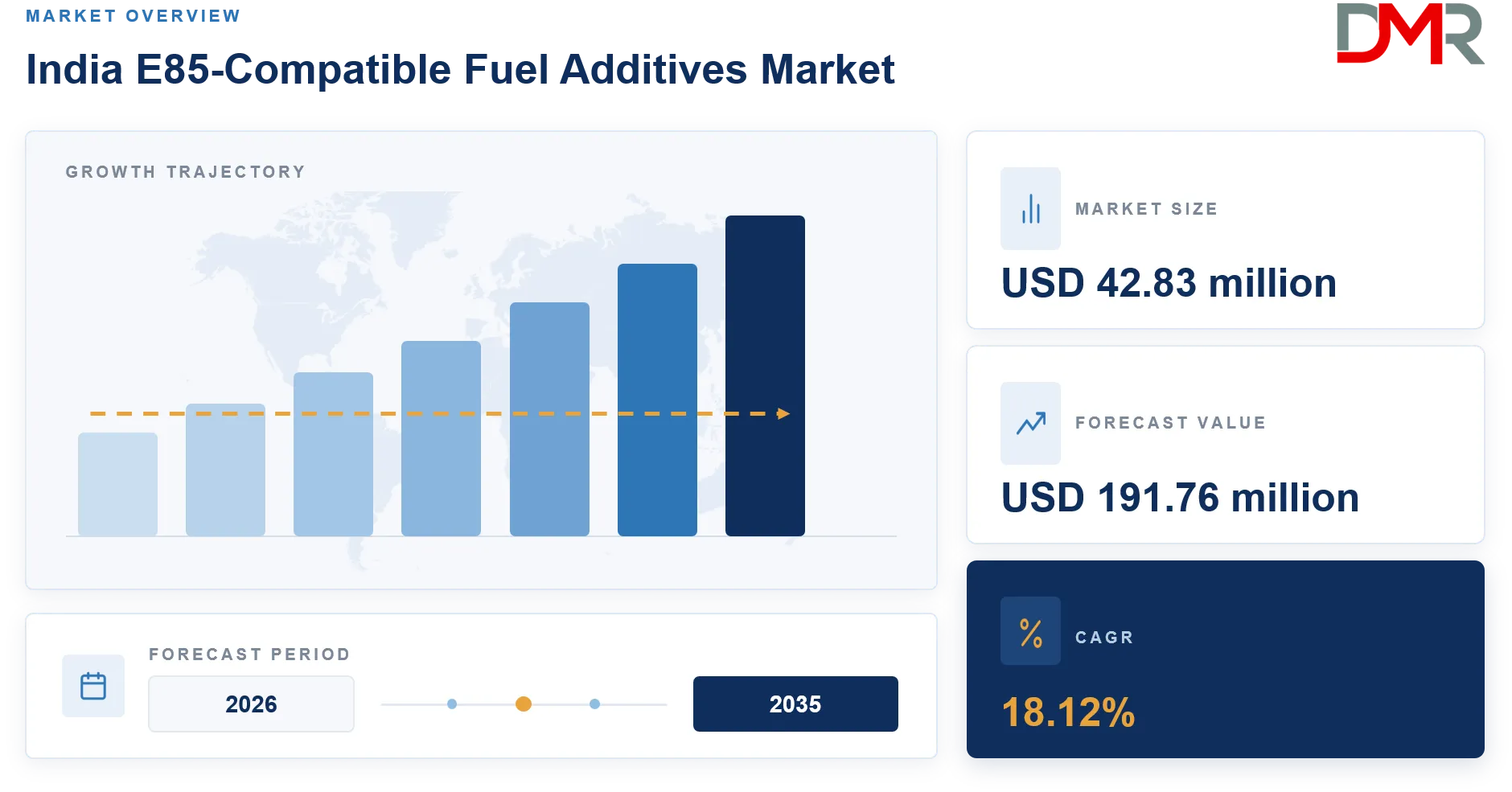
- Market Value: India E85-compatible fuel additives market is valued at USD 42.83 million in 2026 and is expected to reach USD 191.76 million by 2035.
- CAGR: India E85-compatible fuel additives market is expected to grow at a CAGR of 18.12% from 2026 to 2035.
- By Type Segment Analysis: Multifunctional additive packages led the type segment with a 22.4% share in 2026.
- By Function Segment Analysis: Emission reduction & combustion improvement led the functional segment with a 21.7% share in 2026.
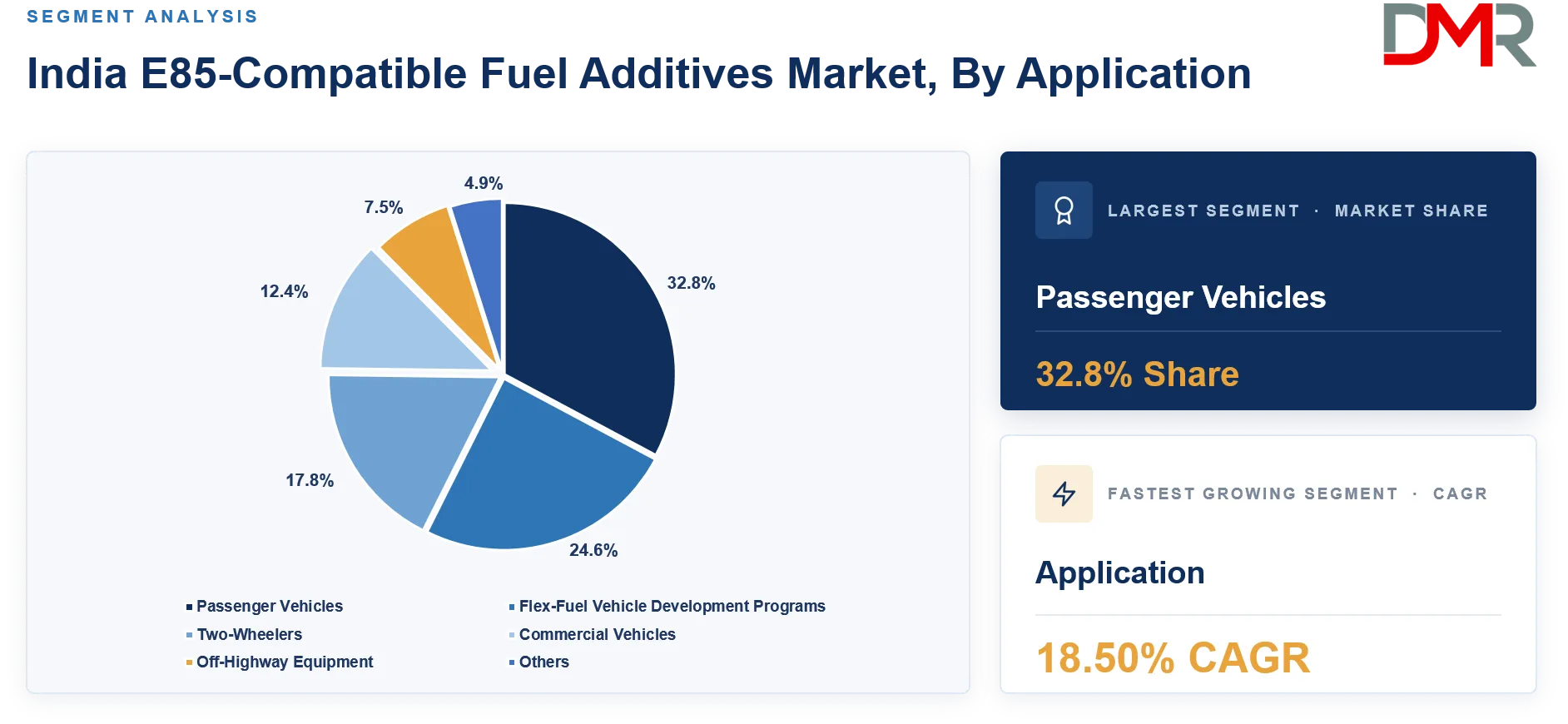
- By Application Segment Analysis: Passenger vehicles held the largest application share at 32.8% in 2026.
- By End User Segment Analysis: Fuel blending facilities accounted for the leading end-user share at 24.6% in 2026.
- Major Players: Chevron Oronite Company LLC, Afton Chemical India Pvt. Ltd., and Others.
What is the India E85-Compatible Fuel Additives Market and its Market Size?
The India E85-compatible fuel additives market size is projected to be valued at USD 42.83 million in 2026 and is expected to reach USD 191.76 million by 2035, expanding at a CAGR of 18.12% during the forecast period. E85-compatible fuel additives include corrosion inhibitors, detergents, antioxidants, lubricity improvers, metal deactivators, water-control agents and multifunctional packages engineered to maintain fuel quality and protect engines, tanks and fuel-distribution equipment exposed to gasoline containing high proportions of ethanol.
ℹ
To learn more about this report –
Download Your Free Sample Report Here
The commercial opportunity is becoming more relevant as India's ethanol ecosystem moves from conventional blending toward higher-ethanol mobility applications. India reached 20% ethanol blending during ethanol supply year 2025-26, while the government has clarified that E85, consisting of approximately 85% ethanol and 15% petrol, is intended specifically for vehicles designed and certified as flex-fuel vehicles. Ethanol production capacity in India also expanded from about 421 crore litres in 2014 to around 2,000 crore litres in 2026, strengthening the supply infrastructure required for broader ethanol use.
Use Cases
- Flex-Fuel Vehicle Protection: E85-compatible additives help protect fuel pumps, injectors, tanks, seals and metallic components against corrosion, deposits and lubrication loss associated with high-ethanol fuels.
- Fuel Blending Operations: Refineries, terminals and blending facilities use multifunctional additive systems to control oxidation, water interaction, corrosion and fuel cleanliness before E85-compatible fuel enters distribution networks.
- Automotive Development: OEM engineering teams use ethanol-compatible additive chemistry while validating flex-fuel powertrains, fuel-system materials and combustion performance across blends ranging from E20 to E85.
- Storage and Distribution: Corrosion inhibitors and water-management additives protect tanks, pipelines, pumps and dispensing infrastructure where ethanol's affinity for moisture can affect fuel handling and long-term storage.
- Combustion and Emissions: Deposit-control agents, detergents and friction-modifying components support injector cleanliness, stable combustion and engine efficiency, helping vehicle manufacturers maintain performance under high-ethanol operating conditions.
How AI/Gen AI is Transforming the India E85-Compatible Fuel Additives Market?
Digital formulation tools are changing how additive suppliers evaluate chemistry for high-ethanol fuels. Predictive models can compare large combinations of detergents, corrosion inhibitors, demulsifiers, antioxidants and lubricity agents before physical testing begins. Suppliers can connect laboratory results with fuel composition, temperature, moisture exposure and engine operating data to identify formulations that remain stable across changing ethanol quality. This is particularly useful in India, where additive developers must account for regional fuel logistics, different ethanol feedstocks, vehicle architectures and the performance requirements of both current E20 platforms and emerging E85-compatible flex-fuel vehicles.
Advanced analytics are also improving quality control and additive-treatment decisions at refineries, fuel terminals and blending facilities. Sensor data from tanks and blending systems can be evaluated for water contamination, oxidation risk, corrosion conditions and off-specification fuel characteristics. For automotive OEMs, simulation and connected-vehicle testing can shorten calibration cycles by identifying deposit formation, combustion variation and material compatibility issues earlier in development. These capabilities support more targeted treat rates and faster product qualification, although final E85 additive performance still depends on physical fuel, engine and materials testing under recognized standards.
Key Drivers in the India E85-Compatible Fuel Additives Market
Expansion of India's Ethanol Fuel Ecosystem
India's rapid ethanol-blending expansion is creating the technical foundation for higher-ethanol fuel applications. Ethanol blending rose from less than 1.5% in 2013-14 to 20% in 2025-26, while national ethanol production capacity reached about 2,000 crore litres in 2026. E85 has also been introduced for certified flex-fuel vehicles. As ethanol concentration increases, fuel suppliers and OEMs need stronger corrosion control, water management, deposit prevention and oxidation protection, directly supporting demand for specialized E85-compatible fuel additive packages.
Development of Flex-Fuel Vehicle Platforms
Indian automotive manufacturers are preparing technology capable of operating beyond E20. Toyota demonstrated a BS6 Stage II electrified flex-fuel prototype based on the Innova Hycross, while SIAM has reported that the two-wheeler industry developed flex-fuel vehicles capable of operating across E20 to E85 and demonstrated mass-production readiness. Higher ethanol exposure changes the fuel-system environment and increases the importance of compatibility, corrosion resistance, detergency and water tolerance. Commercial FFV deployment would therefore expand additive demand across OEM development, fuel blending and retail distribution.
Restraints in the India E85-Compatible Fuel Additives Market
Limited Commercial Scale of E85 Vehicle Adoption
E85 remains a specialized fuel in India rather than the standard nationwide gasoline blend. The government stated in July 2026 that no decision had been taken to raise the base ethanol blending requirement beyond 20% and that E85 is intended exclusively for certified flex-fuel vehicles. This distinction limits immediate E85 additive volumes because demand depends on the pace of FFV commercialization, dedicated dispensing infrastructure and consumer acceptance. Additive suppliers therefore face a market where technical readiness can develop faster than near-term consumption.
Fuel Quality and Water-Management Complexity
High-ethanol fuels require tighter control of moisture, corrosion and fuel stability across storage and distribution. Ethanol readily interacts with water, making contamination control important throughout terminals, pumps, vehicle tanks and engine systems. Industry solutions already include E85-compatible corrosion inhibitors designed to protect storage facilities, pipelines, pumps and vehicle components. However, additional testing, monitoring and treatment can raise handling complexity and qualification costs for fuel suppliers, particularly where infrastructure was designed primarily for conventional petrol or lower ethanol blends.
Growth Opportunities in the India E85-Compatible Fuel Additives Market
Multifunctional Packages for E20-to-E85 Fuel Systems
The shift from E20 toward vehicle platforms capable of using blends up to E85 creates a strong opening for multifunctional additive packages. Rather than treating corrosion, deposits, lubrication and water separately, refiners and fuel marketers can use integrated formulations that address multiple performance requirements at controlled treat rates. Products already available internationally combine detergency, corrosion protection, water tolerance and friction reduction across ethanol-containing fuels. Suppliers able to validate similar packages for Indian fuel specifications, BS6 engines and local distribution conditions can capture higher-value contracts.
Two-Wheeler Flex-Fuel Commercialization
India's two-wheeler sector represents an important volume opportunity because industry participants have developed vehicles capable of operating from E20 to E85. SIAM has stated that the industry has demonstrated mass-production readiness while identifying an E85 fuel roadmap, pricing alignment and taxation as key enablers. Once commercial deployment broadens, additive requirements could extend across fuel terminals, OMC networks and vehicle-development programs. Suppliers with low-treat-rate corrosion inhibitors, injector detergents, lubricity solutions and combustion-support packages could gain from the scale of India's two-wheeler fleet.
Trends in the India E85-Compatible Fuel Additives Market
Increasing Focus on Corrosion and Water Tolerance
Fuel-system protection is becoming a central formulation requirement as ethanol content rises. High-ethanol fuel can create greater corrosion exposure and makes moisture control more important across storage, pipelines and vehicle hardware. Additive developers are therefore combining corrosion inhibitors with demulsification, deposit control and water-tolerance chemistry. Afton, for example, markets a corrosion inhibitor suitable for E85 and other ethanol blends, while broader gasoline packages offer corrosion control and demulsibility. This product direction indicates growing demand for integrated protection rather than single-function treatment.
OEM Validation of High-Ethanol Powertrains
Automotive development is moving from ethanol-blending compliance toward flexible powertrains capable of handling much higher ethanol concentrations. Toyota's India program demonstrated an electrified flex-fuel vehicle designed around BS6 Stage II requirements, and earlier pilot work highlighted FFV operation from E20 to E85. As OEM testing expands, additive suppliers have opportunities to participate earlier in fuel-system validation, deposit testing, durability studies and calibration programs. This increases the strategic importance of additive chemistry that performs consistently across changing ethanol concentrations rather than at one fixed blend.
Research Scope and Analysis
The India E85-compatible fuel additives market is segmented based on type, function, application and end user. The study examines the commercial role of additive chemistry across high-ethanol fuel production, vehicle development, storage, blending and distribution. It also evaluates demand patterns associated with corrosion control, combustion improvement, fuel stability, engine cleanliness, lubricity and water management as India's ethanol ecosystem progresses toward dedicated flex-fuel applications.
ℹ
To learn more about this report –
Download Your Free Sample Report Here
By Type
Multifunctional additive packages dominated the type segment with a 22.4% share in 2026. Their market position reflects the need to address several high-ethanol fuel challenges through one treatment system. E85-compatible packages can combine deposit-control detergents, corrosion inhibitors, lubricity agents, antioxidants and water-management components, allowing blending facilities and OMCs to reduce formulation complexity while meeting multiple performance targets. The segment also benefits from the growing use of direct-injection engines, where injector cleanliness and combustion chamber deposits require close control. Commercial additive portfolios already demonstrate combinations of detergency, friction modification, corrosion control and water tolerance, supporting wider adoption of bundled chemistries as E85-compatible vehicle programs advance.
By Function
Emission reduction & combustion improvement led the functional segment with a 21.7% share in 2026. High ethanol content provides different combustion properties from conventional petrol, making injector condition, deposit management and consistent fuel delivery important for stable engine performance. Performance additives can help maintain injector and intake-valve cleanliness, improve combustion consistency and reduce friction-related efficiency losses. The segment also gains relevance from India's BS6 Stage II environment and the development of flex-fuel powertrains that must operate reliably across changing ethanol concentrations. Additive packages designed for gasoline and alternative fuels increasingly combine detergency with friction modification, corrosion protection and water tolerance, positioning combustion-performance chemistry as a core element of E85 fuel management.
By Application
Passenger vehicles accounted for the largest application share at 32.8% in 2026. The segment benefits from growing OEM work on higher-ethanol powertrains and the need to protect sophisticated fuel-injection hardware. Toyota's electrified flex-fuel prototype based on the Innova Hycross demonstrates how passenger-vehicle engineering is being adapted for higher ethanol blends while retaining BS6 Stage II compatibility. For additive suppliers, passenger vehicles create demand for corrosion control, injector detergency, intake-valve cleanliness, friction modification and water tolerance. Growing adoption of gasoline direct injection further raises the performance threshold because deposit formation can influence fuel economy, emissions and drivability, encouraging OEMs and fuel marketers to adopt more advanced additive packages.
By End User
Fuel blending facilities held the leading end-user share at 24.6% in 2026. These facilities sit at a critical point between ethanol production, petrol supply and downstream fuel distribution, making them responsible for consistent blend quality and additive dosing. India's ethanol procurement and production infrastructure has expanded sharply alongside the E20 program, increasing the operational importance of blending assets. Higher ethanol grades create additional requirements for oxidation control, corrosion protection, water management and storage stability. Additive suppliers that can provide accurate dosing support, product compatibility testing and refinery-to-terminal technical service are therefore positioned to benefit as blending facilities prepare for differentiated fuels intended for certified E85 flex-fuel vehicles.
The India E85-Compatible Fuel Additives Market Report is Segmented on the Basis of the Following:
By Type
- Antioxidants
- Metal Deactivators
- Deposit Control Additives
- Lubricity Improvers
- Demulsifiers & Water Control Additives
- Multifunctional Additive Packages
- Corrosion Inhibitors
- Others
By Function
- Water Management
- Emission Reduction & Combustion Improvement
- Fuel Stability & Oxidation Control
- Lubricity Enhancement
- Corrosion Protection
- Engine Cleanliness & Deposit Control
- Others
By Application
- Off-Highway Equipment
- Flex-Fuel Vehicle Development Programs
- Two-Wheelers
- Commercial Vehicles
- Passenger Vehicles
- Others
By End User
- Fuel Additive Manufacturers
- Automotive OEMs
- Fuel Blending Facilities
- Petroleum Refineries
- Oil Marketing Companies
- Others
Competitive Landscape
The India E85-compatible fuel additives market is characterized by competition among multinational additive formulators, specialty-chemical producers and companies with established Indian manufacturing or distribution networks. Competitive advantage increasingly depends on ethanol compatibility, multifunctional performance, treat-rate efficiency, OEM validation and technical support rather than basic additive availability. Chevron Oronite states that its gasoline additive portfolio is designed for gasoline containing ethanol, including E85, and maintains manufacturing and sales operations in India through Indian Additives Limited. Afton Chemical offers E85 corrosion-inhibitor technology as well as gasoline additives compatible with broad ethanol-blend ranges, while Lubrizol highlights the growing importance of corrosion protection as ethanol concentration increases. Suppliers including Infineum, Evonik, Clariant, LANXESS, Innospec and Dorf Ketal add competition through formulation expertise, specialty chemistry and relationships with refiners and automotive customers. As India's FFV ecosystem develops, partnerships with OMCs, blending facilities and OEM engineering teams are likely to become major differentiators because additives must prove performance across fuel storage, distribution and modern BS6 powertrains.
Some of the prominent players in the India E85-compatible fuel additives industry are:
- Chevron Oronite Company LLC
- Evonik India Pvt. Ltd.
- Dorf Ketal Chemicals India Pvt. Ltd.
- Clariant Chemicals (India) Ltd.
- Infineum International Ltd.
- Afton Chemical India Pvt. Ltd.
- LANXESS India Pvt. Ltd.
- Innospec Performance Chemicals India Pvt. Ltd.
- The Lubrizol Corporation (Lubrizol India Pvt. Ltd.)
- Others
Technology Analysis
Technology development in the India E85-compatible fuel additives market is focused on solving performance issues created by high ethanol concentrations, including water absorption, corrosion, oxidation, deposit formation and reduced fuel-system lubricity. Multifunctional additive packages are gaining technical importance because they combine corrosion inhibitors, deposit-control detergents, antioxidants, metal deactivators, lubricity improvers and water-control agents in a single formulation. Advanced chemistry is also being optimized for gasoline direct-injection systems and flex-fuel engines operating across changing ethanol blends from E20 toward E85. Additive suppliers are improving low-treat-rate formulations to protect injectors, pumps, storage tanks, pipelines and metallic fuel-system components without adversely affecting combustion. As Indian OEMs advance flex-fuel vehicle development and fuel suppliers prepare higher-ethanol infrastructure, technology differentiation will increasingly depend on material compatibility, thermal stability, injector cleanliness, corrosion protection and consistent performance across variable ethanol concentrations.
Patent Analysis
Patent activity relevant to the India E85-compatible fuel additives market is concentrated around formulation chemistry rather than E85 fuel alone. Intellectual property development covers detergent packages, corrosion inhibitors, friction modifiers, antioxidants, demulsifiers, lubricity improvers and multifunctional compositions designed for ethanol-containing gasoline. A key innovation area involves formulations that retain deposit-control and corrosion-protection performance as ethanol concentration changes, since flex-fuel vehicles can operate across a broad gasoline-ethanol range. Patent competition also extends to polyetheramines, succinimide-based detergents, nitrogen-containing compounds, surface-active corrosion inhibitors and combinations that improve injector cleanliness or fuel economy at lower treat rates. For Indian market participants, commercially relevant patents can influence formulation freedom, licensing strategy, localization and partnerships with global additive developers. As E85-compatible vehicle programs mature, new filings are likely to focus on multifunctional chemistry, water tolerance and protection of modern high-pressure fuel systems.
Recent Developments
- June 2026: Indian Oil Corporation Ltd. E85 rollout began at 50–100 fuel stations, with expansion to about 5,000 outlets targeted by 2027, creating a direct demand channel for ethanol-compatible additive packages.
- April 2026: Government of India Draft amendments formally proposed E85 and E100 within vehicle-fuel rules, enabling certified flex-fuel vehicles and establishing a regulatory pathway for India’s E85-compatible additive market.
- March 2025: The Lubrizol Corporation announced a Maharashtra technology and innovation center alongside a planned major manufacturing facility, strengthening localized development and supply capabilities for transportation additives.
Report Details
| Report Characteristics |
| Market Size (2026) |
USD 42.83 Million |
| Forecast Value (2035) |
USD 191.76 Million |
| CAGR (2026–2035) |
18.12% |
| Historical Data |
2021 – 2025 |
| Forecast Data |
2027 – 2035 |
| Base Year |
2025 |
| Estimate Year |
2026 |
| Segments Covered |
By Type (Antioxidants, Metal Deactivators, Deposit Control Additives, Lubricity Improvers, Demulsifiers & Water Control Additives, Multifunctional Additive Packages, Corrosion Inhibitors, and Others), By Function (Water Management, Emission Reduction & Combustion Improvement, Fuel Stability & Oxidation Control, Lubricity Enhancement, Corrosion Protection, Engine Cleanliness & Deposit Control, and Others), By Application (Off-Highway Equipment, Flex-Fuel Vehicle Development Programs, Two-Wheelers, Commercial Vehicles, Passenger Vehicles, and Others), and By End User (Fuel Additive Manufacturers, Automotive OEMs, Fuel Blending Facilities, Petroleum Refineries, Oil Marketing Companies, and Others) |
| Regional Coverage |
India |
Frequently Asked Questions
What is the current size of the India E85-Compatible Fuel Additives Market?
▾ The India E85-Compatible Fuel Additives Market is valued at USD 42.83 million in 2026 and forecast to reach USD 191.76 million by 2035.
What is the growth rate of the India E85-Compatible Fuel Additives Market during?
▾ The India E85-Compatible Fuel Additives Market is expected to grow at a CAGR of 18.12% during the forecast period 2026-2035.
What factors are driving the growth of the India E85-Compatible Fuel Additives Market?
▾ Growth of the India E85-Compatible Fuel Additives Market is driven by ethanol blending, flex-fuel vehicles and demand for fuel-system protection.
What are the major challenges restraining the India E85-Compatible Fuel Additives Market?
▾ The India E85-Compatible Fuel Additives Market faces limited E85 vehicle adoption, infrastructure gaps and complex fuel compatibility requirements.
Which segment holds the largest share of the India E85-Compatible Fuel Additives Market?
▾ Passenger vehicles hold the largest application share of the India E85-Compatible Fuel Additives Market, accounting for 32.8% in 2026.
Who are the leading companies in the India E85-Compatible Fuel Additives Market?
▾ Chevron Oronite Company LLC, Evonik India Pvt. Ltd., Dorf Ketal Chemicals India Pvt. Ltd., Clariant Chemicals (India) Ltd., Infineum International Ltd., Afton Chemical India Pvt. Ltd., LANXESS India Pvt. Ltd., Innospec Performance Chemicals India Pvt. Ltd., and The Lubrizol Corporation (Lubrizol India Pvt. Ltd.) are leading companies in the India E85-Compatible Fuel Additives Market.
How is AI influencing the India E85-Compatible Fuel Additives Market?
▾ AI supports the India E85-Compatible Fuel Additives Market through formulation modeling, fuel-quality monitoring and predictive performance testing.
What are the future opportunities and trends in the India E85-Compatible Fuel Additives Market?
▾ The India E85-Compatible Fuel Additives Market offers opportunities in flex-fuel vehicles, multifunctional additives and advanced corrosion control.