India Textile Manufacturing Automation Market Snapshot
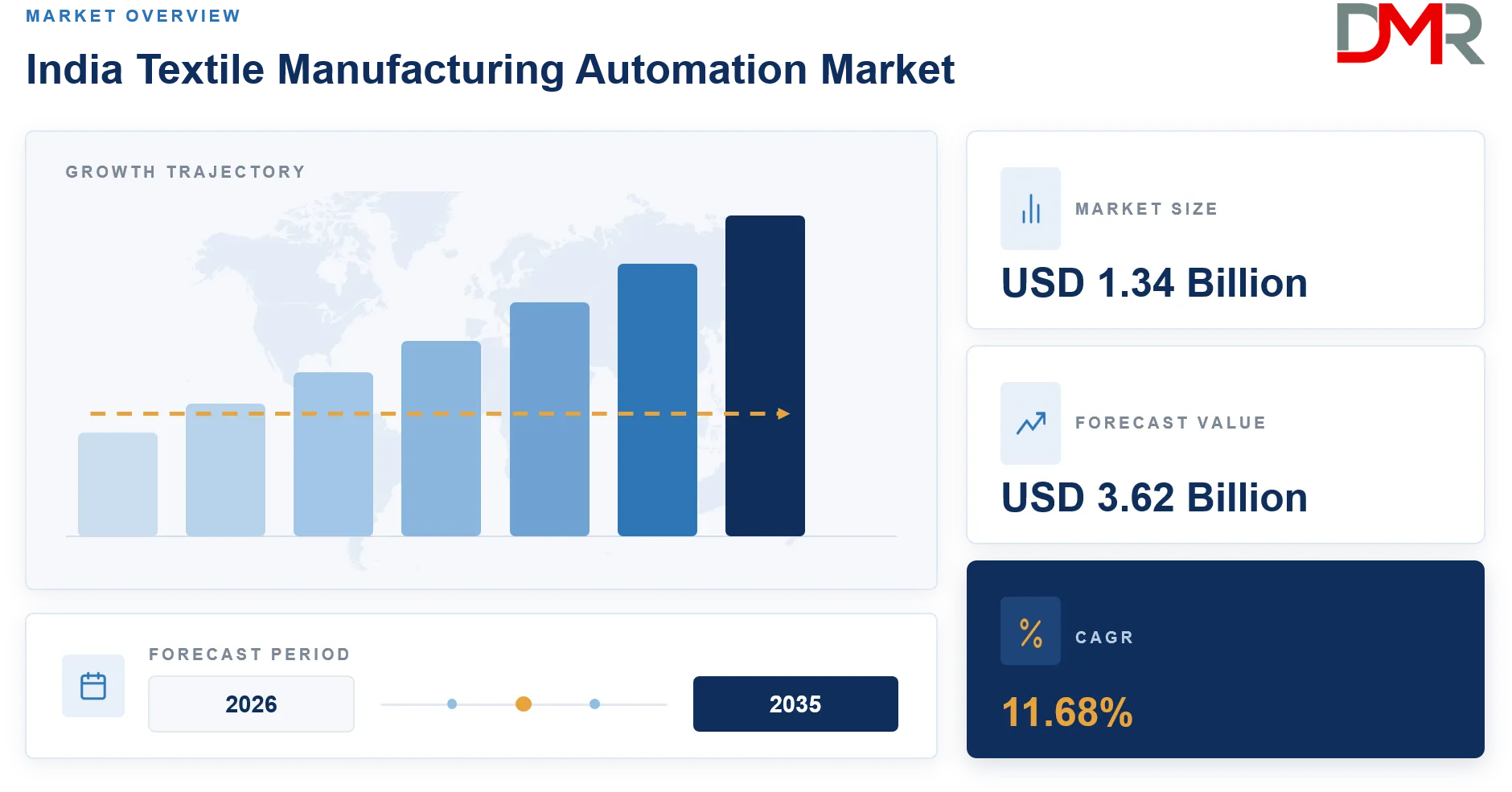
- Market Value: India textile manufacturing automation market is valued at USD 1.34 billion in 2026 and is projected to reach USD 3.62 billion by 2035.
- CAGR: India textile manufacturing automation market is expected to grow at a CAGR of 11.68% from 2026 to 2035.
- By Automation Solution Analysis: Hardware led the market with a 58.4% share in 2026.
- By Manufacturing Process Analysis: Spinning held the leading position with a 24.2% share in 2026.
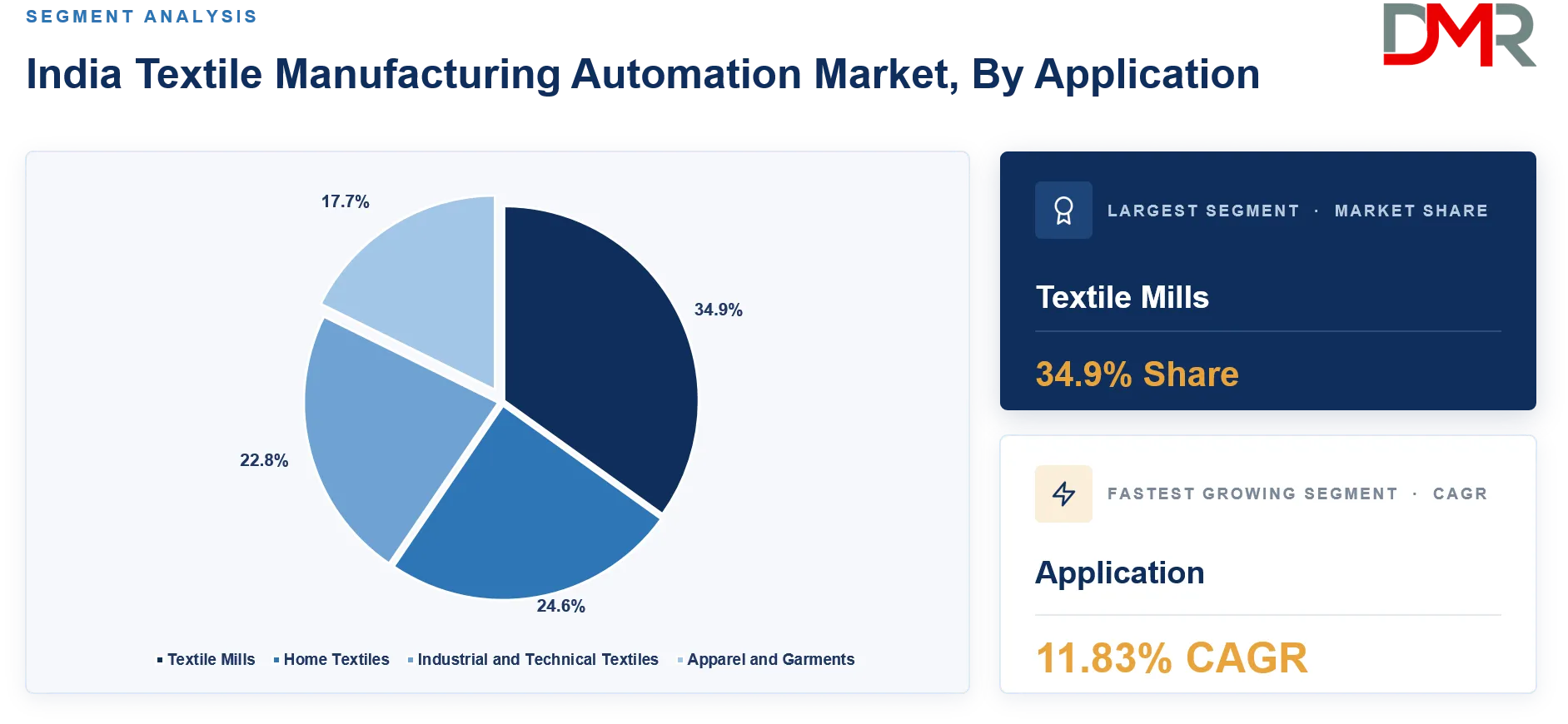
- By Application Analysis: Textile mills accounted for the largest share of 34.9% in 2026.
- By Automation Level Analysis: Semi-automated systems led the market with a 62.8% share in 2026.
- Major Players: Lakshmi Machine Works (LMW), Rieter India, Trützschler India, Saurer Textile Solutions India, and Others.
What is the India Textile Manufacturing Automation Market and its Market Size?
The India textile manufacturing automation market size is projected to be valued at USD 1.34 billion in 2026 and is expected to reach USD 3.62 billion by 2035, expanding at a CAGR of 11.68% during the forecast period. Textile manufacturing automation covers sensors, control systems, industrial robots, machine vision, production software, automated material handling, digital quality inspection, and integrated machinery used across spinning, weaving, knitting, dyeing, finishing, cutting, sewing, and packaging operations.
ℹ
To learn more about this report –
Download Your Free Sample Report Here
India's automation demand is closely linked with the modernization of its large textile manufacturing base. Manufacturers in Tamil Nadu, Gujarat, Maharashtra, Karnataka, Punjab, Telangana, and other production hubs are replacing isolated mechanical processes with connected equipment that can monitor production, energy use, quality, machine condition, and material movement. Government-backed textile parks, modernization initiatives, export quality requirements, technical textile investments, and pressure to raise productivity are supporting capital expenditure. The seven PM MITRA textile parks are designed around integrated manufacturing infrastructure, while investments in man-made fiber and technical textile capacity are creating additional opportunities for automation suppliers.
Use Cases
- Automated Spinning Operations: Connected blowroom, carding, drawing, roving, spinning, winding, and material transport systems reduce manual handling while maintaining stable yarn parameters. Mills can monitor spindle performance, yarn breaks, production speed, waste, energy consumption, and machine availability from centralized production systems.
- Machine Vision Quality Inspection: Cameras, lighting systems, sensors, and inspection software identify fabric faults, yarn irregularities, stains, weaving defects, color variation, and surface problems during production. Automated inspection helps manufacturers improve consistency and reduce dependence on manual visual checking at high line speeds.
- Dyeing and Finishing Control: Automated dosing, temperature control, recipe management, process monitoring, and digital shade management improve batch repeatability. Processing units can control chemicals, water, steam, cycle time, and finishing parameters more precisely, which is important for export orders and resource-intensive wet processing operations.
- Predictive Maintenance: Machine data from vibration, temperature, motor load, pressure, speed, and other operating parameters can identify abnormal conditions before equipment failure. Textile manufacturers use these signals to schedule maintenance, protect critical machinery, reduce unplanned stoppages, and improve asset utilization.
- Automated Material Handling: Automated can transport, bobbin movement, yarn package handling, conveyors, robotic transfer, palletizing, and warehouse systems reduce repetitive movement between processes. The use case is becoming more relevant for large spinning mills and integrated manufacturing facilities seeking lower material handling time and better production traceability.
How AI/Gen AI is Transforming the India Textile Manufacturing Automation Market?
Artificial intelligence is extending textile automation from fixed machine control toward data-driven production decisions. Indian mills are increasingly evaluating machine vision for defect detection, predictive maintenance models, production optimization, intelligent scheduling, energy monitoring, and yarn quality analysis. In spinning, digital mill platforms can combine machine output, energy use, quality measurements, maintenance conditions, and production efficiency in a common operating view. Rieter's digital spinning approach, for example, connects production and quality data with automation, while advanced systems are moving toward autonomous material transport and robotic assistance. Similar capabilities are emerging in weaving and processing, where mills can identify abnormal loom stops, monitor fabric defects, manage recipes, and react to performance deviations faster.
Generative systems can add another decision layer by turning complex factory information into explanations, alerts, operating summaries, maintenance guidance, and searchable technical knowledge. A production manager could compare shifts, locate a recurring efficiency loss, review maintenance history, or summarize quality deviations without manually examining several dashboards. The strongest near-term opportunity in India is likely to be augmentation of supervisors and engineers rather than fully autonomous factories. This matches the market's current structure, where semi-automated systems hold 62.8% of revenue. As mills connect older and newer machines through sensors, software, MES platforms, ERP integration, and edge controls, intelligent analytics can help bridge fragmented production environments while supporting gradual movement toward fully automated textile manufacturing.
Key Drivers in the India Textile Manufacturing Automation Market
Modernization of India's Large Textile Manufacturing Base
Modernization of spinning, weaving, processing, and garment facilities is a central driver of India textile manufacturing automation market growth. Many established manufacturers operate a mix of equipment generations, creating demand for sensors, drives, machine controls, monitoring software, automated inspection, and retrofit solutions. Technology upgrades help mills raise output without matching increases in labor, improve process stability, and reduce production losses. India's modernization programs and state-level support for machinery replacement further strengthen investment in automation-ready textile equipment.
Productivity, Quality, and Export Competitiveness
Export-oriented textile producers require tighter control over yarn quality, fabric defects, batch consistency, delivery schedules, and traceability. Automation allows mills to record production parameters continuously and respond faster when machines move outside target conditions. Modern winding, spinning, inspection, and process control systems reduce variability created by repeated manual intervention. As Indian manufacturers compete for apparel, home textile, technical textile, and yarn orders, the ability to deliver consistent quality at predictable cost is increasing demand for connected machinery and digital production systems.
Restraints in the India Textile Manufacturing Automation Market
High Capital Cost for Smaller Textile Manufacturers
Automation projects can require substantial spending on machinery, sensors, controllers, software, electrical systems, integration, training, and plant modification. This creates a larger financial barrier for small mills and decentralized manufacturing units than for integrated textile groups. A company may also need to continue using productive legacy equipment, reducing the business case for immediate replacement. These conditions favor phased automation, retrofits, modular controls, and semi-automated machinery, explaining why semi-automated systems maintain a strong position in the Indian market.
Legacy Equipment and Integration Complexity
Indian textile plants often contain machines from different suppliers, installation periods, communication standards, and control generations. Connecting such equipment to MES, production monitoring, quality software, or centralized analytics can require custom engineering. Older machines may not expose sufficient operating data, while inconsistent data formats can reduce visibility across the plant. Integration complexity increases project time and places greater importance on system integrators, controls specialists, retrofit providers, and suppliers that can support mixed-machine environments without forcing complete factory replacement.
Growth Opportunities in the India Textile Manufacturing Automation Market
Automation of Brownfield Textile Mills
India's large installed base creates a significant brownfield automation opportunity. Manufacturers do not always need to replace entire spinning, weaving, dyeing, or finishing lines to achieve measurable improvements. Sensors, variable-speed drives, programmable controllers, machine monitoring, automated inspection, energy meters, and digital production platforms can extend existing assets. Suppliers that offer modular upgrades with clear payback periods can address medium-sized mills that are not ready for full automation. This opens a broad market between traditional machinery operation and fully connected smart factories.
Smart Textile Parks and New Integrated Manufacturing Capacity
Greenfield textile parks provide automation vendors with opportunities to design connected production environments from the beginning rather than retrofit existing facilities. India's seven PM MITRA parks are intended to create integrated textile value chains with modern infrastructure and plug-and-play manufacturing facilities. New projects can incorporate automated material movement, centralized utility monitoring, machine connectivity, digital quality systems, warehouse automation, and production software during plant design. This reduces integration constraints and supports larger automation packages across multiple manufacturing processes.
Trends in the India Textile Manufacturing Automation Market
Connected Spinning Mills and Autonomous Material Movement
Spinning automation is shifting from standalone high-speed machines toward connected production systems. Modern solutions link fiber preparation, carding, drawing, roving, spinning, winding, package handling, and mill management software. Autonomous or highly automated can transport, bobbin movement, piecing, package handling, palletizing, and labeling are reducing repetitive factory-floor tasks. Rieter has outlined a path toward spinning mills that combine digital platforms with automated transport and robotics, while Indian machinery suppliers such as LMW continue to strengthen automation across spinning operations.
Machine Vision and Real-Time Quality Management
Quality inspection is moving closer to the production point as machine vision systems become easier to integrate with textile machinery. Cameras and defect classification software can inspect fabric continuously rather than relying only on downstream manual examination. Real-time detection allows operators to link defects to loom conditions, yarn problems, process settings, or recurring machine events. This is particularly relevant for exporters and technical textile producers, where defect tolerance can be low. Demand is therefore expanding for cameras, lighting, edge computing, inspection software, and production data integration.
Research Scope and Analysis
The India textile manufacturing automation market is segmented based on automation solution, manufacturing process, application, automation level, company size, and other relevant categories. The study provides an in-depth analysis of key segments and sub-segments, covering their applications, industry adoption, demand patterns, and contribution to overall market growth.
ℹ
To learn more about this report –
Download Your Free Sample Report Here
By Automation Solution
Hardware dominated the India textile manufacturing automation market with a 58.4% share in 2026. The segment includes sensors and field devices, control systems, industrial robots, and machine vision systems that directly monitor or automate physical manufacturing activities. Textile plants require hardware for machine speed control, temperature and pressure measurement, yarn and fabric inspection, motion control, material handling, and equipment condition monitoring. Hardware also forms the physical foundation for software-led factory intelligence because production platforms depend on reliable machine data. Continued replacement of older equipment, investment in high-speed spinning and weaving lines, camera-based inspection, and robotic handling will support hardware demand through 2035.
By Manufacturing Process
Spinning led the manufacturing process segment with a 24.2% share in 2026, supported by India's extensive yarn production capacity and the high automation potential of short-staple spinning operations. Automation can be applied across blowroom, carding, drawing, roving, ring spinning, winding, fiber preparation, can transport, bobbin handling, and yarn quality monitoring. Suppliers including LMW, Rieter India, Trützschler India, Saurer Textile Solutions India, and Murata Machinery India serve important parts of this production chain. A recent Indian greenfield spinning project by Sportking has also selected advanced Rieter systems and automation for 150,000 spindles, illustrating the scale at which integrated spinning technology can be deployed.
By Application
Textile mills represented the largest application segment with a 34.9% share in 2026. Spinning mills, weaving mills, and processing mills operate continuous or high-throughput equipment where small improvements in uptime, speed, energy consumption, waste, and quality can influence production economics across large volumes. Automation is therefore increasingly connected to operational performance rather than only labor replacement. Production monitoring, machine controls, digital maintenance, quality systems, automated package handling, and energy monitoring provide mill operators with more consistent information for managing output. Integrated mills can gain additional value by connecting information across multiple stages of manufacturing.
By Automation Level
Semi-automated systems accounted for 62.8% of market revenue in 2026. This leadership reflects India's diverse manufacturing structure, which ranges from large integrated textile groups to medium-sized mills and smaller production units. Semi-automation allows manufacturers to automate high-value or repetitive processes without redesigning the entire plant. A mill can automate winding, material transport, quality inspection, production monitoring, or process control while retaining operator involvement elsewhere. Over the forecast period, fully automated systems are expected to gain attention as greenfield facilities, larger textile companies, and export-focused mills adopt integrated robotics, autonomous material handling, digital production management, and connected machine ecosystems.
The India Textile Manufacturing Automation Market Report is Segmented on the Basis of the Following:
By Automation Solution
- Hardware
- Sensors and Field Devices
- Control Systems
- Industrial Robots
- Machine Vision Systems
- Software
- Manufacturing Execution Systems
- Production Monitoring Software
- Quality Control Software
- Enterprise Resource Planning Integration
- Services
- System Integration
- Installation and Commissioning
- Maintenance and Support
By Manufacturing Process
- Spinning
- Fiber Preparation
- Yarn Production
- Winding and Quality Monitoring
- Dyeing and Finishing
- Dyeing
- Printing
- Finishing
- Weaving
- Knitting
- Cutting and Sewing
- Inspection and Quality Control
- Packaging and Material Handling
By Application
- Apparel and Garments
- Home Textiles
- Industrial and Technical Textiles
- Textile Mills
- Spinning Mills
- Weaving Mills
- Processing Mills
By Automation Level
- Semi Automated Systems
- Fully Automated Systems
By Company Size
- Large Textile Manufacturers
- Medium Sized Textile Manufacturers
- Small Textile Manufacturers
Competitive Landscape
The India textile manufacturing automation market includes established textile machinery groups, industrial automation companies, specialist engineering firms, system integrators, robotics providers, and domestic machinery manufacturers. Competition is increasingly based on the ability to combine mechanical equipment with controls, sensors, software, quality monitoring, energy optimization, and lifecycle services. LMW has a strong position in Indian spinning machinery and offers technology across the spinning process. Rieter is advancing automated and digitized spinning through connected machinery, autonomous transport concepts, winding technology, and digital mill management. Trützschler India participates in fiber preparation and spinning technology, while Saurer and Murata Machinery provide specialized spinning and winding solutions.
Industrial automation companies such as Rockwell Automation and Inovance Technology India add control, drive, connectivity, and factory automation capabilities. Domestic engineering specialists compete through lower-cost machinery, customization, retrofits, service access, and faster support for regional mills. As automation expands, interoperability, local service capability, measurable productivity gains, retrofit compatibility, energy performance, and integration with existing machinery will become increasingly important competitive factors.
Some of the prominent players in the India textile manufacturing automation industry are:
- Lakshmi Machine Works (LMW)
- Rieter India
- Trützschler India
- Saurer Textile Solutions India
- Murata Machinery India
- Oerlikon Textile India
- Sieger Spintech Equipments
- Mohler Machine Works
- Reshmi Industries
- Yash Textile Machines
- Gayatritex Engineers
- Baba Textile Machinery
- DEBMAC India
- Retro Robotix
- Hitech Automation Solutions
- Inovance Technology India
- Rockwell Automation
- Batliboi
- Magnum Resources / AM Automation Solutions
- Veyyil Textile Innovation
- Others
Technology Analysis
Technology adoption in the India textile manufacturing automation market is moving from standalone machine controls toward connected production environments that combine sensors, programmable controllers, machine vision, robotics, industrial drives, MES platforms, and ERP integration. Spinning mills are adopting automated fiber preparation, yarn monitoring, winding, bobbin handling, and production management systems to improve output consistency and machine utilization. In weaving and processing, real-time loom monitoring, automated chemical dosing, recipe control, defect inspection, and energy management are gaining importance. Machine vision enables continuous fabric quality inspection, while condition-monitoring sensors support predictive maintenance of motors, bearings, spindles, and other critical assets. Large manufacturers are also integrating production data across equipment from different vendors. This technology shift supports higher traceability, lower waste, faster quality decisions, reduced downtime, and more consistent production, creating demand for both new automated machinery and retrofit solutions for India's extensive installed textile equipment base.
Investment and White Space Analysis
Investment opportunities in the India textile manufacturing automation market are expanding beyond large greenfield factories into brownfield modernization, creating white space for suppliers that can automate existing mills without requiring complete machinery replacement. Medium-sized spinning, weaving, knitting, and processing companies represent an important addressable segment for modular sensors, machine connectivity, automated inspection, energy monitoring, material handling, and production software with measurable payback periods. New integrated textile infrastructure, including PM MITRA parks, creates another opportunity for automation to be incorporated during plant design through connected machinery, centralized utilities, digital quality systems, and automated warehouses. Technical textiles and man-made fiber manufacturing also require tighter process and quality control, opening specialized opportunities for automation providers. Vendors offering retrofit-compatible systems, local integration, financing flexibility, remote diagnostics, cybersecurity, and multi-brand machine connectivity can address gaps between basic semi-automation and expensive fully automated factories.
Recent Developments
- July 2026: Rockwell Automation launched a strategic software-defined manufacturing collaboration with Cisco in India, inaugurating a Gurugram demo pod and digital skills initiative to advance AI-enabled automation for manufacturers.airedale+1
- June 2026: LMW accelerated AI and enterprise-wide digital transformation investments, restructuring business processes to navigate textile machinery slowdown and position for next-phase growth in automation.
- May 2025: Trützschler India inaugurated its ₹400 crore state-of-the-art manufacturing plant in Sanand, Gujarat, consolidating operations and doubling capacity to support automation and digital transformation.
Report Details
| Report Characteristics |
| Market Size (2026) |
USD 1.34 Bn |
| Forecast Value (2035) |
USD 3.62 Bn |
| CAGR (2026–2035) |
11.68% |
| Historical Data |
2021 – 2025 |
| Forecast Data |
2027 – 2035 |
| Base Year |
2025 |
| Estimate Year |
2026 |
| Segments Covered |
By Automation Solution (Hardware {Sensors and Field Devices, Control Systems, Industrial Robots, Machine Vision Systems}, Software {Manufacturing Execution Systems, Production Monitoring Software, Quality Control Software, Enterprise Resource Planning Integration}, and Services {System Integration, Installation and Commissioning, Maintenance and Support}), By Manufacturing Process (Spinning {Fiber Preparation, Yarn Production, Winding and Quality Monitoring}, Dyeing and Finishing {Dyeing, Printing, Finishing}, Weaving, Knitting, Cutting and Sewing, Inspection and Quality Control, and Packaging and Material Handling), By Application (Apparel and Garments, Home Textiles, Industrial and Technical Textiles, and Textile Mills {Spinning Mills, Weaving Mills, Processing Mills}), By Automation Level (Semi Automated Systems and Fully Automated Systems), By Company Size (Large Textile Manufacturers, Medium Sized Textile Manufacturers, and Small Textile Manufacturers) |
| Regional Coverage |
India |
Frequently Asked Questions
What is the current size of the India Textile Manufacturing Automation Market?
▾ The India textile manufacturing automation market is USD 1.34 billion in 2026 and may reach USD 3.62 billion by 2035.
What is the growth rate of the India Textile Manufacturing Automation Market during?
▾ The India textile manufacturing automation market is forecast to grow at an 11.68% CAGR during the 2026-2035 period.
What factors are driving the growth of the India Textile Manufacturing Automation Market?
▾ India textile manufacturing automation market growth is driven by mill modernization, productivity, and quality needs.
What are the major challenges restraining the India Textile Manufacturing Automation Market?
▾ High capital costs and legacy equipment integration restrain the India textile manufacturing automation market growth.
Which segment holds the largest share of the India Textile Manufacturing Automation Market?
▾ Hardware leads the India textile manufacturing automation market by automation solution, with a 58.4% share in 2026.
Who are the leading companies in the India Textile Manufacturing Automation Market?
▾ Lakshmi Machine Works (LMW), Rieter India, Trützschler India, Saurer Textile Solutions India, Murata Machinery India, Oerlikon Textile India, Sieger Spintech Equipments, Mohler Machine Works, Reshmi Industries, Yash Textile Machines, Gayatritex Engineers, Baba Textile Machinery, DEBMAC India, Retro Robotix, Hitech Automation Solutions, Inovance Technology India, Rockwell Automation, Batliboi, Magnum Resources / AM Automation Solutions, and Veyyil Textile Innovation are leading companies in the India textile manufacturing automation market.
How is AI influencing the India Textile Manufacturing Automation Market?
▾ AI is advancing the India textile manufacturing automation market through machine vision and predictive maintenance.
What are the future opportunities and trends in the India Textile Manufacturing Automation Market?
▾ Brownfield retrofits, textile parks, and connected mills offer India textile manufacturing automation market growth.