Middle East Oil & Gas Monitoring System Market Snapshot
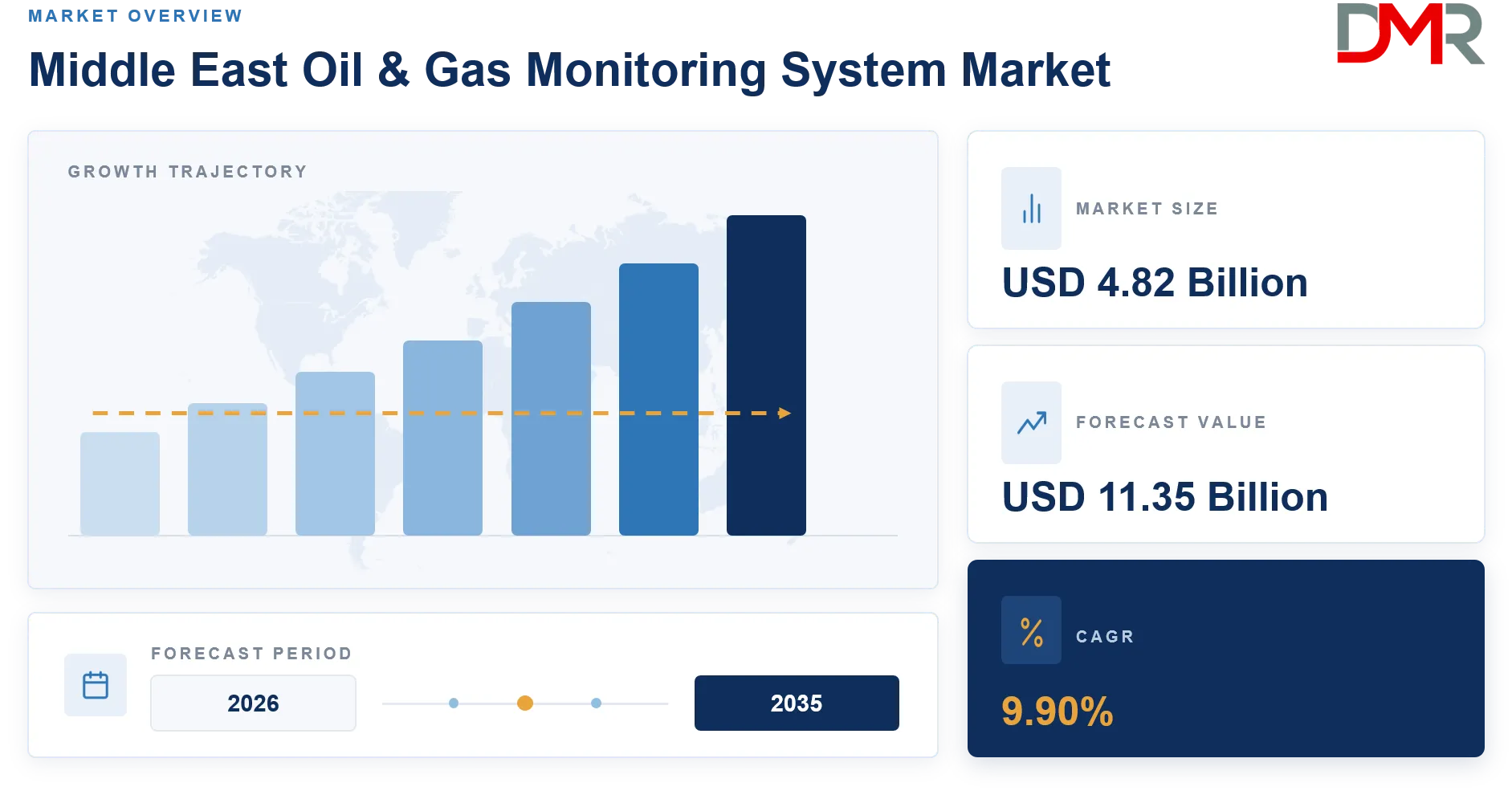
- Market Value: Middle East Oil & Gas Monitoring System Market is valued at USD 4.82 billion in 2026 and is expected to reach USD 11.35 billion by 2035.
- CAGR: Middle East Oil & Gas Monitoring System Market is expected to grow at a CAGR of 9.9% from 2026 to 2035.
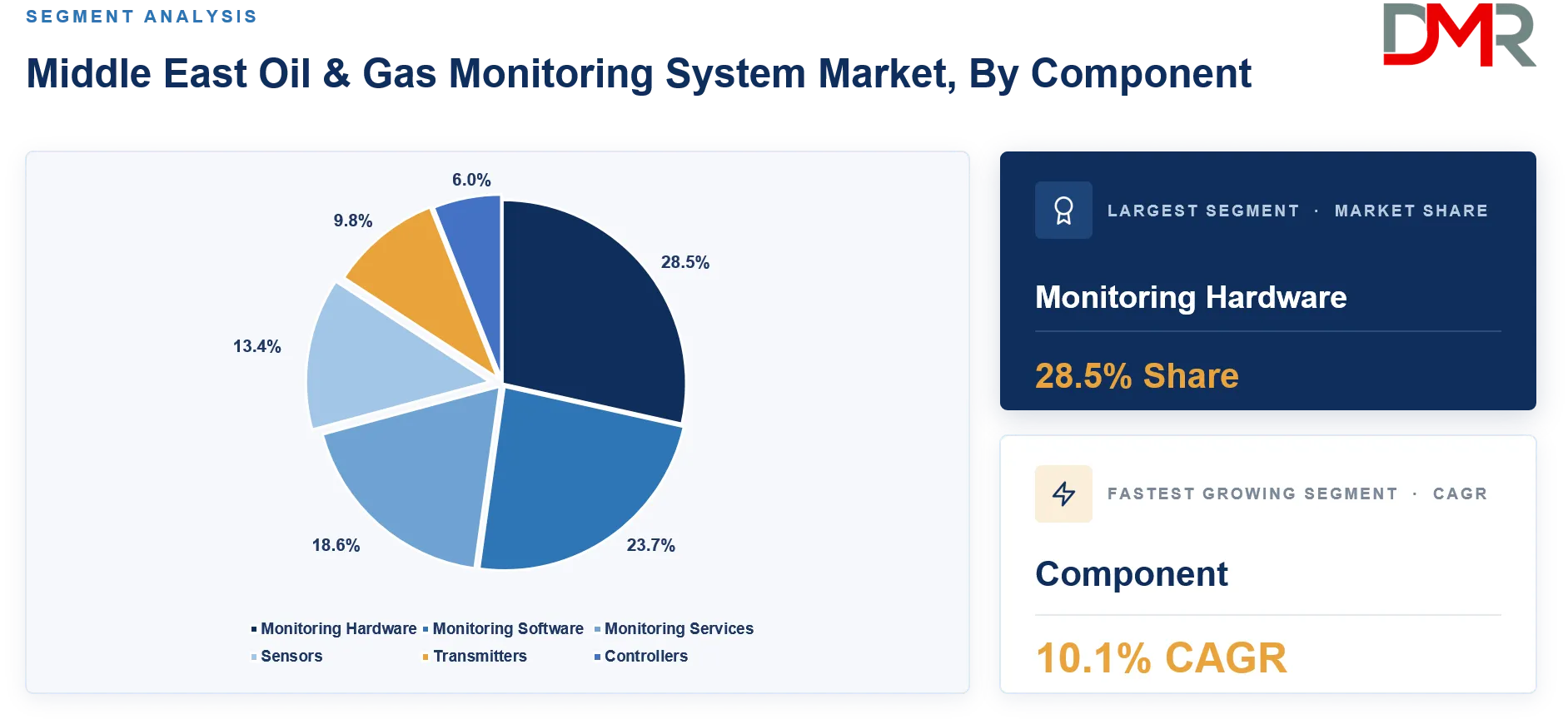
- By Component Analysis: Monitoring Hardware dominated the component segment with a 28.5% share in 2026.
- By Technology Analysis: Wireless Monitoring Systems led the technology segment with a 24.5% share in 2026.
- By Monitoring Type Analysis: Pipeline Integrity Monitoring held a 26.5% share in 2026.
- UAE Market Size: The UAE Oil & Gas Monitoring System Market size is expected to reach USD 2.50 billion by 2035 from USD 1.06 billion in 2026, at a CAGR of 10.0%.
- Saudi Arabia Market Size: The Saudi Arabia Oil & Gas Monitoring System Market size is expected to reach USD 3.18 billion by 2035 from USD 1.35 billion in 2026, at a CAGR of 10.0%.
- Kuwait Market Size: The Kuwait Oil & Gas Monitoring System Market size is expected to reach USD 1.02 billion by 2035 from USD 0.43 billion in 2026, at a CAGR of 10.0%.
- Major Players: Honeywell International, Emerson Electric, Siemens AG, ABB Ltd, and Yokogawa Electric.
What is the Middle East Oil & Gas Monitoring System Market and its Market Size?
The Middle East Oil & Gas Monitoring System Market size is projected to be valued at USD 4.82 billion in 2026 and is expected to reach USD 11.35 billion by 2035, expanding at a CAGR of 9.9% during the forecast period. The market covers hardware, sensors, software, controllers, communication networks, SCADA platforms, pipeline integrity systems, leak detection tools, equipment condition monitoring, emissions monitoring, and remote operating technologies used across upstream, midstream, and downstream assets. Growth is increasingly linked to the need for continuous asset visibility across large oilfields, pipelines, processing plants, export terminals, refineries, offshore platforms, and petrochemical complexes.
ℹ
To learn more about this report –
Download Your Free Sample Report Here
Monitoring systems have become part of the operating infrastructure of Middle Eastern oil and gas companies rather than stand-alone safety equipment. Large operators are connecting field sensors with centralized control systems, analytics platforms, digital twins, and remote operations centers to detect process deviations before they affect production. Saudi Aramco states that IoT sensors can collect real-time well data and combine it with analytics and self-diagnostic tools, while ADNOC has deployed centralized approaches for monitoring critical rotating equipment. These operating models are increasing demand for interoperable monitoring hardware and software.
Use Cases
- Pipeline Integrity Monitoring: Operators use pressure, flow, acoustic, fiber optic, corrosion, and temperature data to identify leaks, abnormal operating conditions, wall degradation, and integrity risks across crude oil and natural gas pipelines. Continuous monitoring supports faster maintenance decisions on geographically dispersed pipeline networks.
- Equipment Condition Monitoring: Sensors monitor vibration, temperature, pressure, lubrication, and operating behavior in pumps, compressors, turbines, motors, and other rotating assets. Maintenance teams use these signals to identify degradation before an unplanned shutdown affects production or processing capacity.
- Leak and Gas Detection: Fixed, portable, optical, wireless, and connected gas detectors identify combustible or toxic gas releases around wells, processing units, storage facilities, pipelines, and refineries. Connected systems can provide faster alarms while creating records for inspection, safety, and emissions management.
- Remote Oilfield Monitoring: Wireless networks and industrial IoT devices allow operators to monitor remote wells, gathering stations, pipelines, tanks, and production equipment without maintaining permanent personnel at every location. The model is particularly relevant for desert fields, offshore sites, and geographically distributed assets.
- Emission Monitoring: Methane sensors, optical gas imaging, continuous monitors, mobile systems, and satellite-supported measurement are being incorporated into emissions management programs. The IEA estimated that fossil fuel operations in the Middle East and North Africa emitted around 20 million tonnes of methane in 2025, with almost all emissions associated with oil and gas activity.
How AI/Gen AI is Transforming the Middle East Oil & Gas Monitoring System Market?
Advanced analytics are changing monitoring from alarm-based observation to condition-based decision support. Instead of reviewing individual sensor readings, oil and gas operators can combine vibration, pressure, temperature, flow, corrosion, imagery, maintenance history, and process data to identify abnormal equipment behavior. Predictive models can prioritize pumps, turbines, compressors, wells, and pipelines that require inspection while reducing unnecessary maintenance. ADNOC's predictive maintenance program was designed to enable centralized monitoring of up to 2,500 critical machines across its group, showing the scale at which equipment data can be consolidated. Saudi Aramco has also applied smart sensors and thermal cameras at its Khurais facility for automated pipeline leak detection.
Generative systems are extending this model by making operational data easier for engineers and managers to interpret. A monitoring platform can combine alarms, work orders, inspection records, operating procedures, equipment histories, and sensor patterns to help users investigate a developing fault. The commercial value is strongest when these tools operate with validated industrial data and human oversight. For vendors, this shift creates demand for monitoring platforms that support open interfaces, edge computing, secure industrial connectivity, digital twins, and enterprise data integration. Operators are therefore evaluating monitoring systems not only by sensor accuracy but also by their ability to support broader digital field architectures.
Key Drivers in the Middle East Oil & Gas Monitoring System Market
Expansion of Digital Oilfield Operations
National oil companies are increasing the amount of operational data collected from wells, pipelines, processing equipment, and production facilities. This creates direct demand for sensors, transmitters, wireless networks, SCADA platforms, edge devices, and condition monitoring software. Aramco's digitalization strategy incorporates industrial IoT and real-time operating data, while ADNOC is pursuing digital oilfield and increasingly autonomous operating models. As digital programs move from selected facilities to wider asset portfolios, monitoring becomes a core layer connecting field equipment with centralized decision systems.
Asset Integrity and Production Reliability
Middle Eastern producers operate extensive pipelines, processing complexes, offshore infrastructure, refineries, gathering systems, and mature production assets where equipment failure can create substantial production and safety costs. This increases demand for pipeline integrity monitoring, corrosion measurement, vibration analysis, leak detection, and predictive maintenance. Continuous monitoring gives maintenance teams earlier visibility into deteriorating conditions and allows intervention to be planned around production schedules. The result is a stronger business case for systems that improve asset availability while reducing emergency inspection and repair requirements.
Restraints in the Middle East Oil & Gas Monitoring System Market
Complex Integration with Legacy Infrastructure
A large oil or gas facility may contain equipment from several generations and multiple automation vendors. Connecting new wireless sensors, cloud applications, analytics tools, and remote monitoring platforms with older PLC, DCS, SCADA, and historian environments can require engineering work beyond the cost of the monitoring device itself. Compatibility, communication protocols, hazardous-area certification, data architecture, and cybersecurity must be assessed before deployment. These integration requirements can extend procurement cycles and encourage operators to modernize assets in stages rather than through a single facility-wide implementation.
Industrial Cybersecurity and Data Governance Requirements
Greater connectivity expands the number of data paths between field equipment, control networks, remote centers, and enterprise platforms. Oil and gas companies must therefore evaluate authentication, network segmentation, device management, software updates, data ownership, and remote-access controls alongside monitoring performance. Wireless and IoT monitoring can be especially sensitive where devices operate near critical production systems. Suppliers that cannot meet operator cybersecurity standards may face longer qualification processes, while oil companies may restrict certain cloud or remote-control functions until security and governance requirements are satisfied.
Growth Opportunities in the Middle East Oil & Gas Monitoring System Market
Methane Measurement and Continuous Emission Monitoring
Methane management is opening a distinct monitoring opportunity across production, processing, storage, and transmission assets. The IEA reported around 20 million tonnes of methane emissions from fossil fuel operations in the Middle East and North Africa during 2025, almost all from oil and gas activity. International requirements are also moving toward measurement-based reporting. This supports demand for fixed methane sensors, optical imaging, mobile detectors, continuous monitoring networks, satellite-supported verification, and software that converts measurements into auditable emissions records.
Brownfield Wireless Monitoring Retrofits
Wireless systems offer operators a practical route for adding measurement points where installing new signal cabling would be expensive or disruptive. This is particularly attractive for refineries, tank farms, remote pipelines, gathering facilities, and mature production sites. Wireless vibration, corrosion, pressure, temperature, gas, and equipment health sensors can extend monitoring coverage without redesigning an entire control network. With Wireless Monitoring Systems holding 24.5% of the technology segment in 2026, retrofit programs represent an important revenue opportunity for sensor vendors, connectivity providers, system integrators, and industrial software companies.
Trends in the Middle East Oil & Gas Monitoring System Market
Shift Toward Unified Operations Centers
Operators are moving from separate monitoring applications toward centralized environments that combine production, maintenance, integrity, and process information. ADNOC's Panorama environment illustrates this approach, with real-time operating information brought together to support performance decisions. Integrated operations centers increase the value of standardized field data because managers can compare asset conditions across plants and business units. This trend favors interoperable monitoring platforms capable of connecting large numbers of instruments, dashboards, historians, alarms, and analytical applications.
Growth of Digital Twins and Predictive Workflows
Digital twins are becoming more relevant as operators seek to connect equipment conditions with production planning and maintenance decisions. Kuwait Oil Company has previously selected digital solutions using automated workflows and digital twins across its fields, while its wider digital transformation program continues to target data, predictive maintenance, and operational improvement. The approach increases demand for accurate real-time monitoring because digital models become more useful when continuously updated with reliable field measurements rather than periodic manual observations.
Research Scope and Analysis
The Middle East Oil & Gas Monitoring System Market is segmented based on Component, Technology, Monitoring Type, Application, Deployment, End-User, and Country. The study evaluates the role of each category in operational monitoring, asset integrity, safety, emissions management, maintenance, remote operations, and production optimization across upstream, midstream, downstream, refinery, and petrochemical environments.
ℹ
To learn more about this report –
Download Your Free Sample Report Here
By Component
Monitoring Hardware led the component category with a 28.5% market share in 2026. Hardware remains fundamental because digital monitoring depends on reliable measurement at the physical asset level. Sensors, transmitters, controllers, gateways, analyzers, cameras, and field devices collect the pressure, flow, vibration, temperature, corrosion, emissions, and equipment health signals required by higher-level software. Hardware demand is reinforced by the large number of distributed oilfield and pipeline assets in the Middle East. Growth opportunities are moving toward connected instruments with self-diagnostics, wireless communication, edge processing, lower power requirements, and compatibility with existing industrial control systems.
By Technology
Wireless Monitoring Systems accounted for the largest technology share at 24.5% in 2026. Their position reflects the economics of connecting remote or difficult-to-wire assets across large fields, pipelines, terminals, refineries, offshore facilities, and tank farms. Wireless systems can add new measurement points with less cabling and civil work than conventional installations, which makes them attractive for brownfield upgrades. The technology is also converging with IoT monitoring, edge analytics, private industrial connectivity, and remote operations. Growth will depend on reliable communication in harsh environments, battery performance, hazardous-area compliance, cybersecurity, and integration with established SCADA and control architectures.
By Monitoring Type
Pipeline Integrity Monitoring represented 26.5% of the market in 2026, making it the leading monitoring type. Pipelines connect production fields with processing plants, refineries, storage hubs, petrochemical complexes, export terminals, and domestic distribution systems across the region. Operators therefore require continuous visibility into pressure changes, flow conditions, corrosion, leaks, third-party interference, and structural integrity. Solutions range from field sensors and computational leak detection to fiber optic systems, acoustic monitoring, inline inspection data, and integrity management software. Expansion of hydrocarbon transportation infrastructure and the need to improve reliability of existing networks support continued demand through 2035.
The Middle East Oil & Gas Monitoring System Market Report is Segmented on the Basis of the Following:
By Component
- Monitoring Hardware
- Monitoring Software
- Monitoring Services
- Sensors
- Transmitters
- Controllers
By Technology
- Wired Monitoring Systems
- Wireless Monitoring Systems
- IoT Monitoring Systems
- SCADA Monitoring Systems
- Fiber Optic Monitoring
- Remote Monitoring Systems
By Monitoring Type
- Equipment Condition Monitoring
- Pipeline Integrity Monitoring
- Process Monitoring
- Emission Monitoring
- Leak Detection Monitoring
- Safety Monitoring
By Application
- Pipeline Monitoring
- Tank Monitoring
- Well Monitoring
- Equipment Monitoring
- Refinery Monitoring
- Platform Monitoring
- Gas Meter Monitoring
By Deployment
- Onshore Monitoring Systems
- Offshore Monitoring Systems
- Subsea Monitoring Systems
- Remote Site Monitoring
By End-User
- Upstream Oil Gas
- Midstream Oil Gas
- Downstream Oil Gas
- Oilfield Service Companies
- Refineries
- Petrochemical Facilities
Countries Analysis
- Saudi Arabia
- United Arab Emirates
- Qatar
- Kuwait
- Oman
- Bahrain
- Iraq
- Iran
- Israel
- Turkey
- Egypt
- Jordan
- Rest of Middle East
Major Countries Analysis
Saudi Arabia Oil & Gas Monitoring System Market
The Saudi Arabia Oil & Gas Monitoring System Market size is expected to increase from USD 1.35 billion in 2026 to USD 3.18 billion by 2035 at a CAGR of 10.0%. The country's opportunity extends across oilfields, processing plants, pipeline networks, refineries, terminals, and petrochemical facilities. Aramco's industrial digitalization strategy is increasing the value of real-time field data, connected sensors, self-diagnostic equipment, and advanced operating platforms. Pipeline integrity and condition monitoring remain particularly relevant because operators need reliable information from geographically distributed assets while maintaining high production availability.
UAE Oil & Gas Monitoring System Market
The UAE Oil & Gas Monitoring System Market size is forecast to rise from USD 1.06 billion in 2026 to USD 2.50 billion by 2035, representing a 10.0% CAGR. Demand is supported by ADNOC's digital-field strategy, offshore operations, predictive maintenance programs, processing infrastructure, and centralized operational visibility. Monitoring requirements span turbines, compressors, pumps, motors, wells, pipelines, platforms, and processing equipment. The combination of wireless instrumentation, remote monitoring, industrial analytics, and integrated command centers offers vendors opportunities to address both new projects and upgrades of operating facilities.
Kuwait Oil & Gas Monitoring System Market
The Kuwait Oil & Gas Monitoring System Market size is projected to grow from USD 0.43 billion in 2026 to USD 1.02 billion by 2035 at a CAGR of 10.0%. Kuwait Oil Company's digital transformation program provides a strong demand signal for connected operations and predictive maintenance technologies. The company has allocated USD 800 million to digital transformation projects and initiatives, according to U.S. Department of Commerce market intelligence published in 2025. Opportunities extend to heavy oil operations, field automation, equipment monitoring, production optimization, digital twins, remote sites, pipeline integrity, and enterprise data integration.
Competitive Landscape
The Middle East Oil & Gas Monitoring System Market has a mixed competitive structure involving global automation companies, oilfield service providers, inspection specialists, leak detection companies, sensing vendors, and regional technology firms. Honeywell International, Emerson Electric, Siemens AG, ABB Ltd, Yokogawa Electric, Schneider Electric, and Rockwell Automation compete across industrial control, instrumentation, asset monitoring, software, and connected operations.
Baker Hughes, SLB, and Halliburton add oilfield domain expertise and digital production capabilities, while MISTRAS Group, Applus+, Oceaneering, Atmos International, TTK Group, and Teledyne FLIR address specialized inspection, pipeline integrity, leak detection, imaging, and asset reliability needs. Competition is increasingly determined by installed-base compatibility, sensor accuracy, cybersecurity, hazardous-area performance, local service capability, interoperability, and the ability to combine hardware with recurring software and monitoring services. Vendors that can connect field measurements with predictive maintenance, integrity management, emissions reporting, digital twins, and centralized operations are positioned to capture a larger share of operator modernization spending.
Some of the prominent players in the Middle East Oil & Gas Monitoring System Industry are:
- Honeywell International
- Emerson Electric
- Siemens AG
- ABB Ltd
- Yokogawa Electric
- Schneider Electric
- Rockwell Automation
- GE Vernova
- Baker Hughes
- SLB (Schlumberger)
- Halliburton
- MISTRAS Group
- Applus+
- Oceaneering
- Petrofibre Arabia
- Opterro
- Atmos International
- TTK Group
- Teledyne FLIR
- Monico
- Others
Technology Analysis
The Middle East Oil & Gas Monitoring System Market is shifting toward connected monitoring architectures that combine wireless sensors, industrial IoT, SCADA, fiber optic sensing, edge computing, and remote operations. Wireless Monitoring Systems held a 24.5% share in 2026, supported by their suitability for pipelines, remote wells, tank farms, offshore platforms, and brownfield facilities where additional cabling can be costly.
Saudi Aramco uses IoT sensors and real-time data technologies to improve operational visibility, while ADNOC has implemented centralized predictive maintenance for critical rotating equipment. Fiber optic monitoring is also gaining relevance for long-distance pipeline integrity, leak detection, and distributed temperature or acoustic sensing. Vendors are increasingly integrating field devices with digital twins, equipment analytics, and condition-based maintenance platforms. This technology convergence is moving purchasing decisions beyond individual sensors toward interoperable systems that provide continuous asset visibility, faster fault detection, secure connectivity, and centralized operational control.
Regulatory Landscape
The regulatory landscape for the Middle East Oil & Gas Monitoring System Market is becoming more closely linked to process safety, asset integrity, methane measurement, environmental compliance, and industrial cybersecurity. Operators in Saudi Arabia, the UAE, Kuwait, Qatar, and other producing countries must align monitoring practices with national environmental and petroleum requirements while also addressing international standards used for hazardous locations, functional safety, pipeline integrity, and emissions management.
Methane regulation is becoming particularly important for technology procurement as exporters respond to stricter measurement, reporting, and verification expectations in international markets. The EU Methane Regulation introduces monitoring, reporting and verification requirements that progressively affect imported fossil fuels, increasing the commercial value of auditable methane data for Middle Eastern exporters. This environment supports demand for certified gas detectors, continuous emission monitoring, leak detection and repair technologies, pipeline integrity platforms, secure industrial networks, and monitoring software capable of maintaining traceable compliance records.
Recent Developments
- August 2026: ADNOC and SLB expanded AI-powered Real-Time Operations Centre platform to monitor and manage drilling across 120+ onshore/offshore rigs, enhancing operational visibility and decision speed in UAE fields.
- July 2026: Halliburton secured multi-year Saudi Aramco contract for Jafurah unconventional gas, deploying Kingdom's first integrated intelligent fracturing platform with OCTIV Auto Frac and Sensori monitoring services from Q3 2026.
- November 2025: ADNOC and SLB launched AiPSO AI production optimization platform across eight UAE fields, using millions of real-time data points to monitor and optimize thousands of wells and hundreds of processing facilities.
Report Details
| Report Characteristics |
| Market Size (2026) |
USD 4.82 Bn |
| Forecast Value (2035) |
USD 11.35 Bn |
| CAGR (2026–2035) |
9.9% |
| Historical Data |
2021 – 2025 |
| Forecast Data |
2027 – 2035 |
| Base Year |
2025 |
| Estimate Year |
2026 |
| Segments Covered |
By Component (Monitoring Hardware, Monitoring Software, Monitoring Services, Sensors, Transmitters, and Controllers), By Technology (Wired Monitoring Systems, Wireless Monitoring Systems, IoT Monitoring Systems, SCADA Monitoring Systems, Fiber Optic Monitoring, and Remote Monitoring Systems), By Monitoring Type (Equipment Condition Monitoring, Pipeline Integrity Monitoring, Process Monitoring, Emission Monitoring, Leak Detection Monitoring, and Safety Monitoring), By Application (Pipeline Monitoring, Tank Monitoring, Well Monitoring, Equipment Monitoring, Refinery Monitoring, Platform Monitoring, and Gas Meter Monitoring), By Deployment (Onshore Monitoring Systems, Offshore Monitoring Systems, Subsea Monitoring Systems, and Remote Site Monitoring), By End-User (Upstream Oil Gas, Midstream Oil Gas, Downstream Oil Gas, Oilfield Service Companies, Refineries, and Petrochemical Facilities), By Country (Saudi Arabia, United Arab Emirates, Qatar, Kuwait, Oman, Bahrain, Iraq, Iran, Israel, Turkey, Egypt, Jordan, and Rest of Middle East) |
| Regional Coverage |
Middle East |
Frequently Asked Questions
What is the current size of the Middle East Oil & Gas Monitoring System Market?
▾ The Middle East Oil & Gas Monitoring System Market size is valued at USD 4.82 billion in 2026 and is forecast to reach USD 11.35 billion by 2035.
What is the growth rate of the Middle East Oil & Gas Monitoring System Market during?
▾ The Middle East Oil & Gas Monitoring System Market is expected to grow at a CAGR of 9.9% during the forecast period from 2026 to 2035.
Which country dominates the Middle East Oil & Gas Monitoring System Market?
▾ Saudi Arabia leads the Middle East Oil & Gas Monitoring System Market with a 28.0% revenue share in 2026, supported by extensive oil and gas infrastructure.
What factors are driving the growth of the Middle East Oil & Gas Monitoring System Market?
▾ Digital oilfields, pipeline integrity needs, remote operations, predictive maintenance, IoT sensors, and emission monitoring are driving the Middle East Oil & Gas Monitoring System Market.
What are the major challenges restraining the Middle East Oil & Gas Monitoring System Market?
▾ Legacy system integration, industrial cybersecurity risks, high deployment costs, and complex field infrastructure restrain the Middle East Oil & Gas Monitoring System Market.
Which segment holds the largest share of the Middle East Oil & Gas Monitoring System Market?
▾ Monitoring Hardware leads the Middle East Oil & Gas Monitoring System Market component segment with a 28.5% share in 2026, supported by growing sensor deployment.
Who are the leading companies in the Middle East Oil & Gas Monitoring System Market?
▾ Honeywell International, Emerson Electric, Siemens AG, ABB Ltd, Yokogawa Electric, Schneider Electric, Rockwell Automation, GE Vernova, Baker Hughes, SLB, Halliburton, MISTRAS Group, Applus+, Oceaneering, Petrofibre Arabia, Opterro, Atmos International, TTK Group, Teledyne FLIR, and Monico are prominent companies in the Middle East Oil & Gas Monitoring System Market.
How is AI influencing the Middle East Oil & Gas Monitoring System Market?
▾ AI supports predictive maintenance, anomaly detection, equipment diagnostics, leak identification, and real-time operational decisions across the Middle East Oil & Gas Monitoring System Market.
What are the future opportunities and trends in the Middle East Oil & Gas Monitoring System Market?
▾ Wireless sensors, digital twins, methane monitoring, remote operations, predictive maintenance, and IoT adoption are creating opportunities in the Middle East Oil & Gas Monitoring System Market.