Netherlands Food Ingredients Market Snapshot
- Netherlands Food Ingredients Market Size in 2026: USD 3.9 Billion
- Netherlands Food Ingredients Market Size in 2035: USD 6.7 Billion
- Netherlands CAGR from 2026 to 2035: 6.1%
- Flavors and Fragrances is the leading ingredient type segment in 2026: 24.8%
- Natural is the leading source segment in 2026: 56.9%
- Dry is the leading form segment in 2026: 59.4%
- Dairy Products is the leading application segment in 2026: 22.6%
- Food and Beverage Manufacturers is the leading end user segment in 2026: 74.2%
What is the Netherlands Food Ingredients Market and its Market Size?
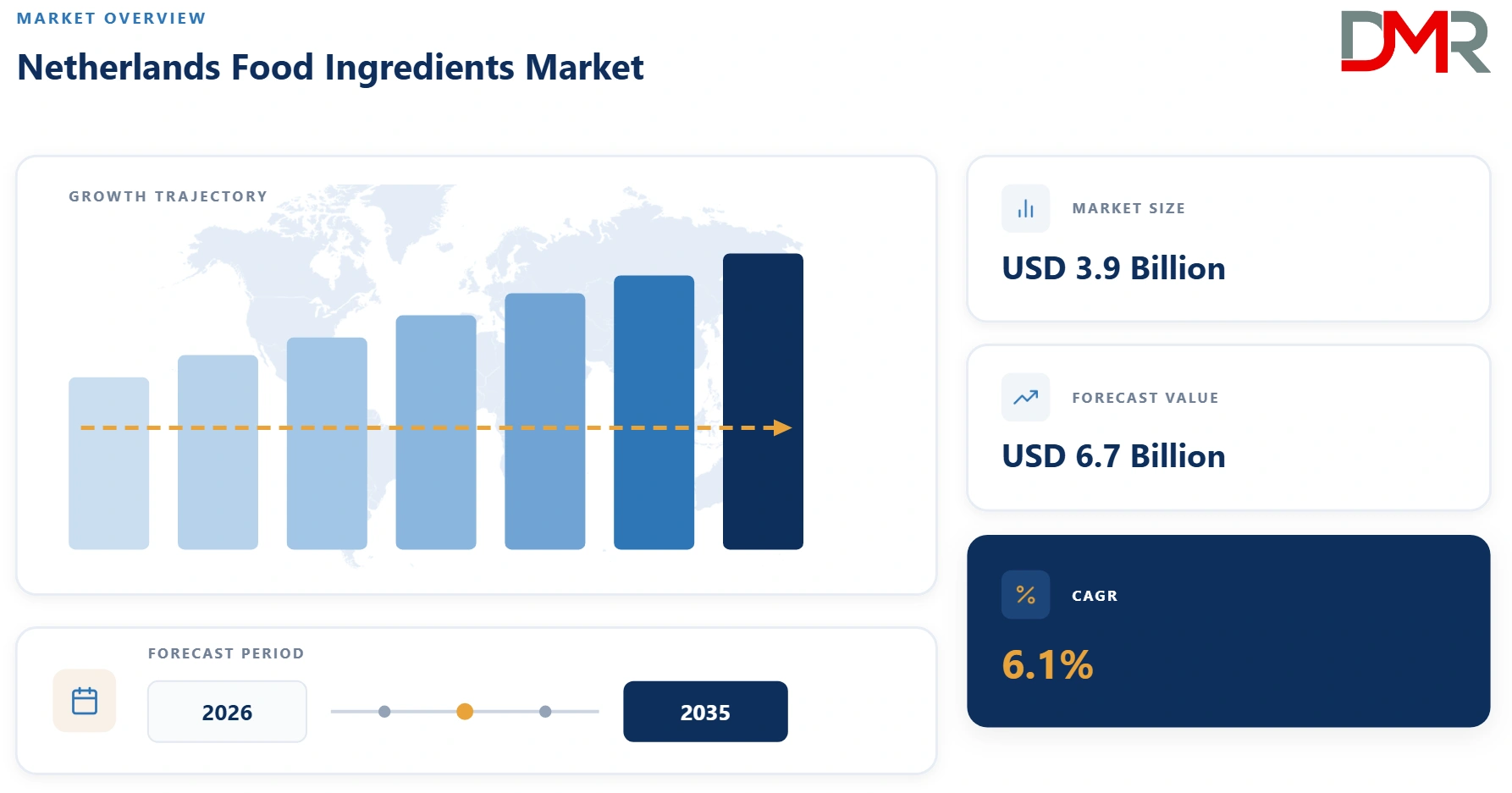
The Netherlands Food Ingredients Market is projected to be valued at USD 3.9 Billion in 2026 and is projected to reach USD 6.7 Billion by 2035, expanding at a CAGR of 6.1% during the forecast period.
ℹ
To learn more about this report –
Download Your Free Sample Report Here
Growth is being propelled by the Netherlands' position as home to several of the world's largest food ingredient and flavor companies, the country's globally significant dairy processing industry that generates substantial demand for functional dairy-derived ingredients, and the Netherlands' concentration of food science research institutions and agri-food technology innovation supporting rapid commercialization of novel ingredient technologies. The maturing of plant-based and alternative protein ingredient production capacity leveraging the Netherlands' strong life sciences and biotechnology research base, growing food manufacturer investment in clean-label and sustainability-certified ingredient sourcing aligned with the country's ambitious circular economy policy environment, and the Netherlands' role as a major European ingredient trading and distribution hub are reshaping the market from a primarily domestic ingredient supply function into one of Europe's most innovation-intensive and internationally connected food ingredient markets. Investment is accelerating as Dutch ingredient companies expand natural, functional, and plant-based ingredient production while leveraging the country's central European distribution position to serve both domestic and broader continental food manufacturer customers.
Use Cases
- Functional Dairy Ingredient Development from Domestic Milk Processing: Dutch dairy processors and ingredient companies develop specialized dairy-derived ingredients, including milk proteins, lactose derivatives, and functional dairy fractions, leveraging the Netherlands' substantial domestic milk processing base to supply both Dutch and broader European food and nutrition manufacturers.
- Plant-Based Protein and Alternative Ingredient Innovation: Food technology companies and ingredient developers headquartered in the Netherlands develop novel plant-based protein, fermentation-derived, and alternative ingredient technologies, capitalizing on the country's strong life sciences research infrastructure and supportive innovation ecosystem.
- Flavor and Fragrance Development for Global Food and Beverage Brands: Major international flavor houses with significant Dutch operations develop and manufacture flavor compounds for both domestic Dutch food manufacturers and global food and beverage brand customers, leveraging the Netherlands' central location and established flavor industry expertise.
- Sustainable and Traceable Ingredient Sourcing for European Distribution: Food manufacturers and ingredient distributors use the Netherlands' central European logistics position to source, verify, and distribute sustainably certified and traceable ingredients across the broader European food manufacturing market.
Key Takeaways
- Market Size: The Netherlands Food Ingredients Market is anticipated to be valued at USD 3.9 Billion in 2026 and is forecast to reach USD 6.7 Billion by 2035, expanding at a CAGR of 6.1%.
- Growth Outlook: Market expansion is sustained by the Netherlands' concentration of major global ingredient and flavor companies, the country's substantial dairy ingredient processing base, and continued innovation in plant-based and functional ingredient technology supported by a strong domestic food science research ecosystem.
- Primary Growth Drivers: The Netherlands' position as a global ingredient industry headquarters location, substantial domestic dairy processing generating functional ingredient supply, strong food science research and innovation infrastructure, and the country's role as a central European ingredient distribution hub are accelerating market growth.
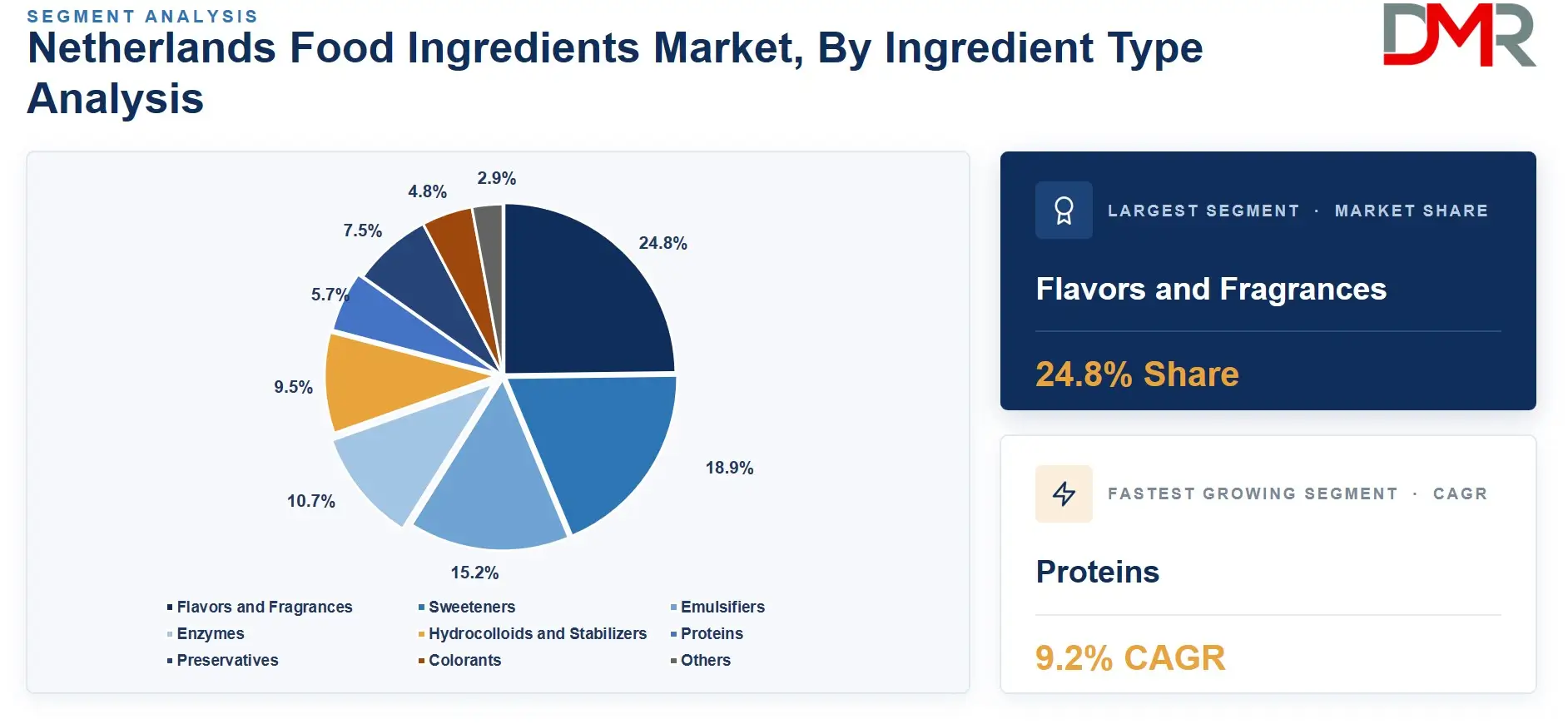
- By Ingredient Type Analysis: Flavors and Fragrances is projected to lead the ingredient type segment with a 24.8% share in 2026, reflecting the Netherlands' concentration of major global flavor company operations. Proteins is the fastest-growing ingredient type segment at 9.2% CAGR, driven by sustained investment in plant-based and dairy-derived protein ingredient innovation.
- By Source Analysis: Natural is expected to dominate with a 56.9% share in 2026, reflecting strong Dutch consumer and regulatory preference for natural and minimally processed ingredients. Natural is also the fastest-growing source segment at 8.1% CAGR, as sustainability and clean-label trends continue favoring naturally derived ingredient systems.
- By Form Analysis: Dry ingredients are poised to lead with a 59.4% share in 2026, supported by favorable shelf stability and distribution logistics economics given the Netherlands' role as a European ingredient trading hub. Liquid is the fastest-growing form segment at 7.3% CAGR, driven by rising demand for ready-to-use flavor and functional ingredient systems in beverage manufacturing.
- By Application Analysis: Dairy Products is expected to command a 22.6% share in 2026, underpinned by the Netherlands' substantial domestic dairy processing and ingredient manufacturing base. Plant-Based Foods is the fastest-growing application segment at 9.8% CAGR, fuelled by strong Dutch innovation investment in alternative protein and plant-based ingredient technology.
- By End User Analysis: Food and Beverage Manufacturers are projected to dominate with a 74.2% share in 2026, reflecting their position as the primary purchasers of bulk ingredient volumes. Nutraceutical and Supplement Companies is the fastest-growing end user segment at 8.9% CAGR, driven by expanding functional and fortified nutrition product development.
Key Drivers in the Netherlands Food Ingredients Market
Concentration of Major Global Food Ingredient and Flavor Company Operations
The Netherlands hosts significant operations of several of the world's largest food ingredient, flavor, and nutrition companies, reflecting the country's favorable business environment, central European logistics position, and strong food science talent base. This concentration of major ingredient industry players creates substantial direct economic activity within the Dutch food ingredients market while also fostering a broader ecosystem of specialized suppliers, research partnerships, and technical talent that supports continued industry innovation and investment within the country.
Strong Food Science Research and Innovation Infrastructure
The Netherlands maintains a globally recognized concentration of food science research institutions, university programs, and agri-food technology innovation clusters, particularly around Wageningen, often regarded as a leading global center for food and agricultural science research. This research infrastructure provides Dutch and internationally operating ingredient companies with access to cutting-edge food science expertise and supports rapid commercialization of novel ingredient technologies, including plant-based proteins, fermentation-derived ingredients, and functional nutrition compounds, reinforcing the Netherlands' position as a leading European food ingredient innovation hub.
Restraints in the Netherlands Food Ingredients Market
Intense Competition and Margin Pressure Among Concentrated Global Ingredient Suppliers
The Netherlands' concentration of major global ingredient and flavor companies creates an intensely competitive domestic market environment, with numerous well-resourced multinational suppliers competing for both domestic Dutch food manufacturer customers and the broader European market served through Dutch distribution operations. This intense competition can create margin pressure, particularly for smaller or specialized Dutch ingredient companies competing against the substantial research and development resources and global scale advantages of major multinational ingredient companies operating within the same market.
Growth Opportunities in the Netherlands Food Ingredients Market
Fermentation-Derived and Precision Biotechnology Ingredient Commercialization
The Netherlands' strong life sciences and biotechnology research base presents a substantial opportunity for ingredient companies to commercialize precision fermentation-derived proteins, flavors, and functional ingredients offering greater supply consistency and sustainability credentials than traditional agricultural sourcing. Companies leveraging the Netherlands' supportive innovation ecosystem and research collaboration opportunities, particularly around Wageningen's food science cluster, can accelerate commercialization of these emerging ingredient technologies ahead of broader European market adoption.
Sustainable and Traceable Ingredient Distribution Hub Services
The Netherlands' central European logistics position and strong sustainability policy environment present an opportunity for ingredient companies to develop specialized sustainable and traceable ingredient distribution hub services, verifying and redistributing certified sustainable ingredients across the broader European food manufacturing market. Companies capable of combining ingredient supply with robust digital traceability and sustainability certification services can differentiate from commodity ingredient distribution and capture premium positioning with European food manufacturers facing increasing sustainability sourcing requirements.
Trends in the Netherlands Food Ingredients Market
Growing Convergence Between Dairy Ingredient Innovation and Plant-Based Alternative Development
Dutch ingredient companies, many with deep expertise in dairy-derived functional ingredients, are increasingly applying similar fractionation and functionality-enhancement techniques to plant-based protein sources, creating convergence between traditionally separate dairy ingredient and plant-based ingredient innovation tracks. This convergence reflects both the transferability of certain processing technologies across protein sources and Dutch ingredient companies' strategic interest in serving both traditional dairy and growing plant-based ingredient market segments from shared technical and research infrastructure.
Consolidation and Strategic Partnership Activity Among Ingredient Innovation Companies
The Netherlands Food Ingredients Market is experiencing continued consolidation and strategic partnership activity as larger ingredient companies acquire or partner with specialized Dutch food technology startups to access novel ingredient technologies and research capabilities. This activity reflects both the attractiveness of the Netherlands' innovation ecosystem to larger, well-capitalized ingredient companies and smaller Dutch technology companies' need for greater scale and market access to fully commercialize promising ingredient innovations.
Research Scope and Analysis
The Netherlands Food Ingredients Market is segmented by ingredient type, source, form, application, and end user, covering flavors, sweeteners, emulsifiers, enzymes, proteins, preservatives, colorants, natural and synthetic sourcing, dry and liquid formats, and food and beverage manufacturing, foodservice, and nutraceutical end users.
ℹ
To learn more about this report –
Download Your Free Sample Report Here
By Ingredient Type Analysis
Flavors and Fragrances is projected to dominate the Netherlands Food Ingredients Market with 24.8% share in 2026, reflecting the Netherlands' concentration of major global flavor company operations and their substantial domestic production and research activity. Proteins is expected to register the highest CAGR of 9.2% during 2026-2035, driven by sustained investment in both dairy-derived and plant-based protein ingredient innovation supported by the Netherlands' strong domestic research infrastructure.
By Source Analysis
Natural ingredients are anticipated to dominate the Netherlands Food Ingredients Market by source, accounting for 56.9% share in 2026, reflecting strong Dutch consumer and regulatory preference for natural and minimally processed ingredients aligned with the country's broader sustainability policy orientation. Natural is also projected to register the highest CAGR of 8.1% between 2026 and 2035, as continued clean-label and sustainability trends favor naturally derived ingredient systems across Dutch and broader European food manufacturing.
By Form Analysis
Dry ingredients are projected to dominate the Netherlands Food Ingredients Market with an estimated 59.4% share in 2026, supported by favorable shelf stability and international distribution logistics economics given the Netherlands' significant role as a European ingredient trading and redistribution hub. Liquid ingredients are expected to register the fastest CAGR of 7.3% through 2035, driven by growing demand for ready-to-use flavor and functional ingredient systems within beverage manufacturing applications.
By Application Analysis
Dairy Products is expected to lead the Netherlands Food Ingredients Market by application, accounting for 22.6% share in 2026, supported by the Netherlands' substantial domestic dairy processing and ingredient manufacturing base generating significant functional dairy ingredient production and consumption. Plant-Based Foods is projected to achieve the fastest CAGR of 9.8% during 2026-2035, driven by strong Dutch innovation investment in alternative protein and plant-based ingredient technology commercialization.
By End User Analysis
Food and Beverage Manufacturers are projected to dominate the Netherlands Food Ingredients Market with 74.2% share in 2026, reflecting their position as the primary bulk purchasers of ingredient volumes across all food categories. Nutraceutical and Supplement Companies are expected to register the fastest CAGR of 8.9% through 2035, driven by expanding development of functional and fortified nutrition products leveraging the Netherlands' strong food science and ingredient innovation base.
The Netherlands Food Ingredients Market Report is segmented based on the following:
By Ingredient Type
- Flavors and Fragrances
- Sweeteners
- Emulsifiers
- Enzymes
- Hydrocolloids and Stabilizers
- Proteins
- Preservatives
- Colorants
- Others
By Source
- Natural
- Synthetic/Artificial
By Form
By Application
- Bakery and Confectionery
- Beverages
- Dairy Products
- Sauces, Dressings and Condiments
- Nutritional and Functional Foods
- Plant-Based Foods
- Others
By End User
- Food and Beverage Manufacturers
- Foodservice Operators
- Nutraceutical and Supplement Companies
Technology Analysis
Technology development is central to the trajectory of the Netherlands Food Ingredients Market as the country's concentrated food science research ecosystem, particularly centered around Wageningen, drives advances in precision fermentation, novel protein extraction, and ingredient functionality enhancement technologies. Growing use of AI-assisted formulation modeling and rapid prototyping tools, often developed in collaboration with Dutch food technology startups and research institutions, is shortening ingredient and product development timelines for both domestic and international food manufacturer customers. Opportunities are expanding for companies developing fermentation-derived flavors and proteins, natural preservation technologies, and digital traceability platforms supporting sustainability and regulatory documentation requirements. However, achieving cost-competitive, large-scale commercialization of emerging biotechnology-based ingredient production methods remains an ongoing capital investment and technical challenge across the industry.
Investment and White Space Analysis
Investment opportunities in the Netherlands Food Ingredients Market are expanding alongside the country's concentration of major global ingredient companies, strong food science research infrastructure, and central European distribution position. Significant white space exists in fermentation-derived natural flavors and proteins, convergent dairy and plant-based ingredient innovation, sustainable and traceable ingredient distribution hub services, and functional ingredient development for nutraceutical applications. Companies with strong research collaboration relationships within the Netherlands' food science innovation ecosystem, established European distribution capability, and sustainability certification credentials are positioned to capture premium, longer-duration contracts. However, intense competition among concentrated global ingredient suppliers operating within the Dutch market, along with the capital intensity of biotechnology-based ingredient production scale-up, can constrain margins for smaller domestic ingredient innovators.
Competitive Landscape
The Netherlands Food Ingredients Market is moderately consolidated and highly competitive, comprising major global ingredient and flavor companies with substantial Dutch operations, specialized Dutch food technology startups and scale-ups, and dairy cooperative-affiliated ingredient processing divisions. Competition centers on natural ingredient innovation, food science research collaboration capability, sustainability and traceability credentials, and central European distribution and logistics capability. Major global ingredient companies benefit from broad research and development resources and established international customer relationships leveraged through their Dutch operations, while specialized Dutch startups compete on cutting-edge innovation and close collaboration with the country's leading food science research institutions. Companies increasingly differentiate through fermentation-based production innovation, sustainability certification, and formulation co-development services rather than ingredient supply alone.
Some of the prominent players in the Netherlands Food Ingredients Market are:
- dsm-firmenich
- Cargill
- Corbion
- Royal FrieslandCampina
- Royal Cosun
- Cosun Beet Company
- Cosun Protein
- Avebe
- Ofi (Olam Food Ingredients)
- Kerry Group
- ADM
- Brenntag
- Barentz
- IMCD
- Caldic
- Sensus
- FrieslandCampina Ingredients
- Hoogwegt Group
- Royal Ingredients Group
- Van Wankum Ingredients
- Magellan Food Ingredients
- Biotaris
- Bunge
- AAK
- IOI Loders Croklaan
- Zeelandia
- Sonneveld Group
- Verstegen Spices & Sauces
- Solina Netherlands
- Ruitenberg Ingredients
- Prinsen Berning
- Döhler Netherlands
- Azelis
- Univar Solutions
- Kreglinger Europe
- Tradin Organic
- SVZ International
- Duynie Ingredients
- Protix
- Meelunie
- Other Key Players
Recent Developments
- July 2026: A leading global ingredient company headquartered in the Netherlands announced expansion of its fermentation-derived flavor and protein production capacity, targeting rising European manufacturer demand for natural, supply-stable ingredient alternatives.
- June 2026: A major Dutch dairy cooperative's ingredients division launched a new functional dairy protein ingredient designed to support both traditional dairy applications and emerging hybrid dairy-plant product formulations.
- May 2026: A prominent Dutch food technology startup, in collaboration with Wageningen University research partners, announced progress toward commercial-scale precision fermentation protein production.
- April 2026: A global flavor and ingredient supplier expanded its Netherlands-based innovation center, citing the country's favorable food science research ecosystem for developing next-generation plant-based ingredient technologies.
Report Details
| Report Characteristics |
| Market Size (2026) |
USD 3.9 Bn |
| Forecast Value (2035) |
USD 6.7 Bn |
| CAGR (2026–2035) |
6.1% |
| Historical Data |
2021 – 2025 |
| Forecast Data |
2026 – 2035 |
| Base Year |
2025 |
| Segments Covered |
By Ingredient Type, By Source, By Form, By Application, By End User |
| Country Coverage |
Netherlands |
Frequently Asked Questions
How big is the Netherlands Food Ingredients Market?
▾ The Netherlands Food Ingredients Market is valued at USD 3.9 Billion in 2026 and is projected to reach USD 6.7 Billion by 2035, reflecting the country's concentration of major global ingredient companies and strong domestic food science innovation ecosystem.
What is the CAGR of the Netherlands Food Ingredients Market from 2026 to 2035?
▾ The market is projected to expand at a compound annual growth rate (CAGR) of 6.1% between 2026 and 2035, supported by continued ingredient innovation, strong natural and sustainable ingredient demand, and the Netherlands' role as a central European ingredient distribution hub.
What factors are driving the growth of the Netherlands Food Ingredients Market?
▾ Growth is driven by the Netherlands' position as a global ingredient industry headquarters location, substantial domestic dairy processing generating functional ingredient supply, strong food science research and innovation infrastructure, and the country's role as a central European ingredient distribution hub.
What are the major trends in the Netherlands Food Ingredients Market?
▾ Major trends include growing convergence between dairy ingredient innovation and plant-based alternative development, continued consolidation and strategic partnership activity among ingredient innovation companies, and rising investment in fermentation-derived and precision biotechnology ingredients.
Who are the key players in the Netherlands Food Ingredients Market?
▾ Key market participants include DSM-Firmenich, Royal FrieslandCampina Ingredients, Corbion, CSK Food Enrichment, and Barentz, among other major global and specialized Dutch food ingredient companies.
How is the Netherlands Food Ingredients Market segmented?
▾ The market is segmented by ingredient type, source, form, application, and end user, with demand analysis concentrated around the Randstad region and the Wageningen food science research cluster.