Oil and Gas Line Pipe Market Snapshot
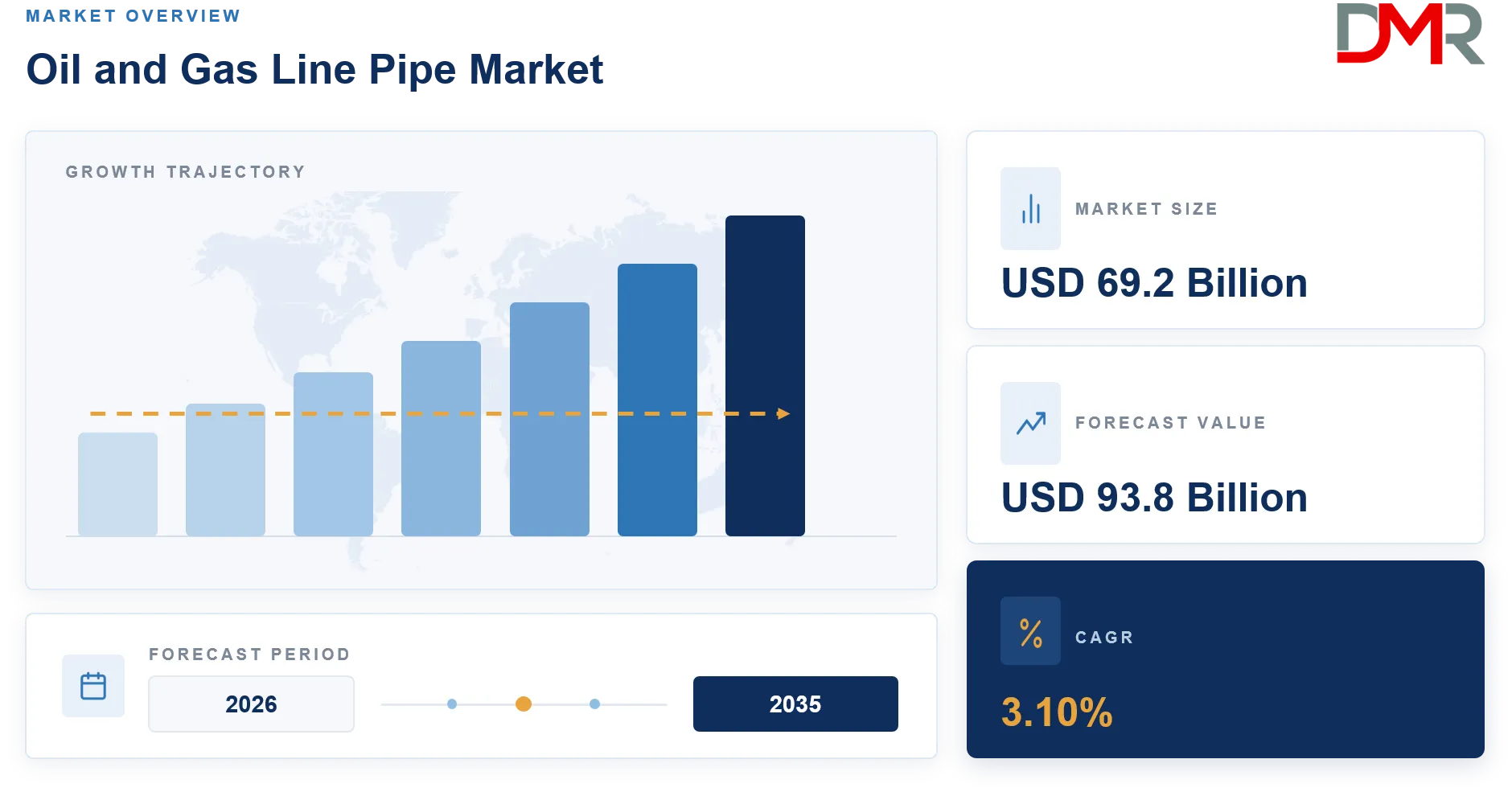
- Market Value: The Oil and Gas Line Pipe Market is valued at USD 69.2 billion in 2026 and is projected to reach USD 93.8 billion by 2035.
- CAGR: The Oil and Gas Line Pipe Market is expected to grow at a CAGR of 3.1% from 2026 to 2035.
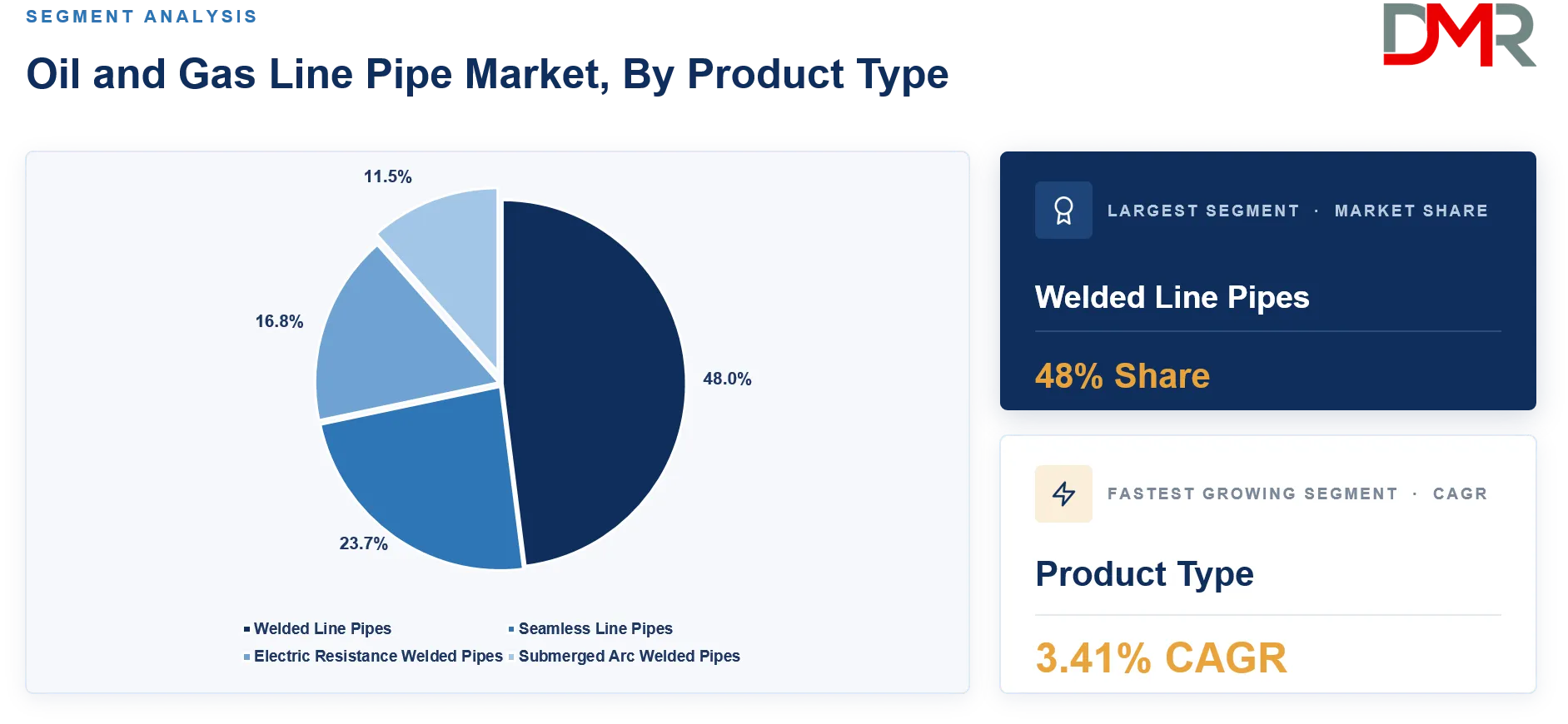
- By Product Type Analysis: Welded Line Pipes led the product type segment with a 48% share in 2026.
- By Material Type Analysis: Carbon Steel led the material type segment with a 68% share in 2026.
- By Grade Analysis: X65 Grade held a 24% share of the Oil and Gas Line Pipe Market in 2026.
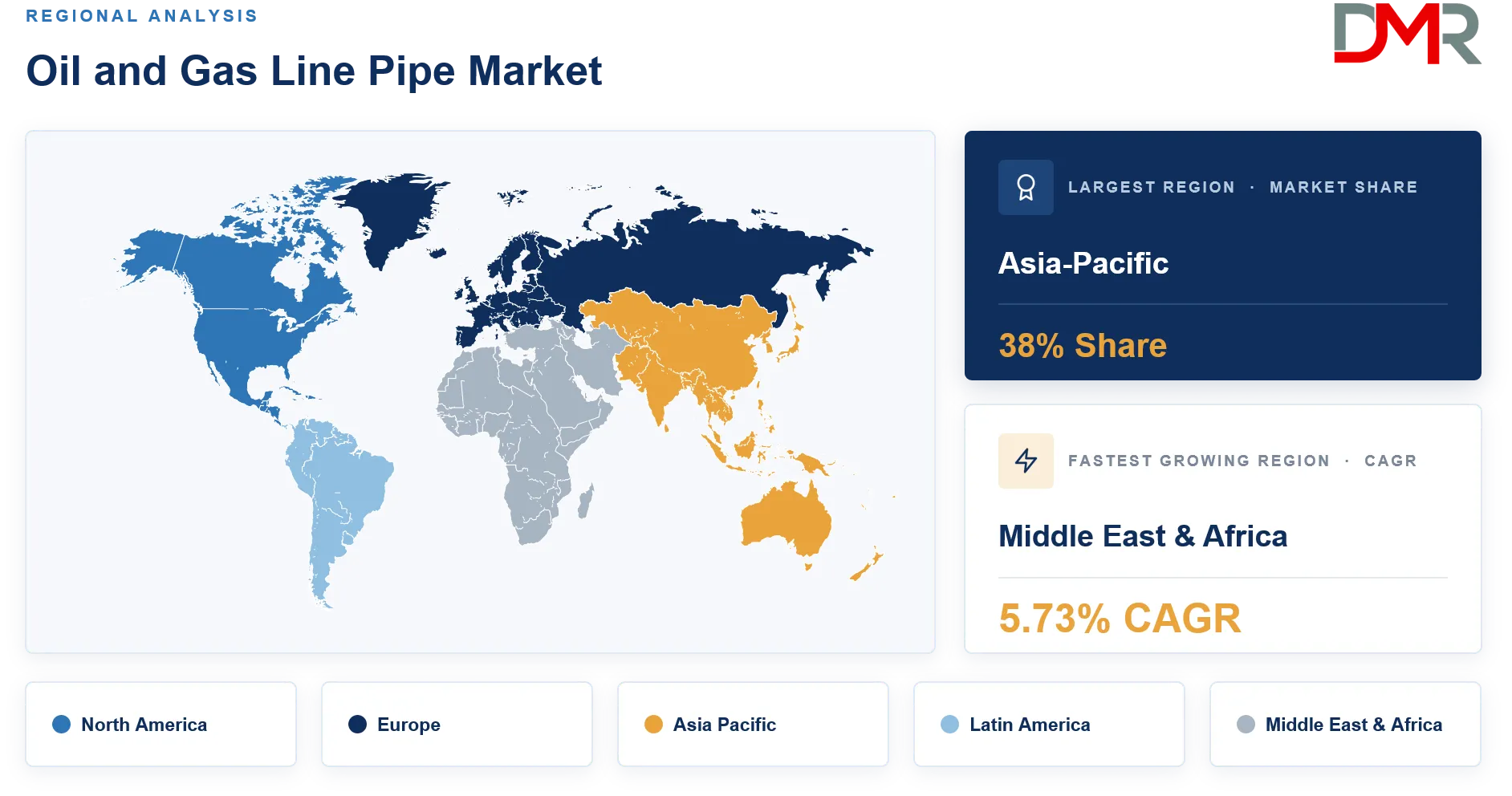
- Regional Analysis: Asia-Pacific led the global market with a 38% revenue share in 2026.
- Major Players: Tenaris S.A., Vallourec S.A., Jindal SAW Limited, Welspun Corp Limited, and Others.
What is the Oil and Gas Line Pipe Market and its Market Size?
The Global Oil and Gas Line Pipe Market size is projected to be valued at USD 69.2 billion in 2026 and is expected to reach USD 93.8 billion by 2035, expanding at a CAGR of 3.1% during the forecast period. Line pipes are engineered steel pipes designed to transport crude oil, refined products, natural gas, condensates, and associated fluids through gathering, transmission, offshore, and distribution pipeline systems. Market demand covers seamless pipes, welded pipes, electric resistance welded pipes, and submerged arc welded pipes across different diameters, pressure classes, steel grades, and operating environments.
ℹ
To learn more about this report –
Download Your Free Sample Report Here
The growth of the market is primarily driven by upstream development, gas transmission capacity, LNG infrastructure, cross-country pipelines, offshore field development, refinery connectivity, and replacement of aging pipeline networks. Buyers increasingly evaluate line pipe products based on API compliance, strength-to-weight performance, weld quality, corrosion resistance, pressure tolerance, traceability, coating compatibility, and lifecycle economics. API 5L remains one of the principal specifications governing seamless and welded steel line pipe used in petroleum and natural gas transportation systems, making technical compliance an important procurement consideration for pipeline operators and engineering contractors.
Use Cases
- Crude Oil Transportation: Line pipes provide high-capacity transportation between producing fields, gathering stations, storage terminals, refineries, and export facilities. Carbon steel and higher-strength API grades are selected according to operating pressure, distance, fluid characteristics, terrain, corrosion exposure, and required pipeline life.
- Natural Gas Transmission: Large-diameter welded line pipes are widely used in long-distance natural gas transmission systems. Pipeline operators seek high-strength grades that can support higher operating pressure while improving transportation efficiency, reducing material requirements, and supporting new gas-fired power, industrial, and LNG supply infrastructure.
- Gathering Networks: Oil and gas producers use gathering pipelines to move hydrocarbons from individual wells to processing plants, separation facilities, storage systems, or larger transmission pipelines. Demand can increase quickly in active shale and conventional producing regions where drilling activity creates continuous requirements for new lateral connections.
- Offshore Pipelines: Offshore developments require line pipes capable of operating under high external pressure, corrosive conditions, low temperatures, seabed movement, and demanding installation loads. Projects often require enhanced toughness, precise dimensional control, specialized coatings, stringent inspection, and qualified welding performance.
- Pipeline Replacement: Aging pipeline infrastructure generates replacement and integrity-related demand, especially where operators need to improve safety, pressure capability, reliability, leak prevention, or regulatory compliance. Replacement programs can create stable opportunities for API-certified producers even when greenfield pipeline construction slows.
How AI/Gen AI is Transforming the Oil and Gas Line Pipe Market?
Artificial intelligence is changing how pipeline owners, engineering companies, and line pipe manufacturers manage inspection, manufacturing quality, asset integrity, and maintenance planning. Machine vision can support weld inspection and surface defect detection during pipe production, while analytical systems can combine operating pressure, corrosion records, inspection data, wall thickness, temperature, and historical failures to identify sections that require attention. For line pipe suppliers, this increases the commercial importance of traceability, consistent manufacturing data, digital quality records, and predictable product performance.
Generative AI can also support engineering documentation, specification review, supplier qualification, procurement analysis, maintenance knowledge management, and project planning. Pipeline operators handle large volumes of technical standards, inspection records, drawings, material certificates, operating manuals, and contractor documents. Systems that organize this information can shorten engineering review cycles and improve access to asset knowledge. The opportunity is not limited to software. Higher adoption of data-driven integrity management can encourage demand for pipes with better traceability, verified metallurgy, consistent weld properties, and documentation suitable for digitally managed pipeline networks.
Key Drivers in the Oil and Gas Line Pipe Market
Expansion of Natural Gas Transmission Infrastructure
Natural gas infrastructure remains a major driver of Oil and Gas Line Pipe Market demand because new production zones, LNG terminals, industrial clusters, power plants, and urban consumption centers require reliable transmission capacity. Long-distance systems commonly use welded high-strength steel pipe because it provides the diameter, pressure capability, and project economics needed for bulk gas transportation. Growing emphasis on energy security is also encouraging countries to diversify supply routes and strengthen domestic pipeline connectivity, supporting demand for large-diameter and API-grade line pipes.
Oil and Gas Production and Pipeline Replacement
Upstream development creates recurring line pipe demand as new wells require gathering infrastructure and producing basins require connections to processing, storage, refining, and export systems. Mature markets add another demand layer through replacement of aging pipelines. Operators must address corrosion, mechanical damage, changing pressure requirements, integrity standards, and capacity bottlenecks. This combination of greenfield pipeline construction and brownfield rehabilitation supports suppliers serving several diameters, grades, coatings, and manufacturing configurations.
Restraints in the Oil and Gas Line Pipe Market
Volatility in Steel and Project Costs
Steel represents a major component of line pipe production economics, making manufacturers sensitive to changes in plate, coil, alloying element, energy, freight, and coating costs. Rapid input-price changes can complicate quotations for multi-year pipeline projects and place pressure on margins when contracts offer limited cost pass-through. Pipeline developers also face higher financing, construction, labor, compressor, permitting, and right-of-way expenses. When total project economics weaken, operators may delay final investment decisions, affecting line pipe order timing and mill utilization.
Lengthy Pipeline Approvals and Execution Risks
Large oil and gas pipelines require environmental assessments, land access, engineering approvals, safety reviews, financing, community engagement, and multiple construction permits. Delays in any stage can shift pipe procurement schedules and create uncertainty for mills that depend on large project orders. Offshore pipelines face additional technical complexity involving marine installation, subsea inspection, specialized coatings, welding procedures, and logistics. These requirements can extend project timelines and make demand less predictable for manufacturers focused on project-driven large-diameter line pipe.
Growth Opportunities in the Oil and Gas Line Pipe Market
High-Strength and Specialized Pipeline Steels
The move toward higher operating pressures, long-distance transmission, challenging terrain, offshore projects, sour service, and demanding installation conditions creates opportunities for higher-value steel grades. X65, X70, X80, high-strength steel, corrosion-resistant solutions, and tightly controlled welded products can help operators optimize wall thickness, pressure capacity, installation performance, and lifecycle reliability. Producers with advanced metallurgy, heat treatment, welding control, inspection systems, coating capabilities, and API qualification can compete in technically demanding projects where purchasing decisions extend beyond basic pipe pricing.
New Gas, CO2, and Energy Transportation Networks
Line pipe suppliers can increasingly address infrastructure beyond traditional crude oil transportation. Natural gas remains a major opportunity, while emerging carbon dioxide transportation networks can create additional specifications and material requirements. API's latest line pipe standard includes updated requirements relevant to CO2 transportation, demonstrating how pipeline standards are evolving with new applications. Manufacturers able to adapt steel chemistry, toughness, weld design, inspection practices, and documentation to new transportation environments can broaden their addressable market over the forecast period.
Trends in the Oil and Gas Line Pipe Market
Localization of Line Pipe Manufacturing Capacity
Pipeline developers increasingly value regional production because local manufacturing can reduce freight exposure, shorten delivery schedules, improve project coordination, and satisfy domestic-content requirements. Major suppliers are therefore aligning production capacity with active energy infrastructure markets. Welspun Corp, for example, has outlined line pipe capacity additions across the United States, Saudi Arabia, and India, reflecting the strategic importance of manufacturing proximity to major pipeline projects. This trend favors producers with flexible global production networks and local coating, testing, and finishing capabilities.
Greater Focus on Quality, Traceability, and Weld Performance
Pipeline procurement is becoming more technically demanding as operators focus on asset integrity, product traceability, inspection results, weld consistency, sour-service performance, and long operating lives. The 47th edition of API Specification 5L introduced requirements across more than 15 technical areas, including high-frequency weld pipe quality and CO2 transportation. This reinforces a market trend toward tighter manufacturing controls and documented quality systems. Suppliers able to demonstrate reliable metallurgy, inspection capability, testing discipline, and manufacturing consistency can strengthen their position in critical pipeline tenders.
Research Scope and Analysis
The Oil and Gas Line Pipe Market is analyzed across product type, material type, diameter, grade, application, manufacturing process, end user, and region. The assessment considers the commercial role of each category in pipeline construction, replacement activity, gathering networks, transmission systems, offshore projects, oil transportation, gas transportation, and energy infrastructure investment.
ℹ
To learn more about this report –
Download Your Free Sample Report Here
By Product Type
Welded Line Pipes dominated the product type segment with a 48% market share in 2026. Their leadership is supported by extensive use in large-diameter oil and gas transmission systems where project economics, high-volume manufacturing, dimensional consistency, and availability across multiple wall thicknesses are important. ERW, HFW, LSAW, and spiral-welded configurations allow suppliers to serve gathering pipelines as well as high-capacity cross-country transmission projects. Large pipeline programs can require substantial pipe volumes within fixed construction windows, favoring manufacturers with high-throughput forming, welding, inspection, coating, and logistics capabilities. Continued gas transmission investment and pipeline replacement should support welded line pipe demand through 2035.
By Material Type
Carbon Steel accounted for 68% of the Oil and Gas Line Pipe Market in 2026, making it the leading material category. Its dominant position reflects an established balance of strength, weldability, availability, manufacturability, and project cost. Carbon steel can be produced across a broad range of API grades, diameters, wall thicknesses, and manufacturing processes, allowing application in gathering lines, crude oil networks, gas transmission systems, and onshore infrastructure. Appropriate coatings, cathodic protection, material selection, and integrity programs can extend operating life in many service environments. Stainless, alloy, and specialized high-strength materials remain important where corrosion, temperature, pressure, weight, or severe-service conditions justify higher material cost.
By Grade
X65 Grade held a 24% share of the market in 2026. Its position reflects the need for pipe grades that combine strong mechanical performance with practical fabrication and welding characteristics for transmission infrastructure. Higher-strength grades allow pipeline engineers to evaluate pressure capacity, wall thickness, steel tonnage, installation requirements, and total project economics together. X65 therefore serves an important position between conventional lower-strength grades and higher-strength X70 or X80 solutions. Adoption is influenced by project pressure, diameter, route conditions, welding procedures, fracture control, toughness requirements, sour-service exposure, and operator specifications.
The Oil and Gas Line Pipe Market Report is segmented on the basis of the following:
By Product Type
- Seamless Line Pipes
- Welded Line Pipes
- Electric Resistance Welded Pipes
- Submerged Arc Welded Pipes
By Material Type
- Carbon Steel
- Stainless Steel
- Alloy Steel
- High Strength Steel
By Diameter
- Below 6 Inches
- 6-12 Inches
- 12-24 Inches
- 24-36 Inches
- Above 36 Inches
By Grade
- API 5L Grade B
- X42 Grade
- X52 Grade
- X60 Grade
- X65 Grade
- X70 Grade
- X80 Grade
By Application
- Oil Transportation
- Gas Transportation
- Gathering Pipelines
- Transmission Pipelines
- Offshore Pipelines
- Onshore Pipelines
By Manufacturing Process
- Hot Rolled
- Cold Rolled
- Extrusion Process
- Spiral Welding
By End User
- Oil Producers
- Gas Producers
- Pipeline Operators
- Refining Companies
- Petrochemical Companies
- Utility Companies
Regional Analysis
Asia-Pacific is the Leading Region in the Oil and Gas Line Pipe Market
Asia-Pacific accounted for 38% of global Oil and Gas Line Pipe Market revenue in 2026. The region benefits from extensive energy infrastructure development across China, India, Southeast Asia, Australia, and other markets. Gas transmission expansion, LNG connectivity, domestic production development, refinery and petrochemical infrastructure, urban energy demand, and industrial growth support line pipe consumption. Large regional steelmaking capacity also strengthens the supply ecosystem for carbon steel, welded, seamless, and higher-strength pipeline products.
Middle East & Africa is an Emerging High-Growth Region in the Oil and Gas Line Pipe Market
Middle East & Africa offers significant growth potential as producing countries expand gas processing, oil export infrastructure, cross-country pipelines, gathering systems, and domestic industrial networks. Saudi Arabia and the UAE are important centers for pipeline investment and local pipe manufacturing, while other producers are developing infrastructure to monetize natural gas resources and improve energy security. Regional localization programs can favor suppliers with domestic production, qualified welding technology, coating capabilities, and relationships with national oil companies and engineering contractors.
By Region
North America
Europe
- Germany
- France
- The UK
- Italy
- Spain
- Rest of Europe
Asia-Pacific
- China
- Japan
- India
- Australia
- South Korea
- Rest of APAC
Latin America
- Mexico
- Brazil
- Colombia
- Argentina
- Rest of LATAM
Middle East & Africa
- Saudi Arabia
- The UAE
- South Africa
- Rest of MEA
ℹ
To learn more about this report –
Download Your Free Sample Report Here
Major Countries Analysis
China Oil and Gas Line Pipe Market
The China Oil and Gas Line Pipe Market size is projected to be valued at USD 12.1 billion in 2026 and is expected to reach USD 16.4 billion by 2035, expanding at a CAGR of 3.1% during the forecast period.
China represents a strategically important country within the Asia-Pacific Oil and Gas Line Pipe Market due to its large steel industry, extensive oil and gas pipeline network, industrial energy demand, and continued development of domestic gas transportation infrastructure. National energy-security priorities encourage stronger connections among producing areas, import terminals, storage facilities, industrial centers, and consumption regions. China also has substantial welded and seamless pipe production capability, creating an integrated domestic supply chain for carbon steel and high-strength grades while supporting exports to international pipeline projects.
India Oil and Gas Line Pipe Market
The India Oil and Gas Line Pipe Market size is projected to be valued at USD 4.8 billion in 2026 and is expected to reach USD 6.3 billion by 2035, expanding at a CAGR of 3.1% during the forecast period.
India offers substantial long-term opportunity as natural gas infrastructure, refinery connectivity, city gas networks, industrial corridors, and national pipeline systems expand. Domestic manufacturers such as Jindal SAW, Welspun Corp, Tata Steel, JSW Steel, and Maharashtra Seamless provide a strong industrial base covering several pipe technologies and applications. Government emphasis on domestic manufacturing and infrastructure investment can support local sourcing, while increasing gas consumption creates additional requirements for gathering and transmission networks. Suppliers with API-qualified products and large project execution capability remain well positioned.
Competitive Landscape
The global Oil and Gas Line Pipe Market has a diversified competitive landscape consisting of multinational steel groups, specialist tubular manufacturers, regional pipe companies, and integrated suppliers. Competition centers on API certification, steel grade capability, diameter range, welding technology, manufacturing capacity, coating services, delivery reliability, technical qualification, local production, and lifecycle performance. Tenaris combines an international manufacturing footprint with energy-sector specialization, while Vallourec maintains strength in advanced tubular solutions. Jindal SAW, Welspun Corp, Tata Steel, JSW Steel, Maharashtra Seamless, and other Asian producers benefit from significant manufacturing bases and access to growing infrastructure markets.
Japanese companies such as Nippon Steel and JFE Steel compete through metallurgy, high-grade products, quality control, and technically demanding applications. Middle Eastern suppliers including Arabian Pipes Company and National Pipe Company benefit from proximity to large regional oil and gas projects. Capacity localization, higher-strength grades, digital quality control, product traceability, coating integration, and qualification for offshore, hydrogen, CO2, and severe-service applications are becoming increasingly important competitive differentiators.
Some of the prominent players in the Oil and Gas Line Pipe Industry are:
- JSW Steel Limited
- Vallourec S.A.
- Arabian Pipes Company
- SeAH Steel Holdings Corporation
- Tenaris S.A.
- Abu Dhabi Metal Pipes and Profiles Industries Complex LLC
- Tata Steel Limited
- Jindal SAW Limited
- EVRAZ plc
- National Pipe Company
- JFE Steel Corporation
- Salzgitter AG
- Welspun Corp Limited
- ChelPipe Group
- Nippon Steel Corporation
- Maharashtra Seamless Limited
- Borusan Mannesmann
- United States Steel Corporation
- TMK Group
- EEW Group
- ArcelorMittal S.A.
- Others
Export Import Analysis
The Oil and Gas Line Pipe Market has a trade-intensive supply structure because major pipeline projects often source API 5L pipes from mills outside the project country when local capacity, diameter range, grade capability, coating facilities, or delivery schedules are insufficient. Key export-oriented manufacturing bases include China, India, Japan, South Korea, Türkiye, and selected European producers, while large importing markets include the United States, Middle East, Southeast Asia, and project-led African economies. Trade flows vary by product because seamless, ERW, LSAW, and spiral welded pipes require different mill capabilities and qualification standards. Buyers also evaluate anti-dumping duties, safeguard measures, local-content rules, freight rates, port handling, lead times, and mill approvals before awarding contracts. Large-diameter transmission projects can therefore shift import demand rapidly between suppliers. Producers with API certification, established EPC relationships, regional inventories, and local coating or finishing facilities are better positioned to protect market share when trade policies or logistics conditions change.
Pricing Analysis
Pricing in the Oil and Gas Line Pipe Market is shaped by steel input costs, pipe grade, diameter, wall thickness, manufacturing route, coating requirements, order volume, delivery location, and project qualification standards. Carbon steel line pipe prices are closely linked to hot-rolled coil or plate costs, while X65, X70, X80, stainless, and alloy products carry additional premiums for chemistry control, strength, toughness, testing, and welding performance. Seamless pipe generally follows a different cost structure from ERW, LSAW, and spiral welded products because billet or tube-round inputs, piercing, heat treatment, and finishing requirements vary. Freight, energy, zinc or coating materials, inspection, hydrotesting, and certification can materially affect delivered pricing. Project timing is also critical: tight mill utilization or large transmission awards can strengthen supplier pricing, while weak order books increase discounting. Buyers increasingly use index-linked contracts, multi-mill sourcing, and regional procurement to reduce exposure to steel and logistics volatility.
Recent Developments
- August 2026: Welspun Corp Limited secured a $1.8 billion (₹17,200 crore) contract to supply line pipes from its US facility—the largest single order in company history—strengthening its North American energy infrastructure footprint.
- July 2026: Vallourec S.A. was awarded a contract by Allseas to supply carbon steel seamless line pipes and thermal insulation coating for the Atapu-2 ultra-deepwater pre-salt project in Brazil's Santos Basin, following its 2025 Thermotite do Brasil acquisition.
- May 2026: Vallourec S.A. received orders from ExxonMobil Guyana for over 145 km (40,000 metric tons) of line pipe, including 90 km with resin-based insulation, for the Hammerhead and Longtail offshore projects in the Stabroek Block.
| Report Characteristics |
| Market Size (2026) |
USD 69.2 Bn |
| Forecast Value (2035) |
USD 93.8 Bn |
| CAGR (2026-2035) |
3.1% |
| The US Market Size (2026) |
USD 13.7 Bn |
| Historical Data |
2021 - 2025 |
| Forecast Data |
2026 - 2035 |
| Base Year |
2025 |
| Segments Covered |
By Product Type, By Material Type, By Diameter, By Grade, By Application, By Manufacturing Process and By End User |
| Regional Coverage |
North America - The US and Canada; Europe - Germany, France, The UK, Italy, Spain, Rest of Europe; Asia-Pacific - China, Japan, India, Australia, South Korea, Rest of APAC; Latin America - Mexico, Brazil, Colombia, Argentina, Rest of LATAM; Middle East & Africa - Saudi Arabia, The UAE, South Africa, Rest of MEA |
Frequently Asked Questions
What is the current size of the Oil and Gas Line Pipe Market?
▾ The Oil and Gas Line Pipe Market size is valued at USD 69.2 billion in 2026 and may reach USD 93.8 billion by 2035.
What is the growth rate of the Oil and Gas Line Pipe Market during?
▾ The Oil and Gas Line Pipe Market is forecast to expand at a CAGR of 3.1% during the 2026-2035 period.
Which region dominates the Global Oil and Gas Line Pipe Market?
▾ Asia-Pacific leads the Oil and Global Gas Line Pipe Market, accounting for a 38% revenue share in 2026.
What factors are driving the growth of the Oil and Gas Line Pipe Market?
▾ Pipeline expansion and rising gas transport investment drive demand across the Oil and Gas Line Pipe Market.
What are the major challenges restraining the Oil and Gas Line Pipe Market?
▾ Steel price swings, trade barriers, and project delays restrain growth of the Oil and Gas Line Pipe Market.
Which segment holds the largest share of the Oil and Gas Line Pipe Market?
▾ Welded Line Pipes dominate the Oil and Gas Line Pipe Market, accounting for a 48% share in 2026.
Who are the leading companies in the Oil and Gas Line Pipe Market?
▾ JSW Steel Limited, Vallourec S.A., Arabian Pipes Company, SeAH Steel Holdings Corporation, Tenaris S.A., Abu Dhabi Metal Pipes and Profiles Industries Complex LLC, Tata Steel Limited, Jindal SAW Limited, EVRAZ plc, National Pipe Company, JFE Steel Corporation, Salzgitter AG, Welspun Corp Limited, ChelPipe Group, Nippon Steel Corporation, Maharashtra Seamless Limited, Borusan Mannesmann, United States Steel Corporation, TMK Group, EEW Group, and ArcelorMittal S.A. are leading companies in the Oil and Gas Line Pipe Market.
How is AI influencing the Oil and Gas Line Pipe Market?
▾ AI improves inspection, predictive maintenance, and quality control across the Oil and Gas Line Pipe Market.
What are the future opportunities and trends in the Oil and Gas Line Pipe Market?
▾ Gas pipelines, offshore projects, and X70 grades create opportunities in the Oil and Gas Line Pipe Market.