UK Nuclear Facility Robotics Market Snapshot
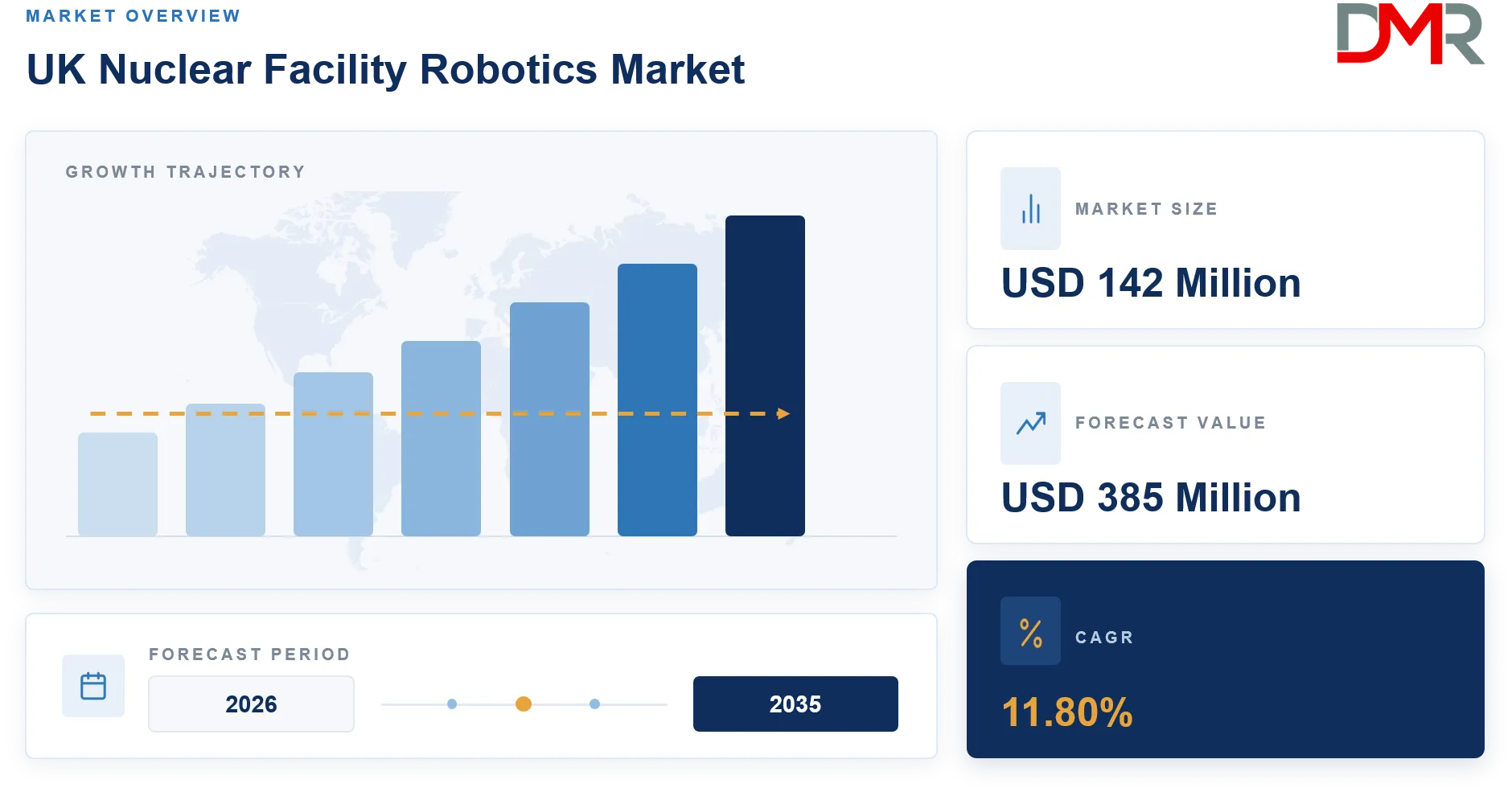
- Market Value: The UK nuclear facility robotics market is valued at USD 142 million in 2026 and is projected to reach USD 385 million by 2035.
- CAGR: The UK nuclear facility robotics market is expected to grow at a CAGR of 11.8% from 2026 to 2035.
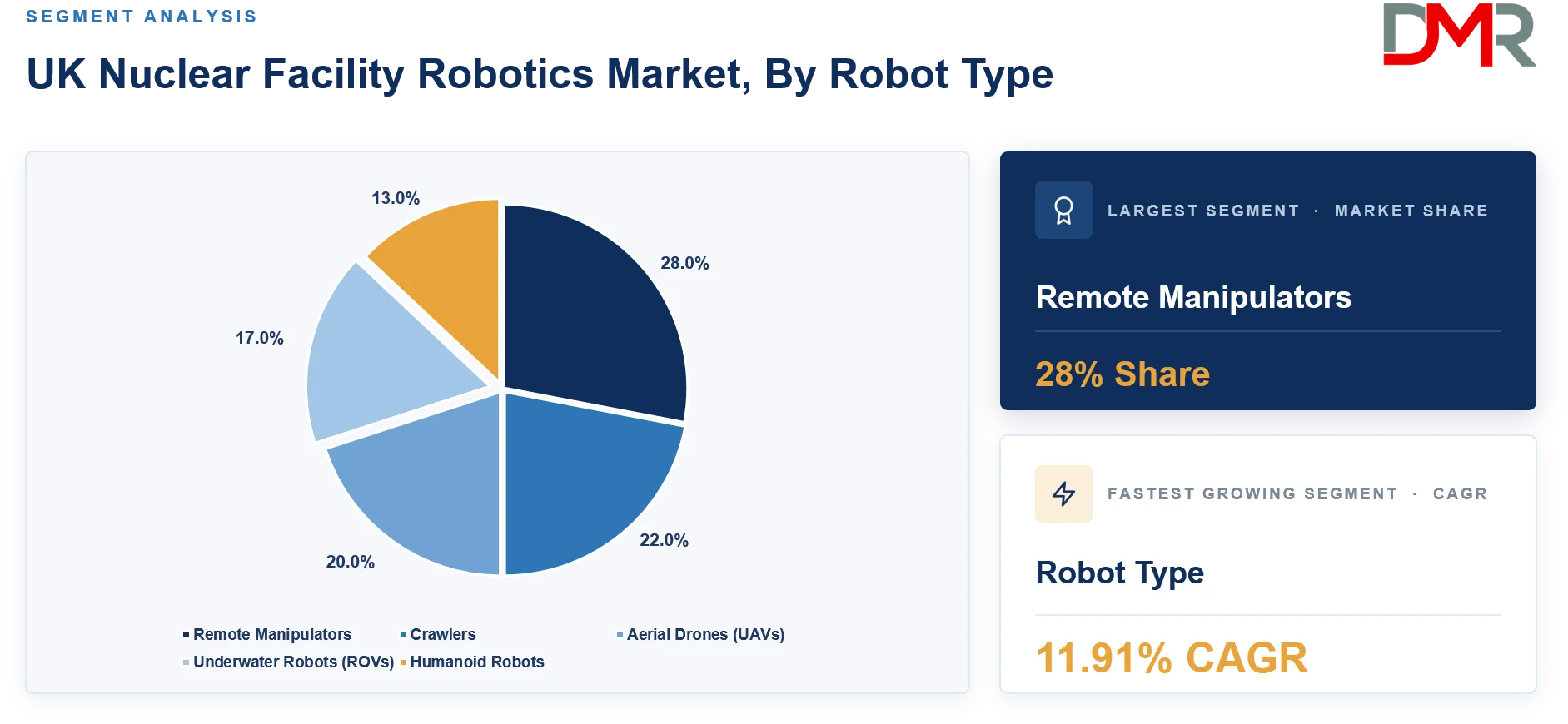
- By Robot Type Analysis: Remote manipulators led the robot type segment with a 28% share in 2026.
- By Application Analysis: Inspection led the application segment with a 32% share in 2026.
- By End User Analysis: Nuclear power plants held a 38% share in 2026.
- By Offering Analysis: Hardware accounted for a 64% share in 2026.
- Major Players: Veolia Nuclear Solutions UK, Createc Ltd, OC Robotics, AtkinsRéalis, and others.
What is the UK Nuclear Facility Robotics Market and its Market Size?
The UK Nuclear Facility Robotics Market size is projected to be valued at USD 142 million in 2026 and reach USD 385 million by 2035, expanding at a CAGR of 11.8% during the forecast period. Nuclear facility robotics covers remotely operated, semi autonomous, and autonomous machines designed to perform inspection, maintenance, decontamination, waste handling, dismantling, monitoring, and emergency tasks in radioactive or physically restricted environments. Demand is closely connected with the UK's long duration nuclear decommissioning programme, life extension and maintenance requirements at operating assets, radioactive waste management, and the need to reduce worker exposure.
ℹ
To learn more about this report –
Download Your Free Sample Report Here
The UK market is particularly shaped by Sellafield and the wider Nuclear Decommissioning Authority estate. The NDA's 2026 strategy places continued emphasis on decommissioning, remediation, spent fuel management, nuclear materials, and integrated radioactive waste management. Robotics and innovation are increasingly used as enabling technologies for these missions. Sellafield is also moving quadrupedal robots from individual trials toward routine operations, including inspection, mapping, radiological characterisation, and remote data collection.
Use Cases
- Radiological Inspection: Robots equipped with cameras, radiation detectors, ultrasonic sensors, and mapping systems inspect cells, pipelines, storage areas, vessels, and ageing assets without requiring personnel to enter high dose or difficult access locations.
- Remote Waste Handling: Manipulators and robotic arms sort, characterise, move, and package radioactive materials. The NDA's Auto-SAS programme is developing autonomous sorting and segregation capabilities for radioactive waste, with up to £9.5 million committed over four years.
- Decommissioning and Dismantling: Remote manipulators, mobile platforms, and robotic cutting systems support dismantling of contaminated equipment, gloveboxes, pipes, and structures while limiting manual intervention. Sellafield has demonstrated robotics and laser cutting for contaminated glovebox dismantling.
- Maintenance and Repair: Remote handling platforms can position tools, inspect components, remove obstructions, and complete repetitive maintenance in environments where access restrictions, contamination, or radiation increase conventional labour requirements.
- Emergency and Hazard Response: Crawlers, drones, ROVs, and remotely operated mobile robots can enter unsafe locations after equipment failures or abnormal events to provide visual intelligence, radiation data, environmental measurements, and situational awareness before human entry.
How AI and Gen AI are Transforming the UK Nuclear Facility Robotics Market?
Artificial intelligence is extending nuclear robotics beyond basic teleoperation. Computer vision can assist robots in identifying objects, locating defects, recognising obstacles, and comparing inspection imagery across repeated missions. Sensor fusion combines visual, radiological, thermal, ultrasonic, and spatial data to improve environmental awareness. At Sellafield, future quadruped deployments are expected to link robotic data with 3D visualisation, digital twins, plant information systems, new sensing payloads, and secure remote operation. These capabilities can make inspections more repeatable while creating structured digital records for asset condition and decommissioning planning.
Generative AI has potential in higher level operator support rather than unrestricted control of safety critical machinery. It can help engineering teams search maintenance records, summarise robot inspection data, organise large image libraries, generate preliminary task plans, and identify information requiring technical review. Human oversight, verification, cybersecurity, functional safety, and nuclear site assurance remain essential. The commercial opportunity is therefore shifting toward integrated robotics systems combining radiation tolerant hardware, sensing, AI navigation, data processing, digital twins, fleet management, and secure human supervision.
Key Drivers in the UK Nuclear Facility Robotics Market
Long Term Nuclear Decommissioning and Hazard Reduction
The scale and duration of the UK's nuclear clean-up programme create sustained demand for robotics used in characterisation, retrieval, dismantling, and waste processing. Sellafield contains complex legacy facilities where contamination, ageing infrastructure, confined spaces, and radiological conditions can restrict conventional access. The NDA's current strategy prioritises site decommissioning and remediation, spent fuels, nuclear materials, and integrated waste management. Robotic systems can address these missions while reducing personnel exposure and supporting more repeatable operations.
Movement from Robotics Trials to Operational Deployment
UK nuclear operators are increasingly testing robotics against real operational requirements rather than treating them only as research projects. Sellafield has demonstrated remote control of a customised Boston Dynamics Spot robot from outside the nuclear licensed site and plans broader routine use of quadrupedal platforms. In another project, a robotic arm was installed and operated inside an active nuclear glovebox. These demonstrations strengthen the commercial case for mobile inspection, remote manipulation, sensing, and integrated robotic services.
Restraints in the UK Nuclear Facility Robotics Market
Nuclear Qualification and Deployment Complexity
Robots entering nuclear facilities must operate reliably around radiation, contamination, difficult surfaces, narrow access routes, communication limitations, and strict safety procedures. A system that performs effectively in a laboratory may require substantial engineering before active deployment. Components, sensors, control links, recovery procedures, tooling, maintenance arrangements, and failure modes must be considered together. This raises development costs and lengthens procurement and validation cycles, particularly for highly specialised platforms produced in small volumes.
Cybersecurity, Integration, and Operator Assurance
Greater connectivity creates additional requirements for secure remote access, data governance, system integration, and controlled autonomy. Nuclear operators must understand how a robot behaves during communications loss, sensor failure, navigation error, or software malfunction. Sellafield has identified cybersecurity as a priority as it expands remote robotic operation and digital integration. Suppliers therefore need more than robotic hardware. They require secure architectures, traceable data, recovery strategies, training, lifecycle support, and integration capability suited to nuclear environments.
Growth Opportunities in the UK Nuclear Facility Robotics Market
Autonomous Radioactive Waste Sorting and Handling
Radioactive waste management offers a high value opportunity because material frequently requires characterisation, segregation, packaging, and transfer before disposal. The NDA's Auto-SAS initiative is developing autonomous sorting and segregation technology, with AtkinsRéalis and Createc working together through ARCTEC. The programme is intended to demonstrate how robotics can categorise waste more accurately, reduce unnecessary use of higher cost waste routes, and remove personnel from hazardous tasks. Successful deployment can support replication across additional NDA sites.
Robotics as a Service and Integrated Data Platforms
Market opportunity is expanding beyond one time robot sales toward complete inspection and remote operations services. Operators need platforms, specialist payloads, deployment engineering, maintenance, communications, data processing, digital twins, training, and fleet support. This creates recurring revenue potential for technology vendors and engineering contractors that can combine robotics with nuclear domain knowledge. As more systems move into routine use, customers are also likely to value interoperable payloads and reusable platforms that can support several facilities and mission types.
Trends in the UK Nuclear Facility Robotics Market
Growing Adoption of Quadrupeds and Mobile Inspection Platforms
Mobile inspection is progressing toward routine use in locations previously entered by workers under restrictive controls. Sellafield has used quadrupedal robots for repeated inspections, environmental mapping, radiological characterisation, and remote monitoring. The next stage includes expanded payloads and greater integration with digital plant information. This trend supports demand for radiation sensors, cameras, mapping systems, communications equipment, autonomous navigation software, and rugged mobile platforms capable of repeated missions.
Remote Manipulation Combined with Higher Autonomy
Remote manipulators remain central because nuclear work often requires physical interaction rather than observation alone. Current UK projects are combining robotic arms with improved control, sensing, and automated decision support for sorting and handling tasks. At Oldbury, teleoperated robotic arms are being trialled for fuel element debris, while Auto-SAS is designed to advance autonomous waste segregation. This progression from direct remote control toward supervised autonomy can widen robotics adoption in repetitive and hazardous material handling.
Research Scope and Analysis
The UK Nuclear Facility Robotics Market is segmented based on robot type, application, end user, payload capacity, autonomy level, and offering. The study evaluates major segments and sub-segments based on operational requirements, adoption patterns, deployment potential, technology development, and contribution to UK nuclear robotics market growth.
ℹ
To learn more about this report –
Download Your Free Sample Report Here
By Robot Type
Remote manipulators dominated the UK nuclear facility robotics market with a 28% share in 2026. Their leading position reflects the need to physically handle contaminated components, radioactive waste, tools, and legacy equipment while maintaining separation between workers and hazardous material. Manipulators can be installed in cells, gloveboxes, waste treatment environments, or mobile robotic systems. Recent Sellafield and Oldbury projects demonstrate their relevance to glovebox clean-up and waste handling. Crawlers, UAVs, ROVs, and humanoid platforms expand the available technology mix for inspection and access missions where fixed manipulation is unsuitable.
By Application
Inspection accounted for 32% of the UK market in 2026, making it the largest application segment. Inspection is an attractive entry point for robotics because robots can collect visual, radiation, ultrasonic, thermal, weld, and pipeline condition data without initially performing complex physical intervention. Repeatable robotic routes also allow operators to compare asset condition over time. Sellafield's quadrupedal robots have already demonstrated repeated inspection, mapping, and radiological characterisation, supporting continued demand for sensors, inspection payloads, data processing software, and mobile robotic platforms.
By End User
Nuclear power plants held 38% of market revenue in 2026. Operating and transitioning nuclear facilities require inspection, maintenance, monitoring, and remote handling to manage assets while reducing exposure in controlled environments. Waste management facilities and decommissioning sites represent another important demand base as the UK manages legacy materials and retired assets. Research laboratories, government organisations, and defence related facilities also create specialised opportunities where radiation tolerance, compact dimensions, secure communications, or purpose built manipulation are required.
By Offering
Hardware accounted for 64% of revenue in 2026 as nuclear deployment depends on specialised physical systems including robotic arms, sensors, actuators, mobility systems, cameras, radiation detectors, communications equipment, and mission specific tools. Software is expected to gain strategic importance as deployments become more connected. AI navigation, data processing, digital twins, remote interfaces, fleet management, and inspection analytics can increase utilisation of installed robotic assets and create recurring software and service opportunities.
The UK Nuclear Facility Robotics Market Report is Segmented on the Basis of the Following:
By Robot Type
- Remote Manipulators
- Crawlers
- Aerial Drones (UAVs)
- Underwater Robots (ROVs)
- Humanoid Robots
By Application
- Inspection
- Visual
- Ultrasonic
- Radiation
- Weld
- Pipeline
- Decontamination
- Maintenance & Repair
- Waste Handling
- Sorting
- Processing
- Transport
- Dismantling
- Emergency Response
By End User
- Nuclear Power Plants
- Waste Management Facilities
- Decommissioning Sites
- Research Labs
- Government and Defense
By Payload Capacity
- Low [<10 kg]
- Medium [10 to 50 kg]
- High [>50 kg]
By Autonomy Level
- Remote Controlled
- Semi Autonomous
- Autonomous
By Offering
- Hardware
- Sensors
- Actuators
- Mobility Systems
- Software
- AI Navigation
- Data Processing
- Digital Twin
- Fleet Management
Competitive Landscape
The UK nuclear facility robotics market combines specialist nuclear engineering companies, robotics developers, systems integrators, research organisations, and global industrial automation vendors. Competition is increasingly based on the ability to convert commercially available robotic platforms into systems suitable for nuclear facilities. This requires radiation sensing, specialised tooling, remote operation, safety engineering, cybersecurity, data management, and lifecycle support. AtkinsRéalis and Createc are collaborating through ARCTEC on the NDA backed Auto-SAS programme, demonstrating how partnerships combine nuclear engineering and robotics capabilities.
Sellafield's deployment of Boston Dynamics Spot also illustrates opportunities for platform vendors working through nuclear engineering and integration partners. Remote handling specialists such as Veolia Nuclear Solutions, OC Robotics, James Fisher Technologies, QinetiQ, Babcock International, and specialist UK technology companies compete across different stages of the robotics value chain. Commercial advantage is likely to depend on proven active environment deployment, modular payload integration, nuclear sector relationships, safety assurance, and the ability to scale successful demonstrations across multiple sites.
Some of the prominent players in the UK Nuclear Facility Robotics Industry are:
- Veolia Nuclear Solutions (UK)
- Createc Ltd
- OC Robotics (GE Vernova)
- Boston Dynamics
- AtkinsRéalis
- Oxford Robotics Institute (ORI)
- QinetiQ
- James Fisher Technologies
- KUKA AG
- FANUC Corporation
- Ice Nine Robotics Solutions
- Delkia Nuclear Solutions
- Digital Concepts Engineering Ltd
- Robotics for Hazardous Environments (RHE)
- Babcock International
- ARCTEC
- Cyan Tec
- Igloo Vision Ltd
- Forth Engineering
- VizFZ
- Others
Regulatory Landscape
The UK nuclear facility robotics market operates within a strict regulatory framework designed to protect workers, the public, nuclear assets, and the environment. The Office for Nuclear Regulation oversees nuclear safety, security, safeguards, and licensed site activities, while the Environment Agency and relevant devolved regulators address radioactive substances and environmental protection. Robotics deployed at Sellafield, nuclear power plants, waste facilities, and decommissioning sites must therefore align with site safety cases, radiation protection requirements, cybersecurity controls, equipment reliability, and operational procedures. Suppliers also need to consider robot recovery, communication loss, component failure, contamination management, maintenance, and human oversight before deployment. As autonomous functions expand, validation of software, sensors, navigation, and decision controls becomes more important. This framework favors vendors with nuclear engineering expertise, documented assurance processes, secure systems, and proven deployment experience.
Technology Analysis
The UK nuclear facility robotics market is evolving from conventional remote controlled equipment toward sensor rich, semi autonomous, and increasingly autonomous robotic systems. Remote manipulators remain commercially important for waste handling, dismantling, maintenance, and operations inside cells or gloveboxes, while tracked and wheeled crawlers provide access to confined or contaminated areas. UAVs support visual inspection and mapping, and ROVs address submerged structures and storage environments. Technology development is increasingly focused on radiation sensors, ultrasonic inspection, 3D mapping, computer vision, AI navigation, digital twins, and secure remote operation. Sellafield's use of quadruped robots demonstrates growing interest in reusable mobile platforms capable of carrying different inspection payloads. Autonomous waste sorting programmes also show how robotics can combine manipulation, sensing, and data processing. Future market growth will increasingly favor modular platforms that integrate hardware, intelligent software, specialist tooling, and fleet management.
Recent Developments
- August 2026: Createc Ltd Named authorised Boston Dynamics reseller for global nuclear sector, expanding Spot robot deployment and enterprise asset management services across UK and international nuclear facilities.
- June 2026: Veolia Nuclear Solutions (UK) awarded UKAEA contract for Project P170 FORT to develop radiation-tolerant robotic vision systems and dynamic path-planning software for fusion energy applications through March 2026.
- June 2025: Nuclear Decommissioning Authority launched £9.5 million Auto-SAS partnership with AtkinsRéalis and Createc (as ARCTEC) to deploy UK's first autonomous robotic system for sorting and segregating radioactive waste at Oldbury site.
Report Details
| Report Characteristics |
| Market Size (2026) |
USD 142 Million |
| Forecast Value (2035) |
USD 385 Million |
| CAGR (2026-2035) |
11.8% |
| Historical Data |
2021 - 2025 |
| Forecast Data |
2027 - 2035 |
| Base Year |
2025 |
| Estimate Year |
2026 |
| Segments Covered |
By Robot Type (Remote Manipulators, Crawlers {Tracked, Wheeled}, Aerial Drones {UAVs}, Underwater Robots {ROVs}, and Humanoid Robots), By Application (Inspection {Visual, Ultrasonic, Radiation, Weld, Pipeline}, Decontamination, Maintenance & Repair, Waste Handling {Sorting, Processing, Transport}, Dismantling, and Emergency Response), By End User (Nuclear Power Plants {PWR, BWR, Gas Cooled}, Waste Management Facilities, Decommissioning Sites, Research Labs, and Government and Defense), By Payload Capacity (Low [<10 kg], Medium [10 to 50 kg], and High [>50 kg]), By Autonomy Level (Remote Controlled, Semi Autonomous, and Autonomous), By Offering (Hardware {Sensors, Actuators, Mobility Systems} and Software {AI Navigation, Data Processing, Digital Twin, Fleet Management}) |
| Regional Coverage |
United Kingdom |
Frequently Asked Questions
What is the current size of the UK Nuclear Facility Robotics Market?
▾ The UK Nuclear Facility Robotics Market is valued at USD 142 million in 2026 and is forecast to reach USD 385 million by 2035.
What is the growth rate of the UK Nuclear Facility Robotics Market during?
▾ The UK Nuclear Facility Robotics Market is expected to grow at a CAGR of 11.8% during the forecast period 2026-2035.
What factors are driving the growth of the UK Nuclear Facility Robotics Market?
▾ Nuclear decommissioning, worker safety, remote inspection, waste handling, and automation drive UK Nuclear Facility Robotics Market growth.
What are the major challenges restraining the UK Nuclear Facility Robotics Market?
▾ High deployment costs, nuclear qualification, cybersecurity, system integration, and safety assurance restrain UK Nuclear Facility Robotics Market growth.
Which segment holds the largest share of the UK Nuclear Facility Robotics Market?
▾ Remote manipulators lead the UK Nuclear Facility Robotics Market by robot type, accounting for a 28% market share in 2026.
Who are the leading companies in the UK Nuclear Facility Robotics Market?
▾ Veolia Nuclear Solutions (UK), Createc Ltd, OC Robotics (GE Vernova), Boston Dynamics, AtkinsRéalis, Oxford Robotics Institute (ORI), QinetiQ, James Fisher Technologies, KUKA AG, FANUC Corporation, Ice Nine Robotics Solutions, Delkia Nuclear Solutions, Digital Concepts Engineering Ltd, Robotics for Hazardous Environments (RHE), Babcock International, ARCTEC, Cyan Tec, Igloo Vision Ltd, Forth Engineering, and VizFZ are prominent participants in the UK Nuclear Facility Robotics Market.
How is AI influencing the UK Nuclear Facility Robotics Market?
▾ AI improves navigation, inspection analytics, object recognition, waste sorting, digital twins, and autonomy in the UK Nuclear Facility Robotics Market.
What are the future opportunities and trends in the UK Nuclear Facility Robotics Market?
▾ Autonomous waste handling, robotic inspection, digital twins, smart sensors, and remote operations offer UK Nuclear Facility Robotics Market opportunities.