Market Snapshot
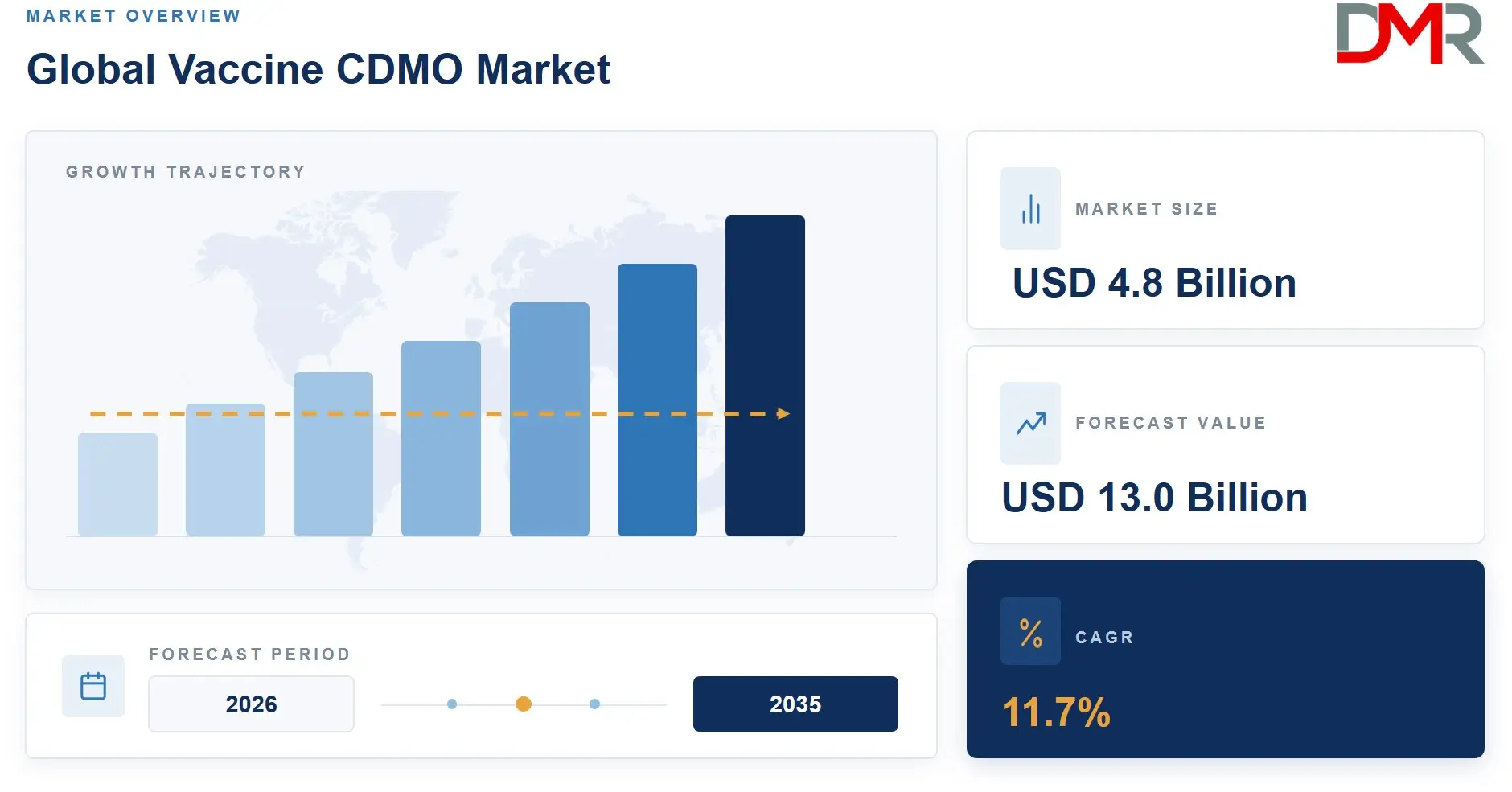
- Market Size (2026): USD 4.8 Bn
- Forecast Value (2035): USD 13.0 Bn
- CAGR (2026-2035): 11.7%
- Largest Region (2026): North America, approximately 38%
- Fastest-Growing Region: Asia-Pacific
- Leading Service Type (2026): Drug Substance Manufacturing, around 34%
- Leading Vaccine Type (2026): Preventive Vaccines, close to 68%
- Key Players: Lonza, Thermo Fisher Scientific, FUJIFILM Diosynth Biotechnologies, and others
What is Vaccine CDMO Market and its Market Size?
Global Vaccine CDMO Market size is estimated to reach USD 4.8 Bn in 2026 and is further anticipated to reach USD 13.0 Bn by 2035, at a CAGR of 11.7%.
ℹ
To learn more about this report –
Download Your Free Sample Report Here
Vaccine contract development and manufacturing organizations provide outsourced technical, development, and production capacity for prophylactic and therapeutic vaccines. The scope includes process development, cell culture or microbial production, purification, formulation, analytical testing, aseptic filling, lyophilization, packaging and commercial supply. It covers conventional vaccine platforms as well as recombinant proteins, viral vectors and nucleic acid technologies.
Demand comes from large pharmaceutical companies seeking flexible capacity, biotechnology developers without dedicated plants, public health programs requiring surge capability, and emerging vaccine companies moving candidates from laboratory scale into regulated manufacturing. Buyers typically select partners on platform expertise, biosafety capability, quality history, tech transfer performance, batch release reliability, and the ability to move from clinical quantities to commercial volumes without changing the manufacturing network.
The industry is changing as sponsors reduce fixed manufacturing exposure and use external networks to manage uncertain pipelines. Platform diversification also matters. mRNA, recombinant proteins, vector systems and thermostable formulations require different equipment, analytical methods and containment approaches, which rewards CDMOs that can combine specialized suites with common quality systems. Capacity is therefore becoming less about simple volume and more about adaptable infrastructure, validated processes and reliable regulatory execution.
Use Cases
- Clinical Vaccine Scale-Up: Biotechnology companies use CDMOs to convert laboratory processes into GMP-ready workflows for early and late clinical batches. The partner establishes scalable upstream and downstream operations, analytical methods, and release procedures, allowing the sponsor to progress trials without building a dedicated manufacturing site.
- Commercial Supply Outsourcing: Established vaccine manufacturers place selected products or production steps with external partners when internal plants are constrained or strategically reserved for core franchises. Outsourcing adds qualified capacity, supports regional supply continuity, and reduces the need to carry underused fixed assets between demand cycles.
- Public Health Surge Manufacturing: Governments, global health organizations and vaccine developers can use qualified external networks when outbreaks or procurement campaigns require rapid additional output. CDMOs provide transferable production capacity, fill and finish slots and quality systems that can shorten the path from bulk antigen availability to deployable doses.
- Specialized Platform Manufacturing: Developers of mRNA, viral vector, recombinant protein and other technically demanding vaccines engage platform-focused contractors for formulation, purification, sterile processing and analytical control. This gives smaller sponsors access to expertise and equipment that would be expensive to establish internally for a single program.
Key Takeaways
- Market Size & Share: The industry is forecast to add about USD 8.2 Bn in annual revenue between 2026 and 2035 as outsourcing expands across development and commercial supply.
- Technology Platform Analysis: Recombinant protein platforms are projected to represent roughly 31% of 2026 revenue because of their broad use across established and newer vaccine programs.
- Regional Analysis: Europe is expected to account for around 28% of 2026 demand, supported by a dense network of biologics manufacturers, sterile specialists, and vaccine developers.
- Scale Analysis: Commercial manufacturing is set to hold nearly 52% of 2026 revenue as validated supply contracts carry larger batch volumes and longer engagement periods.
- Growth Platform: mRNA and nucleic acid vaccine services are expected to expand at a CAGR of 18.9% through 2035 as programs broaden beyond pandemic applications.
- Customer Mix: Biotechnology companies are projected to grow at a CAGR of 15.2%, reflecting greater dependence on outsourced infrastructure among capital-constrained developers.
How AI/Gen AI is Transforming the Vaccine CDMO Market?
AI is being applied mainly to process control, development speed, and quality operations rather than replacing core biomanufacturing. Machine learning models can relate critical process parameters to yield and quality attributes, helping teams narrow design spaces before expensive engineering runs. Computer vision can strengthen visual inspection in fill and finish, while predictive models can identify equipment drift and scheduling conflicts across multi-product facilities.
Generative AI has a more targeted role in knowledge-heavy workflows. LLM-based document processing can organize deviation histories, batch records, and regulatory evidence for expert review, while digital twins can simulate process changes before physical execution. Human oversight remains essential because GMP decisions require traceability, validated systems, and controlled data governance.
- Process Modeling: Machine learning supports multivariate analysis of fermentation, cell culture, purification, and formulation parameters to reduce experimental cycles.
- Digital Batch Review: LLM-assisted document workflows can surface inconsistencies across manufacturing records and quality documentation for qualified personnel to investigate.
- Visual Inspection: Computer vision improves detection consistency for particulate, container, and cosmetic defects during sterile drug product operations.
- Capacity Scheduling: Reinforcement learning and optimization models can improve suite allocation across campaigns with different biosafety, cleaning, and turnaround requirements.
Key Drivers in the Global Vaccine CDMO Market
Outsourcing is moving deeper into vaccine development as sponsors balance pipeline uncertainty against the high fixed cost of specialized biologics infrastructure. Two forces are especially important.
- Capital-Efficient Outsourcing Across Complex Platforms: Building a vaccine plant requires specialized upstream suites, purification trains, aseptic areas, utilities, analytical laboratories, and quality systems that may sit underused when a candidate fails or demand shifts. With commercial manufacturing representing nearly 52% of 2026 revenue by scale, sponsors have a strong reason to place selected products with external partners that can spread fixed assets across multiple programs. The mechanism is financial as much as technical: CDMO access converts part of a large fixed investment into contracted operating spend while providing experienced tech transfer teams. This is particularly attractive for biotechnology companies that need credible GMP capability before their own revenue base can support dedicated infrastructure.
- Broader Vaccine Pipelines and Platform Diversity: Vaccine development now spans recombinant proteins, viral vectors, nucleic acids, conjugates, and established inactivated or attenuated technologies. Preventive vaccines are expected to account for approximately 68% of 2026 revenue by vaccine type, but faster-growing therapeutic and nucleic acid programs are increasing the number of specialized manufacturing workflows that sponsors must manage. External partners with modular suites and platform-specific analytics can absorb this complexity without requiring each developer to build parallel capabilities. As portfolios diversify, procurement decisions increasingly favor networks able to support more than one modality and bridge clinical development, sterile filling, and commercial supply.
Restraints in the Global Vaccine CDMO Market
Growth is constrained by the fact that vaccine manufacturing is difficult to transfer, validate, and operate consistently. Capacity on paper does not always translate into usable capacity for a specific platform.
- Lengthy Tech Transfer and Regulatory Qualification: Vaccine processes are sensitive to raw materials, cell substrates, equipment geometry, hold times and analytical methods. Drug substance manufacturing is projected to hold around 34% of 2026 service revenue, which concentrates a large share of value in the most technically demanding portion of the workflow. Moving a process to a new contractor can therefore require comparability work, method transfer, engineering batches, validation, and regulatory documentation before commercial output begins. A sponsor may face months of duplicated cost while the old and new supply paths overlap. This friction favors incumbents with proven quality histories but slows switching, limits rapid capacity reallocation, and raises the commercial penalty for execution failures.
- Specialized Capacity and Talent Bottlenecks: Not every biologics facility can handle live organisms, viral vectors, high containment needs or lipid nanoparticle workflows. Asia-Pacific is modeled at approximately 26% of 2026 demand, yet rapid regional expansion can strain experienced quality, validation, and process engineering talent. The same constraint applies globally when multiple programs compete for sterile filling slots or specialized analytical teams. New suites require commissioning and regulatory readiness before they become productive, while skilled operators need platform-specific training. These limits can produce mismatches between nominal installed capacity and qualified capacity, leading sponsors to reserve slots earlier and accept less flexibility in campaign timing.
Growth Opportunities in the Global Vaccine CDMO Market
White space is strongest where new platforms meet underbuilt regional capacity and where smaller developers need integrated services rather than isolated manufacturing steps.
- Integrated mRNA and Nucleic Acid Manufacturing: mRNA and nucleic acid services are projected to expand at a CAGR of 18.9% from 2026 to 2035, well above the broader industry. The commercial opening is not limited to RNA synthesis. Sponsors need lipid nanoparticle formulation, sterile filling, analytical characterization, cold-chain strategy, and increasingly alternative dosage forms that improve stability or delivery. CDMOs that integrate these steps can reduce handoffs and shorten investigation cycles when a process changes. The opportunity is particularly attractive for developers with several early programs but insufficient scale to justify an internal platform. Providers that establish flexible small and mid-scale trains can capture programs before they reach commercial volumes and retain them through later development.
- Regionalized Supply for Emerging Vaccine Producers: Latin America and the Middle East & Africa together are expected to represent about 8% of 2026 global demand, leaving substantial room for local and regional manufacturing partnerships. Governments and public health buyers increasingly value supply resilience, local fill and finish capability, and faster access during outbreaks. A CDMO does not always need full end-to-end antigen production to participate; sterile drug product, packaging, analytical release and technology transfer services can form practical entry points. Partnerships with local manufacturers can combine global quality systems with regional procurement access. The main opening lies in building qualified capacity before demand spikes, rather than attempting to add it during an emergency.
Trends in the Global Vaccine CDMO Market
Technology choices and contracting models are shifting toward flexible facilities, integrated service chains, and manufacturing designs that can be repurposed across programs.
- Modular and Single-Use Bioprocessing: Viral vector services are expected to grow at a CAGR of 15.8% through 2035, supporting demand for facilities that can change campaigns without the long turnaround associated with fixed stainless-steel systems. Single-use bioreactors, disposable flow paths and modular downstream skids can reduce cleaning validation burden and make smaller batches more economical. For CDMOs, the benefit is higher asset flexibility across a portfolio with uncertain clinical outcomes. The tradeoff is greater dependence on consumable supply chains and careful extractables, leachables, and material qualification. Providers are therefore pairing flexible equipment with stronger supplier qualification and inventory strategies rather than treating disposables as a simple plug-in solution.
- From Standalone Manufacturing to End-to-End Programs: Process development and analytical services are modeled at close to 24% of 2026 service revenue, showing that sponsors buy substantial technical work before commercial production begins. CDMOs are responding by connecting process development, analytical methods, clinical supply, drug substance, fill and finish, and packaging under fewer contractual interfaces. This model can reduce repeated tech transfers and make root-cause investigations faster because development history stays within one network. It also changes competition: providers are judged not only on batch capacity but on program management, regulatory support, and the ability to preserve process knowledge across development stages.
Research Scope and Analysis
Segment performance is assessed across service type, vaccine type, technology platform, scale of operation, and end user. Each axis identifies where 2026 revenue is concentrated and which sub-segment is expected to expand fastest through 2035, together with the commercial mechanism behind that shift.
ℹ
To learn more about this report –
Download Your Free Sample Report Here
By Service Type
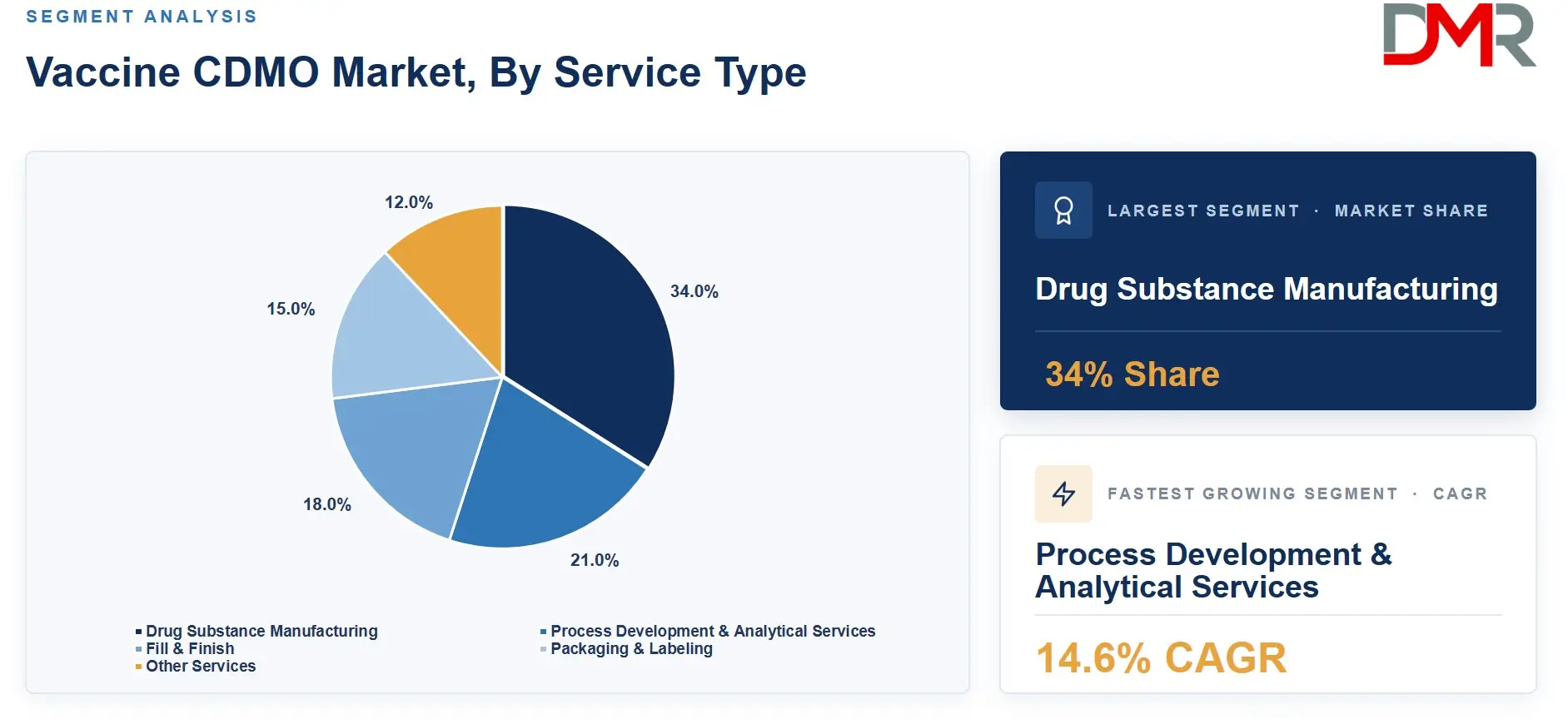
Drug substance manufacturing is projected to lead service type in 2026 with roughly 34% of revenue because upstream production, purification, and bulk formulation carry high technical complexity, long qualification cycles, and substantial batch value. Sponsors also tend to retain qualified drug substance partners once a process has reached late clinical or commercial status. Growth, however, is concentrated in process development and analytical services, expanding at a CAGR of 14.6% between 2026 and 2035. More emerging developers are outsourcing method development, characterization, process optimization, and comparability work earlier in the pipeline. This creates a front-end route for CDMOs to enter programs before manufacturing scale is fixed and increases the probability that development contracts convert into later GMP supply.
By Vaccine Type
Preventive vaccines are expected to account for approximately 68% of 2026 revenue by vaccine type, reflecting routine immunization programs, established infectious disease franchises and recurring public procurement. Their manufacturing economics also favor experienced suppliers because many products require validated processes, large campaigns, and dependable fill and finish capacity. The steeper trajectory sits with therapeutic vaccines, which are forecast to grow at a CAGR of 16.4% from 2026 to 2035. Oncology and immune-modulating programs are expanding the vaccine concept beyond prevention and often use newer platforms with smaller, more variable batch requirements. That profile suits flexible CDMO infrastructure, particularly when developers need rapid clinical supply and do not yet have predictable commercial volumes.
By Technology Platform
Recombinant protein technology is projected to hold close to 31% of 2026 revenue because it supports a wide range of subunit vaccines and benefits from established microbial and cell-based production knowledge. The platform fits both high-volume infectious disease products and newer antigen designs, giving CDMOs opportunities across development and commercial manufacturing. Growth, however, is concentrated in mRNA and nucleic acid platforms, expanding at a CAGR of 18.9% between 2026 and 2035. Developers are exploring respiratory, oncology, and personalized applications, while improvements in formulation and stability are widening the addressable pipeline. CDMOs with integrated RNA synthesis, lipid nanoparticle formulation, analytical characterization and sterile filling can capture more value per program than providers offering a single isolated step.
By Scale of Operation
Commercial manufacturing is set to represent nearly 52% of 2026 revenue by scale because approved vaccines generate recurring campaigns, larger batch volumes, and longer contracts than early clinical programs. Once a product is validated at a facility, switching costs and regulatory work also encourage continuity, supporting stable utilization for qualified suppliers. The faster expansion is expected in late clinical manufacturing, with a CAGR of 14.1% from 2026 to 2035. A growing pipeline of platform-diverse candidates requires scale-up, process characterization, validation preparation and launch-readiness work before approval. These projects are commercially attractive because they combine higher technical intensity with a meaningful probability of converting into commercial supply if the candidate succeeds.
By End User
Large pharmaceutical companies are projected to account for around 46% of 2026 revenue by end user, supported by broad vaccine portfolios, global supply obligations and deliberate use of external capacity to complement internal plants. These buyers also award larger multi-year contracts and can place separate development, drug substance and drug product work across qualified networks. Growth, however, is concentrated among biotechnology companies, which are forecast to expand at a CAGR of 15.2% through 2035. Smaller developers often possess platform science but lack validated manufacturing infrastructure, so they outsource earlier and across more steps. Their need for integrated development, analytics, and GMP supply creates a strong opportunity for CDMOs that can scale contracts as financing, trial progress, and demand visibility improve.
The Global Vaccine CDMO Market Report is Segmented Based on the Following
By Service Type
- Process Development & Analytical Services
- Drug Substance Manufacturing
- Fill & Finish
- Packaging & Labeling
- Other Services
By Vaccine Type
- Preventive Vaccines
- Therapeutic Vaccines
- Combination Vaccines
- Other Vaccine Types
By Technology Platform
- Recombinant Protein
- Viral Vector
- mRNA & Nucleic Acid
- Inactivated & Live Attenuated
- Conjugate & Subunit
- Other Platforms
By Scale of Operation
- Preclinical & Early Clinical
- Late Clinical
- Commercial Manufacturing
- Other Scales
By End User
- Large Pharmaceutical Companies
- Biotechnology Companies
- Emerging Vaccine Developers
- Government & Global Health Organizations
- Other End Users
Regional Analysis
Region with the Largest Revenue Share
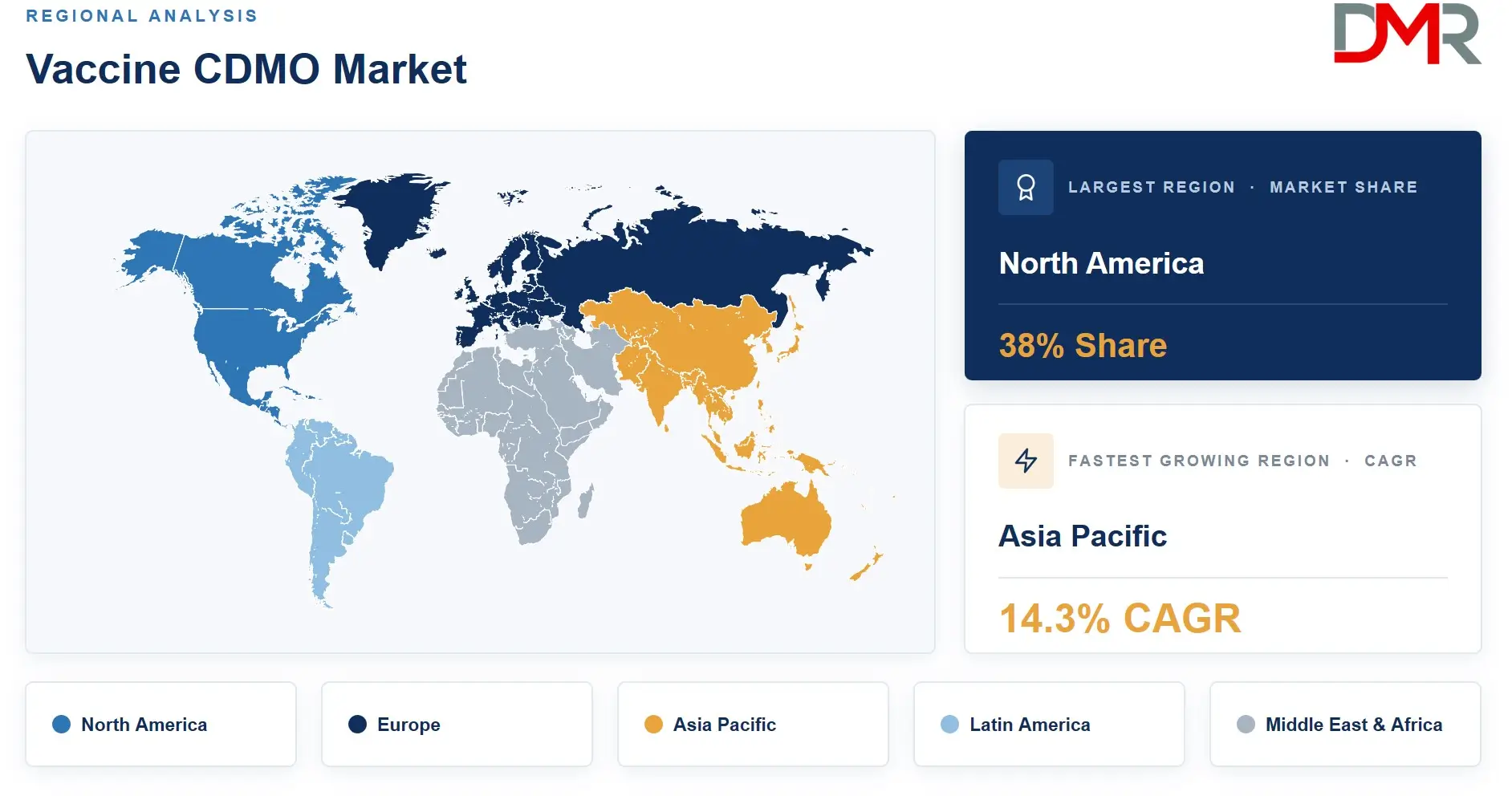
North America is expected to remain the largest regional market in 2026, accounting for approximately 38% of global revenue. The region combines a large biotechnology funding base, established vaccine developers, substantial public health procurement, and a dense network of biologics and sterile manufacturing assets. US sponsors frequently use external partners to avoid committing capital before clinical and commercial demand is clear, while established pharmaceutical companies use CDMOs to add redundancy and specialized platform capacity. The region also benefits from experienced regulatory, quality, and technical talent. High operating costs can limit commodity manufacturing, but the value of complex development, analytical and launch-support work keeps North America commercially important.
ℹ
To learn more about this report –
Download Your Free Sample Report Here
Region with the Highest CAGR
Asia-Pacific is forecast to post the highest regional CAGR at 14.3% from 2026 to 2035. China, India, South Korea and other manufacturing hubs are expanding biologics capabilities while local vaccine companies broaden pipelines and seek internationally compliant supply. The region also has a growing base of CDMOs able to combine competitive operating costs with modern single-use facilities and experienced technical teams. Domestic procurement, export ambitions and supply-chain localization support additional investment. Growth will not be uniform because regulatory systems, quality maturity and platform specialization differ by country, but the region's expanding manufacturing ecosystem is expected to increase its role in both clinical development and commercial vaccine supply.
By Region
North America
Europe
- Germany
- France
- The UK
- Italy
- Spain
- Rest of Europe
Asia-Pacific
- China
- Japan
- India
- Australia
- South Korea
- Rest of APAC
Latin America
- Mexico
- Brazil
- Colombia
- Argentina
- Rest of LATAM
Middle East & Africa
- Saudi Arabia
- The UAE
- South Africa
- Rest of MEA
Regulatory Landscape
Vaccine CDMOs operate under GMP requirements that place process validation, aseptic control, data integrity, comparability, and batch traceability at the center of commercial performance. Regulatory expectations are shifting toward stronger lifecycle process understanding and more disciplined control of outsourced activities, which raises the value of mature pharmaceutical quality systems. The commercial opening sits with providers that can support multiple jurisdictions using harmonized documentation, validated analytical methods, and inspection-ready facilities, reducing duplication for sponsors pursuing broad launches. Risk remains high because a serious quality event can affect several customer programs at once and consume scarce capacity during remediation. Regulatory execution therefore directly influences utilization, contract duration, and the premium attached to proven manufacturing networks.
Technology Analysis
Manufacturing technology is moving toward flexible single-use systems, intensified processing, improved process analytical technology and platform-specific formulation capabilities. The most important shift is the need to run smaller, more diverse campaigns without sacrificing reproducibility, especially as nucleic acid, viral vector, and recombinant programs share the outsourcing pipeline. Commercial white space sits in integrated platforms that connect development models, automated data capture, closed processing and sterile drug product operations, reducing handoffs between contractors. The brake is qualification complexity: new equipment, software and materials must fit validated GMP processes and cannot be adopted solely because they are faster. Technology leadership therefore improves competitiveness when it lowers transfer risk, supports faster changeovers and preserves consistent critical quality attributes.
Competitive Landscape
Competition is fragmented across large multi-modality CDMOs, vaccine specialists, sterile fill and finish providers, and regional biologics manufacturers. Large networks compete on geographic reach, integrated development-to-commercial services, and the ability to reserve capacity across several sites. Specialists differentiate through platform depth in viral vectors, microbial systems, mRNA, lyophilization, or high-throughput sterile filling. Buyers place heavy weight on inspection history, deviation management, tech transfer speed, supply reliability, and access to experienced process teams. Strategic investment is increasingly directed toward flexible suites and end-to-end offerings rather than undifferentiated bulk capacity. Partnerships with emerging developers are also important because an early clinical project can become a long-duration commercial contract if the candidate succeeds.
Some of the Prominent Players in the Global Vaccine CDMO Market Are
- Lonza
- Thermo Fisher Scientific
- FUJIFILM Diosynth Biotechnologies
- Samsung Biologics
- WuXi Biologics
- AGC Biologics
- Recipharm
- Boehringer Ingelheim BioXcellence
- Rentschler Biopharma
- Ajinomoto Bio-Pharma Services
- IDT Biologika
- Siegfried
- Emergent BioSolutions
- KBI Biopharma
- Curia
- Piramal Pharma Solutions
- Jubilant HollisterStier
- PCI Pharma Services
- Vetter
- CordenPharma
- Alcami
- Bora Pharmaceuticals
- Delpharm
- Fareva
- Ardena
- Polpharma Biologics
- Serum Institute of India
- Biological E
- Bharat Biotech
- Panacea Biotec
- Indian Immunologicals
- Gennova Biopharmaceuticals
- SK bioscience
- GC Biopharma
- CanSinoBIO
- Sinovac Biotech
- Porton Biopharma
- MabPlex International
- Pharmaron
- Minaris Advanced Therapies
- Other Key Players
Recent Developments
- In May 2026, Recipharm announced investment in a new blow-fill-seal manufacturing line, adding sterile capacity that can support vaccine programs from development through commercial supply and widening options for alternative container and filling formats.
- In October 2025, Recipharm secured additional funding to develop AI-enabled process control and simulation for continuous xRNA manufacturing, signaling a move toward lower-cost, more automated production approaches for nucleic acid vaccines.
- In October 2025, Recipharm completed cGMP manufacturing work for PnuBioVax to support a Phase 2 study, demonstrating how rapid technology transfer and scale-up can move a vaccine candidate between clinical stages without sponsor-owned capacity.
- In June 2025, the University of Oxford and Recipharm expanded their collaboration to manufacture two malaria vaccine candidates for Phase 1/2 studies, extending a relationship that combines drug substance, drug product and fill and finish support.
- In April 2025, Ethris and Lonza announced a collaboration to develop spray-dried mRNA vaccine formulations for respiratory disease prevention, bringing room-temperature stability and mucosal delivery into the manufacturing development agenda for next-generation RNA vaccines.
Report Details
| Report Characteristics |
| Market Size (2026) |
USD 4.8 Bn |
| Forecast Value (2035) |
USD 13.0 Bn |
| CAGR (2026-2035) |
11.7% |
| The US Market Size (2026) |
USD 1.4 Bn |
| Historical Data |
2021 - 2025 |
| Forecast Data |
2026 - 2035 |
| Base Year |
2025 |
| Segments Covered |
By Service Type, By Vaccine Type, By Technology Platform, By Scale of Operation and By End User |
| Regional Coverage |
North America - The US and Canada; Europe - Germany, France, The UK, Italy, Spain, Rest of Europe; Asia-Pacific - China, Japan, India, Australia, South Korea, Rest of APAC; Latin America - Mexico, Brazil, Colombia, Argentina, Rest of LATAM; Middle East & Africa - Saudi Arabia, The UAE, South Africa, Rest of MEA |
Frequently Asked Questions
How big is the Global Vaccine CDMO Market?
▾ Global vaccine CDMO revenue is estimated at USD 4.8 Bn in 2026. Demand includes outsourced process development, drug substance production, sterile fill and finish, analytical services and related manufacturing support for established and next-generation vaccines. Growth is being supported by platform diversification and the preference of many sponsors to access qualified capacity rather than build dedicated plants.
What is the growth rate of the Global Vaccine CDMO Market?
▾ The industry is forecast to expand at a CAGR of 11.7% from 2026 to 2035. Growth is expected to come from deeper outsourcing by biotechnology companies, additional late-stage vaccine programs, regional capacity expansion and greater use of specialized external infrastructure for mRNA, viral vector, recombinant protein and sterile drug product manufacturing.
Which region holds the largest share in the Global Vaccine CDMO Market?
▾ North America is projected to hold the largest regional position in 2026 with a share of approximately 38%. Its lead reflects a concentrated biotechnology ecosystem, large vaccine portfolios, strong public health demand and extensive biologics outsourcing. Asia-Pacific is expected to grow faster as new manufacturing assets and domestic vaccine pipelines expand across major regional hubs.
Who are the key players in the Global Vaccine CDMO Market?
▾ Key participants include Lonza, Thermo Fisher Scientific, FUJIFILM Diosynth Biotechnologies, Samsung Biologics, WuXi Biologics, AGC Biologics and Recipharm. Competitive positions differ by platform, development stage and geography, so sponsors typically evaluate technical fit, quality history, available capacity, sterile processing capability and the ability to support regulatory filings across intended launch markets.
Which service type holds the largest share of the market?
▾ Drug substance manufacturing is expected to lead service revenue in 2026 with a share of roughly 34%. It captures high-value upstream and downstream activities that are technically difficult to transfer and qualify. Once a vaccine reaches late clinical or commercial scale, validated drug substance relationships can persist for long periods because changing sites requires substantial comparability and regulatory work.
Which technology platform is growing fastest?
▾ mRNA and nucleic acid vaccine manufacturing services are forecast to grow at a CAGR of 18.9% between 2026 and 2035. Expansion beyond emergency pandemic production into respiratory, oncology and other applications is increasing demand for RNA synthesis, lipid nanoparticle formulation, analytical characterization and sterile filling capabilities that many developers prefer to source from specialized external partners.
What factors will shape the Vaccine CDMO Market through 2035?
▾ The Vaccine CDMO Market will be shaped by outsourcing economics, the number and maturity of vaccine pipelines, regional supply localization, platform-specific capacity and regulatory performance. Providers that can integrate development, analytics, drug substance and sterile drug product services while maintaining reliable tech transfer and quality execution are positioned to capture a larger share of complex, long-duration programs.