Global Zero Trust Network Access (ZTNA) Market Snapshot
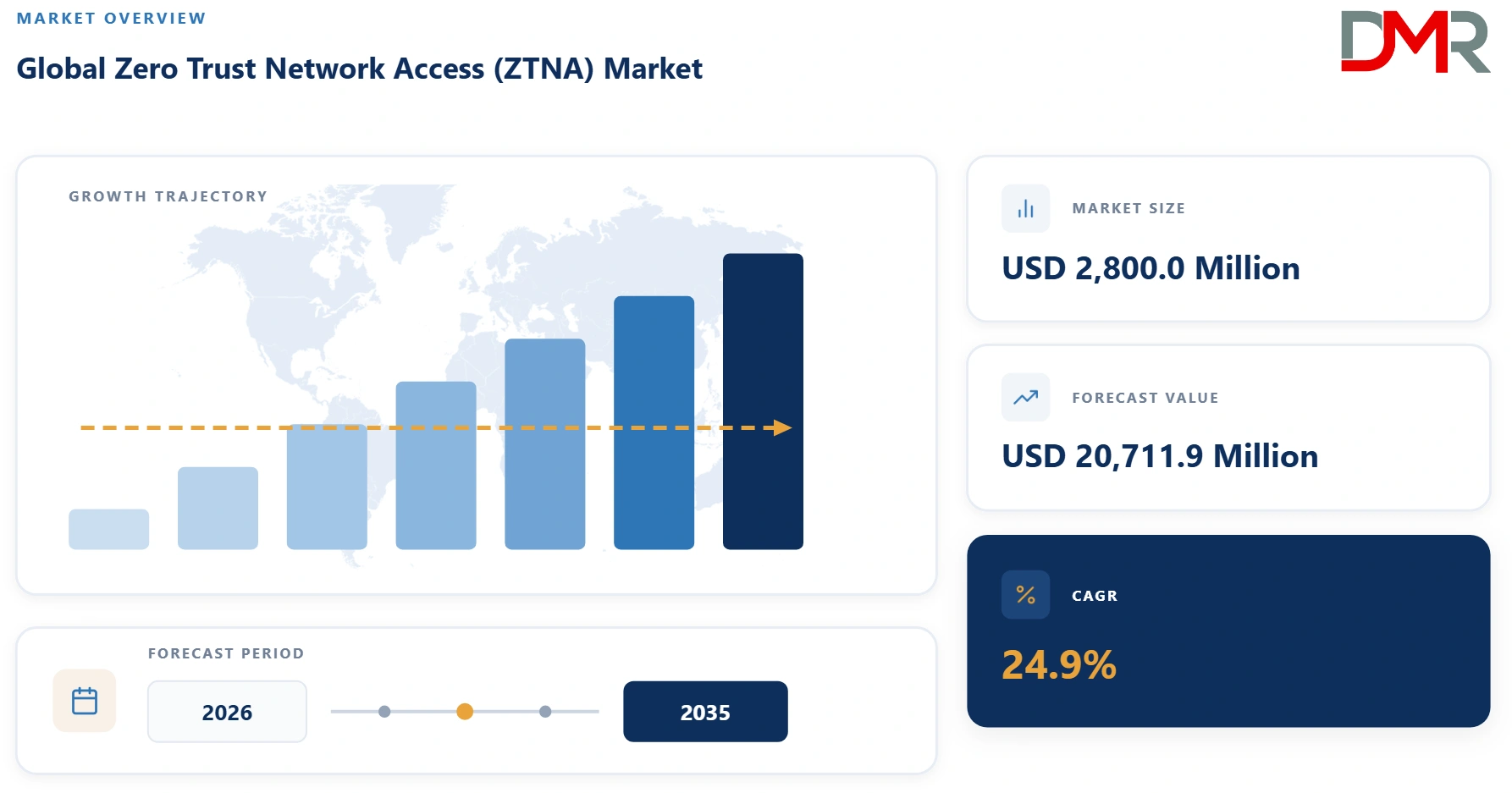
- Global ZTNA Market Size in 2026: USD 2,800.0 million
- Global ZTNA Market Size in 2035: USD 20,711.9 million
- Global CAGR from 2026 to 2035: 24.9%
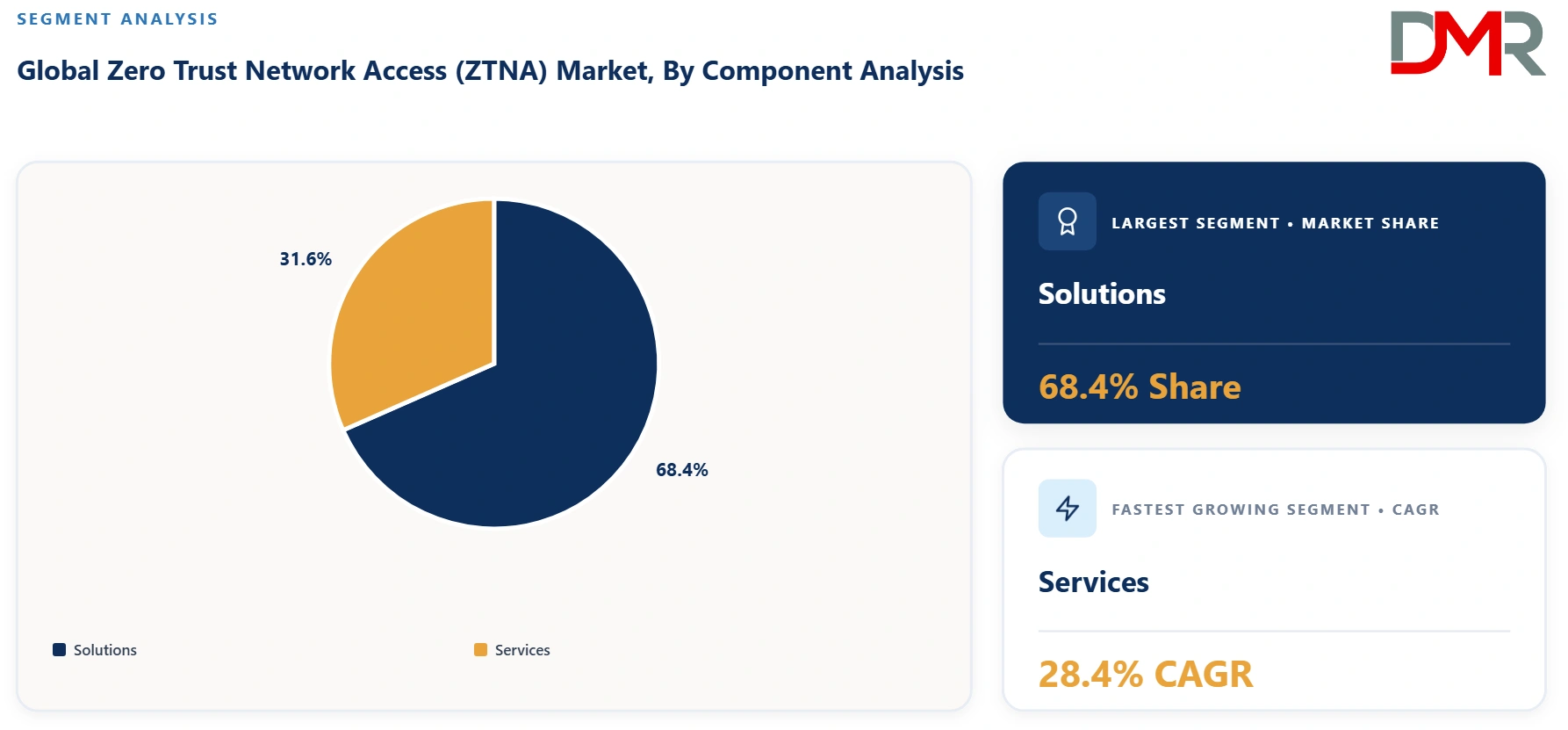
- Solutions is the leading Component segment in 2026: 68.4%
- Large Enterprises is the leading Organization Size segment in 2026: 58.7%
- Services is the fastest-growing Component segment: 28.1% CAGR
- SMEs is the fastest-growing Organization Size segment: 28.3% CAGR
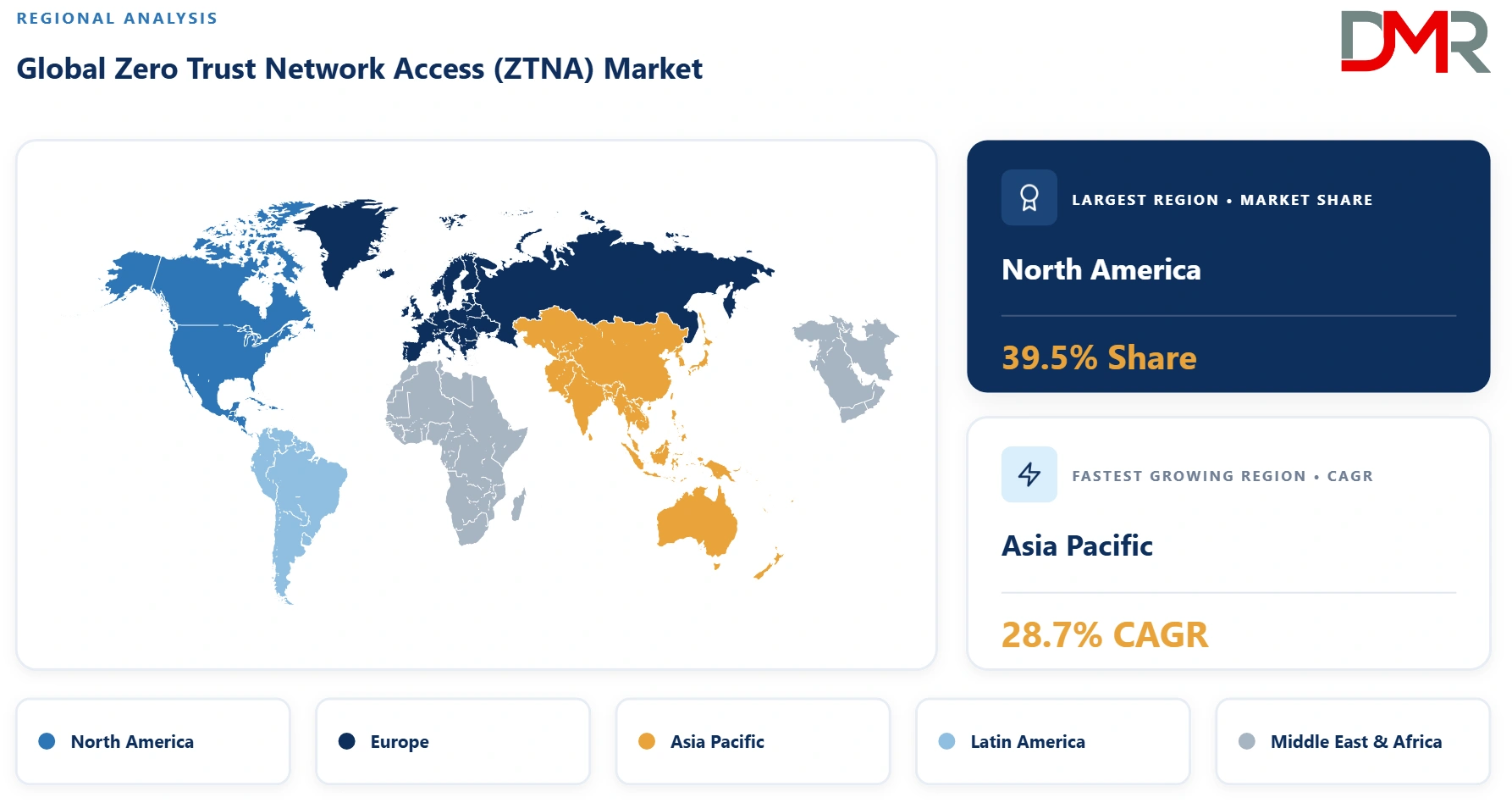
- North America is the leading Region in 2026: 38.9%
- Asia Pacific is the fastest-growing Region: 28.7% CAGR
What is the Global Zero Trust Network Access (ZTNA) and its Market Size?
The Global Zero Trust Network Access (ZTNA) Market size is projected to be valued at USD 2,800.0 million in 2026, and it is further anticipated to reach a market value of USD 20,711.9 million by 2035, at a CAGR of 24.9%.
ℹ
To learn more about this report –
Download Your Free Sample Report Here
The global market for zero trust network access has expanded at pace as the collapse of the traditional network perimeter, driven by hybrid work, multi-cloud adoption, and an increasingly distributed device fleet, has pushed enterprises to rethink how users, workloads, and machines are authenticated and authorized. ZTNA operationalizes the "never trust, always verify" principle by replacing implicit, location-based trust with continuous, identity-centric, context-aware verification for every access request, whether it originates from an employee laptop, a third-party contractor, an API, or a workload in a container cluster. Market growth is driven by rising cyberattack sophistication, credential-based breaches, ransomware proliferation, and mounting regulatory pressure across BFSI, healthcare, government, and critical infrastructure sectors, all of which are accelerating the replacement of legacy VPNs and castle-and-moat architectures with software-defined, least-privilege access models. The convergence of ZTNA with Secure Access Service Edge (SASE), Security Service Edge (SSE), identity and access management (IAM), and micro-segmentation frameworks is further widening the addressable market as vendors bundle zero trust capabilities into unified security platforms.
Use Cases
- Remote and Hybrid Workforce Enablement: ZTNA grants employees and contractors application-level access rather than full network access, reducing lateral-movement risk while supporting distributed and hybrid work models at scale.
- Third-Party and Vendor Access Governance: Organizations use ZTNA to extend tightly scoped, time-bound access to external partners, suppliers, and contractors without exposing broader internal network segments.
- Privileged Access Protection: ZTNA strengthens control over administrator, DevOps, and other high-privilege accounts through continuous verification, session monitoring, and just-in-time access provisioning.
- Workload-to-Workload and API Security: As cloud-native architectures proliferate, ZTNA is applied to authenticate and authorize machine-to-machine traffic, securing API calls and service-to-service communication across hybrid and multi-cloud environments.
- Micro-Segmentation of Internal Applications: Enterprises deploy ZTNA to isolate sensitive internal applications and data stores, containing breaches and limiting the blast radius of compromised credentials or endpoints.
Key Takeaways
- Global Market Value: The global ZTNA market is projected to be valued at USD 2,800.0 million in 2026 and is further anticipated to reach USD 20,711.9 million by 2035.
- Global Growth Rate: The global ZTNA market is expected to register a CAGR of 24.9% during the forecast period from 2026 to 2035.
- Technology Trends: Continued convergence of ZTNA with SASE/SSE architectures, identity-first security, continuous adaptive risk and trust assessment (CARTA), and AI-driven behavioral analytics is deepening enterprise adoption across industries.
- Market Drivers: Escalating credential-based and ransomware attacks, accelerating cloud and hybrid-work adoption, legacy VPN replacement cycles, and tightening data-privacy and access-control regulations are propelling market expansion.
- Component Segment Analysis: The Solutions segment is anticipated to be the largest component segment, holding a 68.4% market share by the end of 2026, while the Services segment is expected to be the fastest-growing, registering a 28.1% CAGR from 2026 to 2035.
- Organization Size Segment Analysis: Large Enterprises represent the leading segment with a 58.7% share in 2026, while SMEs are projected to post the fastest CAGR of 28.3% through 2035 as affordable, cloud-delivered ZTNA lowers the adoption barrier for smaller organizations.
- Regional Analysis: North America is poised to hold the largest market share at 38.9% in 2026, while Asia Pacific is expected to be the fastest-growing region, registering a CAGR of 28.7% during the forecast period.
How AI/Gen AI is Transforming the Zero Trust Network Access (ZTNA) Market?
Artificial intelligence and machine learning are becoming embedded in ZTNA platforms to strengthen continuous verification, risk scoring, and anomaly detection. AI-driven user and entity behavior analytics (UEBA) enable ZTNA solutions to flag deviations in login patterns, device posture, or data-access behavior in real time, allowing policy engines to dynamically tighten or revoke access without manual intervention. Generative AI is also being used to accelerate policy authoring, translating plain-language security intent into granular access rules, and to simulate attack paths for proactive posture management. Machine-learning-based device fingerprinting and adaptive authentication are reducing friction for verified low-risk users while escalating scrutiny for higher-risk sessions. As enterprises scale toward hundreds of thousands of managed identities and machine accounts, AI-assisted automation is becoming essential to keep policy management, monitoring, and analytics operationally feasible.
Key Drivers in the Global Zero Trust Network Access (ZTNA) Market
Escalating Ransomware and Credential-Based Attacks
The relentless rise in ransomware, phishing, and credential-stuffing attacks is one of the strongest catalysts for ZTNA adoption. Traditional perimeter defenses and flat network architectures allow attackers who compromise a single credential to move laterally with minimal resistance. ZTNA's continuous verification and least-privilege enforcement contain breaches at the point of entry, making it a foundational control in modern enterprise security stacks and a key reason boards and CISOs are prioritizing zero trust investment.
Accelerating Cloud Migration and Hybrid Work Adoption
Enterprises are increasingly hosting applications and workloads across multiple public and private clouds while supporting a permanently hybrid workforce. This distributed footprint has rendered legacy site-to-site VPNs and hardware-centric perimeter security largely ineffective. ZTNA's cloud-native, identity-anchored delivery model aligns naturally with distributed infrastructure, giving IT and security teams consistent policy enforcement regardless of user location or application hosting environment.
Restraints in the Global Zero Trust Network Access (ZTNA) Market
Integration Complexity with Legacy Infrastructure
Many large enterprises continue to operate substantial legacy IT estates, including on-premises applications, older identity systems, and traditional network hardware. Integrating modern ZTNA platforms with this legacy infrastructure often demands significant architectural redesign, custom connectors, and extended migration timelines, which can slow deployment and increase implementation costs, particularly for organizations with limited in-house security engineering resources.
High Total Cost of Ownership for Comprehensive Deployment
While cloud-delivered ZTNA lowers upfront hardware costs relative to legacy perimeter security, achieving full-scale zero trust maturity, spanning identity governance, continuous monitoring, micro-segmentation, and policy orchestration, requires sustained investment in licensing, professional services, and skilled personnel. This total cost of ownership can be a meaningful barrier for small and mid-sized organizations operating with constrained security budgets.
Growth Opportunities in the Global Zero Trust Network Access (ZTNA) Market
Convergence with SASE and SSE Platforms
Vendors are increasingly bundling ZTNA with secure web gateway, cloud access security broker, and firewall-as-a-service capabilities under unified SASE and SSE architectures. This convergence creates cross-selling opportunities for established network and security vendors and positions ZTNA as an entry point into broader platform consolidation deals, expanding average deal sizes and vendor stickiness.
Rising Government Zero Trust Mandates
Government agencies across North America, Europe, and Asia Pacific are issuing zero trust architecture mandates for public-sector and critical-infrastructure networks, following frameworks such as NIST SP 800-207. These mandates are compelling accelerated ZTNA procurement across defense, government, and regulated critical-infrastructure operators, creating a durable, policy-driven demand base independent of broader IT spending cycles.
Trends in the Global Zero Trust Network Access (ZTNA) Market
Shift Toward Universal and Agentless ZTNA Models
Vendors are increasingly offering agentless or browser-based ZTNA alongside traditional agent-based deployment, enabling secure access for unmanaged and BYOD devices, contractors, and third parties without requiring endpoint software installation. This flexibility is broadening the addressable use cases for ZTNA beyond managed corporate devices.
Deepening Identity-Centric Security Architecture
Enterprises are tightening integration between ZTNA and identity providers, device posture assessment tools, and privileged access management systems, treating identity as the primary control plane rather than network location. Continuous, contextual authentication factoring in user role, device health, geolocation, and behavioral signals is becoming the default expectation rather than a differentiator.
Research Scope and Analysis
The global ZTNA market is segmented based on component into solutions (ZTNA platforms, identity & access management, policy management & enforcement, data-centric security, and monitoring & analytics) and services (professional services, comprising consulting & advisory and integration & implementation and training & support, and managed services). The market is further segmented by deployment model, organization size, ZTNA architecture, authentication mechanism, deployment platform, application, and industry vertical.
ℹ
To learn more about this report –
Download Your Free Sample Report Here
By Component Analysis
The Solutions segment is projected to dominate the component landscape, holding 68.4% of the total market share in 2026, underpinned by sustained enterprise investment in ZTNA platforms, identity and access management tooling, and policy enforcement engines as the technical backbone of zero trust architecture. Within solutions, ZTNA Platforms represent the largest sub-segment given their role as the central orchestration layer connecting identity, policy, and enforcement. The Services segment, encompassing professional services and managed services, is expected to register the fastest CAGR of 28.1% through 2035, as organizations lean on consulting, integration, and managed ZTNA offerings to navigate deployment complexity and address persistent cybersecurity talent shortages, with Managed Services emerging as the quickest-growing services sub-segment.
By Deployment Model Analysis
Cloud-Based deployment is expected to lead the market, capturing 61.2% share in 2026, as cloud delivery aligns naturally with distributed workforces, multi-cloud application hosting, and rapid, low-friction rollout compared with on-premises alternatives. The Hybrid deployment model is projected to post the fastest CAGR of 27.5% during the forecast period, reflecting enterprises' pragmatic approach to migrating mission-critical and regulated workloads gradually while maintaining certain systems on-premises for compliance or latency reasons.
By Organization Size Analysis
Large Enterprises are expected to remain the dominant organization-size segment, accounting for 58.7% of the market in 2026, given their expansive, globally distributed digital estates, higher exposure to sophisticated cyber threats, and greater budget capacity for comprehensive zero trust rollouts. SMEs are anticipated to be the fastest-growing segment, with a CAGR of 28.3% from 2026 to 2035, as affordably priced, cloud-native ZTNA offerings lower the technical and financial barriers that previously limited zero trust adoption among smaller organizations.
By ZTNA Architecture Analysis
Service-Initiated ZTNA is expected to lead the architecture segment, holding 55.6% share in 2026, favored for its lighter footprint on endpoint devices and simpler deployment across unmanaged and BYOD environments. Endpoint-Initiated ZTNA is projected to be the faster-growing architecture, registering a CAGR of 26.1% through 2035, as enterprises increasingly deploy agent-based models on managed corporate devices to enable deeper device-posture checks and more granular policy enforcement.
By Authentication Mechanism Analysis
Multi-Factor Authentication (MFA) is expected to dominate the authentication mechanism segment, commanding roughly 76.0% share in 2026 and continuing to expand at a CAGR of approximately 25.9% through 2035, as regulatory mandates and cyber-insurance requirements make MFA a near-universal baseline for zero trust deployments. Single-Factor Authentication is expected to see materially slower growth as enterprises phase it out of sensitive access workflows in favor of layered, adaptive verification.
By Deployment Platform Analysis
Network Infrastructure is projected to be the leading deployment platform segment, accounting for 42.1% of the market in 2026, reflecting the foundational role of network-level enforcement points in brokering secure connections between users and resources. The Applications segment is expected to be the fastest-growing, with a CAGR of 27.9% during the forecast period, as organizations increasingly apply ZTNA controls directly at the application layer to support granular, workload-specific access policies in cloud-native environments.
By Application Analysis
Remote Workforce Access is expected to remain the leading application segment, representing 33.6% of the market in 2026, driven by the enduring shift toward hybrid and remote work models across industries. Workload-to-Workload & API Access is projected to be the fastest-growing application segment, with a CAGR of 29.4% through 2035, propelled by the rapid expansion of microservices architectures, containerized workloads, and machine-to-machine communication that require continuous authentication independent of human users.
By Industry Vertical Analysis
IT & Telecom is expected to be the leading industry vertical, holding 24.3% of the market share in 2026, owing to the sector's early adoption of cloud-native security architectures and its role in developing and operationalizing ZTNA technology itself. Government & Defense is projected to register the fastest CAGR of 28.6% during the forecast period, driven by binding zero trust mandates, heightened nation-state threat activity, and sustained public-sector cybersecurity modernization budgets.
The Global Zero Trust Network Access (ZTNA) Market Report is segmented based on the following:
By Component
- Solutions
- ZTNA Platforms
- Identity & Access Management
- Policy Management & Enforcement
- Data-Centric Security
- Monitoring & Analytics
- Services
- Professional Services
- Consulting & Advisory
- Integration & Implementation
- Training & Support
- Managed Services
By Deployment Model
- Cloud-Based
- On-Premises
- Hybrid
By Organization Size
- Small & Medium-Sized Enterprises (SMEs)
- Large Enterprises
By ZTNA Architecture
- Endpoint-Initiated ZTNA
- Service-Initiated ZTNA
By Authentication Mechanism
- Multi-Factor Authentication (MFA)
- Single-Factor Authentication
By Deployment Platform
- Applications
- Endpoint Devices
- Network Infrastructure
By Application
- Remote Workforce Access
- Third-Party & Partner Access
- Privileged Access
- Workload-to-Workload & API Access
- Internal Application Access & Micro-Segmentation
- Others
By Industry Vertical
- BFSI
- IT & Telecom
- Healthcare
- Government & Defense
- Retail & E-Commerce
- Manufacturing
- Energy & Utilities
- Education
- Others
Regional Analysis
North America is the Leading Region in the Global ZTNA Market
North America is anticipated to lead the global ZTNA market with a 38.9% share in 2026, supported by its mature cybersecurity ecosystem, strong presence of major security vendors, and early adoption of zero trust frameworks. Federal cybersecurity mandates in the United States are accelerating implementation across government agencies, while enterprises are replacing traditional VPNs with identity-centric access solutions. High cloud penetration, substantial cybersecurity spending, and growing adoption of SASE and SSE platforms further strengthen regional demand. Financial services, healthcare, technology, and government remain major adopters as organizations prioritize continuous authentication, least-privilege access, and protection of distributed digital environments.
ℹ
To learn more about this report –
Download Your Free Sample Report Here
Asia Pacific is the Fastest-Growing Region in the Global ZTNA Market
Asia Pacific is projected to be the fastest-growing ZTNA market, registering a CAGR of 28.7% from 2026 to 2035. Rapid cloud migration, digital transformation, expanding remote workforces, and increasing cyber threats are accelerating adoption across China, India, Japan, South Korea, and Australia. Governments are strengthening cybersecurity frameworks to protect critical infrastructure and sensitive digital assets, creating opportunities for ZTNA vendors. Financial institutions, manufacturers, technology companies, and government organizations are increasingly implementing identity-based access controls. Growing adoption among SMEs, expansion of cloud-native applications, and increasing integration of ZTNA with SASE and endpoint security platforms are expected to sustain regional growth.
Europe ZTNA Market
Europe represents a significant ZTNA market, supported by stringent data protection requirements, sophisticated cybersecurity infrastructure, and increasing enterprise migration toward identity-centric security. GDPR and national cybersecurity regulations are encouraging organizations to strengthen access controls and reduce dependence on traditional perimeter-based security. Germany, the UK, France, and Italy are major contributors, with adoption expanding across BFSI, manufacturing, healthcare, government, and technology sectors. Growing cloud deployment, hybrid working models, and increasing ransomware threats are strengthening demand. Enterprises are also integrating ZTNA with SASE, SSE, identity management, and endpoint security solutions to improve compliance, visibility, and protection across distributed applications and workforces.
Latin America ZTNA Market
Latin America's ZTNA market is expanding as enterprises strengthen cybersecurity capabilities amid increasing ransomware, data breaches, and cloud adoption. Brazil and Mexico remain important markets, supported by expanding digital services, financial technology ecosystems, and enterprise modernization programs. Organizations are gradually replacing VPN-based remote access with identity-centric solutions offering stronger authentication and application-level controls. Demand is particularly increasing across BFSI, telecommunications, retail, government, and technology industries. Growing cloud adoption among SMEs provides additional opportunities for ZTNA-as-a-Service providers. However, cybersecurity skill shortages and budget constraints may influence adoption, creating demand for managed security services and simplified cloud-delivered ZTNA platforms.
Middle East and Africa (MEA) ZTNA Market
The Middle East and Africa ZTNA market is gaining momentum through national cybersecurity programs, cloud transformation, smart-city investments, and digital government initiatives. Saudi Arabia and the UAE are prominent adopters, with financial services, government, energy, and critical infrastructure organizations strengthening identity-based security frameworks. Growing cloud adoption and increasing concerns regarding sophisticated cyberattacks are encouraging enterprises to move beyond traditional perimeter security. Saudi Vision 2030 and regional digitalization programs are creating opportunities for ZTNA and SASE providers. South Africa is also experiencing gradual adoption as businesses modernize security infrastructure, while managed services are becoming increasingly important for addressing cybersecurity expertise and implementation challenges.
Major Countries Analysis
United States ZTNA Market
The United States ZTNA market is projected to reach USD 980.3 million in 2026 and USD 6,647.9 million by 2035, expanding at a CAGR of 23.7%. Federal zero trust requirements, high cybersecurity spending, extensive cloud adoption, and the presence of leading security vendors support market growth. Government agencies and enterprises are increasingly replacing legacy VPN infrastructure with identity-aware, application-level access solutions. BFSI, healthcare, technology, and government organizations remain major adopters. Integration of ZTNA with SASE, SSE, endpoint protection, and identity management platforms is accelerating as organizations seek continuous verification, least-privilege access, and stronger protection for hybrid workforces and cloud applications.
Japan ZTNA Market
Japan's ZTNA market is expanding as enterprises modernize cybersecurity architectures in response to increasing cyberattacks, cloud migration, and digital transformation. The country's advanced technology infrastructure and strong manufacturing, financial services, and telecommunications industries provide a favorable environment for adoption. Organizations are increasingly implementing identity-centric access controls to secure remote employees, contractors, cloud applications, and sensitive corporate resources. Government initiatives focused on strengthening critical-infrastructure cybersecurity are also supporting demand. Integration of ZTNA with SASE, endpoint security, multi-factor authentication, and cloud security platforms is gaining momentum, while increasing adoption of hybrid working environments is expected to create further opportunities for domestic and international cybersecurity providers.
Saudi Arabia ZTNA Market
Saudi Arabia's ZTNA market is benefiting from Vision 2030, expanding cloud infrastructure, national cybersecurity initiatives, and rapid digitalization across government and private enterprises. Government agencies, banks, energy companies, and critical infrastructure operators are strengthening access security to protect sensitive applications and digital assets. Increasing cloud migration and adoption of hybrid working models are encouraging organizations to implement identity-based access controls and continuous authentication. Demand is also supported by investments in smart cities and digital government platforms. Integration of ZTNA with SASE, identity management, endpoint protection, and managed security services is expected to create substantial opportunities for cybersecurity vendors and system integrators.
Regulatory Landscape
The ZTNA market operates within an evolving regulatory environment shaped by data-protection regulations, sector-specific cybersecurity mandates, and national zero trust architecture frameworks. In the United States, federal zero trust mandates for government agencies have set a reference architecture that is influencing private-sector adoption. In Europe, GDPR and sector-specific directives are reinforcing demand for identity-centric, auditable access controls. Regulatory bodies across BFSI, healthcare, and critical-infrastructure sectors globally are increasingly referencing zero trust principles in compliance frameworks, shaping vendor product roadmaps and market entry strategies.
Investment and White Space Analysis
Rising venture capital and strategic investment in identity security, micro-segmentation, and AI-driven threat detection are fueling innovation across the ZTNA ecosystem. Established network and security vendors continue to expand ZTNA capabilities through acquisitions and platform integration, while venture-backed challengers are targeting agentless, developer-friendly, and API-security-focused ZTNA niches. Significant white space remains in workload-to-workload and API-access security, SME-focused affordable ZTNA offerings, and zero trust solutions tailored to operational technology (OT) and industrial control system environments, presenting strong opportunities for both established players and emerging entrants.
By Region
North America
Europe
- Germany
- France
- The U.K.
- Italy
- Spain
- Rest of Europe
Asia-Pacific
- China
- Japan
- India
- Australia
- South Korea
- Rest of APAC
Latin America
- Mexico
- Brazil
- Rest of LATAM
Middle East & Africa
- Saudi Arabia
- The UAE
- South Africa
- Rest of MEA
Competitive Landscape
The competitive landscape of the ZTNA market is shaped by established network and cybersecurity vendors expanding into identity-centric access control, alongside cloud-native challengers built specifically around zero trust architecture. Companies such as Palo Alto Networks, Zscaler, and Cisco continue to invest heavily in platform consolidation, integrating ZTNA with broader SASE and SSE offerings. Cloud-native specialists including Cloudflare, Twingate, and Tailscale are gaining traction with lightweight, developer-friendly deployment models, while identity-focused vendors such as Okta and Microsoft are deepening ZTNA integration with identity and access management ecosystems.
Some of the prominent players in the Global Zero Trust Network Access (ZTNA) Market are:
- Palo Alto Networks
- Zscaler
- Cisco Systems
- Cloudflare
- Microsoft
- Fortinet
- Check Point Software Technologies
- Netskope
- Akamai Technologies
- Cato Networks
- Forcepoint
- Ivanti
- Okta
- Appgate
- Menlo Security
- Illumio
- Sophos
- Broadcom
- IBM
- Twingate
- Teleport
- iboss
- SonicWall
- F5
- Tailscale
- Zero Networks
- Nord Security
- Cyolo
- Versa Networks
- Jamf
- Trend Micro
- Xage Security
- Hillstone Networks
- Systancia
- Accops
- Google
- Amazon Web Services
- Tata Communications
- Proofpoint
- Fortra
- Other Key Players
Recent Developments
- July 2026: Palo Alto Networks expanded its Prisma Access ZTNA Connector capacity to support up to 40,000 private applications per tenant and introduced disaster-recovery capabilities using primary and standby connector groups.
- June 2026: Zscaler introduced major innovations extending its Zero Trust Exchange platform to secure autonomous AI agents, including controls for how agents connect, access enterprise data, interact with systems, and operate across devices.
- April 2026: Palo Alto Networks announced general availability of its ADEM Universal Agent for Prisma Access customers, designed to improve digital experience management and support distributed enterprise environments alongside its SASE security architecture.
Report Details
| Report Characteristics |
| Market Size (2026) |
USD 2,800.0 Mn |
| Forecast Value (2035) |
USD 20,711.9 Mn |
| CAGR (2026–2035) |
24.9% |
| The US Market Size (2026) |
USD 980.3 Mn |
| Historical Data |
2021 – 2025 |
| Forecast Data |
2026 – 2035 |
| Base Year |
2025 |
| Segments Covered |
By Component, By Deployment Model, By Organization Size, By ZTNA Architecture, By Authentication Mechanism, By Deployment Platform, By Application, By Industry Vertical |
| Regional Coverage |
North America – The US and Canada; Europe – Germany, France, The UK, Italy, Spain, Rest of Europe; Asia-Pacific – China, Japan, India, Australia, South Korea, Rest of APAC; Latin America – Mexico, Brazil, Colombia, Argentina, Rest of LATAM; Middle East & Africa – Saudi Arabia, The UAE, South Africa, Rest of MEA |
Frequently Asked Questions
How big is the ZTNA Market?
▾ The global ZTNA market is projected to reach USD 2,800.0 million in 2026 and USD 20,711.9 million by 2035, reflecting strong demand for identity-centric security, secure remote access, cloud protection, and zero trust architectures.
What is the CAGR of the ZTNA Market from 2026 to 2035?
▾ The global ZTNA market is anticipated to expand at a CAGR of 24.9% from 2026 to 2035, driven by cloud migration, hybrid work environments, cybersecurity threats, regulatory requirements, and increasing replacement of traditional VPN infrastructure.
What factors are driving the growth of the ZTNA Market?
▾ ZTNA market growth is driven by rising ransomware and credential attacks, cloud migration, hybrid work adoption, replacement of legacy VPNs, zero trust regulatory mandates, and increasing integration of identity-centric access technologies with SASE and SSE security platforms.
What are the major trends in the ZTNA Market?
▾ Major ZTNA market trends include growing adoption of agentless and universal ZTNA, identity-centric security architectures, AI-powered continuous risk assessment, context-aware authentication, cloud-delivered security, and increasing convergence of ZTNA capabilities with comprehensive SASE and SSE security platforms globally.
Which region held the largest share of the ZTNA Market in 2026?
▾ North America is poised to dominate the global ZTNA market in 2026, accounting for 38.9% of total revenue, supported by advanced cybersecurity infrastructure, leading technology vendors, federal zero trust mandates, cloud adoption, and substantial enterprise security spending.
Which region is expected to grow the fastest in the ZTNA Market?
▾ Asia Pacific is projected to become the fastest-growing ZTNA market, recording a CAGR of 28.7%, supported by rapid digitalization, cloud adoption, increasing cyberattacks, government cybersecurity initiatives, expanding remote workforces, and growing enterprise security investments across major economies.
Who are the key players in the ZTNA Market?
▾ Key ZTNA market players include Palo Alto Networks, Zscaler, Cisco Systems, Cloudflare, Microsoft, Check Point, Fortinet, Ivanti, Forcepoint, Citrix, Akamai, VMware, Netskope, Okta, CrowdStrike, Cato Networks, Illumio, Appgate, Twingate, Tailscale, and other cybersecurity providers globally.
How is the ZTNA Market segmented?
▾ The ZTNA market is segmented by component, deployment model, organization size, architecture, authentication mechanism, deployment platform, application, and industry vertical, covering solutions, services, cloud, hybrid, enterprises, remote access, privileged access, BFSI, healthcare, government, manufacturing, and other sectors.