Market Snapshot
- Market Size (2026): USD 28.6 Bn
- Forecast Value (2035): USD 202.6 Bn
- CAGR (2026-2035): 24.3%
- Largest Region (2026): North America, approximately 42%
- Fastest-Growing Region: Asia-Pacific
- Leading Offering (2026): Software, around 58%
- Leading Technology (2026): Machine Learning, close to 47%
- Key Players: Microsoft, NVIDIA, GE HealthCare and others
What is Artificial Intelligence In Medicine Market and its Market Size?
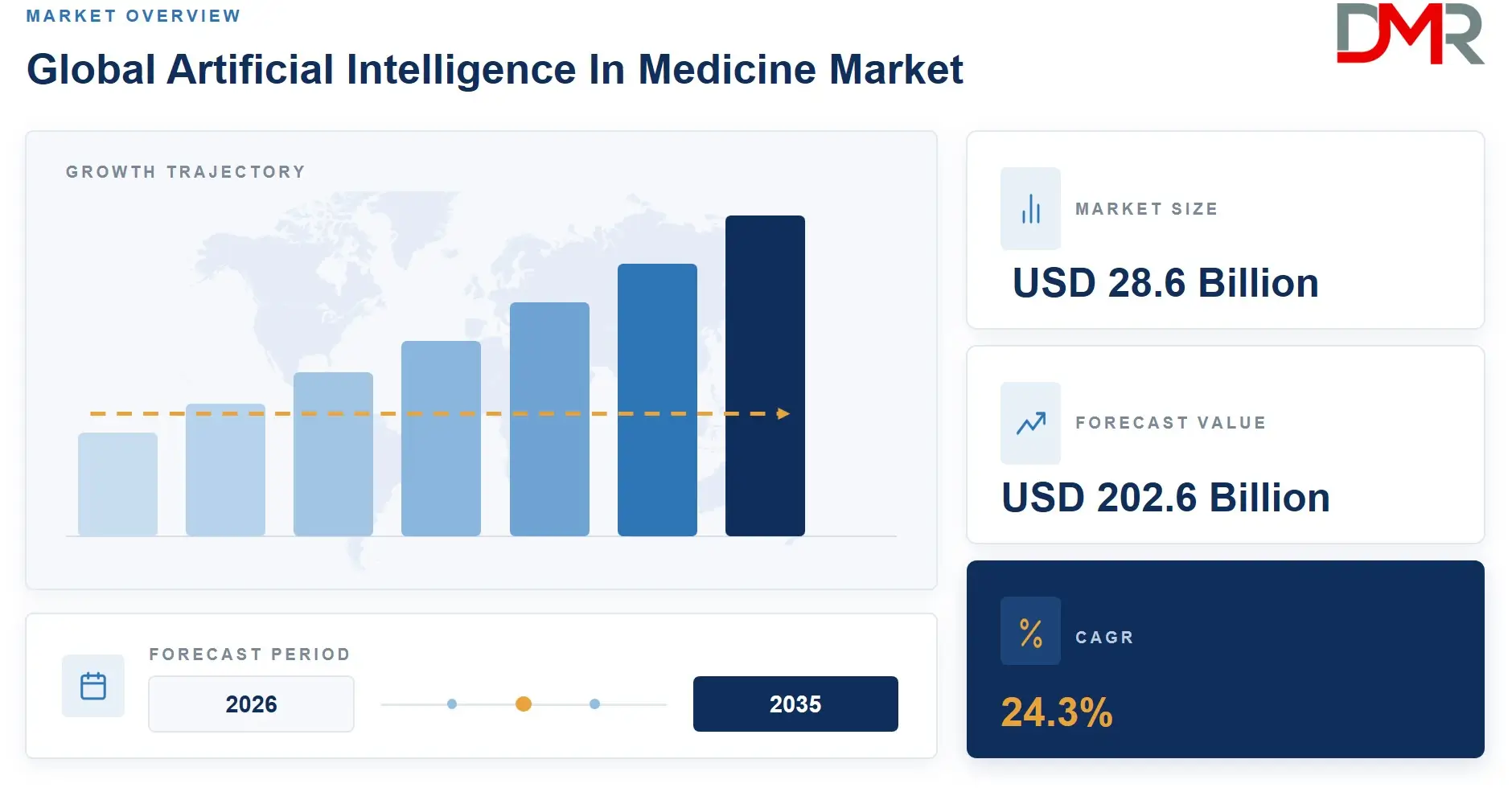
Global Artificial Intelligence In Medicine Market size is estimated to reach USD 28.6 Bn in 2026 and is further anticipated to reach USD 202.6 Bn by 2035, at a CAGR of 24.3%.
ℹ
To learn more about this report –
Download Your Free Sample Report Here
Artificial intelligence in medicine covers software, computing infrastructure and specialist services that apply machine learning, natural language processing, computer vision and related computational methods to clinical care, biomedical research and healthcare operations. The scope includes systems that assist diagnosis, interpret medical images, prioritize clinical information, support drug research, predict risk, automate documentation and coordinate patient workflows. It excludes general enterprise AI that has no healthcare-specific deployment or medical workflow connection.
Demand comes from hospitals, health systems, diagnostic networks, pharmaceutical and biotechnology companies, research institutes, laboratories and other healthcare organizations that need to process complex data at a scale that manual workflows cannot sustain. Buyers increasingly evaluate solutions on clinical utility, workflow fit, interoperability, explainability, data governance and measurable labor or cycle-time savings rather than on model accuracy alone. This changes competition from isolated algorithms toward integrated platforms that can operate inside electronic health records, imaging systems, laboratory environments and regulated development processes.
Structural change is being driven by the convergence of multimodal foundation models, healthcare-specific language models, accelerated computing, cloud infrastructure and expanding access to longitudinal clinical data. At the same time, regulators and health systems are demanding stronger lifecycle monitoring, bias controls, cybersecurity and human oversight. Vendors that combine technical performance with clinical validation, deployment support and post-deployment governance are therefore positioned to capture a larger share of enterprise spending.
Use Cases
- Radiology Worklist Prioritization: Imaging departments deploy AI to flag examinations that may require urgent review, organize worklists and assist with image interpretation. The result is a more focused reading sequence for radiologists and a practical way to manage growing imaging volumes without treating the algorithm as an autonomous final diagnosis.
- Biopharmaceutical Research: Pharmaceutical and biotechnology teams use AI to rank targets, screen molecular candidates, analyze omics data and refine trial design decisions. These systems narrow large search spaces before expensive laboratory or clinical work begins, helping research groups direct scientists and experimental budgets toward candidates with stronger evidence.
- Hospital Clinical Operations: Health systems deploy predictive tools to identify deterioration risk, support bed planning and coordinate care pathways across departments. The value comes from combining patient signals with operational context so clinical teams can intervene earlier and managers can allocate constrained staff and capacity more deliberately.
- Precision Treatment Planning: Oncology and specialty-care teams use computational models to combine imaging, pathology, genomic and clinical information when assessing treatment options. The workflow helps multidisciplinary teams compare patient-specific evidence, identify relevant patterns and document the reasoning that supports a more individualized care plan.
Key Takeaways
- Market Size & Share: North America is projected to account for approximately 42% of worldwide revenue in 2026, reflecting concentrated healthcare technology spending and early enterprise adoption.
- Offering Analysis: Services are expected to be the fastest-growing offering, advancing at a CAGR of 27.8% from 2026 to 2035 as integration, validation and governance requirements expand.
- Regional Analysis: Asia-Pacific is projected to record a CAGR of 27.1% through 2035 as digital health investment and clinical AI deployment broaden.
- Application Analysis: Medical imaging & diagnostics is expected to represent roughly 29% of revenue in 2026, supported by mature image-analysis workflows and established purchasing channels.
- Deployment Shift: Cloud-based solutions are set to hold close to 61% of 2026 revenue as health organizations favor scalable model hosting and centralized updates.
- End-User Momentum: Pharmaceutical & biotechnology companies are forecast to expand AI spending at a CAGR of 26.9%, led by discovery, development and evidence-generation use cases.
How AI/Gen AI is Transforming the Artificial Intelligence In Medicine Market?
Generative AI is shifting medical AI from narrow prediction toward systems that can summarize, retrieve, draft and reason across unstructured clinical information while remaining connected to conventional machine learning models. Large language models are being adapted for clinical documentation, patient communication, trial intelligence and scientific knowledge retrieval. Multimodal architectures add images, waveforms, pathology, genomics and structured records, allowing one workflow to use several data types rather than forcing clinicians to move between disconnected point solutions.
The transformation is operational as much as algorithmic. Health systems are placing AI inside existing clinical software, while life-science companies are connecting models to research pipelines and regulated evidence processes. Human review, retrieval grounding, auditability and model monitoring are becoming design requirements because medical errors carry consequences beyond ordinary enterprise automation.
- Computer Vision: Image models assist detection, segmentation, measurement and triage across radiology, pathology, ophthalmology and other image-intensive specialties.
- LLM Clinical Documentation: Healthcare-adapted language models convert conversations and notes into structured drafts, summaries and workflow actions for clinician review.
- Multimodal Decision Support: Models combine text, images and structured patient variables to surface evidence that can support clinical assessment and treatment planning.
- Generative Drug Research: Generative models propose molecular structures, prioritize biological hypotheses and help research teams explore candidate spaces before laboratory validation.
Key Drivers in the Global Artificial Intelligence In Medicine Market
Demand is strengthening where medical data growth intersects with constrained clinical and research capacity. The strongest forces are workflow pressure in care delivery and the economic incentive to shorten complex development cycles.
- Rising Clinical Data Volume and Specialist Workload: Hospitals are processing larger quantities of imaging, notes, laboratory results and monitoring data while specialist capacity remains limited. Medical imaging & diagnostics is expected to hold around 29% of application revenue in 2026, illustrating where structured AI assistance has already found a clear operational fit. Algorithms that prioritize cases, automate measurements, summarize records and identify patterns can reduce repetitive work while keeping clinicians responsible for final decisions. This mechanism supports procurement because buyers can connect AI investment to throughput, turnaround time and consistency rather than treating it as a speculative technology project.
- Pressure to Improve Drug Research Productivity: Pharmaceutical and biotechnology companies face large search spaces across target identification, molecular design, biomarker discovery and trial planning. Their AI spending is forecast to grow at a CAGR of 26.9% through 2035 as computational methods become embedded earlier in research workflows. The economic logic is straightforward: filtering weak hypotheses before expensive experimental stages can redirect laboratory capacity and shorten iteration cycles. Adoption is therefore expanding from isolated discovery teams toward integrated data science environments that connect research informatics, translational evidence and clinical development.
Restraints in the Global Artificial Intelligence In Medicine Market
Medical AI faces a higher deployment threshold than general-purpose enterprise software because performance must remain dependable across patients, sites and changing data. Regulatory, integration and trust requirements can delay scaling even when technical prototypes perform well.
- Clinical Validation, Liability and Regulatory Friction: Computer vision accounts for an estimated 24% of technology revenue in 2026, but image-based clinical tools still require careful validation across equipment, populations and workflows. Developers must address intended use, human factors, performance drift, transparency and post-deployment monitoring, while providers must define responsibility when AI output conflicts with clinical judgment. These obligations lengthen procurement and evidence-generation cycles. They also favor vendors able to support quality systems, regulatory submissions and lifecycle management, which raises the barrier for small developers seeking to move from pilot projects into routine clinical deployment.
- Fragmented Data and Integration Burden: On-premise deployments are expected to retain around 25% of revenue in 2026 because many institutions still operate sensitive workloads inside complex local infrastructure. Clinical data is distributed across EHRs, PACS, laboratory systems, devices and departmental applications, often with inconsistent terminology and access rules. An accurate model can still fail commercially if it adds clicks, requires duplicate data entry or cannot exchange information through standards such as FHIR and DICOM. Integration work, cybersecurity review and governance therefore remain material cost centers and can slow multi-site rollouts.
Growth Opportunities in the Global Artificial Intelligence In Medicine Market
White space is opening where buyers need an operating layer around the model rather than another standalone algorithm. Services, edge deployment and under-digitized care environments offer particularly strong room for differentiated growth.
- Implementation, Validation and Managed AI Services: Services are projected to grow at a CAGR of 27.8% from 2026 to 2035, faster than the overall industry, because healthcare organizations need support beyond software licensing. Providers require data preparation, workflow redesign, model evaluation, integration, monitoring, security and staff training before AI can move from demonstration to dependable production use. This creates room for specialist integrators, clinical AI consultancies and managed-service providers that can combine technical deployment with healthcare governance. Vendors that package continuous performance monitoring and model maintenance into recurring contracts can also build more durable revenue than firms dependent on one-time implementation projects.
- Edge and Hybrid Intelligence for Time-Sensitive Care: Edge & hybrid deployment is expected to expand at a CAGR of 28.2% through 2035 as buyers seek lower latency, greater resilience and tighter control over sensitive data. Imaging devices, operating rooms, intensive care environments and remote monitoring settings can benefit when inference occurs close to the point of care while centralized infrastructure handles training, fleet management and updates. The opportunity extends to medical device manufacturers and compute suppliers that can deliver validated, power-efficient inference. Hybrid architectures also help institutions balance privacy requirements with the scalability of cloud-based model development.
Trends in the Global Artificial Intelligence In Medicine Market
Competition is moving away from single-task models toward platforms that fit broader clinical and research workflows. Buyers are also placing more weight on evidence, monitoring and interoperability when comparing vendors.
- Shift Toward Multimodal and Workflow-Native Platforms: Machine learning is projected to retain close to 47% of technology revenue in 2026, but the product architecture around it is becoming more multimodal. Vendors are combining predictive models with language interfaces, retrieval systems and image analysis so users can move from detection to explanation, documentation and action inside one workflow. This favors platforms that integrate with EHR, imaging and research systems rather than requiring separate user interfaces. The commercial result is a shift in purchasing from narrow algorithm licenses toward broader enterprise contracts where integration depth and governance determine renewal value.
- Cloud Delivery with Stronger Governance Controls: Cloud-based deployment is expected to represent approximately 61% of 2026 revenue as organizations seek scalable compute, faster model updates and centralized administration. The trend is not a simple migration of protected health data into public infrastructure. Buyers increasingly require private networking, encryption, identity controls, audit logs, regional data handling and clear model-use policies before deployment. Cloud providers and application vendors are therefore competing on healthcare-specific security and compliance capabilities as well as raw compute. This makes governance tooling part of the product proposition rather than an after-sale compliance exercise.
Research Scope and Analysis
Segment performance is assessed across offering, technology, application, end user and deployment. Each axis identifies where revenue is concentrated in 2026 and where growth is moving through 2035, linking those positions to workflow maturity, infrastructure choices, buyer economics and changing adoption requirements.
ℹ
To learn more about this report –
Download Your Free Sample Report Here
By Offering
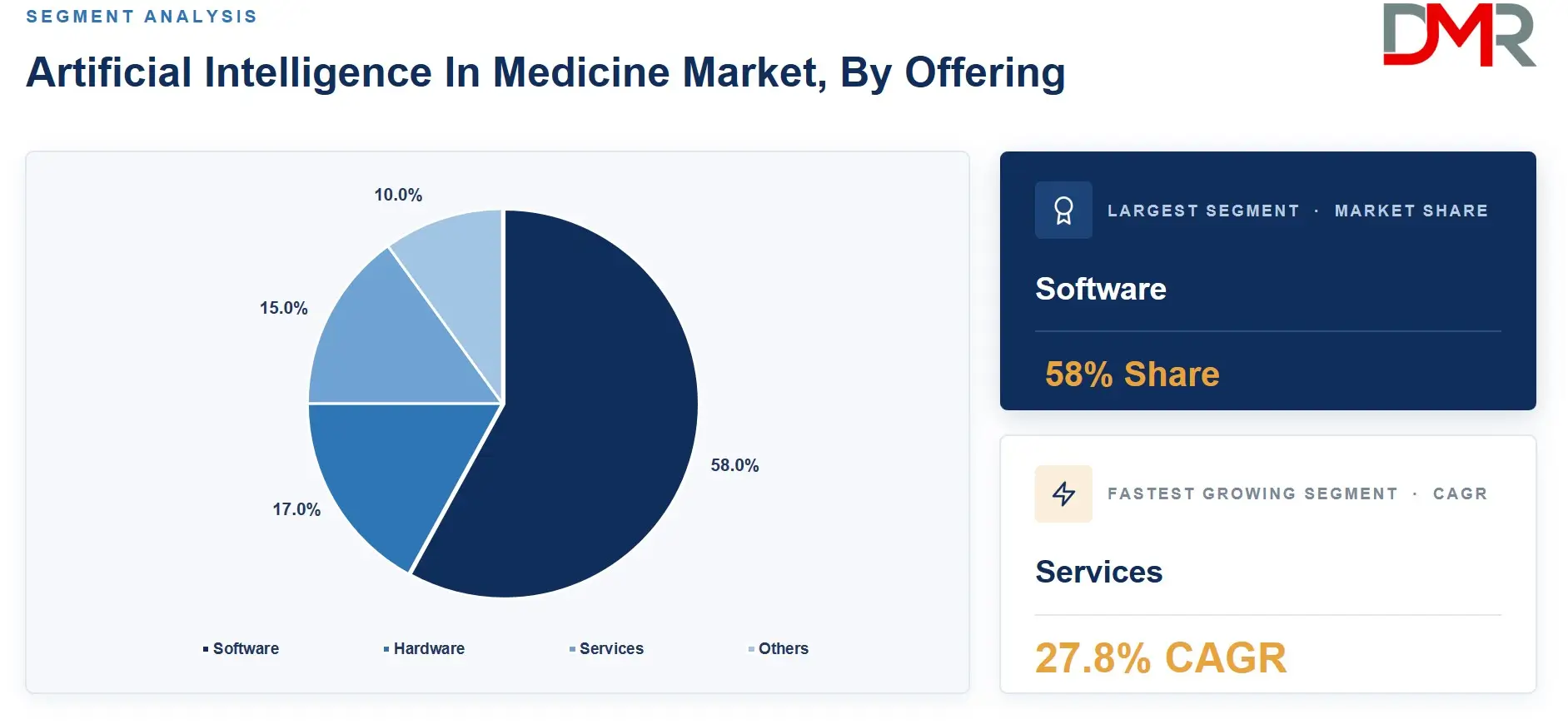
Software is projected to hold the largest share by offering in 2026, accounting for approximately 58% of revenue because algorithms, clinical applications, orchestration layers and workflow interfaces capture recurring licensing and platform spending. Hospitals and life-science organizations increasingly buy software that can connect with existing data systems rather than commissioning every model internally. Growth, however, is concentrated in services, which are forecast to expand at a CAGR of 27.8% between 2026 and 2035. Implementation complexity is pushing buyers toward specialist support for integration, validation, governance, training and lifecycle monitoring. As deployments spread across departments and sites, service requirements rise with the number of interfaces, stakeholders and performance checks that must be managed.
By Technology
Machine learning is expected to lead technology spending in 2026 with close to 47% of revenue, supported by its established role in prediction, classification, risk scoring and pattern recognition across clinical and research workflows. Its installed base also spans conventional statistical learning and deep neural networks, giving it a wider commercial footprint than newer interfaces. The steeper trajectory sits with natural language processing, projected to grow at a CAGR of 28.6% through 2035. Clinical documentation, record summarization, coding support, knowledge retrieval and conversational interfaces are broadening the addressable user base beyond data science teams. Healthcare-adapted language models and retrieval-grounded systems are making unstructured text more usable while human review remains central to safety.
By Application
Medical imaging & diagnostics is set to represent roughly 29% of application revenue in 2026, reflecting mature computer-vision use cases, established radiology purchasing channels and the availability of digitized image data. Imaging workflows also offer measurable endpoints such as detection performance, reading time and case prioritization, which can support procurement decisions. Growth, however, is concentrated in drug discovery & development, forecast to advance at a CAGR of 29.1% from 2026 to 2035. Biopharmaceutical companies are applying AI across target selection, molecular generation, biomarker analysis and trial intelligence. The ability to narrow experimental search spaces before costly wet-lab and clinical stages creates a strong economic case for continued investment.
By End User
Hospitals & health systems are projected to account for around 46% of end-user revenue in 2026 because they purchase across imaging, decision support, documentation, monitoring and operational workflows. Their scale also creates demand for enterprise integration, security and governance capabilities that increase contract value beyond the core model. Pharmaceutical & biotechnology companies are expected to post the highest growth, at a CAGR of 26.9% through 2035. These organizations are expanding AI from discovery experiments into translational research, clinical development and medical evidence workflows. Adoption is reinforced by large proprietary datasets and the financial value of improving research prioritization, although validation and reproducibility remain necessary before computational outputs can influence regulated decisions.
By Deployment
Cloud-based solutions are expected to hold the largest deployment share in 2026 at approximately 61%, supported by scalable compute, centralized model management and the ability to distribute updates across multiple sites. Cloud infrastructure also lowers the need for every healthcare organization to maintain specialized accelerator hardware locally. Growth, however, is strongest in edge & hybrid architectures, which are forecast to expand at a CAGR of 28.2% between 2026 and 2035. Point-of-care inference can reduce latency and preserve local control for sensitive or high-bandwidth data, while cloud resources remain available for training and orchestration. This combination is especially relevant for imaging, monitoring and connected medical devices where resilience and response time matter.
The Global Artificial Intelligence In Medicine Market Report is Segmented Based on the Following
By Offering
- Software
- Hardware
- Services
- Others
By Technology
- Machine Learning
- Natural Language Processing
- Computer Vision
- Knowledge Representation
- Others
By Application
- Medical Imaging & Diagnostics
- Clinical Decision Support
- Drug Discovery & Development
- Precision Medicine
- Patient Monitoring & Virtual Care
- Administrative & Workflow Automation
- Others
By End User
- Hospitals & Health Systems
- Pharmaceutical & Biotechnology Companies
- Diagnostic Centers & Laboratories
- Research & Academic Institutes
- Payers & Other Healthcare Organizations
- Others
By Deployment
- Cloud-based
- On-premise
- Edge & Hybrid
- Others
Regional Analysis
Region with the Largest Revenue Share
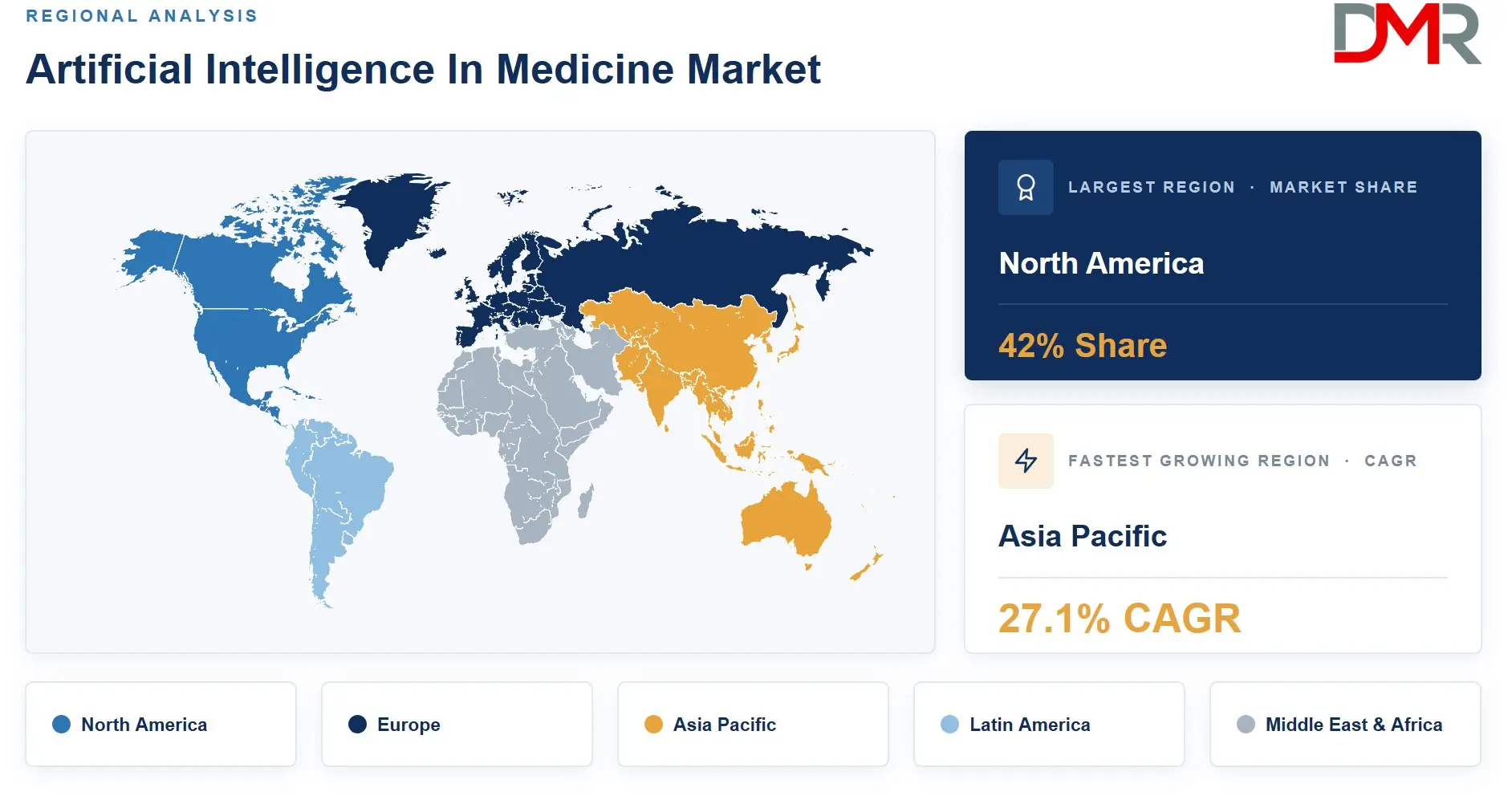
North America is expected to remain the largest regional market in 2026, accounting for approximately 42% of global revenue. The region combines high healthcare expenditure, large hospital networks, major cloud and AI suppliers, deep biopharmaceutical research activity and established digital-health procurement. The US also has a substantial base of AI-enabled medical technology development, which supports commercialization pathways and clinician exposure to algorithmic tools. Enterprise buyers increasingly seek platforms that can connect clinical documentation, imaging, decision support and administrative workflows under common security and governance controls. This concentration of technology supply and healthcare demand keeps North America ahead in absolute spending even as adoption accelerates elsewhere.
ℹ
To learn more about this report –
Download Your Free Sample Report Here
Region with the Highest CAGR
Asia-Pacific is projected to record the highest regional CAGR at 27.1% from 2026 to 2035. Expansion is supported by large patient populations, rising digital-health investment, growing hospital digitization and strong AI ecosystems in China, Japan, India, South Korea and Australia. The region also contains major electronics, cloud and computing supply chains that can support lower-cost deployment and edge inference. Growth will remain uneven because reimbursement, data governance and clinical infrastructure differ substantially by country. Even so, the combination of unmet specialist demand and expanding digital records creates a strong incentive for imaging support, virtual care, clinical workflow automation and AI-assisted research.
By Region
North America
Europe
- Germany
- France
- The UK
- Italy
- Spain
- Rest of Europe
Asia-Pacific
- China
- Japan
- India
- Australia
- South Korea
- Rest of APAC
Latin America
- Mexico
- Brazil
- Colombia
- Argentina
- Rest of LATAM
Middle East & Africa
- Saudi Arabia
- The UAE
- South Africa
- Rest of MEA
Regulatory Landscape
Medical AI sits across several regulatory pathways because a clinical algorithm may function as device software, support a regulated medical product, or operate as a lower-risk workflow tool. Regulators are moving toward lifecycle oversight that considers intended use, validation, transparency, bias, cybersecurity, change management and post-deployment performance rather than evaluating only a static model at launch. Commercial openings favor vendors that can build evidence and monitoring into product architecture from the start. The main brake is that requirements differ by jurisdiction and use case, increasing documentation and validation costs. As oversight becomes more explicit, regulatory readiness will increasingly influence procurement confidence and competitive position.
Patent Analysis
Intellectual property activity in medical AI is shifting from broad algorithm claims toward defensible combinations of data processing, clinical workflow, model architecture, device integration and specialized applications. Competitive value often rests on more than patents because training data access, clinical partnerships, regulatory evidence, software integration and trade secrets can be equally important. White space remains in multimodal models, privacy-preserving learning, edge inference, explainability and systems that monitor performance after deployment. The risk is rapid technical obsolescence, since a narrow claim can lose commercial relevance as foundation models and computing architectures change. Companies therefore need patent strategy to complement, rather than substitute for, clinical validation and product execution.
Competitive Landscape
Competition spans hyperscale technology companies, medical imaging and device manufacturers, clinical software vendors, AI specialists, pharmaceutical technology providers and computing suppliers. Large incumbents compete through installed customer bases, cloud infrastructure, regulatory experience and integration with hospital or research systems, while specialists differentiate through focused clinical models, proprietary datasets and faster product iteration. Partnerships are common because no single vendor controls every layer from compute and foundation models to clinical validation and distribution. Strategic advantage increasingly depends on workflow integration, evidence quality, interoperability, cybersecurity, model monitoring and the ability to support enterprise deployment across multiple sites. Consolidation is likely to continue as buyers prefer fewer vendors with broader, governed platforms.
Some of the Prominent Players in the Global Artificial Intelligence In Medicine Market Are
- Microsoft
- Google
- Amazon Web Services
- NVIDIA
- IBM
- Oracle
- GE HealthCare
- Siemens Healthineers
- Philips
- Medtronic
- Tempus AI
- PathAI
- Viz.ai
- Aidoc
- Qure.ai
- Owkin
- Insilico Medicine
- Recursion Pharmaceuticals
- Exscientia
- Atomwise
- Paige
- Arterys
- HeartFlow
- RapidAI
- ConcertAI
- Flatiron Health
- Komodo Health
- H2O.ai
- SOPHiA GENETICS
- Biofourmis
- Ping An Healthcare and Technology
- Alibaba Cloud
- Tencent
- Baidu
- Huawei
- Lunit
- Vuno
- Fujifilm
- NEC
- Wipro
- Other Key Players
Recent Developments
- In August 2026, Huawei outlined plans to broaden AI collaborations with pharmaceutical companies, extending its healthcare AI activity from computational drug research toward wider clinical implementation and strengthening competition around locally supplied AI compute and biomedical modeling.
- In January 2026, the US FDA issued final guidance on Clinical Decision Support Software, sharpening the policy environment for software functions used by healthcare professionals and giving developers clearer boundaries when designing decision-support products.
- In October 2025, Microsoft expanded Dragon Copilot capabilities toward nursing workflows and partner extensions, broadening ambient and generative AI from physician documentation into additional care-team and operational use cases.
- In March 2025, Microsoft introduced Dragon Copilot as a unified clinical workflow assistant combining voice dictation, ambient listening and healthcare-adapted generative AI, increasing competitive pressure in enterprise clinical documentation and workflow automation.
- In January 2025, the US FDA issued draft guidance covering lifecycle management and marketing submissions for AI-enabled medical device software functions, emphasizing transparency, bias, monitoring and documentation across the product lifecycle.
Report Details
| Report Characteristics |
| Market Size (2026) |
USD 28.6 Bn |
| Forecast Value (2035) |
USD 202.6 Bn |
| CAGR (2026-2035) |
24.3% |
| The US Market Size (2026) |
USD 9.4 Bn |
| Historical Data |
2021 - 2025 |
| Forecast Data |
2026 - 2035 |
| Base Year |
2025 |
| Segments Covered |
By Offering, By Technology, By Application, By End User and By Deployment |
| Regional Coverage |
North America - The US and Canada; Europe - Germany, France, The UK, Italy, Spain, Rest of Europe; Asia-Pacific - China, Japan, India, Australia, South Korea, Rest of APAC; Latin America - Mexico, Brazil, Colombia, Argentina, Rest of LATAM; Middle East & Africa - Saudi Arabia, The UAE, South Africa, Rest of MEA |
Frequently Asked Questions
How big is the Global Artificial Intelligence In Medicine Market?
▾ Worldwide revenue is estimated at USD 28.6 Bn in 2026. Spending includes healthcare-specific AI software, hardware and services used across clinical care, medical imaging, research, drug development and workflow automation. Growth is being supported by expanding digital health data, stronger computing infrastructure and enterprise demand for tools that can reduce manual clinical and research workloads.
What is the growth rate of the Global Artificial Intelligence In Medicine Market?
▾ The industry is forecast to expand at a CAGR of 24.3% from 2026 to 2035. Growth is supported by broader deployment of clinical language models, imaging algorithms, predictive systems and AI-assisted drug research, although adoption depends on clinical validation, data access, workflow integration, cybersecurity and regulatory compliance.
Which region holds the largest share in the Global Artificial Intelligence In Medicine Market?
▾ North America is expected to hold the leading position, with a share of roughly 42% in 2026. The region benefits from concentrated health technology spending, major AI and cloud suppliers, large hospital systems, advanced life-science research and an active medical software ecosystem. These factors support both early adoption and larger enterprise contract values.
Who are the key players in the Global Artificial Intelligence In Medicine Market?
▾ Key participants include Microsoft, NVIDIA, GE HealthCare, Siemens Healthineers, Philips, Tempus AI and Aidoc. Competition also includes cloud providers, medical device manufacturers, clinical software companies and specialized AI developers. Their strategies differ by workflow, but integration, clinical evidence, data access, regulatory readiness and scalable computing increasingly determine enterprise purchasing decisions.
Which application leads the Artificial Intelligence In Medicine industry?
▾ Medical imaging & diagnostics is projected to lead applications with approximately 29% of revenue in 2026. Imaging has a relatively mature digital data environment and clear AI tasks such as detection, segmentation, measurement and worklist prioritization. Established radiology and diagnostic purchasing channels also make commercial deployment more structured than many emerging clinical AI use cases.
Which technology is growing fastest in medical AI?
▾ Natural language processing is forecast to expand at a CAGR of 28.6% through 2035. Growth is being driven by clinical documentation, summarization, coding assistance, knowledge retrieval and conversational workflow tools. Healthcare-adapted language models are broadening adoption, while retrieval grounding, human review and governance are becoming important controls for clinical deployment.
What will shape the Artificial Intelligence In Medicine Market through 2035?
▾ The Artificial Intelligence In Medicine Market will be shaped by multimodal models, stronger healthcare data infrastructure, cloud and edge computing, regulatory lifecycle controls, interoperability and the ability to prove clinical and economic value. Vendors that connect AI directly to established care and research workflows while maintaining monitoring, security and human oversight are likely to build the most durable positions.