Market Overview
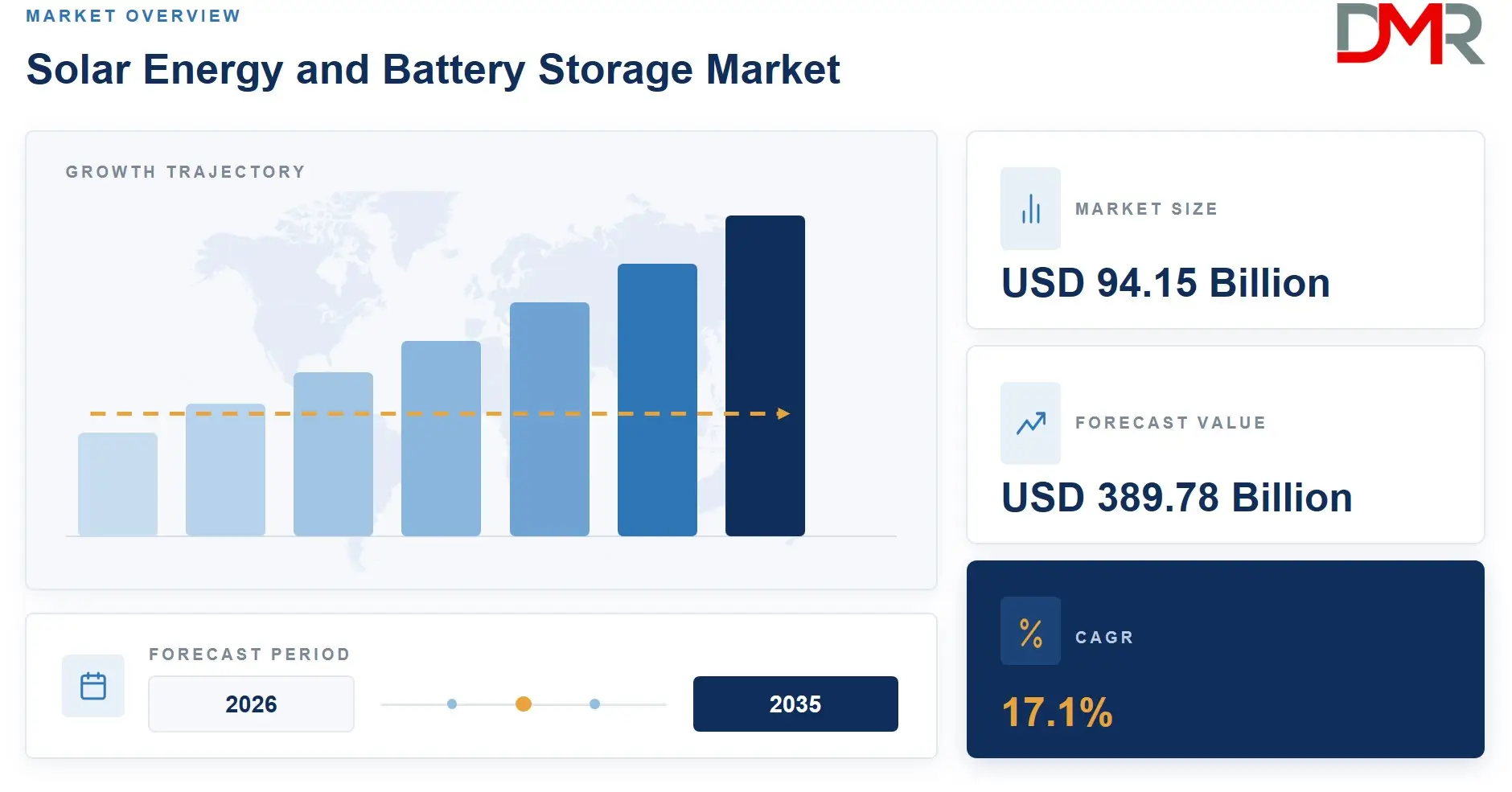
The Global Solar Energy and Battery Storage Market size is estimated at USD 94.15 Billion in 2026, and is projected to reach USD 389.78 Billion by 2035, exhibiting a CAGR of 17.1% during the forecast period. Global PV installations reached an estimated 698 GW in 2025, a 16% annual increase, as reported by IEA-PVPS. Cumulative installed capacity climbed to nearly 2,974 GW, up from 2,276 GW just one year earlier. That pace of addition explains why forecasters keep revising base-year figures upward mid-cycle. Buyers locking in Solar-plus-Storage contracts today are negotiating against a capacity base that grew by almost 700 GW in a single year.
This market covers photovoltaic and concentrated solar generation paired with electrochemical or thermal storage across utility, commercial, and residential ownership models. It excludes standalone wind, hydro, and non-solar renewable hybrids. Grid operators, project developers, and equipment manufacturers all sit inside this value chain, and their purchasing decisions ripple into adjacent transmission and semiconductor markets.
ℹ
To learn more about this report –
Download Your Free Sample Report Here
Key Takeaways
- The market size is USD 94.15 Billion in 2026, and is projected to hit USD 389.78 Billion by 2035 at a CAGR of 17.1%.
- By Solar Technology: Photovoltaic (PV) led as the largest category with a 88.4% share in 2025.
- By Battery Technology: Lithium-Ion Battery led as the largest category with a 80.1% share in 2025.
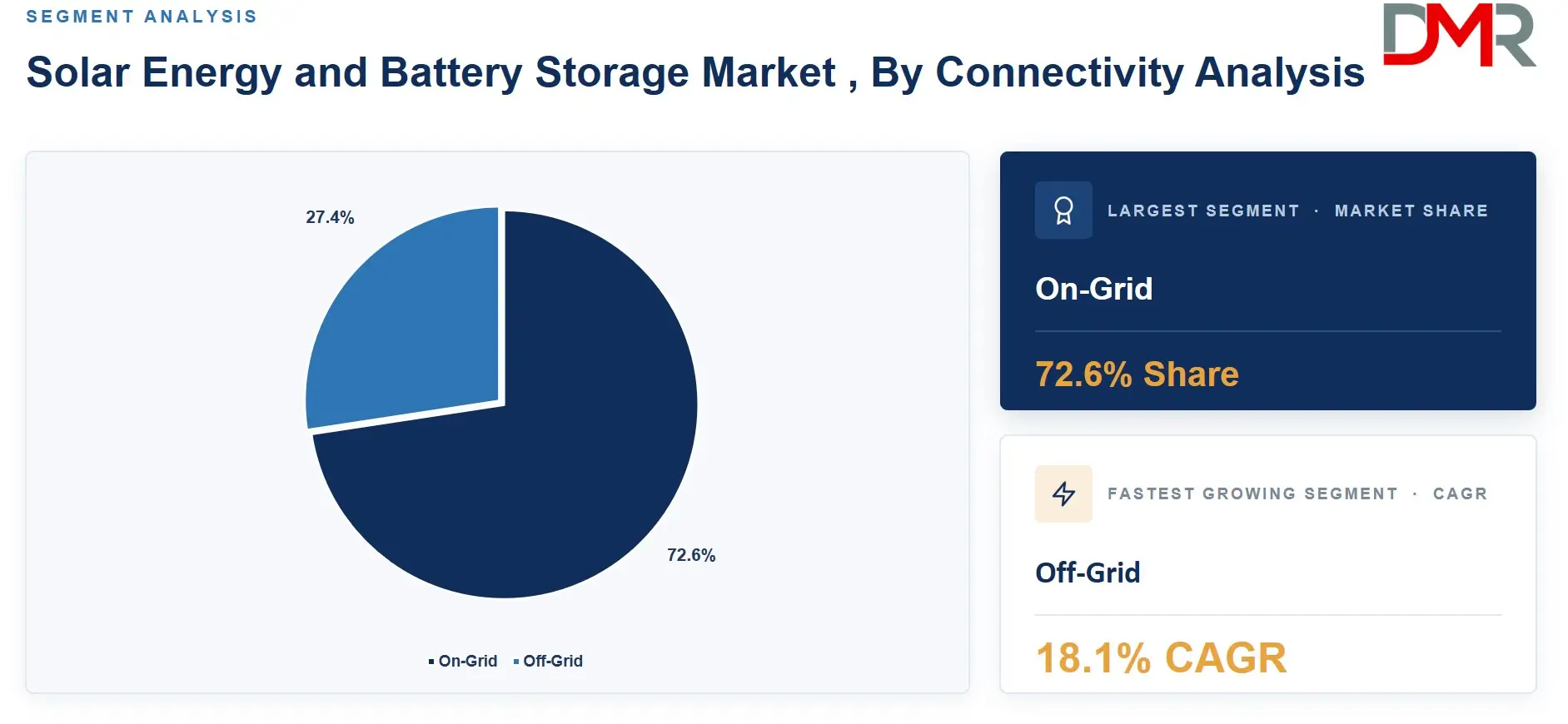
- By Connectivity: On-Grid led as the largest category with a 72.6% share in 2025.
- By Application: Utility-Scale led as the largest category with a 54.6% share in 2025.
- By Ownership: Utility-Owned led as the largest category with a 54.8% share in 2025.
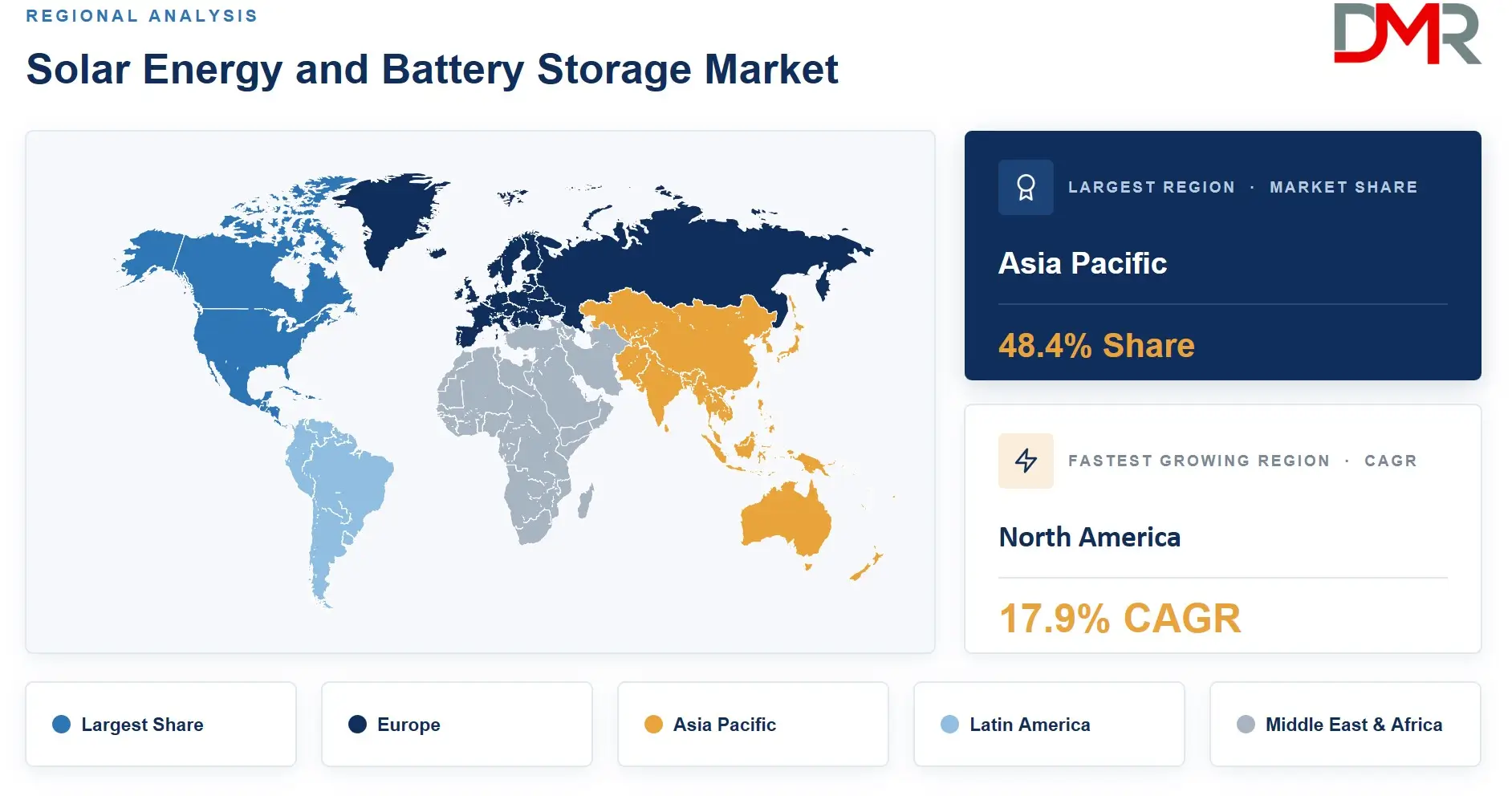
- By Region: Asia Pacific led with a 48.4% share, valued at USD 38.5 Billion, in 2025.
- Top 5 key players: Tesla, Inc., BYD Company Ltd., CATL, Sungrow Power Supply Co., Ltd., LG Energy Solution.
Solar Technology Analysis
Photovoltaic (PV) accounted for 88.4% of solar technology demand in 2025, the highest of any category. Silicon module costs fell below USD 0.10/Wp globally in 2025, according to Fraunhofer ISE, and that price collapse locked PV ahead of concentrated and hybrid alternatives. Utility developers now default to PV first and treat other solar technologies as niche fits for specific thermal or land-constrained sites. Concentrated Solar Power holds a shrinking niche in high-irradiance desert markets where thermal storage adds dispatchability that batteries cannot match at equivalent duration. Hybrid solar technologies remain early stage, combining PV panels with thermal or mechanical backup on the same site. Neither category threatens PV's position soon, but hybrid designs could gain share as developers chase higher land-use efficiency in space-constrained regions.
Battery Technology Analysis
With a 80.1% share in 2025, Lithium-Ion Battery outpaced all other battery technology categories. Lithium-ion pack prices for stationary storage averaged USD 70/kWh in 2025, a steep 45% drop from 2024, based on data from BloombergNEF. That collapse makes lithium-ion the default choice even where cycle life or fire risk favor alternatives, because upfront cost still wins most utility procurement decisions. Lead-acid batteries persist in legacy backup applications but keep losing ground on energy density. Flow batteries and sodium-sulfur chemistries target long-duration niches where lithium-ion degrades faster, particularly in Energy Storage Systems built for eight-hour or longer discharge. Other battery technologies, including emerging metal-hydrogen designs, remain small but are drawing serious venture capital as developers hedge against lithium supply risk.
Connectivity Analysis
On-Grid captured 72.6% of the connectivity segment in 2025, ahead of all rivals. Grid-tied systems dominate because utility interconnection unlocks capacity payments and merchant revenue streams unavailable to isolated systems. Off-grid installations remain a small slice of total capacity today, yet this category is externally sourced as the fastest growing connectivity type. Pacific island nations and remote communities without transmission access are pulling off-grid solar-storage kits forward faster than grid-tied demand in those specific geographies.
ℹ
To learn more about this report –
Download Your Free Sample Report Here
Application Analysis
Utility-Scale accounted for 54.6% of application demand in 2025, the highest of any category. Large solar-storage plants win because project financing rewards scale, and utilities need dispatchable capacity to meet clean energy mandates. In the United States, utility-scale battery installations reached almost 50 GWh across 16 GW in 2025, according to SEIA, dwarfing behind-the-meter volumes. That gap shows why institutional capital keeps flowing toward Grid Scale Energy Storage projects over distributed alternatives. Residential systems trail in absolute volume but grow fastest on a percentage basis as rooftop owners chase backup power and demand-charge avoidance. Commercial and industrial buyers sit between the two, driven by sustainability mandates and high demand charges rather than backup power alone.
Ownership Analysis
A 54.8% share made Utility-Owned the clear leader across ownership categories in 2025. Utilities retain ownership because rate-based assets earn guaranteed returns, a structure that customer-owned and third-party models cannot replicate. Standalone storage assets under utility ownership added nearly 30 GWh in the United States during 2025, ahead of solar-paired storage at 20 GWh, per SEIA figures. Residential storage under customer ownership grew fastest, up 51% year over year to 3.1 GWh, showing homeowners increasingly self-fund Residential Battery Energy Storage Systems rather than lease them. Third-party ownership sits in between, letting commercial buyers avoid capital outlay while developers capture long-term service revenue. Expect this model to expand fastest in markets where financing costs stay high and customers resist upfront investment.
Key Market Segments
By Solar Technology
- Photovoltaic (PV)
- Concentrated Solar Power (CSP)
- Hybrid Solar Technologies
By Battery Technology
- Lithium-Ion Battery
- Lead-Acid Battery
- Flow Battery
- Sodium-Sulfur Battery
- Other Battery Technologies
By Connectivity
By Application
- Utility-Scale
- Residential
- Commercial & Industrial
By Ownership
- Utility-Owned
- Customer-Owned
- Third-Party Owned
Regional Analysis
Asia Pacific led the global market with a 48.4% share, valued at USD 38.5 Billion, in 2025.
Asia Pacific
China's manufacturing base and India's auction-driven procurement model anchor Asia Pacific's lead. A 2025 Indian reverse auction produced a record tariff of INR 3.32/kWh for a project combining 1,200 MW of solar with 600 MW and 2,400 MWh of storage, undercutting a comparable December 2024 tender by 5.8%, as per JMK Research. Falling tariffs of that kind keep pulling regional demand forward faster than developers in Japan Solar Energy markets can match on cost.
North America
North America is the fastest growing region. The United States installed 57.6 GWh of battery storage in 2025, a 29% year-over-year jump, according to SEIA, and momentum has not slowed. Q1 2026 alone added 9.7 GWh, with 7.8 GWh of that utility-scale, and Q2 2026 pushed installations to 20.2 GWh, lifting first-half 2026 volume to 30.8 GWh. Policy incentives tied to domestic manufacturing are reshaping how Distributed Energy Resources get built and financed across the country.
ℹ
To learn more about this report –
Download Your Free Sample Report Here
Europe
Germany alone consumed 91.6 TWh of PV electricity in 2025, avoiding roughly 62.7 million tonnes of CO2-equivalent emissions, per Fraunhofer ISE. Across the wider bloc, the EU installed 27.1 GWh of new battery capacity, a 45% annual increase that brought cumulative capacity to 77.3 GWh, according to SolarPower Europe. Utility-scale storage is now the dominant driver of that growth, not rooftop solar alone.
Latin America
Latin America remains a smaller share of global capacity today, but grid instability across several national markets makes solar-storage pairing attractive for both utilities and industrial buyers seeking reliability over pure cost savings.
Middle East & Africa
Middle East and Africa developers increasingly pursue mega-scale solar-storage projects backed by sovereign wealth capital, positioning the region as a future export hub for green hydrogen adjacent to existing solar buildouts.
Key Regions and Countries
North America
Europe
- Germany
- France
- The UK
- Spain
- Italy
- Rest of Europe
Asia Pacific
- China
- Japan
- South Korea
- India
- Australia
- Rest of APAC
Latin America
- Brazil
- Mexico
- Rest of Latin America
Middle East & Africa
- GCC
- South Africa
- Rest of MEA
Macroeconomic Impact
Interest rate paths shape project financing costs more than any other macro variable in this market. High rates delay financial close on capital-intensive utility-scale plants, while falling rates accelerate the queue of projects reaching construction. Trade policy adds a second layer of risk, since tariffs on imported cells and modules push developers toward domestic sourcing even at higher upfront cost. The United States illustrates how quickly momentum can build under supportive conditions. Storage installations hit 9.7 GWh in the first quarter of 2026, then jumped to 20.2 GWh in the second quarter, pushing first-half volume to 30.8 GWh. That acceleration signals developers are pulling projects forward ahead of any future policy uncertainty rather than waiting.
Market Dynamics
Driver: Utility-Scale Storage Costs Keep Falling
Worldwide battery-storage additions reached 108 GW in 2025, 40% above 2024 volume, with roughly 80% of that capacity utility-scale, as reported by the IEA. Falling costs explain most of that jump. The installed cost of four-hour utility-scale batteries dropped nearly 30% in 2025 to about USD 140/kWh, based on data from IRENA. Clean energy mandates across more than 30 U.S. states create procurement volume that utilities cannot avoid regardless of near-term price swings. Combine mandated demand with falling battery costs, and utility-scale solar-storage becomes one of the few power infrastructure categories where economics and policy pull in the same direction.
Restraint: Mineral Supply and Insurance Costs Squeeze Margins
Lithium, cobalt, and nickel supply constraints create procurement lead times that threaten bankability-dependent financial close deadlines. Developers who miscalculate delivery windows risk losing financing commitments tied to strict construction timelines. Insurance markets have hardened around utility-scale battery fire risk, and that shift raises financing costs while forcing tighter site design constraints. Fewer insurers now underwrite large battery installations without additional safety margins, and that scarcity pushes premiums higher across the industry.
Opportunity: Long-Duration Storage Contracts Reshape Procurement
Form Energy signed a commercial anchor deal worth $1 billion with Google in February 2026, deploying 100-hour iron-air batteries at a 300 MW and 30 GWh facility in Minnesota to serve continuous data center loads. That single contract signals hyperscalers now treat long-duration storage as core infrastructure, not experimental technology. The global benchmark levelized cost for four-hour battery projects fell 27% year over year to USD 78/MWh in 2025, while combined solar-plus-storage projects averaged just USD 57/MWh, according to BloombergNEF. Merchant developers in deregulated markets can now stack capacity payments on top of energy arbitrage, a revenue combination that did not pencil out two years earlier.
Porter's Five Forces
New entrants face high capital barriers in cell manufacturing but low barriers in project development and integration, splitting competitive intensity by value chain layer. Suppliers of lithium, cobalt, and nickel hold significant leverage given constrained global reserves, though sodium-based and metal-hydrogen alternatives are chipping at that power. Utility and hyperscaler buyers wield strong negotiating power because they commit to multi-year, multi-hundred-megawatt offtake agreements that few developers can replace quickly. Substitutes remain limited since thermal storage and pumped hydro serve narrower use cases than electrochemical batteries paired with solar. Rivalry among established players like Tesla, Inc., CATL, and BYD Company Ltd. stays intense as each races to lock in vertically integrated supply chains from cell to grid connection.
AI and Gen AI Impact
Generative AI now optimizes battery dispatch schedules, predicting price spikes in deregulated markets and timing discharge to capture peak arbitrage value. Enphase's 2025 white paper rates its IQ Battery 5P at 90% AC round-trip efficiency, and AI-driven inverter controls help systems approach that ceiling under real-world conditions rather than only in lab tests. Early movers embedding AI into storage management are capturing arbitrage revenue that laggards using static dispatch schedules simply miss. Companies that delay this shift risk operating assets at a structural cost disadvantage against AI-optimized competitors.
Market Trends
Storage Duration Requirements Are Moving From One Hour to Eight
Regulated utility RFPs increasingly demand four-hour and eight-hour storage minimums instead of the one-hour standard common a few years ago. The global PV fleet produced 3,378 TWh in 2025, equal to 10.5% of global electricity demand, according to IEA-PVPS, and grid operators now need longer discharge windows to keep that volume of variable generation usable after sunset. Expect Long Duration Energy Storage technologies to keep gaining specification share in new utility contracts.
Market Competition Overview
The market stays moderately fragmented despite a handful of dominant battery cell manufacturers. Utility-scale batteries accounted for 87 GW of the 108 GW added globally in 2025, with about 24 GW co-located directly with renewable generation, based on data from the IEA. That concentration around utility-scale procurement rewards vertically integrated players who control cells, inverters, and project development under one roof. Pure-play component suppliers are losing ground to integrated developers who bundle solar, storage, and long-term service contracts into single offtake agreements. Expect further consolidation as smaller manufacturers struggle to match the balance-sheet strength needed for multi-gigawatt-hour supply commitments.
Pricing Analysis
Module prices fell to a global average of USD 0.10/Wp in 2025, according to Fraunhofer ISE, while large PV system costs averaged EUR 595/kWp. The 2025 weighted-average LCOE for utility PV reached EUR 40/MWh, though it ranged from EUR 25 to EUR 86/MWh depending on site and financing terms. Battery pricing pressure compounds the solar cost decline. India's standalone two-hour battery storage tariffs fell 33% within a single year, from INR 221,000/MW per month to INR 148,000/MW per month, as reported by Saur Energy. Market leaders with scale can absorb thinner margins per contract, while smaller challengers increasingly compete only in niche duration or geographic segments.
Company Profiles
Tesla, Inc. expanded beyond hardware manufacturing into energy retail, and Ofgem granted the company a full electricity supply licence in the United Kingdom on March 12, 2026. That approval lets Tesla sell electricity directly to households and businesses across England, Scotland, and Wales, turning its battery installed base into a captive retail customer channel that pure equipment makers cannot replicate. Enphase Energy, Inc. deployed its IQ Battery 10C system across Canada and the United States in August 2026, with retrofitting capability for third-party solar installations through an integrated meter collar. That retrofit compatibility widens Enphase's addressable market to existing rooftop solar owners who never bought Enphase inverters originally, a channel expansion rivals focused only on new installations cannot match.
Key Players
- Tesla, Inc.
- BYD Company Ltd.
- CATL
- Sungrow Power Supply Co., Ltd.
- LG Energy Solution
- Samsung SDI Co., Ltd.
- ABB Ltd.
- GE Vernova
- Schneider Electric SE
- Enphase Energy, Inc.
- SolarEdge Technologies
- Panasonic Energy
- Huawei Digital Power
- Fluence Energy, Inc.
- Wärtsilä
- ACCIONA, S.A.
- Masdar (Abu Dhabi Future Energy Company)
- TotalEnergies SE
- EDF Renewables (EDF power solutions)
- First Solar, Inc.
Supply Chain and Value Chain Analysis
Worldwide PV module production reached 706 GWp in 2025, split between 690 GWp of monocrystalline silicon and 16 GWp of thin-film output, according to Fraunhofer ISE. Silicon wafer-based technology accounted for about 98% of global production, with n-type wafers making up 86% of that wafer supply. Wafer producers now hold outsized influence over module economics given how concentrated that manufacturing step remains. Maximum value creation sits at the system integration layer, where developers combine panels, inverters, and batteries into bankable projects. The biggest bottleneck remains upstream: polysilicon and battery mineral processing capacity concentrated in a small number of countries creates single points of failure for the entire chain.
Regulatory Landscape
Renewable Portfolio Standards across more than 30 U.S. states force utilities to procure solar and storage capacity regardless of short-term price conditions, creating durable demand independent of federal policy shifts. Domestic manufacturing incentives in the United States and European Union are reshaping supply chain strategy, pushing developers to qualify local content even when imported components cost less upfront. Insurance regulation tightening around battery fire risk is emerging as a quieter but equally powerful barrier, since underwriting availability now gates project financing as much as any formal policy mandate.
Investment and White Space Analysis
Capital is flowing fastest into long-duration storage technologies that extend beyond standard four-hour lithium-ion systems. German BESS tolling operator Terralayr secured €192 million in equity funding led by Eurazeo in January 2026 to expand its virtualized storage capacity pipeline, a sign investors now back storage-as-a-service models over hardware ownership alone. Pacific island and remote community programs represent underserved white space, funded increasingly through climate finance mechanisms rather than commercial capital alone. Behind-the-meter commercial and industrial systems also remain underpenetrated relative to utility-scale, offering new entrants a lower-capital entry point than competing directly against integrated utility-scale developers.
Recent Developments
- May 2026: Enphase Energy introduced its IQ9 microinverter series using Gallium Nitride technology to improve thermal and operational architecture for residential and high-power commercial modules.
- August 2026: MARS Energy Group completed its acquisition of California-based Citadel Roofing & Solar, absorbing over 1,000 employees to scale regional solar-plus-storage construction.
- September 2026: BW ESS announced the acquisition of a 126 MW and 675 MWh utility-scale battery portfolio in Valencia, Spain, purchased from developer Navacant.
- March 2026: Lithium-free metal-hydrogen storage company EnerVenue Holdings closed a $300 million Series B extension round led by Full Vision Capital.
- August 2026: Independent power producer Avantus closed a $300 million tax equity commitment from Truist Bank for its 150 MW solar and 452 MWh Aratina 2 storage facility in California.
Report Scope
| Report Characteristics |
| Market Value (2026) |
USD 94.15 Billion |
| Forecast Revenue (2035) |
USD 389.78 Billion |
| CAGR (2026 to 2035) |
17.1% |
| Base Year for Estimation |
2025 |
| Historic Period |
2020 to 2024 |
| Forecast Period |
2026 to 2035 |
| Report Coverage |
Revenue Forecast, Market Dynamics, Competitive Landscape, Recent Developments |
| Segments Covered |
By Solar Technology (Photovoltaic, Concentrated Solar Power, Hybrid Solar Technologies), By Battery Technology (Lithium-Ion, Lead-Acid, Flow, Sodium-Sulfur, Other), By Connectivity (On-Grid, Off-Grid), By Application (Utility-Scale, Residential, Commercial & Industrial), By Ownership (Utility-Owned, Customer-Owned, Third-Party Owned) |
| Regional Analysis |
North America (US and Canada), Europe (Germany, France, The UK, Spain, Italy, and Rest of Europe), Asia Pacific (China, Japan, South Korea, India, Australia, and Rest of APAC), Latin America (Brazil, Mexico, and Rest of Latin America), Middle East & Africa (GCC, South Africa, and Rest of MEA) |
| Competitive Landscape |
Tesla, Inc., BYD Company Ltd., CATL, Sungrow Power Supply Co., Ltd., LG Energy Solution, Samsung SDI Co., Ltd., ABB Ltd., GE Vernova, Schneider Electric SE, Enphase Energy, Inc., SolarEdge Technologies, Panasonic Energy, Huawei Digital Power, Fluence Energy, Inc., Wärtsilä, ACCIONA, S.A., Masdar, TotalEnergies SE, EDF Renewables, First Solar, Inc. |
| Customization Scope |
Customization for segments and region or country level will be provided. Additional customization can be done based on requirements. |
| Purchase Options |
Three license options: Single User License, Multi-User License (Up to 5 Users), Corporate Use License (Unlimited Users and Printable PDF) |
Frequently Asked Questions
What is the biggest investment opportunity in the Solar Energy and Battery Storage market?
▾ Long-duration storage beyond four-hour lithium-ion systems draws the strongest investor interest today. Storage-as-a-service platforms and behind-the-meter commercial systems offer lower-capital entry points than competing directly in utility-scale development.
Who are the top companies in the Solar Energy and Battery Storage market?
▾ Tesla, Inc., BYD Company Ltd., CATL, Sungrow Power Supply Co., Ltd., and LG Energy Solution lead the competitive landscape. Each combines manufacturing scale with vertically integrated project development capability.
Which segment is growing fastest in the Solar Energy and Battery Storage market and why?
▾ Off-grid connectivity is growing fastest, driven by remote community and Pacific island energy independence programs. These projects skip grid interconnection delays entirely, making off-grid systems the quickest path to power access in underserved geographies.
Which region is growing fastest in the Solar Energy and Battery Storage market and why?
▾ North America is growing fastest, with U.S. battery storage installations climbing to 57.6 GWh in 2025 alone. Domestic manufacturing incentives and 24/7 carbon-free energy commitments from hyperscalers keep pulling investment into the region.
What is the biggest challenge holding in the Solar Energy and Battery Storage market back?
▾ Critical mineral supply constraints for lithium, cobalt, and nickel create procurement lead-time risk for projects with strict financing deadlines. Hardening insurance markets around battery fire risk compound that challenge by raising financing costs industry-wide.