Market Snapshot
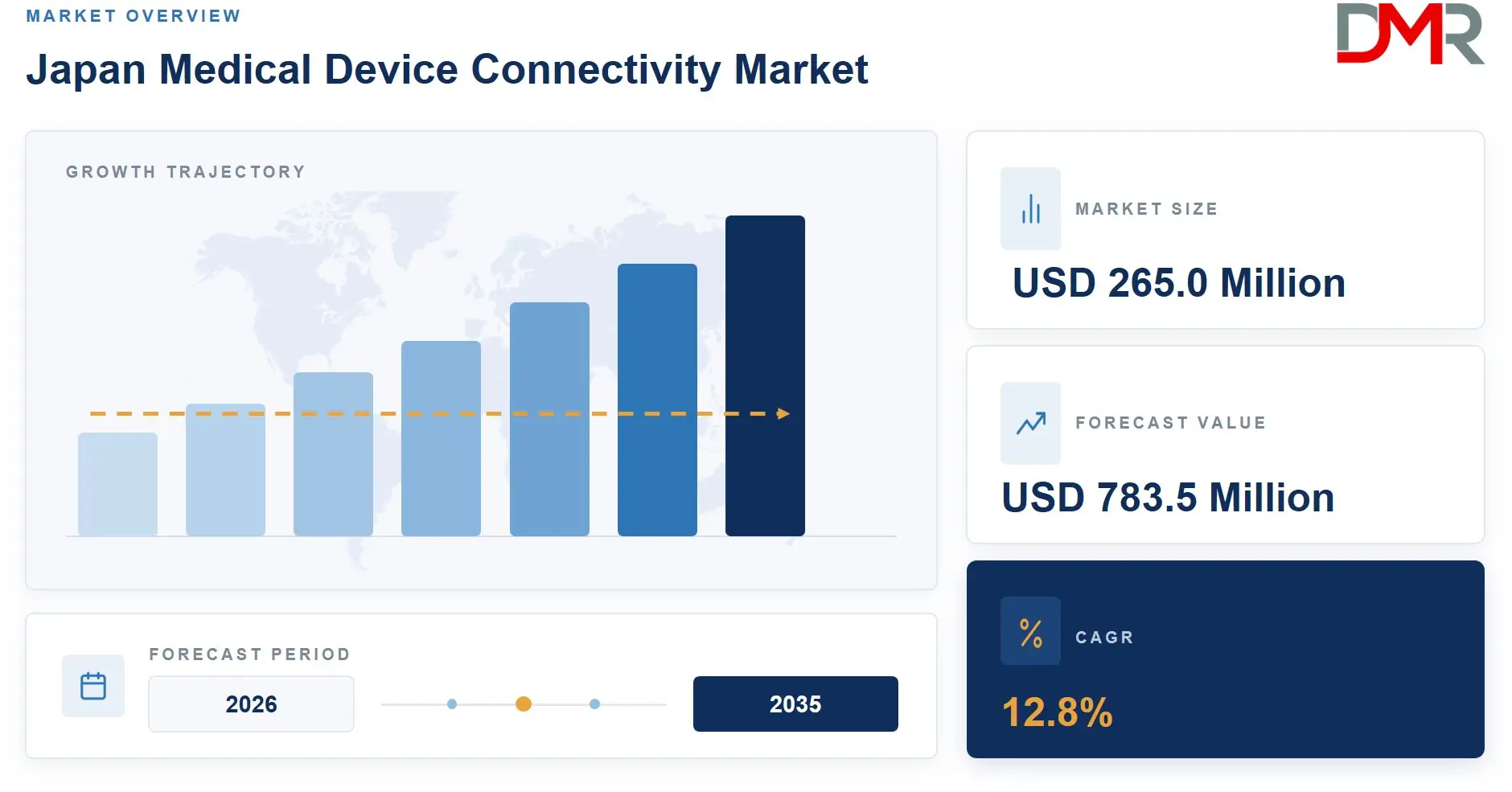
- Market Size (2026): USD 265.0 Mn
- Forecast Value (2035): USD 783.5 Mn
- CAGR (2026-2035): 12.8%
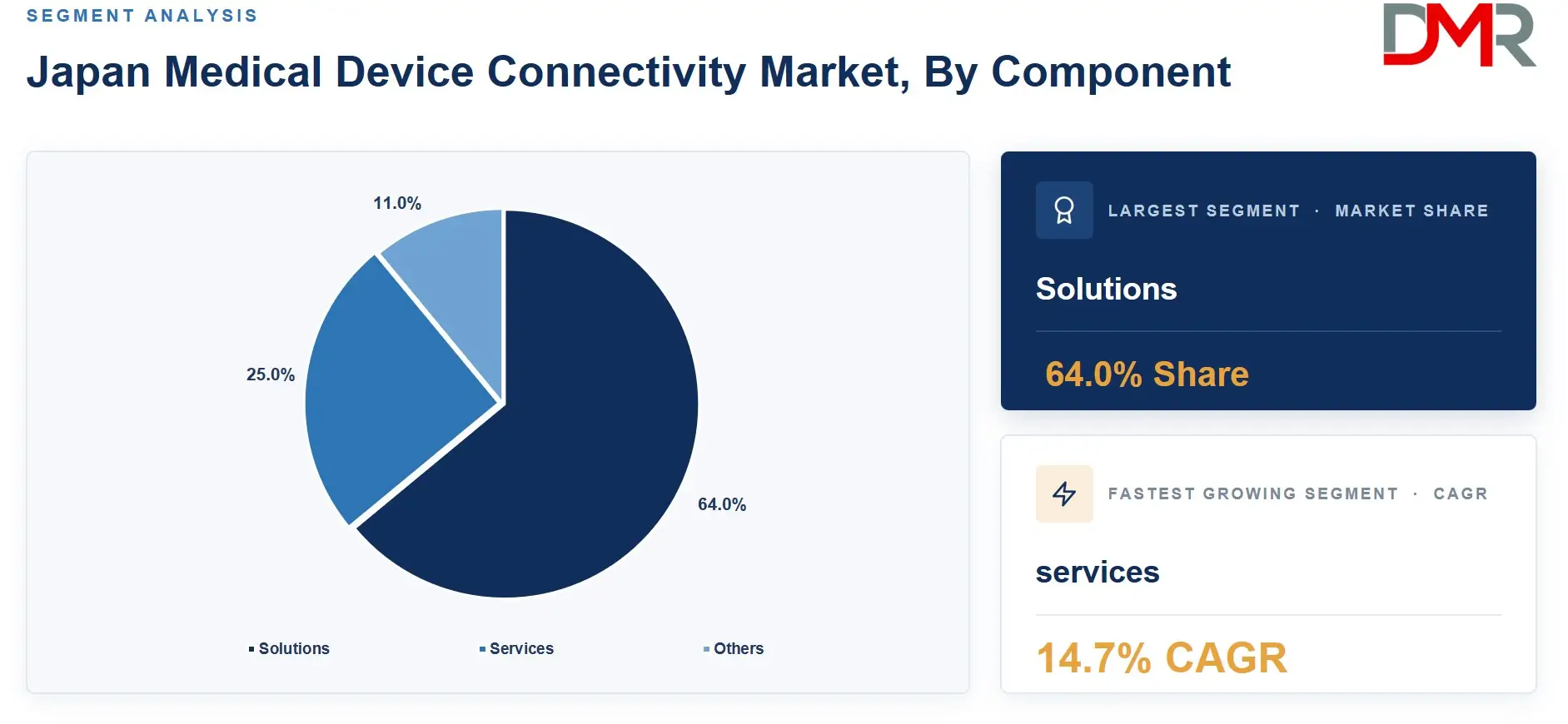
- Leading Component (2026): Solutions, approximately 64.0%
- Leading Connectivity Technology (2026): Wired Connectivity, around 46.0%
- Key Players: Nihon Kohden Corporation, Fujitsu Limited, GE HealthCare and others
What is Japan Medical Device Connectivity Market and its Market Size?
The Japan Medical Device Connectivity Market size is estimated to reach USD 265.0 Mn in 2026 and is further anticipated to reach USD 783.5 Mn by 2035, at a CAGR of 12.8%.
ℹ
To learn more about this report –
Download Your Free Sample Report Here
Medical device connectivity covers the hardware interfaces, middleware, software platforms and integration services that move data between bedside or diagnostic equipment and hospital information systems. The scope includes connections linking patient monitors, imaging systems, infusion equipment, ventilators and selected home monitoring devices with electronic medical records, clinical data repositories, alarm management platforms and analytics environments. It excludes the value of the underlying medical devices themselves. The figures therefore represent demand generated inside Japan for connectivity products and services, not worldwide revenue of companies headquartered in Japan.
Demand is shaped by Japan's shift toward interoperable clinical information exchange, the expansion of electronic medical record sharing, and the need to reduce manual transcription in hospitals facing persistent workforce pressure. HL7, FHIR, DICOM, IEEE 11073, Wi-Fi, Ethernet and secure API architectures increasingly sit inside procurement discussions. Large acute care hospitals remain the deepest buyers because they operate dense fleets of heterogeneous devices, while mid-sized institutions are gradually adopting managed gateways and cloud-linked integration to reduce internal IT workload.
The structural change is from point-to-point device interfaces toward governed connectivity layers that normalize data, preserve device context and feed multiple downstream applications. Cybersecurity, identity management, network segmentation and lifecycle support have become part of the purchase rather than after-sale considerations. This favors vendors that can combine clinical workflow knowledge with integration engineering and long-term service capacity across Japanese hospital environments.
Use Cases
- Intensive Care Unit Data Capture: Acute care hospitals connect bedside monitors, ventilators and other critical care equipment to clinical information systems so nurses do not repeatedly transcribe observations. Automated capture improves timestamp consistency, creates denser longitudinal records and gives care teams a more reliable foundation for escalation and review.
- Operating Room Integration: Surgical departments link anesthesia systems, patient monitors and perioperative applications to coordinate device observations with procedure records. The result is a more complete case record, less fragmented documentation and faster access to device-generated information during post-operative review and quality assurance.
- Diagnostic Workflow Exchange: Imaging and diagnostic centers connect modalities and reporting environments with enterprise systems so patient context, orders and results move with fewer manual handoffs. This reduces mismatched identifiers, supports faster routing of studies and helps specialists work across distributed sites.
- Home Monitoring Escalation: Healthcare providers connect selected remote monitoring devices to clinical platforms for chronic care follow-up. Structured data transfer lets teams prioritize patients whose measurements require review, rather than relying on telephone reporting or disconnected consumer dashboards that are difficult to incorporate into clinical workflows.
Key Takeaways
- Market Size & Share: Services are expected to represent roughly 36.0% of 2026 revenue as integration and lifecycle support remain essential.
- Component Analysis: Solutions lead in 2026, while services are forecast to expand at a CAGR of 14.7% through 2035.
- Demand Concentration: Hospitals are projected to account for close to 61.0% of 2026 demand because of their large installed device fleets.
- Technology Shift: Wireless connectivity is forecast to grow at 15.6% as mobile monitoring and flexible clinical layouts expand.
- Deployment Shift: Cloud-based connectivity is expected to post a CAGR of 17.1%, outpacing the broader market.
- Application Momentum: Asset and workflow management is forecast to grow at 16.4% as hospitals seek better equipment utilization.
How AI/Gen AI is Transforming the Japan Medical Device Connectivity Market?
AI raises the value of connected device data by turning continuous streams into prioritized clinical and operational signals. In Japan, the near-term effect is less about autonomous care and more about data preparation, anomaly detection, alarm reduction, predictive maintenance and workflow support. Connectivity platforms provide the normalized, time-aligned inputs that machine learning systems need. Without dependable interfaces and patient-device association, advanced analytics remain difficult to deploy safely at scale.
Generative AI has a narrower but growing role around documentation and technical operations. Large language models can summarize device events for review, assist interface engineers with mapping documentation and help support teams search configuration knowledge. Hospitals still need governed data provenance, human review and security controls, especially when outputs influence clinical decisions.
- Alarm Intelligence: Machine learning can rank multi-device alerts using patient context and historical patterns, reducing low-value notifications.
- Predictive Maintenance: Connected equipment telemetry can support failure prediction and maintenance scheduling before devices become unavailable.
- Interface Documentation: LLM tools can help technical teams interpret mapping specifications, integration logs and change records during implementation.
- Operational Analytics: AI can combine utilization data from connected equipment to identify bottlenecks, idle assets and capacity constraints.
Key Drivers in the Japan Medical Device Connectivity Market
Growth is being pulled by national healthcare digitization and by hospital-level pressure to move more clinical work through standardized data flows.
- Expansion of Interoperable Electronic Health Information: Japan's push toward standardized electronic health information exchange is increasing the value of device data that can enter clinical records without manual re-entry. Solutions hold approximately 64.0% of component revenue in 2026 because hospitals need gateways, middleware and interface engines before device observations can be reused across records, dashboards and analytics. As FHIR implementation matures alongside established HL7 and DICOM environments, procurement is shifting toward platforms that can translate legacy messages, preserve device context and expose structured data to newer applications. This creates a practical bridge between long-lived hospital equipment and national digital health infrastructure.
- Hospital Workforce Pressure and Documentation Automation: Hospitals account for around 61.0% of 2026 end-user demand, reflecting both device density and the operational cost of manual documentation. Japan's aging population and constrained clinical workforce make repetitive data entry increasingly difficult to justify. Connectivity can automatically capture observations from monitors, ventilators and infusion-related systems, reducing transcription steps while improving timeliness. The economic case is strongest where many devices operate continuously and data must reach several systems. Vendors that quantify nursing time saved, interface reliability and reduced documentation variance can compete on workflow outcomes rather than connectivity specifications alone.
Restraints in the Japan Medical Device Connectivity Market
Adoption is constrained by the complexity of mixed-generation hospital estates and by the security burden created when clinical equipment becomes network dependent.
- Legacy Device and Interface Fragmentation: Wired connectivity still represents close to 46.0% of 2026 technology revenue because many Japanese hospitals depend on stable Ethernet, serial interfaces and established departmental architectures. This installed base protects reliability but raises integration cost when devices use proprietary protocols, older message formats or inconsistent identifiers. Replacing clinically serviceable equipment purely for interoperability is rarely economical, so hospitals often require protocol conversion, custom mapping and staged migration. Smaller institutions can struggle to maintain these interfaces after initial deployment, which slows projects and favors vendors with strong local service organizations and long support horizons.
- Cybersecurity, Validation and Change-Control Burden: On-premises deployment is projected to retain approximately 53.0% of 2026 revenue because many providers prefer direct control over clinical networks and sensitive data flows. Connected medical devices expand the number of endpoints that require authentication, segmentation, patch governance and monitoring. A software update can also affect validated workflows, making change management more demanding than in ordinary enterprise IT. Hospitals therefore evaluate connectivity projects through both clinical engineering and information security lenses. Lengthy risk reviews, limited specialist staff and uncertainty over responsibility between device vendors, network teams and integrators can delay rollouts even when the operational benefit is clear.
Growth Opportunities in the Japan Medical Device Connectivity Market
White space is opening in managed integration, cloud-linked architectures and connectivity models designed for smaller providers that cannot maintain large interface teams.
- Cloud-Linked Integration for Mid-Sized Providers: Cloud-based deployment is forecast to grow at a CAGR of 17.1% from 2026 to 2035, creating an opportunity for vendors that package secure gateways, remote management and subscription support. Mid-sized hospitals and ambulatory facilities need interoperability but often lack the staffing to operate complex interface engines internally. Hybrid architectures can keep latency-sensitive device communication on site while moving management, analytics or selected data services to controlled cloud environments. Commercial success will depend on transparent data residency, auditability, downtime procedures and integration with Japanese electronic record ecosystems rather than generic cloud positioning.
- Connected Asset and Workflow Intelligence: Asset and workflow management is expected to expand at a CAGR of 16.4% through 2035 as hospitals seek measurable returns from connectivity beyond documentation. Device location, utilization, maintenance status and availability data can help clinical engineering teams reduce search time, balance equipment pools and plan replacement cycles. The opportunity extends to real-time location systems, network telemetry and operational dashboards that combine data from multiple device classes. Suppliers that connect these functions with maintenance records and clinical workflows can move from interface projects toward recurring operational platforms with broader hospital management relevance.
Trends in the Japan Medical Device Connectivity Market
Technology choices are moving toward wireless mobility and standards-based exchange, while buyers increasingly expect connectivity to support analytics and lifecycle management.
- Shift from Fixed Interfaces to Managed Wireless Connectivity: Wireless connectivity is projected to grow at a CAGR of 15.6% between 2026 and 2035, faster than the headline market. Portable monitoring, mobile workstations and flexible care environments are increasing demand for secure Wi-Fi and other managed wireless links. The trend does not eliminate wired infrastructure; instead, hospitals are adopting layered designs in which fixed backbones support mobile endpoints. This raises the importance of coverage planning, roaming performance, device identity and quality-of-service controls. Connectivity suppliers increasingly need networking competence alongside clinical integration expertise, especially for high-acuity environments where data continuity is essential.
- Greater Use of Standards-Based APIs and FHIR: Hybrid connectivity is expected to represent nearly 18.0% of technology revenue in 2026 as providers combine established device protocols with newer API-based exchange. FHIR adoption in Japan is broadening the architectural options for moving structured clinical information between systems, although device-level integration still relies on multiple standards and vendor interfaces. The practical trend is coexistence rather than immediate replacement. Integration platforms are being designed to normalize legacy feeds and expose selected information through modern services, allowing hospitals to modernize incrementally while protecting prior investment in devices and departmental systems.
Research Scope and Analysis
Segment performance is assessed across component, connectivity technology, deployment, application and end user. Each axis identifies where 2026 revenue is concentrated and which sub-segment is expected to expand fastest through 2035, together with the commercial mechanism behind that movement.
ℹ
To learn more about this report –
Download Your Free Sample Report Here
By Component
Solutions are projected to hold the largest component share in 2026, accounting for approximately 64.0% of revenue because hospitals require gateways, interface engines, device management software and integration platforms before connected data can flow reliably into clinical systems. Software also captures recurring value as hospitals add device types and downstream applications. Growth, however, is concentrated in services, which are forecast to expand at a CAGR of 14.7% from 2026 to 2035. Japanese providers operate heterogeneous estates with long equipment replacement cycles, so implementation, protocol mapping, cybersecurity assessment, validation, maintenance and interface upgrades remain labor intensive. Managed services gain further relevance as hospitals seek to reduce dependence on scarce in-house integration specialists.
By Connectivity Technology
Wired connectivity is expected to retain the largest share in 2026 at around 46.0%, supported by dependable Ethernet and established fixed-device interfaces in intensive care, imaging and operating environments. Reliability, predictable latency and the long life of installed clinical infrastructure keep wired links central to high-acuity workflows. The steeper trajectory sits with wireless connectivity, forecast to grow at a CAGR of 15.6% through 2035. Portable monitoring, mobile diagnostics and flexible bed configurations are expanding the number of devices that need managed mobility. Better enterprise Wi-Fi design and stronger endpoint security make wireless deployment more practical, while hospitals increasingly prefer connectivity that can follow equipment and patients without adding cabling at every care location.
By Deployment
On-premises deployment is projected to represent close to 53.0% of revenue in 2026 because hospitals retain direct control over latency-sensitive integrations, network policies and sensitive clinical data. Existing interface engines and departmental systems also favor local deployment, especially in large institutions with established IT teams. Growth, however, is concentrated in cloud-based deployment, which is forecast to expand at a CAGR of 17.1% between 2026 and 2035. Remote management, subscription economics and easier multi-site scaling are attractive to providers with limited integration staff. Adoption will often occur through hybrid architectures, with device-facing functions kept locally while selected management, analytics and interoperability services move to controlled cloud environments.
By Application
Vital signs and patient monitoring is expected to lead application revenue in 2026 with roughly 34.0%, reflecting the continuous data volume generated by bedside monitors and the clinical value of moving observations directly into records and surveillance systems. High device density in acute care creates a clear return from automated capture. The fastest growth is expected in asset and workflow management at a CAGR of 16.4% through 2035. Hospitals are extending connectivity beyond clinical documentation to understand where equipment is located, how often it is used and when it requires maintenance. Combining utilization, location and service data supports equipment pooling, replacement planning and capacity management, turning connectivity infrastructure into an operational decision layer.
By End User
Hospitals are projected to account for approximately 61.0% of 2026 revenue because they operate the largest and most diverse fleets of networked medical equipment and must integrate device data with multiple enterprise systems. Acute care settings also have the strongest need for continuous data capture and alarm coordination. The fastest-growing end user is home healthcare providers, forecast to expand at a CAGR of 18.2% from 2026 to 2035. Aging demographics, chronic disease management and interest in care outside hospital walls are increasing demand for clinically governed remote device data. Growth depends on reliable patient identity, secure transmission and workflows that help clinical teams review exceptions without being overwhelmed by raw consumer-device data.
The Japan Medical Device Connectivity Market Report is Segmented Based on the Following
By Component
- Solutions
- Services
- Others
By Connectivity Technology
- Wired Connectivity
- Wireless Connectivity
- Hybrid Connectivity
- Others
By Deployment
- On-Premises
- Cloud-Based
- Hybrid
- Others
By Application
- Vital Signs and Patient Monitoring
- Medical Imaging and Diagnostics
- Infusion and Medication Management
- Ventilator and Respiratory Device Integration
- Asset and Workflow Management
- Others
By End User
- Hospitals
- Clinics and Ambulatory Care Centers
- Diagnostic and Imaging Centers
- Home Healthcare Providers
- Others
Competitive Landscape
Competition in Japan combines domestic medical technology groups, hospital IT suppliers, global device manufacturers and specialist interoperability vendors. Large incumbents compete through installed device bases, service networks and the ability to integrate monitoring or imaging ecosystems with hospital information systems. IT companies compete on middleware, cloud, cybersecurity and enterprise integration. Specialist vendors differentiate through protocol libraries, vendor-neutral connectivity and rapid interface deployment. Partnerships are common because no single supplier controls every device class or clinical application inside a hospital. The market is therefore moderately fragmented at the solution level but more concentrated around large hospital accounts, where procurement favors proven reliability, Japanese-language support, regulatory discipline and long lifecycle commitments. Recurring services and managed connectivity are becoming more important as customers seek fewer integration handoffs.
Some of the Prominent Players in the Japan Medical Device Connectivity Market Are
- Nihon Kohden Corporation
- Fujitsu Limited
- NEC Corporation
- Sony Group Corporation
- OMRON Healthcare Co., Ltd.
- Canon Medical Systems Corporation
- FUJIFILM Healthcare Corporation
- Shimadzu Corporation
- Konica Minolta, Inc.
- Terumo Corporation
- Nipro Corporation
- PHC Holdings Corporation
- Sysmex Corporation
- A&D Company, Limited
- GE HealthCare
- Koninklijke Philips N.V.
- Siemens Healthineers AG
- Medtronic plc
- Baxter International Inc.
- Drägerwerk AG & Co. KGaA
- Masimo Corporation
- Stryker Corporation
- Hillrom (Baxter)
- Cisco Systems, Inc.
- Oracle Corporation
- InterSystems Corporation
- Capsule Technologies (Philips)
- Ascom Holding AG
- Lantronix, Inc.
- Digi International Inc.
- Lanier Healthcare Japan
- Toshiba Digital Solutions Corporation
- NTT DATA Group Corporation
- SoftBank Corp.
- KDDI Corporation
- Hewlett Packard Enterprise
- Dell Technologies Inc.
- Advantech Co., Ltd.
- Aruba Networks (HPE)
- Extreme Networks, Inc.
- Other Key Players
Recent Developments
- In July 2026, Japan's Digital Agency updated technical materials and API specifications for the Public Medical Hub, reinforcing the wider shift toward standardized system-to-system exchange across healthcare institutions and public services.
- In June 2026, Japan's Ministry of Health, Labour and Welfare released updated technical documentation for the electronic medical record information sharing service, including implementation guidance that strengthens the environment for structured clinical data exchange.
- In May 2026, SMBC Group, Fujitsu and SoftBank announced an alliance to build a Japan-developed healthcare platform focused on sustainable healthcare operations, adding momentum to domestic health data infrastructure and connected care ecosystems.
- In March 2026, Fujitsu and DT-Axis began a digital health collaboration supporting Software as a Medical Device development, regulatory approval and commercialization, broadening the ecosystem around connected software, clinical data and regulated digital products.
- In November 2025, MEDIUS Holdings and Plug and Play Japan formed a partnership aimed at accelerating medical DX and the nationwide introduction of advanced medical devices, supporting stronger channels for digitally enabled equipment in Japanese healthcare facilities.
- In February 2025, the Ministry of Health, Labour and Welfare published vendors supporting the electronic medical record information sharing service, giving healthcare organizations a clearer implementation ecosystem for national clinical information exchange.
Report Details
| Report Characteristics |
| Market Size (2026) |
USD 265.0 Mn |
| Forecast Value (2035) |
USD 783.5 Mn |
| CAGR (2026-2035) |
12.8% |
| Historical Data |
2021 - 2025 |
| Forecast Data |
2026 - 2035 |
| Base Year |
2025 |
| Segments Covered |
By Component, By Connectivity Technology, By Deployment, By Application and By End User |
| Regional Coverage |
Japan |
Frequently Asked Questions
How big is the Japan Medical Device Connectivity Market?
▾ The Japan Medical Device Connectivity Market is estimated at USD 265.0 Mn in 2026. Demand includes connectivity solutions and services used to move device-generated information into clinical, operational and enterprise systems. Hospitals remain the primary buyers because their mixed device fleets create the largest integration burden and the strongest case for automated capture.
What is the growth rate of the Japan Medical Device Connectivity Market?
▾ Industry revenue is forecast to expand at a CAGR of 12.8% from 2026 to 2035. Growth is supported by interoperability programs, hospital digitization, workforce constraints and rising demand for secure data exchange between medical devices and electronic records. Wireless, cloud-linked and managed-service models are expected to grow faster than traditional fixed connectivity.
What is driving demand in the Japan Medical Device Connectivity Market?
▾ Demand is being driven by the need to automate clinical documentation, connect heterogeneous device fleets and support standardized health information exchange. Hospitals want fewer manual handoffs between equipment and electronic records, while national digital health initiatives encourage more structured data movement. Cybersecurity and lifecycle management requirements also increase spending on professionally managed connectivity layers.
Who are the key players in the Japan Medical Device Connectivity Market?
▾ Key participants include Nihon Kohden Corporation, Fujitsu Limited, NEC Corporation, GE HealthCare, Philips, Siemens Healthineers and Canon Medical Systems Corporation. Competition also includes networking, cloud and interoperability specialists. Vendors with strong Japanese service coverage and the ability to integrate mixed-brand equipment are well positioned for complex hospital deployments.
Which component holds the largest share of the Japan Medical Device Connectivity Market?
▾ Solutions are expected to hold approximately 64.0% of component revenue in 2026. Hospitals need gateways, middleware, interface engines and device management software to normalize data from diverse equipment and deliver it to clinical systems. Services remain important because implementation, validation, security assessment and ongoing interface maintenance require specialized technical support.
Which deployment model is growing fastest in Japan?
▾ Cloud-based deployment is forecast to grow at a CAGR of 17.1% between 2026 and 2035. Adoption is being pulled by remote management, subscription economics and multi-site scalability. Most providers are expected to use controlled hybrid architectures rather than move every device-facing function off site, particularly where latency and continuity requirements are strict.
What technologies are shaping the Japan Medical Device Connectivity Market?
▾ The Japan Medical Device Connectivity Market is increasingly shaped by HL7, FHIR, DICOM, IEEE 11073, secure APIs, Ethernet, enterprise Wi-Fi, device identity controls and network segmentation. These technologies allow hospitals to connect legacy and newer equipment while creating structured data flows for electronic records, analytics, operational dashboards and emerging AI-supported applications.